


Recruiting students has become more expensive and more contested, and the spreadsheet no longer follows each candidate all the way to enrolment. In that setting, the educational CRM stops being a contact list and becomes the engine of recruitment: it organises the admissions funnel and automates what the team cannot do by hand.
The gap between owning the platform and getting results sits in the implementation. A funnel designed for the admissions process, reliable data and conversion sequences change the game, while the same licence, badly configured, turns into an expensive contact list.
Across implementation projects run by mkt4edu, four fronts separate success from abandonment: the right tool, a configuration the team adopts, automations that generate enrolments and honest measurement of the return.
What is an educational CRM and what does it need?
An educational CRM has to centralise the whole candidate journey in one place: lead source, programme of interest, conversations, funnel stage and outstanding admissions steps. With that data organised, marketing and admissions read the same reality, and automation works with precise segments instead of generic lists.
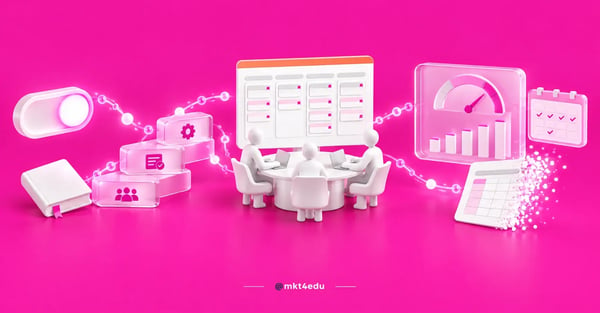 Caption: an educational CRM moves enrolment out of the spreadsheet and puts the admissions funnel at the centre
The platform replaces the trio of spreadsheet, inbox and messaging app that still holds up many recruitment operations. Each candidate becomes a single record with a complete history, and no conversation is lost when shifts or advisers change.
Before comparing vendors, it pays to align the team on what a CRM is and what it does for student recruitment: without that shared vocabulary, any platform is born underused.
Five requirements separate a platform ready for education from a tool that will demand endless adaptation:
- A funnel mirroring the admissions process, with stages the admissions team recognises
- Programme, shift and campus recorded on every candidate, from the first form
- Native integration with forms, WhatsApp and email, with no manual list exports
- Automation of sequences, tasks and lead distribution inside the platform itself
- Reports by funnel stage and by source, not just total lead volume
Missing any of these items shows up later as rework. The integration point deserves double attention: the institution's digital marketing strategies generate leads across several channels at once, and every channel outside the CRM is a piece of the funnel left in the dark.
The same applies to inbound marketing already in place: landing pages, gated content and nurturing flows need to feed straight into the platform, with each lead's source preserved.
This list serves higher education and also a CRM for K-12 schools, where the journey involves the family and annual re-enrolment weighs as much as recruiting new students.
What changes from a generic CRM to one built for an institution?
The core difference is the funnel: a generic CRM is born for a continuous sales pipeline, while a CRM for education works with seasonal cycles, a candidate who picks a programme and a shift, and an admissions process full of formal steps. The closer the tool mirrors that journey, the lower the chance the team abandons it.
The academic calendar concentrates volume into short windows. Entrance exams, the ENEM (Brazil's national secondary education exam) and transfers create peaks of thousands of candidates in a few weeks, and service has to scale without inflating the team.
The growth of distance learning has raised that pressure. In the 2024 Higher Education Census run by Inep, Brazil's national education statistics institute, distance learning accounted for 50.7% of enrolments and 66.8% of new entrants, and that candidate compares institutions in minutes.
Generic marketing campaigns make the problem worse by treating every lead the same way. Someone interested in on-campus medicine and a candidate for an online postgraduate course get the same message, and the conversation cools before the application.
The choice between adapting a generic platform and adopting a specialised one comes up in almost every recruitment conversation, and the mkt4edu channel devotes a whole video to that decision:
Video: video from the mkt4edu channel on when an institution needs an educational CRM
The differences sort into five dimensions, from funnel design to the shape of the metrics:
|
Dimension |
Generic CRM |
Educational CRM |
|
Funnel |
Continuous sales pipeline |
Recruitment cycles by admissions process |
|
Core record |
Company and open deal |
Candidate, programme, shift and campus |
|
Rhythm |
Steady flow all year |
Application peaks in short windows |
|
Integrations |
Sales system and email |
Student records, entrance exam and WhatsApp |
|
Main metric |
Revenue per closed deal |
Enrolments by programme and funnel stage |
Table: comparison between a generic CRM and an educational CRM across the dimensions that most affect recruitment
None of this stops a robust generic platform from being adapted, and that adaptation is exactly what defines the project. Properly configured, the CRM becomes the centre of the education marketing strategy: campaigns, service and admissions all run on the same data.
How does an educational CRM implementation work?
Implementing an educational CRM advances on five fronts: enrolment funnel design, data and integrations, automations, training and governance. In projects run by mkt4edu, the funnel is always the first delivery, because every other front depends on well-defined stages to work.
- Enrolment funnel design: stages, criteria for moving forward and an owner for each phase
- Data and integrations: required fields, deduplication and connection to existing systems
- Automations and sequences: response flows, nurturing and lead distribution
- Training and adoption: daily routine, naming and close follow-up in the first weeks
- Governance: roles, permissions and continuous database cleaning
At one education group we serve, the full pipeline starts at partial application, the candidate who began the form and already has an identifiable programme, and ends at enrolled. In between sit completed application, exam scheduling, approval and pre-enrolment, each stage with its own volume and conversion.
That design does two jobs: it produces the enrolment forecast for the cycle and shows at which stage the candidate is lost. When conversion collapses between approval and enrolment, the problem is usually price, paperwork or a competitor, and there is still time to act within the open cycle.
Admissions statuses, such as absent from the exam, not approved or called in a second round, become record properties, never funnel stages. The rule keeps the commercial reading clean: the funnel answers where the candidate is, and the properties tell what has already happened to them.
Another practice that changes adoption: collect the day-to-day vocabulary of each campus and replicate it in the CRM's internal names. If the team calls the stage a call-up, the system should not display qualified lead, because every mental translation is one more point of friction.
On integrations, the minimum map connects the CRM to the entrance exam application system and to the academic ERP (Enterprise Resource Planning). Without that bridge, the team types the same data twice, and the database is outdated from day one.
Governance closes the cycle with roles, permissions and a cleaning routine, within what Brazil's LGPD data protection law requires for candidate data. The practices of data governance in the CRM stop the database from rotting six months after the project.
Training goes back to basics, from what a CRM is to logging each conversation correctly, and continues after go-live. A recurring CRM training programme holds adoption when the routine gets tight and the pull of the spreadsheet returns.
With the funnel live, inbound sales gains rhythm: the adviser starts the day knowing who to approach, at which stage and with what context, without hunting for information across three systems.
This path varies with the size and the legacy systems of each institution, and the guide to CRM implementation for education details the typical decisions of each phase. For teams running HubSpot CRM, mkt4edu offers HubSpot CRM implementation and management, taking on the five fronts end to end.
Which automations deliver results in recruitment and retention?
The automations with the greatest impact on recruitment are the ones that cut response time and bring stalled candidates back: an immediate welcome with lead distribution, a partial-application sequence, exam and paperwork reminders and nurturing segmented by programme. On retention, persistence sequences flag dropout risk before the student disappears.
The underlying logic is one and the same: marketing automation and CRM work as a single system. Automation talks at scale, and the CRM records, scores and prioritises, so no candidate is left without a reply or gets the wrong message.
Video: audiobook from the mkt4edu channel on the relationship management behind an educational CRM
Splitting those two layers is the most common mistake among teams starting out. The full case for using marketing automation and CRM together runs through attribution, coordinated sequences and unified data, and usually changes how campaigns are designed.
Sequences inherited from other tools deserve an audit before migration. At one education group we serve, the inherited cadences concentrated everything on collections, between invoice reminders and deadline alerts, and left the advisory conversation out.
The redesign flipped the sequence towards conversion: content that answers questions about the programme, financial aid and career first, the call to action afterwards. The change turns automation from an insistent debt collector into an adviser who helps the candidate decide.
Education marketing campaigns segmented by programme, shift and funnel stage come straight out of CRM data. Teams that build segments from cold lists pay more per click and talk to the wrong person.
Lead scoring supported by AI (Artificial Intelligence) helps prioritise service during application peaks, but it depends on a clean database and a well-designed funnel so it does not prioritise the wrong leads.
Retention runs on the same infrastructure. The 16th Higher Education Map by Semesp, the association representing private higher education providers in Brazil, records a 2024 dropout rate of 41.6% in distance learning and 24.8% on campus, and every point of that index is revenue walking away.
Persistence sequences cross attendance, grades and financial status to trigger a human conversation at the right moment, and the route to retaining students with CRM and automation shows how to build those alerts without turning follow-up into surveillance.
How do you measure whether the educational CRM is working?
Measurement starts with conversion rates between stages: how many partial applications are completed, how many applicants show up for the exam and how many approved candidates enrol. Read by programme, campus and source, those rates turn the funnel into an enrolment forecast and point to where to act first.
The partial-application-to-enrolled pipeline exists for exactly that reading. With historical volume and conversion per stage, the manager projects how many enrolments the cycle will deliver and corrects course while admissions are still open.
The second block of measurement connects lead source to the final outcome. The report by source shows which marketing strategies actually produce enrolments, not just lead volume that dies halfway down the funnel.
Reading by source avoids a classic budgeting trap: campaigns that fill the top of the funnel but barely appear among enrolled students keep receiving budget just because the cost per lead looks good.
The same report rebalances education marketing campaigns across programmes: a course with enrolments to spare gives budget to one with empty seats. For that, digital marketing strategies have to carry the lead source all the way to enrolment, with tracking configured from the first form.
On the team side, first response time and contact rate measure the health of inbound sales, and activity logged per adviser shows whether the CRM became routine or decoration.
A minimum weekly dashboard covers five indicators:
- First response time to a new applicant
- Conversion by funnel stage, broken down by programme and campus
- Cost per enrolment by source, not just cost per lead
- Loss reasons logged at each stage
- Team adoption, measured by activities logged in the CRM
Numbers from that dashboard are worth more than any opinion in a recruitment meeting. When marketing and the admissions team read the same funnel, the conversation moves from who got it wrong to where to act, and the CRM starts paying for itself.
Frequently asked questions about educational CRM
Where do you start with an educational CRM?
Start with the funnel on paper, before any contract: admissions stages, criteria for moving forward, statuses that become properties and names the team actually uses. That design makes the educational CRM implementation cheaper and avoids the rework of reconfiguring the platform mid-cycle.
Then treat automation as a consequence, never as a starting point. A good sequence grows out of a clear funnel and reliable data, and a mature education marketing strategy treats the CRM as the foundation of recruitment, not as an accessory for the sales team.
If the platform already exists and the challenge is getting more out of it, the shortest route is to review processes before switching tools. These educational CRM tips to increase student recruitment and retention gather sequence, segmentation and follow-up adjustments you can apply in the next cycle, with no new project and no extra budget.











 Portugal