






Distance education overtook on-campus education in Brazil and accounted for 50.7% of higher education enrollments in 2024, according to the 16th Higher Education Map by Instituto Semesp. It was in this majority scenario that the rule for the mode changed.
The new distance learning regulatory framework reorganizes how a program may be designed, named and offered. The least discussed consequence is about communication, because every change of mode turns into a promise made to the candidate.
Program pages, creatives, service scripts and local centre materials carry descriptions written under the previous rule. Until they are reviewed, they keep promising something the institution may no longer be able to deliver.
What is the new distance learning regulatory framework?
The distance learning regulatory framework is the set of rules that redefined distance education delivery in higher education from 2025 on. It is formed by Decree 12,456, of 19 May 2025, and by MEC Ordinances 378 and 381 of the same year, which detail contact-hour percentages and transition rules.
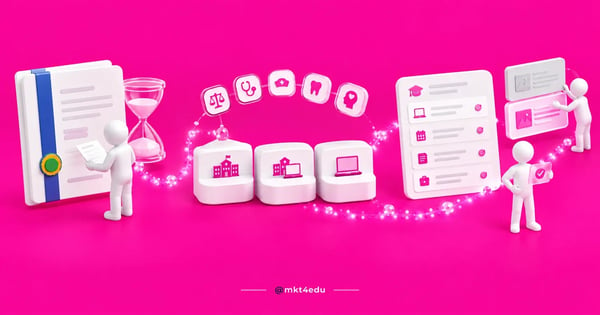 Caption: the distance learning regulatory framework changes program design and, with it, everything the institution promises the candidate
The central change is in how delivery is classified. Instead of the simple split between on-campus and distance, the design now recognizes three modes, with distinct requirements for in-person meetings and synchronous activity.
The FAQ on the new distance education framework published by ABMES gathers how sector bodies read these points. It is the most practical reference available for anyone who needs to translate the rule into a portfolio decision.
It is worth noting what the framework does not do. It does not end distance education nor reduce the importance of the mode, which remains the majority in the country's higher education enrollments.
What it does is tighten the link between the program name and the real study format. A program described as fully online that requires periodic in-person meetings becomes a compliance problem, not just an expectation problem.
That tightening has a direct effect on the work of whoever handles student recruitment. The ad promise has to match the approved program design, at the risk of generating complaints, cancellations and brand wear in the middle of the admissions process.
What are the three distance learning modes and how should you communicate them?
The framework organizes delivery into on-campus, blended and distance. The practical difference lies in the proportion of in-person and synchronous activities required in each format, and it is exactly that proportion that has to appear clearly to the candidate before enrollment.
The blended mode is the novelty that demands the most attention from the marketing team. It combines in-person activities with technology-mediated activities, and it should not be communicated as equivalent to a fully distance program.
Here is how the difference between the modes translates into a message for the candidate:
|
Mode |
What characterizes the delivery |
How to communicate it on the page and in the ad |
|
On-campus |
Classes on campus, supported by digital resources |
State the city, the unit and the shift in the first block of the page |
|
Blended |
Combines in-person meetings and technology-mediated activities |
Say how often the student goes to the local centre and what happens synchronously |
|
Distance |
Activities predominantly mediated by technology |
Spell out assessments, internships and practice that require attendance |
Table: the delivery modes in the distance learning regulatory framework translated into the language used on the program page and in the creative
The right-hand column concentrates the marketing work. Changing the mode label in the page title is not enough, because the candidate decides based on what the study routine demands of them.
There is a hidden gain in this review. A page that explains meeting frequency, assessment format and internship requirements reduces questions in the service queue and lowers drop-off between application and enrollment.
Which programs stop being offered at a distance?
Five degrees are restricted to on-campus delivery by article 8 of Decree 12,456/2025, as the ABMES FAQ reproduces: Law, Medicine, Nursing, Dentistry and Psychology. The restriction has an immediate effect on communication, because any piece that still offers these programs at a distance contradicts the rule in force.
The first move is to take inventory. It is worth listing every page, active ad, local centre material and automated email that mentions these programs, including old pieces that remain indexed and keep receiving organic visits.
The second move is demand redirection. The search for these programs at a distance does not disappear with the rule, and the candidate who arrives looking for that offer needs to find a clear alternative at your institution.
The third move is about expectation. Students already enrolled under the previous rule have a legitimate question about their own situation, and institutional silence on this point usually turns into a public complaint.
Institutions with distributed local centres feel this impact unevenly. Where there is a physical unit, migrating to on-campus delivery is viable, and local SEO applied to colleges helps capture demand from each city without cannibalizing the other units.
What changes for teaching degrees under the new framework?
Teaching degrees gained their own in-person requirement. Under article 7 of MEC Ordinance 378/2025, blended delivery of teaching degrees requires at least 30% in-person activities and 20% in-person or synchronous technology-mediated activities.
The impact on recruitment is concrete because it changes the cost of the decision for the candidate. A relevant share of in-person classes implies commuting, and commuting weighs heavily for the adult audience that works during the day.
That is why hiding this information at the bottom of the page is a poor choice. The candidate discovers the requirement after enrolling, and the frustration shows up as dropout in the first weeks of class.
The reverse reading also holds. Regular attendance builds a bond with the class and with the professor, which tends to favour student retention when the institution organizes those meetings well.
The communication work here is one of honest framing. Presenting the in-person meeting as part of teacher training, with a defined date, place and purpose, converts better than treating it as fine print.
How should you review program pages and ads before the compliance deadline?
The full compliance deadline is two years, according to MEC Ordinance 381/2025, and the communication review has to follow the academic calendar rather than wait for the deadline to end. The most efficient sweep starts with the pages that receive traffic, moves to active ads and finishes with local centre materials and automated flows.
Start with the program pages that get the most organic visits. They are the ones that appear in search, feed the candidate's comparison and sustain the promise that the service team will have to keep.
Check four fields on each page: correct mode, required in-person hours, assessment format and internship or practice requirements. That quartet answers most of the questions that reach the service team today.
Then move to the ads. Paid traffic creatives age silently, and it is common to find a piece in circulation describing a mode the program no longer has.
Next, review the automated flows. Email marketing sequences, messages and automations built two years ago keep sending old descriptions to new leads, without anyone noticing.
Optimizing program pages solves compliance and conversion in the same effort, since the information the rule asks for is also what the candidate looks for before deciding.
Institutions without a team dedicated to this sweep usually turn to an educational consultancy to define the review priority order.
Finally, record the versions. Knowing when each page was updated and who approved the change avoids rework and supports the institution's answer if the information is questioned.
What does the framework change in educational marketing strategies?
The framework shifts the axis of the dispute from price to clarity. When two institutions offer the same program in the same mode, the winner is the one that better explains the study routine, the in-person requirement and the admission path, because that is what the candidate needs to fit into their own life.
The first change appears in segmentation. Programs that migrate to the blended format start to depend on geographic proximity, which brings the distance learning campaign closer to the logic of an on-campus campaign by unit.
The second change appears in funnel content. Questions about mode, diploma validity and meeting frequency come to dominate the top of the funnel, and the material that answers them captures qualified demand.
The third change appears in measurement. Comparing cost per enrollment between modes without considering the new attendance requirement leads to the wrong conclusion about which program deserves more budget.
Together, these three changes redesign educational marketing strategies for distance programs in the next cycle.
In institutions that already track permanence indicators, this adjustment is simpler. The institution can see how much the change of format affects dropout control and student retention before the term closes.
There is also a positioning opportunity. In a market where many institutions will take a while to update their own communication, whoever explains the rule clearly earns the candidate's trust and performs better in the comparisons they make.
This movement matches the marketing trends in the Brazilian education market, which were already rewarding transparency about format, price and admission conditions.
What will candidates ask about the new distance learning framework?
The questions concentrate on four themes: whether the diploma remains valid, whether the program they want still exists in the advertised mode, how many times they will have to attend the local centre and what happens to those already enrolled. The service script has to answer all four without improvising.
The question about diploma validity is the most frequent and the simplest. An authorized and recognized program keeps its validity regardless of the mode, and that answer has to be given directly, without technical detours.
Video: the service mistake that becomes dropout when questions about the distance learning regulatory framework go unanswered, on the mkt4edu channel (in Portuguese)
The question about whether the program still exists demands extra care. If the institution stopped offering that degree at a distance, the honest answer includes the available alternative, not an attempt to push just any other program.
The question about how often they must attend the local centre decides the enrollment. Answering with a clear number, such as how many meetings per term, is worth more than any adjective about flexibility.
The question from the already enrolled student is about retention, not recruitment, and shows why student recruitment and retention go together. It arrives through the same channel and usually receives less priority, which turns an administrative question into a cancellation request.
Since much of this volume arrives by message, it is worth revisiting the WhatsApp marketing flows applied to distance education so that standard answers already reflect the current rule.
Frequently asked questions about the distance learning regulatory framework
How do you turn the distance learning regulatory framework into a recruitment advantage?
Treat compliance as a communication project, not only as an academic task. While most of the market still sells programs with the old description, the institution that explains format, frequency and requirements precisely earns the preference of a candidate who has exactly that question.
Start with what already has an audience. Program pages with organic traffic and active ads concentrate the greatest risk and the greatest conversion opportunity in the same place.
Then align the service team. A correct page is useless if the answer sent by WhatsApp repeats the old promise, because the conversation is what closes the enrollment.
Finally, use the moment to reorganize portfolio and budget, with your own team or with support from an educational consultancy. Programs that changed mode changed audience, geographic radius and acquisition cost, and deserve their own target.
Institutions that treat Student Recruitment and Retention as a single process come out ahead in this transition, because the same clarity that attracts the right candidate sustains their permanence after enrollment.
Once communication is adjusted to the new rule, the next step is to recruit within it. The content on how inbound generates enrollment shows how to attract distance learning candidates without promising what the rule does not allow.
























 Portugal