



.jpg)


Comparing CRM implementation services is hard because proposals rarely describe the same thing. Two companies can present a "complete implementation" with enough difference in scope to explain the entire price gap between them.
The result shows up months later, when the first unforeseen integration appears or the data migration reveals a volume nobody sized. The bill grows, and the original comparison loses its meaning.
This guide organizes the criteria that make different proposals comparable. The idea is not to pick the cheapest one, but the one that delivers the CRM working inside the company's real process.
What is included in CRM implementation services?
Complete CRM implementation services include six deliverables: commercial process design, platform configuration, data migration, integrations with existing systems, training by role and post-delivery follow-up. Proposals that leave out migration, integration or follow-up are describing a smaller project under the same name.
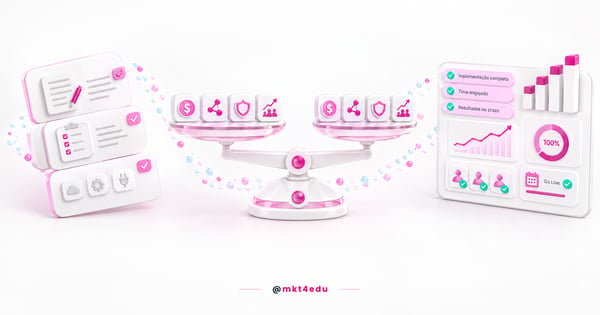 Caption: comparing CRM implementation services starts by putting scope against scope, and only then price against price
Process design tends to be the most neglected item in the comparison. Without it, the company receives a platform configured with the vendor's default process, not with its own.
Data migration is the item that surprises budgets the most. An old database with duplicates, free-text fields and incomplete history requires treatment, and that treatment is work, not configuration.
Integrations define whether the CRM becomes a single source of truth or just one more screen. The academic system, the ERP, the payment platform and the service channels all have to be named in the proposal, one by one.
It is worth separating implementation from onboarding when reading a proposal. HubSpot's official onboarding delivers a guided plan for the first steps, while implementation configures the platform for the company's process, and buying one while expecting the other creates frustration.
The correct order of the phases in a HubSpot implementation shows why these deliverables depend on one another and cannot be bought in any sequence.
How do you calculate the total cost of a CRM implementation?
The total cost of a CRM implementation adds up four parts: the platform's annual license, the implementation project, specific integrations and the team's internal hours. The fourth part almost never appears in proposals, and it is usually the one that weighs most at mid-market companies.
The license is the easiest part to compare, because the price lists are public. It is also the part that varies least between vendors, since the price comes from the manufacturer.
The implementation project is where the variation shows up. Differences in scope, team seniority and working method explain proposals with double the value for the same software.
Internal hours deserve an explicit estimate. Someone at the company will validate the process, review data and take part in training, and that time comes out of another activity.
Here are the criteria that make two proposals genuinely comparable:
|
Criterion |
What to ask |
Warning sign |
|
Scope |
Which of the six deliverables are included? |
A proposal with no list of deliverables |
|
Migration |
How many records and what duplicate handling? |
Volume not sized |
|
Integrations |
Which systems, named, and at what frequency? |
"Necessary integrations" with nothing named |
|
Adoption |
What happens in the 90 days after delivery? |
The project ends at go-live |
|
Support |
Who answers, within what time and for how long? |
Support only through the manufacturer's channel |
Table: Comparison criteria between implementation proposals and the signals that deserve attention.
How do you evaluate integrations and data governance in a proposal?
Evaluating integrations starts with the named list of systems and the sync frequency of each one. Data governance shows up in a proposal when it describes duplicate rules, required fields, the record lifecycle and who accesses each type of information.
Sync frequency looks like a technical detail and is a business decision. Data refreshed once a day works for a report, but not for real-time service.
Defining the source of truth avoids conflict later. When two systems hold the same information, someone has to decide which one wins.
Quality rules are worth more than migrated volume. Taking a hundred thousand dirty records into a new system merely transfers the problem with the appearance of a finished project.
It is worth agreeing on a historical cut-off before starting. Migrating contacts with no interaction in recent years raises the project cost and pollutes the reports in the very first week of use.
The record lifecycle is the rule that holds the rest together. Without defining when a contact enters, changes stage and leaves the active base, any clean-up done during migration unravels within months.
Ask for the validation plan too. A mature project describes how the data will be checked after the load, with sampling and a named owner, instead of treating migration as a stage finished on the day of the upload.
The proposal should also address permissions. In operations dealing with sensitive data, care with privacy inside the CRM has to be designed before the database is populated, not afterwards.
Why does the adoption plan have to be in the proposal?
The adoption plan has to be in the proposal because delivering on time does not guarantee use. Prosci's change management research links active and visible sponsorship to a 79% chance of the project meeting its objectives, against 27% when that sponsorship is very ineffective. Without that front, the system runs and the team stays in spreadsheets.
A mature proposal describes what happens after go-live. Follow-up meetings, usage indicators and a training plan by role show that the vendor understands where the project usually fails.
A conversation about the strategic use of HubSpot CRM, on the mkt4edu channel.
Training deserves special attention when reading a proposal. Sessions by role are worth more than a single meeting for the whole company, because each area uses a different part of the platform.
Reference material reduces dependence on the vendor. A manual of the platform's features resolves day-to-day questions without opening a ticket.
Does sector experience weigh more than the vendor's size?
In processes with their own vocabulary and rules, sector experience usually weighs more than the vendor's size. A partner that has already modeled the enrollment funnel of an educational institution arrives with the design ready, while a generalist vendor learns during the project, on your time and on your budget.
The difference shows up in the first process meeting. Someone who knows the sector asks about re-enrollment, dropout and admissions without needing a prior explanation.
The vendor's size, when it matters, is verifiable. HubSpot publishes how the partner program tiers work, from Gold to Elite, with the criteria behind each level.
This observation does not disqualify generalist vendors. In standard commercial operations, with few systems involved, sector specialization weighs less than technical capability.
For a mid-market company, the difference shows up in project time. Every meeting spent explaining your own business is a meeting that does not advance the configuration, and that time is usually priced into the contract.
It is worth asking who executes, and not only who sells. Experienced sales teams present the method well, but what determines the outcome is the consultant who will sit down with your process.
The practical criterion is vocabulary. If the proposal describes your process in your terms, the vendor understood it; if it describes a generic sales process, the translation is still to be done.
It is worth asking for cases from the same sector with a stated result. The experience applied to HubSpot CRM in revenue strategy shows the kind of evidence that separates talk from repertoire.
How do you build the comparison table between CRM solutions?
The comparison table between CRM solutions works when it compares scope before it compares price. List the six implementation deliverables, mark what each proposal includes, and only then divide the total value by the scope actually covered.
The second step is normalizing the time horizon. Comparing a three-month project with a six-month one without accounting for the license cost over that period distorts the reading.
The third is separating the mandatory from the desirable. Integrations the operation does not use today can leave the initial scope and enter a second phase, which usually lowers the value without hurting the result.
A good CRM software evaluation also considers the cost of leaving. Data portability and dependence on customization determine how locked in the company becomes to a choice made today.
For anyone starting that comparison, understanding the benefits a CRM brings to an organization helps define which criteria really matter in your case.
The comparison of CRM systems usually resolves itself before the comparison of partners. Once the platform is defined, the discussion concentrates on implementation scope, which is where the real variation happens.
When the platform is still open, the CRM software evaluation has to consider three practical points: what the team will use every day, which integrations already exist and how much it costs to grow the number of users.
A CRM for mid-market companies rarely fails for lack of features. It fails from excess, when the company buys an advanced plan and uses a fraction of it throughout the contract.
Customer relationship management also changes its demands by sector. Long-cycle operations ask for detailed history, while high-volume operations ask for automation and speed of record keeping.
Frequently asked questions about CRM implementation services
Specialist partner or generalist vendor: which makes more sense?
The answer depends on how far your process departs from the standard. Conventional commercial operations, with few systems, are well served by competent generalist vendors, and paying for specialization there is not justified.
When the process has its own vocabulary, strong seasonality and integration with sector systems, the math changes. The time a generalist takes to understand the business usually costs more than the price gap between the proposals.
In either case, compare scope before you compare value. A cheap proposal with migration and adoption out of scope becomes an expensive project in the second quarter.
If your operation is in education and involves recruitment, enrollment and persistence in the same funnel, the mkt4edu team implements and sustains that design with HubSpot CRM. Talk to our team to compare scopes with your scenario on the table.


























 Portugal