





Chatbot technology is no longer new to any university. Almost every institutional website has a little window in the corner, and almost every applicant has been served by one of them.
The problem is that many of those windows still run on 2021 logic. A fixed script, three menu options and an “I did not understand, could you repeat?” whenever the question leaves the script.
The market moved on. Automated conversation went from rule-based bots to AI agents that interpret requests in natural language and act on institutional systems, and student recruitment was the first process to feel the difference.
This article separates what still holds from what aged badly. It also shows where an AI SDR agent belongs without turning support into an automated wall.
What is chatbot technology and what changed in it?
Chatbot technology is the set of resources that enables automated conversation between a person and a system. What changed was not the interface but the engine: the field moved from pre-configured keyword answers to language models that interpret intent and decide the next step inside a process.
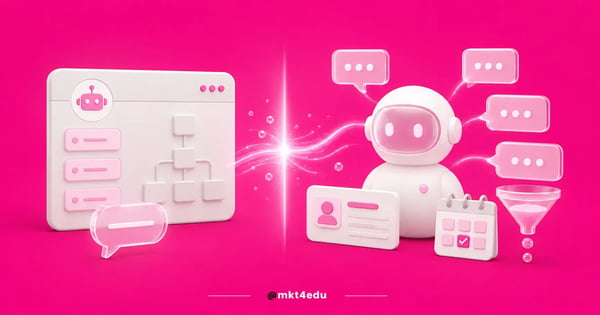 Caption: Chatbot technology left the three-option menu behind and reached the AI agent, which interprets the request, queries the CRM and returns the history to the team.
Product renaming tells that story. Watson Assistant, quoted in almost every chatbot article of the past decade, is now called watsonx Assistant and runs on a generative AI foundation.
In practice, three limits of the old bot fell away. It could not understand questions outside the script, could not query any system and could not decide anything on its own.
The effect on user experience is still visible. The Super Panorama Mobile Time/Opinion Box survey, with 4,138 respondents in Brazil in 2026, found that 79.4% of smartphone users were served by a chatbot in the past year and rated the experience 5.6 on average.
The score also varies by age, which matters for recruitment. Among people aged 16 to 29 the average rises to 6.2, while above 50 it falls to 5.0.
The technology is available and the audience is exposed to it, yet perceived quality remains mediocre. That gap is exactly where the competitive advantage sits for whoever does it better.
Rule-based chatbot or AI agent: what is the real difference?
The difference lies in who decides the next step. In a rule-based chatbot, the decision belongs to a flow someone designed in advance, and every new situation needs a new branch. In an AI agent, the system interprets the request, picks the action and queries whatever data it needs to answer.
That distinction is not vendor vocabulary. It changes maintenance cost, because a rule-based bot grows in complexity with every exception the admissions team discovers.
Rule-based bots are still the right choice in some cases. Short, predictable, high-volume flows, such as checking an invoice or confirming an application, work well and cost little.
AI agents pay off when the conversation is open-ended. “I want to go back to school, but I do not know whether my previous credits transfer” does not fit inside a three-option menu.
It is worth recording what AI agents still cannot solve alone. They depend on an accurate knowledge base, on integration with the academic system and on a clear rule for handing the conversation to a person.
How does chatbot technology work in lead generation?
Chatbot technology works in lead generation by shortening the gap between a question and an answer. It responds on any day and at any hour, collects contact details inside the conversation and writes everything to the CRM, which avoids the abandoned form and the next-day callback queue.
The main gain is speed, not savings. An applicant researching programs at midnight compares three institutions in the same session, and whoever answers first stays in the running.
The second function is qualification. A well-built bot finds out the program of interest, the format, the city and the decision timeline before taking up a human advisor's time.
The third is nurturing. With the data in the CRM, customer service stops restarting from scratch at every contact and continues the previous conversation instead.
The channel also moved. Much of this recruitment activity migrated to messaging apps, where the conversation happens in the app the applicant already opens every day.
Adoption in the sector, however, was never universal. A mkt4edu study of the 500 largest educational institutions in Brazil found 42.4% of them using chatbots, which still leaves many institutions answering only during business hours, as the discussion on chatbots and AI shows.
What does an AI SDR agent do in student recruitment?
An AI SDR agent handles the pre-sales stage of student recruitment. It approaches the new lead, qualifies interest in open conversation, handles simple objections, books the human appointment and returns the full record to the CRM. It is the job of a sales development rep, executed by software.
The difference from a website bot is scope. A bot waits to be approached, while an AI SDR agent starts contact, follows up and chases an answer over several days.
Four tasks concentrate its value in recruitment. Reaching out within minutes, qualifying without a robotic questionnaire, persisting politely and handing over with context.
The fourth is the one that fails most often in practice. An agent that transfers the conversation without history forces the advisor to repeat every question, and the applicant notices.
A market forecast helps size the trend. Gartner projects that by 2029 agentic AI will autonomously resolve 80% of common customer service issues without human intervention, with a 30% reduction in operational costs.
That is a projection, not an observed result. In many cases an institution hits the limits of its own knowledge base long before it hits the limits of the model, which is why AI-powered SDR tools need content work behind them.
AI SDR vs human SDR: who does what in recruitment?
When comparing an AI SDR with a human SDR, the useful criterion is not which one is better but which stage each resolves with less friction. The AI agent wins on volume, speed and availability. The person wins on difficult conversations, negotiation and reading emotional context.
The most stable split in universities follows lead temperature. Cold lists and first contact go to the agent, while decisions and financial objections go to the human team.
Here is how the two roles divide up:
|
Stage |
Who leads |
Why |
|
First reply to a new lead |
AI agent |
Answers within minutes, at any hour |
|
Initial qualification |
AI agent |
Collects program, format and timeline with no hourly cost |
|
Cold list reactivation |
AI agent |
High volume and low response rate |
|
Price and scholarship objections |
Human SDR |
Requires negotiation and context reading |
|
Applicant torn between programs |
Human SDR |
Consultative conversation about careers |
|
Closing the enrollment |
Human SDR |
High-value, high-anxiety decision |
Table: How stages divide between an AI agent and the human team in student recruitment.
The handover rule is what holds this arrangement together. It has to be written down, with clear triggers by subject, by number of attempts and by explicit request from the applicant.
Without that rule, the agent becomes a barrier, and the cost of it never shows up in the tool's dashboard, it shows up in the enrollment that never happened.
How much does an AI SDR agent cost?
An AI SDR agent costs the sum of four lines, not a single subscription. The bill includes the platform hosting the agent, the per-message cost of the chosen channel, the integration with the CRM and the academic system, and the continuous curation of the knowledge base.
The channel line surprises people most. On WhatsApp, Meta replaced conversation-based charging with per-message pricing on July 1, 2025, which changes the math for any operation that sends a lot and converts little.
That change rewards useful conversation. Long cadences aimed at cold leads got more expensive, while messages that earn a reply became relatively cheaper.
Curation is the line most often left out of the budget. An agent without knowledge base maintenance ages within a single term, because curriculum, pricing, scholarships and deadlines change every admissions cycle.
An honest comparison with the human team also needs a different unit. The deciding number is cost per qualified conversation, not cost per license or per support seat.
One last caveat applies to budgeting. Platform pricing varies widely by volume, by language and by vendor, so any fixed estimate produced without a defined conversation volume tends to be optimistic.
Is chatbot technology a trend in education marketing?
Chatbot technology stopped being a trend and became infrastructure. Among the trends in education marketing, what is in play now is not having a bot but having an agent that resolves the whole conversation, integrated with the CRM and governed by a clear rule for handing over to the human team.
Treating the subject as novelty costs position. When nearly half of the large institutions already run conversational automation, the differentiator moves to answer quality.
Three fronts concentrate the evolution of the topic. Agents that execute tasks inside systems, voice conversation sharing the same knowledge base, and use of conversation history as a source of topics and products.
The third front is underused. Bot logs show, in natural language, exactly what the applicant failed to find on the website, and that feeds entire education marketing strategies.
Automation also reached retention, not only recruitment. The same knowledge base that answers applicants can follow enrolled students, as in the use of AI in student retention service.
Frequently asked questions about chatbot technology
Is chatbot technology for now or can it wait?
It is for now, with one condition. Chatbot technology only delivers when the knowledge base is organized and the CRM integration exists, because the bottleneck is rarely the AI model. Without those two pieces, moving early only automates the wrong answer.
The lowest-risk path starts small. Pick one high-volume flow, measure the resolution rate without a human for four weeks and only then widen the agent's scope.
Institutions already running an old bot have an earlier task. It is worth rereading the current script and checking how many questions land on “I did not understand”, because that number is the real size of the opportunity.
Still unsure whether this tool is a good investment? Then follow the link and find out 5 compelling reasons to implement AI chatbots in education.

























 Portugal