The WhatsApp Business API, now officially called the WhatsApp Business Platform, charges per delivered message, and the math changed last month. Since October 1, 2026, Meta also charges for service messages beyond 1,000 per number each month.
The impact varies with conversation volume. An operation using an AI SDR (Sales Development Representative) agent on WhatsApp to prospect and answer leads at scale feels the charge faster, because service message volume grows along with the automation.
This guide covers the math line by line: what each category costs, what changed, a complete calculation example and the specific view for teams that recruit and retain students through the channel.
What is the WhatsApp Business API?
The WhatsApp Business API is the version of the app built for companies to automate support at scale, without depending on an app installed on a phone. It can be accessed directly through Meta's Cloud API or through a BSP (Business Solution Provider, a provider approved by Meta), and it connects systems such as a CRM (Customer Relationship Management), a chatbot and an AI agent directly to the company's official number.
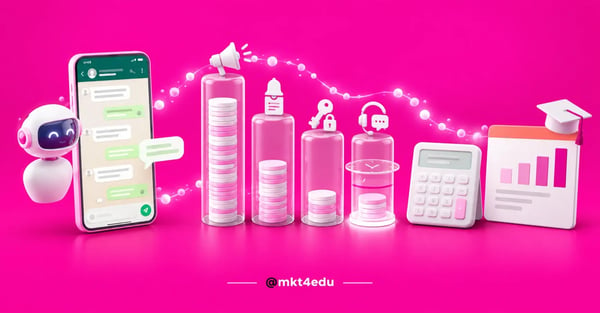 Caption: the WhatsApp Business API charges per delivered message, and each category follows a different pricing rule
The WhatsApp Business App, free and used on a phone, handles small volumes well, with one person answering each conversation manually. The API replaces that person with direct integration and charges per delivered message, not per seat or per connected user.
The product's official name is WhatsApp Business Platform, but the market and much of the technical documentation still use both names interchangeably. Meta was already calling it that when it announced the Cloud API in 2022, the version it hosts itself, with free hosting and direct access for anyone who would rather not go through a partner. See how the product works in more detail in the content about how WhatsApp Business works.
What are the WhatsApp Business billing categories?
The WhatsApp Business Platform pricing documentation lists five message categories: marketing, utility, authentication, service and Meta Business Agent. Each has its own pricing and discount rule, and billing is per delivered message.
Marketing is the most expensive category, used for offers and campaigns the customer did not ask for. It also has no volume tiers: only utility and authentication do, which is why marketing tends to be the first line cut when the budget tightens.
Utility notifies the customer about something they already requested, such as an enrollment confirmation or an exam reminder. Authentication only sends verification codes, usually the lowest-volume category day to day. Both have volume tiers that unlock lower rates as monthly volume grows, by market and by category.
Service is the free-form, non-template reply sent inside the 24-hour customer service window opened by the customer, by a person or by a third-party AI solution. This is the category that grows most with automation and the only one that went back to being paid in October 2026.
The fifth category is recent and easy to miss. Meta Business Agent covers free-form replies inside the window when they are powered by Meta's own Business Agent Platform. In other words, the same kind of reply can land in service or in Meta Business Agent depending on what generates the text, and neither has volume tiers.
Here is how the categories line up when you build the budget:
|
Category |
What it covers |
Volume discount |
|
Marketing |
Promotional templates, sent at any time |
None |
|
Utility |
Transactional or informational templates already requested |
Yes, by volume tier |
|
Authentication |
Identity verification templates |
Yes, by volume tier |
|
Service |
Free-form replies in the 24-hour window, by a person or third-party AI |
None, but 1,000 free per number each month |
|
Meta Business Agent |
Free-form replies in the window powered by Meta's agent platform |
None |
Table: billing rules per category on the WhatsApp Business API, according to Meta's documentation
What changed in WhatsApp Business billing in October 2026?
On October 1, 2026, Meta resumed charging for service messages beyond 1,000 delivered per business phone number each month. Resumed is the right word: the category was free from November 1, 2024 to September 30, 2026 and, before November 2024, it was billed per 24-hour service conversation, under the model that preceded per-message pricing.
Meta's changelog describes October 2026 as resuming charges, on a per-message basis, for messages that were previously free. The same date brought a rate card update with 40 revised rates and new authentication-international rates in 9 markets.
Meta's documentation is explicit on two points that change the math. The free allowance is per business phone number, not per account, and whatever is left does not roll over to the next month, so operations with several numbers have several allowances, and a quiet January buys no slack in February.
The second change on the same date is quieter. Utility templates sent in response to users had been free since July 1, 2025 and went back to being charged as regular utility messages on October 1, 2026. The exception still standing is the free entry point window, opened by a click-to-WhatsApp ad.
There was also an operational detail that caught inattentive teams. Meta warned it would stop delivering service messages, from the moment they became chargeable, for accounts without a payment method on file by September 30, 2026.
The figures in Brazilian reais come from Meta's official rate table for Brazil: R$ 0.3217 for marketing and R$ 0.0350 for utility, authentication and service. Meta updates that table without prior notice, and the rate selector loads values dynamically, so confirm your own account's current rate before closing a budget.
There is a useful corroboration in Meta's own material. The comparison table in the documentation uses 0.68 US cents per message as the current utility and authentication rate for users in Brazil, which is the same order of magnitude as the R$ 0.0350 the providers report.
It is also worth knowing that BRL billing itself is recent. Meta started migrating Brazilian accounts to real-denominated billing in July 2026 and set June 2027 as the final migration deadline, so your account's currency decides which table applies to you.
This is not the first recent change to the model. Meta swapped billing per 24-hour conversation for billing per individual message on July 1, 2025, a step that made pricing more predictable by volume, but also more sensitive to automation spikes.
What does it cost to run the WhatsApp Business API per month?
The monthly cost adds up the volume of messages delivered per category and the share of service messages above the free allowance. Teams using a BSP instead of connecting directly through the Cloud API also add the provider's subscription. There is no single plan, because the amount changes with each number's real usage.
- Marketing, utility and authentication messages: monthly volume per category multiplied by the price per message, remembering that utility and authentication can drop a tier at scale.
- Service messages above 1,000: every extra unit per number lands on the invoice.
- Provider fee (optional): it only exists for teams using a BSP instead of the direct Cloud API, and it varies by plan and by the number of connected channels.
- Dedicated number: the cost of keeping the line active, charged separately by some providers.
An example helps. An operation with 2,000 utility messages and 500 marketing messages in a month, plus 4,000 service messages, pays about R$ 70 in utility, R$ 105 in service above the allowance and R$ 161 in marketing, excluding the BSP subscription for those who use one.
|
Category |
Billable volume in the month |
Approximate cost |
|
Utility |
2,000 messages |
R$ 70.00 |
|
Service above the free allowance |
3,000 messages (4,000 minus 1,000) |
R$ 105.00 |
|
Marketing |
500 messages |
R$ 160.85 |
Table: example of a monthly WhatsApp Business API cost by category, excluding any BSP subscription
Before deciding between connecting directly and hiring a BSP, simulate the expected volume of each category based on your support history. Teams that already automate part of the conversation can compare this budget with the effort of implementing an AI SDR agent, another cost that lands in the same account.
How does an AI agent on WhatsApp affect API cost?
An AI agent answering on WhatsApp generates a billable message with every free-form reply it sends. The more the automation scales support, the faster the account passes 1,000 free messages per number each month.
Which category that reply falls into depends on where the agent runs. A third-party AI solution connected to your number bills as service; a reply generated by Meta's agent platform bills as Meta Business Agent. When budgeting automation, it is worth confirming with your BSP which of the two your operation falls under.
Fifty service messages a day take a number to 1,500 in a month, 500 above the allowance, roughly R$ 17.50 extra at the current rate table. The figure looks small in isolation, but it grows fast with multiple numbers or simultaneous campaigns.
Video: the flow design that decides how many messages automation fires, and therefore the WhatsApp Business API cost, on the mkt4edu channel (in Portuguese)
None of this makes automation expensive on its own. An SDR agent on WhatsApp usually qualifies and answers more leads per hour than a person, which dilutes the cost per message in the final result, and the role of an AI agent in the operation is exactly to absorb volume without hiring in the same proportion.
The practical point is to forecast that volume before scaling automation, not after. Monitoring how many service messages each number sends per week avoids the surprise of a bigger invoice at the end of the month.
What does the charge mean for institutions using WhatsApp in recruitment?
For an HEI (Higher Education Institution), the service-message charge goes straight into cost per lead and cost per enrollment, not into the cost of a product sold. It is recruitment operating budget, the same kind of line that already exists for paid media or a pre-sales team.
WhatsApp for student recruitment tends to generate a lot of service messages: exam schedule confirmations, restarting a stalled enrollment, answering questions about scholarships or financing. That volume is exactly what became billable above the free allowance.
In practice, an institution that already measures cost per enrollment only needs to add one line to the spreadsheet: service messages above 1,000 per number, multiplied by the price per message. The rest of the recruitment math stays the same as before October.
Video: the return of an AI chatbot in recruitment and retention, the other side of the WhatsApp Business API math, on the mkt4edu channel (in Portuguese)
In retention, the same channel answers questions about re-enrollment, invoices and the academic calendar, almost always as service messages. Separating the number used for recruitment from the one used for retention helps show which operation consumes more of the free allowance, and it also gives you two allowances instead of one.
How do you integrate and control WhatsApp API cost in the CRM?
Connecting the WhatsApp API to a CRM centralizes conversation history in one place and makes it easier to measure how many messages of each category went out per team, campaign or number during the month, without a parallel spreadsheet or a manual export from the provider.
The guide on WhatsApp in HubSpot shows the practical limits of that integration, including what the CRM displays about message volume and where that data helps forecast the month's invoice before it arrives.
A simple dashboard, with message volume by category and by number updated weekly, is already enough to stop the team from discovering the allowance overrun only when the month’s invoice is already closed.
Frequently asked questions about WhatsApp Business API cost
Is the WhatsApp Business API worth paying for today?
It is worth it when support volume already justifies automation: the time saved and the lift in replies per lead tend to outweigh the cost per message. For small, low-volume teams, the free WhatsApp Business App still does the job at no extra cost.
Teams already automating support with AI who want to compare this new cost with keeping a human pre-sales team will find the full math in the content about how much an AI SDR costs, and the overview of what an SDR agent does helps size message volume before switching the operation on.
Whatever the decision, confirm your account's current rate table before approving the budget. Meta changed the model twice in two years, and the number that counts is the one in your manager, not the one in a third party's table.












 Portugal