





Choosing a university is not like buying any other product. It means betting years of your own life and, often, taking on real debt.
That is why video content for student recruitment became a central piece of education marketing: before filling out any form, the applicant wants to see with their own eyes what studying there is like.
And here is the turning point. The video that converts most is not the most expensive one, it is the most truthful.
A testimonial filmed on a phone by a first-semester student, telling the fear she felt and how she got past it, carries more persuasive power than a flawless commercial full of generic footage of people smiling in empty hallways.
In this piece, you will understand the logic behind that and leave with a practical path to producing real video at scale, without depending on large budgets.
What is video content for student recruitment?
Video content for student recruitment is any audiovisual material created to attract, inform and convince an applicant along the journey to enrollment.
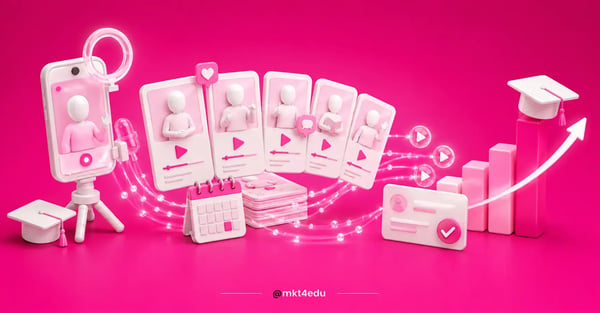 Caption: every piece of video content for student recruitment filmed by a real student becomes another asset in the funnel.
It ranges from the short video introducing the campus to a graduate's testimonial, taking in class behind-the-scenes, answers to questions and real stories of personal trajectory.
What changes compared to traditional video is the focus. Here, every piece exists to resolve a doubt or overcome a specific objection the applicant has.
It is not institutional video meant to "look good on the website". It is content with a clear function inside the recruitment funnel.
The most important distinction is between produced video and authentic video. The first is scripted, filmed with a crew and professionally edited.
The second comes out of real daily life — a professor explaining something in the hallway, a student showing her packed backpack before an exam, a glimpse of the lab.
Both have their place, but the mix that produces results leans much further toward the authentic side.
Why does authentic video convert more enrollments than polished production?
Authentic video converts more because it activates trust before the decision. The applicant recognizes someone like themselves, hears a believable story and lowers their guard.
Overly polished production, on the other hand, triggers the opposite effect: it sounds like advertising, and advertising breeds distrust in someone who is already insecure.
The preference for video is not guesswork. According to Wyzowl's State of Video Marketing research, 63% of people say they would rather watch a short video to learn about a product or service, ahead of articles, ebooks and sales calls.
The same Wyzowl research indicates that 89% of consumers say video quality impacts their trust in a brand. Quality here means clarity and truth, not necessarily a cinema camera.
In recruitment, enemy number one is insecurity. "Is this school really any good? Will I be able to keep up? Are the people there like me?"
Authentic video answers those questions without looking like it is selling. It is the difference between someone telling you the place is good and you seeing, with your own eyes, a real person saying it.
This trust logic is the same one behind the experience, authority and trustworthiness Google values as E-E-A-T. Video of real people is E-E-A-T in motion.
What is UGC and why do applicants trust a real student more?
UGC (user generated content) is material produced by the people who actually live the experience, not by the brand.
In recruitment, it is the video a student films about their routine, the professor who captures a moment of class or the graduate who shows where they got to. Applicants trust it because they do not sense a script behind it.
The trust comes from a simple place: social proof. When we see other people making a choice, it reduces our risk of getting it wrong.
When an applicant watches a real student, with no "actor" badge, their brain processes it as a recommendation from a peer, not as an ad. And a peer's recommendation weighs far more in the decision.
There is also a scale effect. An institution cannot produce hundreds of videos a month on its own, but hundreds of students, encouraged the right way, can.
UGC turns the student body into a team of content creators, where every lived story becomes raw material for recruitment.
One important caveat: UGC is not chaos. Authentic does not mean directionless. You guide the topic, provide the hook and let the person speak in their own way. The spontaneity lives in the delivery, not in the absence of strategy.
Which short video formats recruit the most students?
The formats that recruit most are the ones answering a real question in seconds. Short vertical video, made for the phone, with one idea per piece.
Student testimonials, a day in the life, objection answers, behind-the-scenes of hands-on classes and graduate trajectories are the ones that engage most and move the applicant.
Each format targets a different moment of the journey — some drive discovery, others knock down the last objection before signing up.
Here are the formats that work best in recruitment:
- Current student testimonial: the person explains why they chose it, what they felt and how it is going. Beats the "is this for me?" objection.
- A day in the life of a student: shows the real routine, from the commute to the cafeteria. Creates immediate identification.
- Behind-the-scenes of a hands-on class: lab, clinic, practice room. Proves the training is concrete, not just theory.
- Answer to a frequent question: a professor or coordinator answers, in 30 seconds, a question that stalls the decision.
- Graduate trajectory: where the person got to after the course. Connects today's effort to a desired outcome.
- Video of a professor in love with the subject: the energy of someone who loves what they teach sells the course on its own.
None of these formats requires a studio. They require direction and consistency.
The practical rule is: one idea per video, a strong hook in the first three seconds and a clear call at the end, even if it is just "come see for yourself".
How do you build a video content machine that drives enrollment?
A video content machine is a repeatable process that captures, edits and distributes real video consistently, without depending on inspiration or big productions.
It rests on four gears: content sources, light scripting, agile editing and a publishing calendar. Steady volume beats occasional production.
The first gear is the source. Map who generates video inside the institution: student ambassadors, communicative professors, proud alumni, the events team. Those people are your in-house production company.
The second is light scripting. Instead of closed texts, create hooks and questions. "Tell us the moment you knew you had chosen right." The answer comes out natural and true.
The third is agile editing. Quick cuts, captions always (most people watch without sound), vertical format. The goal is to publish a lot, not to publish perfect.
The fourth is the calendar. Set a sustainable frequency and stick to it. Three well-made videos a week beat ten irregular ones.
This continuous production logic is the heart of content marketing applied to education. Video is not a one-off campaign, it is an asset that works all year inside the education marketing strategies that sustain recruitment.
And do not forget the destination. Every video that generates interest needs to lead somewhere, and that somewhere is a landing page designed to convert the applicant. Video without a conversion route is just entertainment.
Where should you distribute recruitment video on social networks?
Recruitment video belongs where the applicant already spends time: on short-video social networks. Instagram, TikTok, YouTube (Shorts and long-form) and, increasingly, search inside those platforms.
The rule is to adapt the same content to each network's format, rather than publishing everything identically everywhere.
Brazil is one of the most video-connected countries in the world. Data from the Digital 2025 DataReportal report for Brazil shows YouTube reaching an audience equivalent to roughly 68% of the population, a vast public watching video every day.
That means the ideal applicant is a few taps away. The question is not whether they use video, but whether they will find yours.
Each network calls for an adjustment. On TikTok and Reels, the hook has to grab in seconds. On YouTube, there is room for the longer story, the campus tour, the in-depth testimonial.
One point many institutions ignore: social networks also work as search engines. Plenty of people search "what is the X course like" straight on the platform. That is why it pays to treat title, description and caption carefully, as the logic of SEO for social media shows.
And there is a new layer growing fast. AI assistants and answer engines already suggest institutions and courses. Structuring your content to be found by them is the field of answer engine optimization, and video with a transcript and clear context helps you get cited.
How do you measure whether video content is driving enrollment?
To measure, look at the whole funnel, not just the likes. At the top, track reach, views and retention time. In the middle, clicks, saves, comments and direct messages. At the bottom, leads generated, applications and enrollments attributed to video.
The metric that decides the budget is the one closest to enrollment.
A like is a signal, not a result. A video can go viral and bring in not a single student, while another, quieter one fills your form.
That is why the retention indicator is so valuable: it shows whether people watch to the end, which is where the call to action lives.
To connect video to enrollment, use simple tracking. Links with source tagging, coupons or codes mentioned in the video, and the question "how did you hear about us?" at sign-up.
Here is how the metrics organize by stage of the journey:
|
Funnel stage |
What to measure |
What it indicates |
|
Discovery |
Reach, views, retention |
Whether the video holds attention and reaches new people |
|
Consideration |
Clicks, saves, comments, DMs |
Whether the applicant went from viewer to interested |
|
Decision |
Leads, applications, attributed enrollments |
Whether the content actually became a student |
Table: Each stage has a main indicator; raising engagement at the top without growing enrollment at the bottom is a sign the conversion route is missing.
With those numbers in hand, you stop betting on gut feeling and start investing where the return shows up.
Frequently asked questions about video content for recruitment
Is it worth investing in video content to recruit students?
It is, more and more. Applicants decide on enrollment based on trust, and nothing builds trust as fast as seeing real people living the experience they are about to choose.
Video content for student recruitment has stopped being a differentiator and become the ground where the fight for enrollment happens.
The good news is that you do not need a studio to start. You need a method: content sources inside the institution, hooks that unlock true stories, agile editing and a calendar that does not stop.
The hard part is sustaining that rhythm with an already full recruitment routine. That is where it helps to work with education marketing specialists who run this machine for institutions every day.
At mkt4edu, we combine content, social media and data to turn real video into enrollment, inside an education marketing strategy designed for recruitment. No pretty video without return: every piece has a function in the funnel.
If you want to move past occasional video and build a machine that generates students, talk to our team and we will design the right plan for your institution.
























 Portugal