






Brazil closed 2024 with 10.2 million higher education enrollments, and 79.8% of them are in the private network, according to the 16th Higher Education Map by Instituto Semesp. That volume is not evenly distributed across the year, and that is exactly where the operation tends to stumble.
A student recruitment calendar exists to solve that mismatch. Without it, the institution works in two alternating modes: absolute rush in December and January, near-complete silence in April and May.
The problem with that alternation is not team fatigue, it is cost. A campaign built in a hurry pays more for the same click and talks to an applicant who heard from competitors weeks earlier.
What are the windows in the student recruitment calendar?
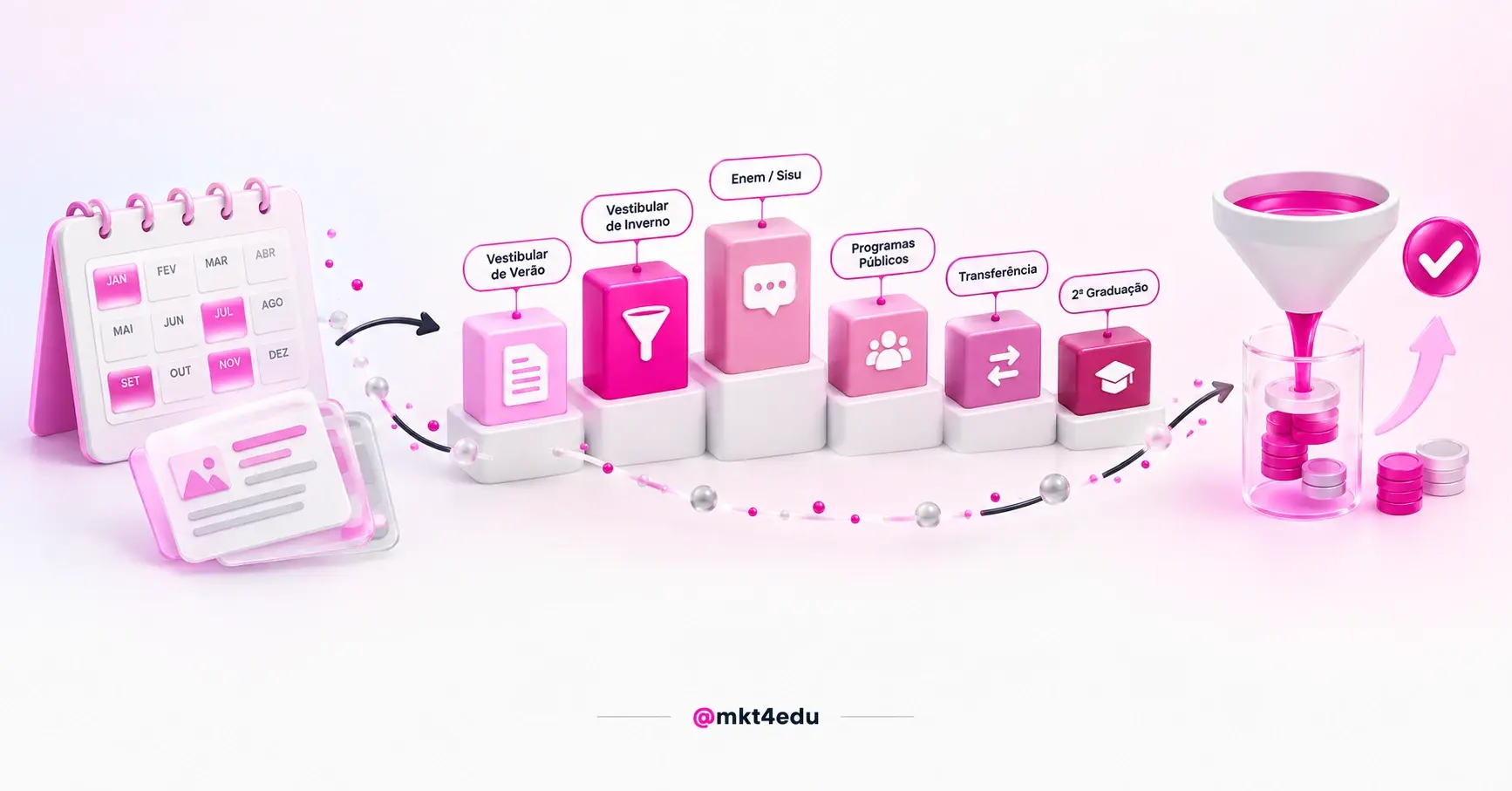
A private institution's student recruitment calendar revolves around six windows: summer entrance exam, winter entrance exam, Enem and Sisu, Prouni and Fies, external transfer and second degree. They overlap in some months and require different messages, even when they compete for the same program.
The summer entrance exam concentrates the largest volume. It feeds first-semester intake and tends to account for most of the year's enrollments at on-campus undergraduate institutions.
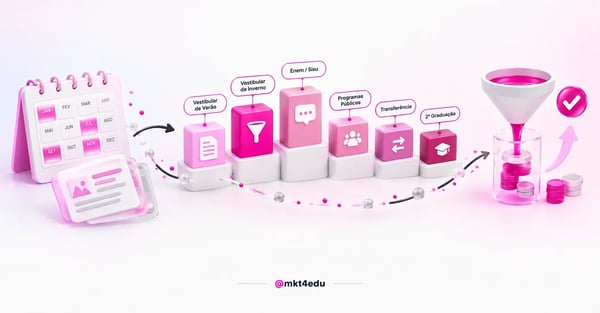 Caption: the student recruitment calendar organizes each intake window with its own marketing action and budget
The winter entrance exam works as a second wind. It serves those who missed the previous cycle, those who dropped another program and those who decided to study mid-year.
Public program windows have their own logic. The Enem score is used in Sisu, Prouni and Fies, and those dates depend on an official notice that changes from one edition to the next, so the calendar records the approximate period and updates as soon as the schedule is out.
External transfer is the most neglected window and one of the most profitable. The applicant is already enrolled at another institution, has already decided to take that degree and is looking for price, proximity or flexibility.
The second degree follows the same short-decision logic. Someone who already completed a degree compares curriculum, duration and credit transfer, and responds better to an objective argument than to an institutional campaign.
Entrance exam seasonality explains why these windows cannot be handled with the same creative. The transfer applicant wants to know how many credits carry over; the summer applicant wants to know the price and how to get in.
What should you do in the first half of the recruitment calendar?
The first half of the year is when the institution builds what it will use at the peak. February and March still collect late enrollments, April and May open room for content and organization, and June already concentrates the winter entrance exam and recruitment for the second semester.
February calls for continuity, not demobilization. In our experience, a good share of drop-offs happens in the first weeks of class, and the same team that enrolled students is the one that can recover those who have not completed their paperwork.
March and April are the best window of the year to work on content planning. Organic traffic takes months to mature, so the pages published in that period are the ones that will receive searches in November and December.
May is the month to prepare winter. The mid-year entrance exam campaign needs creative, pages and nurturing ready before June, when applicants start researching.
June concentrates two fronts at once. The winter entrance exam opens applications and, in parallel, external transfer gains strength, because dissatisfied students decide to move between semesters.
That period is also the best moment to review the recruitment and retention strategies that worked in the previous cycle, while the team still remembers what got stuck.
Among the educational marketing strategies that pay off most outside the peak, building an owned base is the one that shows up least in the monthly report and cuts costs the most later. A list of interested prospects, indexed content and a tested form are assets, not expenses.
What should you do in second-semester and summer-cycle recruitment?
The second half is where the year is decided. August and September prepare the summer campaign, October and November concentrate Enem and the opening of applications, and December and January convert all of that into completed enrollments, with a short deadline and maximum competition.
August is a month for structure, not for advertising. A revised program page, a defined offer, approved scholarships and integration between form and CRM all have to be closed before the budget goes up.
September opens brand communication. That is when the Enem applicant starts researching the institution, still without urgency, and the cost per click is cheaper than in November.
October and November are the months of greatest competition for attention. Enem happens in that interval, and an institution that only shows up after the exam is competing for an applicant who has already formed a preference.
December and January concentrate conversion. An application becomes an enrollment when the paperwork is uploaded and the first tuition payment is made, and that stretch is where the funnel loses the most applicants.
Campaigns tied to Enem and entrance exams have their own search and advertising mechanics, and sponsored links applied to Enem and entrance exams show how to structure the fight for those queries.
Social also changes function in that period. Entrance exam and Enem campaigns on social media stop building brand and start pushing deadlines, which is the trigger that actually moves the undecided applicant in December.
How do you prepare the funnel and paid media before each peak?
Preparing each peak has four mandatory items: a revised landing page, a form tested end to end, an active nurturing flow and a paid media budget split by program. Without those four, the campaign generates contacts nobody answers and leads nobody can trace through to enrollment.
Order matters. Raising the budget before the form is integrated with the CRM is the most expensive way to find out the lead never reached the sales team.
Managing paid media in recruitment works on two different clocks. The brand campaign goes up early and runs cheap; the conversion campaign goes up late, costs more and only makes sense when the funnel is already prepared to receive volume.
Paid traffic also changes format across the cycle. At the start of the window, the applicant responds to content and video; close to the deadline, they respond to the cut-off date, the tuition price and the way in.
Part of the preparation is the owned base. Those who worked on inbound marketing to increase the recruitment rate reach the peak with a warm list and pay less for each new enrollment.
The last item is the record. If each contact is not stored in the CRM that supports student recruitment, next year's calendar will be built on memory rather than on data.
How do you fit student retention into the annual calendar?
Student retention enters the calendar at three fixed moments: the first weeks of class, mid-semester and the re-enrollment window. Treating those moments as a campaign, rather than as an administrative task, is what keeps the enrollment won in January from disappearing in May.
Dropout in Brazilian higher education justifies that space in the calendar. The 16th Higher Education Map by Instituto Semesp records total dropout of 41.6% in distance learning in 2024 and 24.8% on campus, which means much of the recruitment effort is consumed simply replacing departures.
The first weeks are the most decisive. A student who cannot access the virtual environment, does not understand the schedule or gets no guidance in the first days joins the statistic before attending a second class.
Mid-semester is the moment for signals. Falling attendance, late tuition payments and disappearing from the virtual environment show up before formal withdrawal and allow contact while there is still something to recover.
Re-enrollment deserves the same treatment as an intake window. It has a deadline, an offer, objections and a funnel, and when it is treated as an administrative procedure, it loses students who would have stayed.
Thinking about student recruitment and retention in the same calendar changes the budget math. A retained enrollment costs far less than a new one, and that comparison rarely appears in the media report.
What does the month-by-month recruitment calendar template look like?
The template below organizes the year into two-month blocks, with the dominant window and the matching marketing action. It serves as a starting point and needs to be adjusted to the institution's portfolio, because an operation with a strong distance learning presence has different peaks from an on-campus one.
Here is how the priorities are distributed across the year:
|
Period |
Dominant window |
Marketing priority |
|
January and February |
Enrollment and re-enrollment |
Convert applicants and reduce early dropout |
|
March and April |
Low season |
Produce content and revise program pages |
|
May and June |
Winter entrance exam and transfer |
Mid-year campaign and credit transfer offer |
|
July and August |
Second-semester intake |
Convert winter and build the summer structure |
|
September and October |
Pre-Enem and summer opening |
Brand campaign and base capture |
|
November and December |
Enem, Sisu, Prouni and Fies |
Conversion, deadlines and response in minutes |
Table: Annual distribution of intake windows and the matching marketing priority.
Public program dates only enter this template once the official notice is published. Working with an estimated Sisu, Prouni or Fies date is the most common way to announce the wrong deadline and lose credibility in admissions support.
The institution's own selection process notice also enters the calendar. In Brazil, Normative Ordinance no. 23/2017 requires publication at least 15 days before the selection takes place, with the program name, the authorizing act, the number of places and the admission rules.
An educational consultancy generally starts exactly with this design, because the calendar reveals in a few hours which windows the institution has never worked and how much revenue they would represent.
Frequently asked questions about the student recruitment calendar
How do you turn the recruitment calendar into enrollments?
Start with the year that just ended. List the windows the institution worked, the ones it ignored and the enrollments each one generated, because that picture sets priorities more precisely than any market benchmark.
External benchmarks help calibrate that reading. The Inep Higher Education Census gathers places offered, applicants, entrants and graduates every year, which shows whether the variation in a window follows the market or diverges from it.
Then mark the preparation dates on the calendar, not just the campaign ones. The difference between a profitable window and an expensive one is usually in the six weeks before applications open.
Finally, decide the budget per window before the cycle starts. Paid media management gets much cheaper when the investment decision is made in August rather than in the week of the final deadline.
A mature calendar treats student recruitment and retention as two sides of the same plan. That joint reading is what sustains educational marketing strategies across the year, and not only in the two peak months.
With the calendar in hand, what is left is adjusting what goes into each window to this year's applicant behavior. The content on educational market trends helps decide where to concentrate effort at each peak of the cycle.

























 Portugal