


The scene is familiar in a mature inbound operation. The flow is built, the emails go out on schedule, the content is good. And the lead who downloaded the material disappears before the third send.
The automatic diagnosis is usually the copy: change the subject line, shorten the flow, rewrite the call to action. In many cases the problem comes earlier, and it is about reach.
That reach gap is what remarketing in Inbound Marketing covers. Not as a parallel channel competing for budget with nurturing, but as the layer that repeats the same message somewhere else, to the same contact. Reading inbound and paid media as opposing strategies has aged badly: both share the same base, which is the contact in the CRM, with recorded consent and a known stage.
Does remarketing contradict inbound marketing or reinforce nurturing?
It does not contradict it. Remarketing in inbound marketing uses the same asset nurturing uses, the contact who arrived through content, and delivers that stage's message in ad format. The difference is the means of transport, not the promise or the permission.
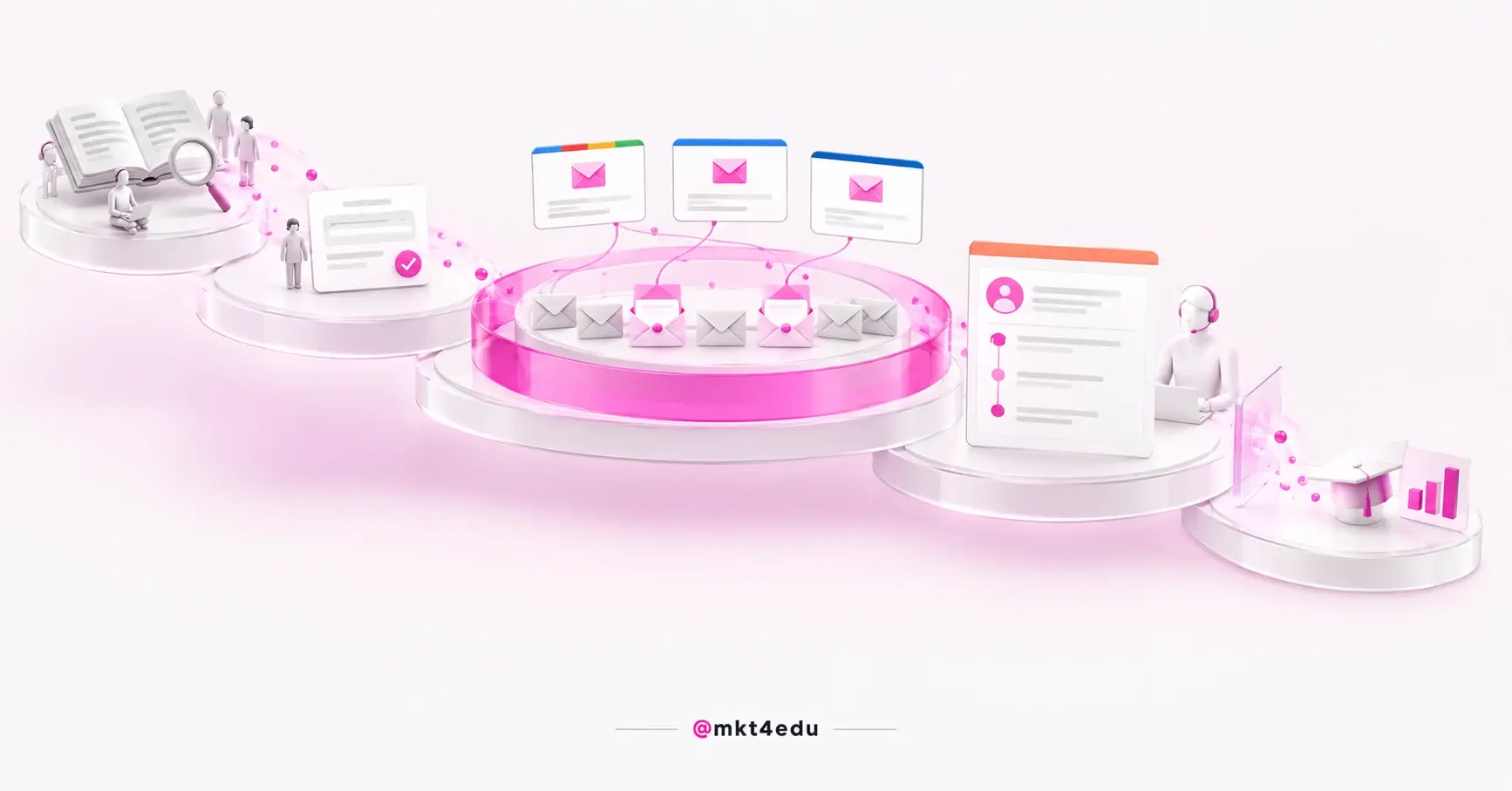
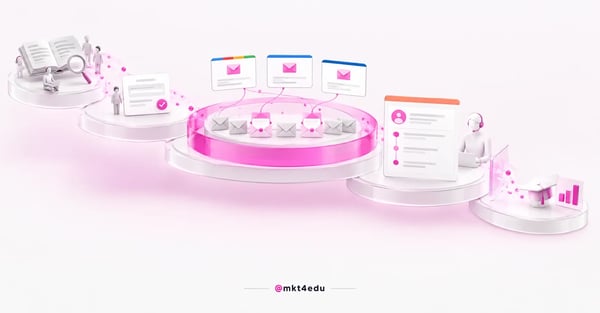 Caption: remarketing in inbound marketing inherits the audience from nurturing instead of building one of its own
The classic objection has a basis: inbound was built on permission, and advertising on paid interruption. What dissolves the opposition is where the audience comes from. An ad to a cold list is prospecting. An ad to someone who downloaded your material last week is the continuation of a conversation that person started.
One practical distinction is worth making: reinforcement is only reinforcement when the message matches. An email about scholarships and an ad about tuition are not a layer, they are two channels saying different things to the same person.
Thinking of remarketing as a layer organizes the operation into five levels that support each other instead of competing for budget:
|
Layer |
What it does |
Actual reach |
|
1. Organic content |
Blog, SEO and social attract the visitor |
People searching the topic |
|
2. Conversion |
A form or an asset turns a visit into a contact |
People who decide to leave their details |
|
3. Email nurturing |
The flow carries the contact through the funnel |
People who receive it, get it delivered and open it |
|
4. Remarketing |
An ad with the same message as that stage |
The whole segment, including people who never opened |
|
5. Sales and CRM |
The lead reaches the team with accumulated context |
People who moved a stage |
Table: the five layers of an inbound operation with remarketing, from attraction to handoff to sales
The detail that changes the operation is in layer 4: it has no audience of its own, it inherits the audience from layer 3. With that structure, the ad stops being one more channel in the media plan and becomes a function of nurturing.
Where does email nurturing lose a lead's reach?
Email nurturing loses reach at three distinct points, and only the first is technical: delivery, attention and measurement. None of them is solved by rewriting the subject line, because none of them happens in the content. They happen before reading or after it.
The first point is delivery, with explicit rules from the providers. Google's requirements for bulk senders cover anyone sending 5,000 or more messages a day to Gmail accounts: SPF, DKIM and DMARC authentication, one-click unsubscribe and a spam rate below 0.10%, with the guidance never to reach 0.30%. Crossing those limits does not produce a warning, it produces filtering.
The second point is attention. A delivered email competes with dozens of others in the inbox, and reading tends to concentrate on senders the person already recognizes.
The third point affects diagnosis: opens stopped being a good indicator of reading. Apple's Mail Privacy Protection downloads remote content in the background, whether or not the user opens the message, and routes that access through relays. In practice, part of the opens your report shows do not correspond to anyone reading.
It is at those three points that the ad covers the gap. It does not depend on the inbox, does not compete with rival senders for space and records impressions consistently.
None of this makes email dispensable. It is still the only channel in the inbound funnel that delivers long text, a link trackable per contact and the possibility of a reply. The division of labor is this: email carries the content, the ad carries the reminder that it exists.
Video: the paid versus organic reading that supports remarketing in inbound marketing as a layer, on the mkt4edu channel (in Portuguese)
How do you sync the email message and the remarketing ad?
Syncing means tying three things to the same stage: the segment, the creative and the window. Each nurturing flow becomes an ad audience with the same entry criterion, and each email in the flow gets a creative that repeats that email's promise, not a generic institutional offer.
The starting point is the segment, and it already exists if the operation runs lead nurturing in HubSpot with active lists. The same criterion that triggers the flow defines the audience.
HubSpot offers different types of ad audience, and the one that matters here is the contact audience, built from a CRM segment. It requires a connected ad account and, for website audiences, the tracking code installed.
Each network's minimum decides what is viable. A 400-contact segment usually runs on Meta, LinkedIn and Google Display, but does not reach the Search and YouTube minimum, which pushes smaller flows toward social channels.
That first-party base is also what gives the layer stability. On April 22, 2025, Google announced it would not roll out a new standalone prompt for third-party cookies in Chrome, keeping its current approach, and an audience built from the CRM stays less exposed to any browser change.
With the segment defined, the flow, the email and the ad set all use the same stage identifier, so nobody has to guess which creative matches which send. The creative does not repeat the email: it repeats its promise. If the third email explains financing, that stage's ad shows financing, in one sentence and one image.
That is the argument for uniting inbound marketing and CRM from the start. Without the CRM as the single source of the stage, email and ads drift apart within weeks.
Which message should you use at each inbound funnel stage?
The message changes according to the only data that matters at that moment: what the person has already done. A visitor who did not convert needs a reason to leave their details; a new lead needs context; an engaged lead needs proof; an opportunity needs a deadline. The ad follows that movement instead of repeating the entry offer.
Splitting by stage avoids the most common mistake in the paid layer, which is talking about enrollment to someone still choosing a field. A good lead scoring system handles that classification with no manual work.
Here is how the email message and the ad message correspond at each stage:
|
Stage |
Signal that defines the audience |
Email message |
Ad message |
|
Visitor |
Visited a content page and did not convert |
None: there is no contact yet |
The asset they almost downloaded, in one sentence |
|
New lead |
Converted in the last 7 days |
Asset delivery and first context |
Reminder of the asset and the next step |
|
Engaged lead |
Opened, clicked or returned to the site |
Comparison of programs, format and investment |
Proof: testimonial, facilities, employability |
|
Opportunity |
Application started or contact with the team |
A specific pending item: document, exam, payment |
Deadline and the short path to finish |
|
Lost or cold |
No interaction for more than 90 days |
Reactivation at a low cadence |
A new cycle, a new program or changed conditions |
Table: how nurturing and remarketing in inbound marketing line up at each funnel stage
The visitor row is the only one where the ad works alone, because there is no contact to nurture there. It is also the only one that depends on a website audience rather than lead segmentation in the CRM.
The other four follow the same pairing: the email delivers the full argument and the ad delivers the short version of it. Whoever reads both gets reinforcement; whoever reads only one gets the right message.
Video: the nurturing whose message remarketing in inbound marketing repeats in ad format, on the mkt4edu channel (in Portuguese)
When should you stop reaching a lead with remarketing?
There are four stopping criteria, and all of them need to be configured before the campaign goes live: conversion, frequency, window and the contact's request. Without them, the reinforcement layer turns into pursuit, and the effect on the institution's brand is usually worse than the conversion gain.
The first criterion is the most obvious and the most forgotten. Whoever converted has to leave that stage's audience, which requires a synced exclusion list, not a manual pause.
The second is frequency. Google Ads lets you limit how many times the same person sees an ad with frequency management in Display and Video campaigns, per day, per week or per month.
The third is the window, which should end when interest tends to dissolve. The program's decision cycle is the best reference: short during an ongoing admissions process, longer for graduate programs.
The fourth criterion is legal. When someone unsubscribes from email, the reasonable expectation is that the request also stops the ads. Remarketing built on first-party data is usually handled under legitimate interest, and Brazil's data protection authority has published a guidance document on that basis. That does not remove the need for transparency or the data subject's right to object.
How do you measure the combined effect of email and remarketing?
Measuring the layer in isolation misleads, because remarketing claims conversions nurturing was already producing. The honest way to evaluate it is to compare the segment's result with and without reinforcement, rather than reading the ad campaign's return as if it were independent of the flow.
The simplest test is a holdout. Separate a fraction of the segment that receives the flow and keep that group out of the ad audience, leaving everything else identical. After a full decision cycle, compare the two stage-advance rates: the difference is the best available estimate of what the paid layer added.
Without that design, the minimum is coherent attribution across channels. Marketing attribution models distribute credit across touchpoints instead of rewarding the last click, which is almost always the ad.
Three indicators say more than campaign return, read at segment level: stage advance, average time to advance and cost per advance. None of them is email opens or cost per click, which serve to diagnose a creative and do not answer whether the operation got better.
The underlying reading is this: the layer tends to deliver more when nurturing already works, and to mask problems when the flow is weak, because it buys attention the content did not earn.
Frequently asked questions about remarketing in inbound marketing
Where does remarketing fit in your inbound operation?
Remarketing comes in after nurturing is built, inheriting its audience and its message. Before that, it has nothing to reinforce, and the budget becomes presence without direction. After that, it is the cheapest way to recover the reach the inbox does not deliver.
The rollout path is short when the base exists. Pick a flow with volume, create the matching audience, produce one creative per email and configure exclusion, frequency and window before the campaign goes live.
Start with one flow, not all of them. One well-synced layer at a single stage teaches you more about your funnel than five generic campaigns at once.
What you say still matters more than where you say it. Educational marketing strategies apply to the email as much as to the ad, and a well-fed CRM is what keeps the two speaking the same language.
If your flow already runs and the lead cools off between sends, the mkt4edu team can review your email marketing cadence and design the reinforcement layer alongside it. The flow you pick to start with has to be standing before the ad, because nurturing is what delivers the segment, the message and the order the remarketing audience will inherit.












 Portugal