


Almost every piece on paid media ends at the first close. The funnel is designed up to the signature, and the audience that generated that revenue leaves the plan the next day. That is where retention remarketing becomes the cheapest part of the operation.
What almost nobody writes is the other side. An ad badly calibrated for people who already pay charges a price in trust, and there are churned customers for whom media budget is money thrown away.
Why is the customer base the cheapest remarketing audience?
The customer base is the cheapest audience because it does not have to be bought twice. Acquisition cost has been paid, the data is already in the CRM and the list is built with a sync, not with prospecting budget. What is left to invest goes into frequency and creative.
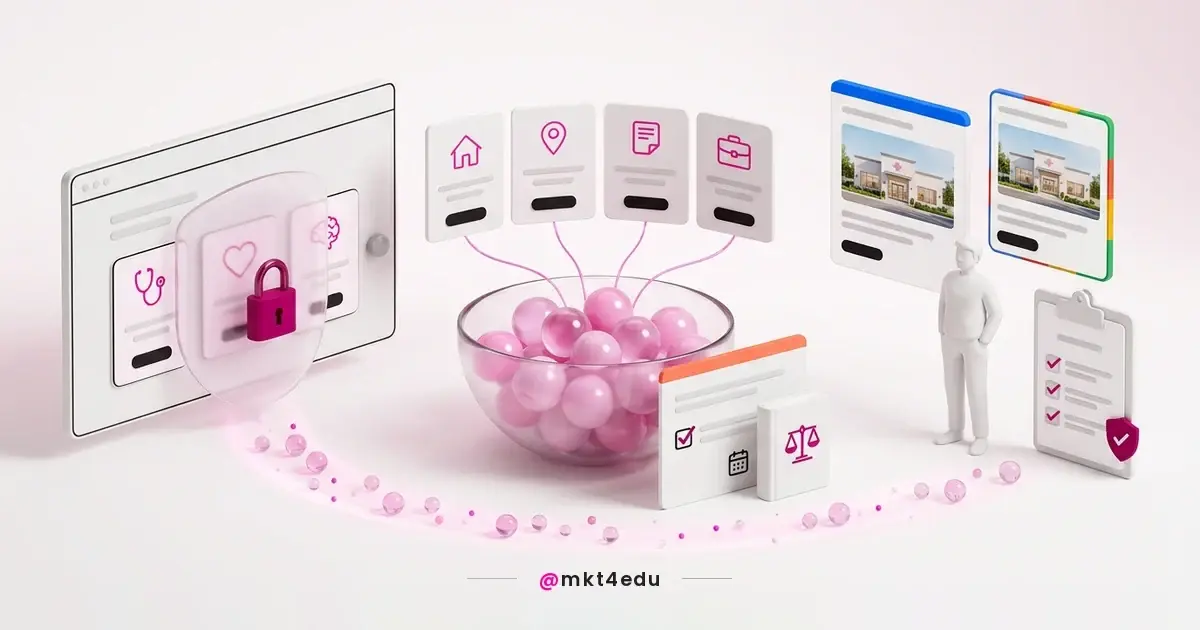
 Caption: retention remarketing is built from the synced CRM base, not from the site pixel
The order of magnitude is known. Harvard Business Review, in an October 2014 article, reports that acquiring a new customer is five to 25 times more expensive than retaining an existing one, without pinning that range to a single study, and credits Frederick Reichheld of Bain & Company with the finding that increasing retention rates by 5% increases profits by 25% to 95%.
Those are portfolio economics, not campaign performance. They justify allocating budget to the post-sale stage, never serve as a target for an ad, and the reference is over a decade old, so treat it as an order of magnitude.
The human layer is still the engine, and media is reinforcement. That is why results show up in operations already running CRM and customer success strategies for loyalty: ads do not build a relationship where there is no delivery.
What are the post-sale audiences in retention remarketing?
Four post-sale audiences hold up in any recurring revenue business: the customer in onboarding, the active and healthy customer, the customer at risk and the churned customer. Each one takes a different kind of message and needs a window of its own.
The customer in onboarding is the most fragile and the cheapest to help. They have paid and not yet seen a result, so the campaign here is about activation.
The active customer needs reminding of what they are not using yet, at low frequency. The customer at risk depends most on speed: a drop in usage, a reopened ticket and a late payment have to leave the CRM and reach the campaign within days.
One technical detail decides whether these audiences really exist: they cannot be born from the site pixel. A site audience has a retention window the platform limits and counts in days, while an annual contract renewed twice spans several cycles without the person returning to the site.
The post-sale audience comes from the synced CRM base, with the lifecycle stage as the criterion. Operations that connect a HubSpot CRM to their ad accounts keep the audience alive with no manual work, because a change of stage redraws the audience.
The table below gives the message that fits each audience, the suggested window and the exit signal. It is a starting reading, to calibrate against your own contract cycle:
|
Post-sale audience |
Message that fits |
Impact window |
Signal to exit the audience |
|
In onboarding |
Activation, first meaningful use, path to the first result |
From signature to the activation milestone |
Activation milestone completed in the CRM |
|
Active and healthy |
Unadopted feature, advanced use case, proof of results |
The whole cycle, at low frequency |
Entering the renewal window |
|
At risk |
Invitation to a results review, support, direct line to the team |
From the risk signal, for a short period |
Risk reversed or case owned by a person |
|
Churned |
A concrete change that addresses the stated reason for leaving |
Only after an interval of silence |
No reaction after a full cycle |
Table: the four post-sale audiences in retention remarketing, with message, window and exit criterion to calibrate against the contract cycle
The column most people forget is the last one. An audience with no exit rule accumulates people who already renewed, already activated or already complained, and the same creative that helped starts getting in the way.
When should you start reaching the customer in the renewal window?
The renewal window starts before the customer's decision, not before the expiry date. Those are different dates, and the second is the one finance sees. On annual contracts, the market usually works 60 to 90 days ahead, when procurement and budgets come in.
No ad platform and no official body publishes a recommended window. That interval is market convention, and it should be adjusted by the history of when renewals are actually decided in your own portfolio.
On monthly subscriptions, the logic changes: the decision is taken every month, silently, so there is no window, there is usage. On corporate contracts with few accounts, the window is individual, and it is worth treating each account as its own audience.
There is an operational requirement that usually slips by. In Google Ads, Customer Match memberships expire after 540 days, and keeping a list eligible requires at least 100 members added or updated within that window. The feature is available on Search, Shopping, YouTube, Gmail and Display.
A file uploaded once and forgotten loses validity, so syncing is a condition of working at all. It is what gives revenue predictability, as in operations that use CRM to build customer loyalty: the decision date has to be recorded before it becomes a target.
How do you run repurchase and upsell remarketing without sounding like collections?
Repurchase and upsell work when the ad shows what the customer does not yet have, not when it reminds them of what they already pay for. Repurchase is the same offer again, typical of one-off services, courses and consumable items. Upsell is the next step up.
The difference between an offer and a collections notice is who gains something from the message: a new module delivers information, an outstanding balance delivers embarrassment. Hence the firm rule that collections is not media.
Payment reminders and debt negotiation belong in a private, identified channel, not in a feed other people can see. Segmenting by late payment is legitimate inside the CRM, but the creative cannot reveal that criterion.
In a catalogue business, repurchase has a more objective trigger: the product's consumption cycle. Whoever organises that history in a CRM for e-commerce gets ahead of the message without relying on discounts.
And one unpopular note: a lower price for the active base trains customers to wait for promotions and erodes margin on revenue that was already profitable.
When do remarketing ads irritate existing customers?
Ads irritate existing customers whenever they contradict the experience that person is having. There are five situations, all of them configuration: an acquisition offer, an automated campaign with no exclusion, an upsell on top of an open problem, excessive frequency and an ad for something the customer already subscribes to.
The first is the most destructive. A customer paying full price who sees a new-subscriber discount does not read a promotion, they read proof that they paid more than they needed to.
The second is silent and expensive. Broad, automated reach campaigns tend to include the current base by default, which is why running formats like Performance Max requires defining exclusions before launch.
The last three are a matter of order and hygiene. An upsell on an account with an open ticket reads as inattention, the same creative for weeks tires people out, and an ad for a product already contracted signals the company does not know who the customer is.
The tool to avoid that is audience exclusion. Google Ads lets you exclude specific segments from a campaign or ad group on Search, Display, Demand Gen, Standard Shopping, Video and Performance Max, and on App campaigns at campaign level only.
That protection has a documented limit, though. The same page warns that audience exclusions may not apply to users who have opted out of ads personalisation, so acquisition creative has to survive being seen by a current customer.
Video: the monitoring routine that keeps retention remarketing from wearing out the base, on the mkt4edu channel (in Portuguese)
Is winning back churned customers worth the remarketing budget?
It depends on the reason for churn, and in most cases the honest answer is that it does not work as a campaign of its own. Win-back pays off when the customer left over price, budget or a change of decision-maker. It pays off negatively when they left over a product or service failure.
The difference is credibility. For someone who left because of circumstance, the ad is a reapproach. For someone who left upset, it reopens the wound and becomes recorded irritation.
There is also a size problem: the churned base is small, and platforms impose minimums many churn lists do not reach.
The numbers look conflicting, but they are not. Google documents 100 active visitors or users within the last 30 days for Search, Display and YouTube, and records on the same page that any list uploaded before 1 February 2024 still has to meet the previous requirement of 1,000 matched users.
That is why HubSpot still records 1,000 users for Search and YouTube, and 100 for Display and Gmail: it is the old threshold living alongside the new one. The same page indicates a minimum of 20 users on Meta and 300 members on LinkedIn.
Low numbers help short lists, but with a few dozen churned accounts the campaign neither learns nor optimises. With an old or rarely refreshed list, plan for the larger figure.
That is why win-back pays off better outside media. Identified email and a sales call reach the same list at lower cost and with a message specific to the reason for leaving.
One scenario still fits media well: when there is a concrete change that resolves the stated reason for leaving, because the ad has news to deliver. Outside it, preventing a cancellation costs less than undoing one already announced.
How do you measure retention influenced by paid media?
Retention influenced by Paid Media is measured by comparing groups, not by click attribution. A renewal is not an event that happens inside the ad, so last click credits whoever passed nearby. The right instrument is a control group left out of the campaign.
The minimum design is simple: set aside part of the eligible base, keep that slice unexposed and compare the renewal rate of both groups at the end of the cycle.
The metrics that support the reading are revenue metrics: renewal rate, net revenue retention, expansion revenue and churn in the at-risk segment. Media cost per renewal retained in each group closes the calculation.
Here comes the statistical honesty almost no report carries. With 40 corporate accounts, a control group test has no statistical power, and the result should be read as directional evidence.
None of this works without indicators agreed before the campaign, and whoever already tracks RevOps KPIs starts ahead. One precaution closes the governance: the ad platform should not receive conversion credit for a renewal.
Which renewal checklist should you use before launching?
The renewal checklist exists to stop a campaign going live with a mistake only the customer will notice. There are eight checks, across the ad account, the CRM, legal and the measurement plan, and three of them should block launch until resolved.
It is worth running the check every new cycle, not only the first time:
|
Item |
Control question |
Blocks launch? |
|
Excluding the active base |
Do acquisition campaigns exclude current customers in every format? |
Yes |
|
Audience source |
Does the list come from the synced CRM rather than the site pixel? |
Yes |
|
Recorded legal basis |
Is there a documented legal basis for using this data in media? |
Yes |
|
List refresh |
Is the sync automatic and within the platform's eligibility window? |
No |
|
Risk reason filled in |
Is the risk field in the CRM kept current by the relationship team? |
No |
|
Safe creative |
Can the ad be seen by a current customer without generating a complaint? |
No |
|
Exit rule |
Does the customer leave the audience on renewal, activation or an open incident? |
No |
|
Control group |
Was a slice of the base kept out of the campaign for comparison? |
No |
Table: the retention remarketing renewal checklist, with the checks that precede the campaign and the ones that block go live
The three items that block launch have something in common: they fail the customer or the law, not performance. The other five cost efficiency and can be fixed with the campaign running.
The legal basis item deserves attention in any sector. Using the customer base in paid media involves processing personal data, and it is worth aligning the justification with whoever owns data privacy in the CRM before syncing.
Frequently asked questions about retention remarketing
When does advertising to existing customers pay off?
Advertising to existing customers pays off when media reinforces a relationship operation that already works. Where delivery is consistent, retention remarketing is the most profitable budget line in the plan, because it works on a list already paid for and a dated decision.
Where it is not, the campaign only lights up the problem faster. No creative compensates for a product that does not deliver, and insisting only increases contact with people about to leave.
The sequence that usually works is modest. First, exclude the active base from acquisition campaigns, which protects revenue at no extra cost. Then the renewal window audience, with a control group from the first cycle. Only then onboarding and expansion.
To build those audiences from your CRM, define the windows of your own cycle and leave with a measurement plan that separates the effect of media from the work of the team, talk to the mkt4edu team.













 Portugal