


There is a question that comes up in almost every diagnostic meeting: “it worked over there, why doesn't it work here?”. The answer is almost never in the creative, the channel or the budget. It is in the funnel.
What makes remarketing by industry deliver different results is the structure of the decision it is trying to influence. One person decides on an $18 purchase in fifteen minutes. A family decides on a four-year degree in eight weeks. A buying committee decides on a corporate contract in five months.
The technical mechanism is identical in all three cases: someone interacted, entered an audience and sees the brand again. What changes is the window, the frequency, the message and the legal limit.
Ignoring that difference produces the worst of both worlds: budget spent too early on people who are not deciding yet, and silence at exactly the moment the decision happens.
Why doesn't one remarketing playbook fit every industry?
Because a playbook is not made of settings, it is made of assumptions about the decision. When the industry changes, so do the speed of the choice, who chooses, what blocks the choice and what the law allows you to ask. The settings are the consequence of those assumptions, not the other way round.
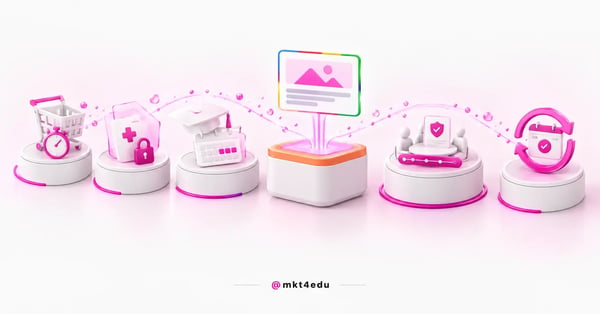 Caption: in remarketing by industry, the same mechanism changes window, restriction and trigger in every market
The most common mistake is importing the window. An e-commerce operation works with audiences measured in hours, because an abandoned cart cools fast. Applying that same short window to an enrolment decision means switching the campaign off weeks before the family actually decides.
The opposite mistake happens too, and costs more. A long window inherited from B2B, applied in retail, spends impressions on people who already bought elsewhere. The audience stays active, the cost keeps running and the return is long gone.
And there is the most serious mistake, because it never shows up in a performance report: importing the targeting logic of an industry with no legal restriction into one that has them.
What are the four axes that change remarketing from industry to industry?
There are four: decision cycle, ideal window, legal restriction and conversion trigger. Together they explain nearly all the performance difference between markets. Defined in that order, they produce a coherent campaign; defined out of order, they produce a campaign that looks right and converts poorly.
The decision cycle is the average time between first contact and the signature, enrolment or purchase. It is not a market estimate, it is a figure that already exists in your CRM. It is the axis to measure first, because the other three depend on it.
The ideal window is the period during which the audience stays eligible to receive ads. The practical rule is simple: the window follows the cycle, not the tool's default. An audience that expires before the decision wastes the cheapest stage of the funnel; one that expires long after burns budget on people who already decided.
The legal restriction defines what can enter the targeting. In some industries it is nearly invisible. In others it is the project's first decision, not its last, because it applies to how the audience is built, not only to the ad copy.
The conversion trigger is the argument that actually unlocks the decision in that market: deadline, trust, price, risk or continuity. It determines the creative, the offer and the order of ads in the sequence.
Order matters. Measure the cycle, set the window from it, filter by the restriction and only then choose the trigger. Inverted, that sequence produces the most frequent symptom of bad remarketing: good creative, wrong audience.
Video: the funnel reading that defines the decision cycle, the first axis of remarketing by industry, on the mkt4edu channel (in Portuguese)
How does remarketing work in education, between intake and the enrolment deadline?
In education, the decision is fast at the end and slow at the beginning. Interest can appear months earlier, but conversion concentrates in the final days before applications close. The window, therefore, is not counted from the visit: it is counted from the calendar.
The practical consequence is a wide window with uneven intensity. The audience stays active throughout the intake period, at low frequency during consideration and with reinforcement concentrated in the final days. Budget follows the curve of the decision, not the curve of the visit.
The second element is the stage structure. Between visiting the site and signing the contract there are named steps: application, exam or assessment, approval, paperwork and payment. Each drop-off happens at an identifiable point, and each point calls for its own message.
That is why the education marketing strategies that sustain recruitment treat the unconverted applicant as a distinct audience from the visitor. They are people with declared intent, an acquisition cost already paid and a concrete pending item to resolve.
There is an added sensitivity in the sector: a good share of the audience involves minors or guardians deciding for them. Among the education marketing strategies that hold up over time, those that avoid promises of academic results tend to preserve reputation and reduce friction at enrolment.
Video: the recruitment strategies that shape remarketing by industry in the education market, on the mkt4edu channel (in Portuguese)
What does the privacy law allow in healthcare remarketing?
In healthcare, the legal restriction comes before any media decision. Article 11 of Lei 13.709/2018 only authorises processing of sensitive personal data when the data subject consents specifically and prominently, for specific purposes, among other legal grounds. And health data is, by the law itself, sensitive data.
That requirement changes the nature of the audience. Targeting people who visited a specialty page, searched a symptom or abandoned a booking can reveal the health condition of an identifiable person. The problem is not in the ad, it is in the existence of that audience.
Article 11, § 1 reinforces the point: the article applies to any processing that reveals sensitive personal data and may cause harm to the data subject. You do not have to store a diagnosis to fall under it.
What remains is more than it seems. Generic browsing audiences, institutional content, information about facilities, clinical staff, accepted insurance and location are still legitimate ground, because none of it infers an individual condition.
The legal basis also has to be chosen carefully. Brazil's ANPD published guidance on legitimate interest, with one limit worth recording: legitimate interest sits in article 7, which covers ordinary data, and does not appear among the article 11 grounds. For sensitive data, the route is specific consent.
Operationally, that restriction pushes the sector towards a more conservative architecture, with clear governance over which fields can feed a media audience. Privacy compliance practices applied to the CRM help separate, at the data level, what can be exported to an ad platform from what should never leave the clinical record.
The conversion trigger here is different too. It is neither price nor deadline: it is trust. Credentials, specialty, years in operation and geographic proximity convert better than a discount.
How do you run retail and e-commerce remarketing with a short cycle?
In retail, the cycle is measured in hours. Purchase intent is born and dies quickly, which makes the window short and activation speed more important than targeting sophistication. An audience that is only ready the next day has already lost most of its value.
Abandonment behaviour is the central asset. An abandoned cart, a product viewed without being added to the cart and a checkout started without payment are three audiences at different temperatures, and each calls for a different offer.
The decision is dominated by price and availability. Shipping, coupons, stock and delivery time resolve more objections than any brand argument at this stage. That has a cost: a discount used as the default trigger erodes margin and teaches the customer to wait for promotions.
Data integration underpins all of it. When the ad platform talks to the order base, you can exclude people who already bought and prioritise those with a repurchase history. CRM structures applied to e-commerce make that exclusion automatic, saving budget with no creative effort.
How does B2B remarketing handle a long cycle and a buying committee?
In B2B (business to business, selling from one company to another), the purchase is collective and slow. A corporate contract usually passes through several roles before it is signed: who uses it, who assesses it technically, who approves the budget and who carries the risk. The window has to cover that whole time, and the message has to vary by role.
Collective buying inverts a logic that works well in retail. Here the number of people is low and the value per account is high, so the campaign organises by company, not by individual. A visit from three people at the same company is a stronger signal than thirty scattered visits.
Low volume creates a concrete operational problem: list minimums. The Google Ads page on minimum audience size records 100 active visitors or users within the last 30 days for Search, Display and YouTube, and adds that a list uploaded before 1 February 2024 remains on the previous requirement of 1,000 matched users.
Two other numbers live alongside that one and matter for planning. The Google page on personalising ads on Search still cites 1,000 cookies, and HubSpot's page on ad audiences documents 1,000 for Search and YouTube, with 100 for Display and Gmail. On a B2B account, plan for the larger number, so the campaign does not stall on launch day.
The conversion trigger is reducing perceived risk. Implementation cases, evidence of results, a free assessment and technical material work better than a direct commercial offer, because the obstacle is not price, it is justifying the choice internally.
That is the logic that brings the sector close to strategic accounts. Operations using HubSpot and ABM together can treat each account as its own audience, with a message sequence by role and engagement read at company level.
How do you turn recurring revenue into a remarketing audience?
In recurring revenue, the most valuable audience is the one already paying. Subscriptions, tuition, health plans and service contracts have a known renewal date, and that date replaces the visit as the starting point of the window. The goal stops being conversion and becomes continuity.
The ideal window counts down. It starts a few weeks before renewal, grows as the date approaches and ends at payment confirmation, so you are not still talking about renewal to someone who already renewed.
The trigger is not acquisition, it is value delivered. Reminding people what they have used, what they achieved and what they lose by stopping converts better than a retention discount, which often only moves the cancellation to the next cycle.
There is a risk specific to this sector: saturating your own base. Because the audience is finite and already converted, high frequency annoys people who were satisfied. The practical rule is to reduce volume and increase precision, using usage and risk signals instead of treating the whole base as one block.
The starting point is the CRM, not the ad platform. CRM strategies aimed at customer success already identify drops in usage, tickets at risk and customers near renewal, and that is the slice that should feed the audience, not the full list of active customers.
How do you choose window and channel by industry?
The choice comes from crossing the four axes. With the cycle defined, the window follows; with the restriction defined, the channel is limited to what accepts that kind of audience; with the trigger defined, the creative and the sequence almost resolve themselves. Here is how the five markets organise on those axes:
|
Industry |
Decision cycle |
Ideal window |
Main restriction |
Conversion trigger |
|
Education |
Weeks to months, tied to the intake calendar |
Wide, from interest to the end of the enrolment deadline, reinforced in the final days |
Audiences including minors: limits on promising academic results |
Deadline: application close, exam date, scholarship and early-payment discount |
|
Healthcare |
Variable, short in urgent care and long for elective procedures |
Short, restricted to generic browsing, inferring no condition |
Article 11: health data is sensitive and requires specific, prominent consent |
Trust: clinical staff, specialty, insurance accepted and proximity |
|
Retail and e-commerce |
Hours to a few days, with intent that cools fast |
Very short, with return dropping quickly after the first days |
Frequency fatigue: margin squeezed when discounts become the default |
Price and availability: coupon, shipping, stock and delivery time |
|
B2B and services |
Months, with a buying committee and several roles |
Long, aligned to the sales cycle, sequenced by decision-maker role |
Low account volume: list minimums required by the platforms |
Risk reduction: implementation cases, evidence of results and assessments |
|
Recurring revenue |
Continuous, with a known renewal date |
Counting down, anchored on renewal, ending at payment confirmation |
A finite own base: risk of saturating people who already pay |
Continuity: value already delivered, usage recorded and the cost of stopping |
|
General rule |
Measure in the CRM, do not estimate |
The window follows the cycle, never the tool's default |
Start with the restriction, before the creative |
One trigger per audience, never all at once |
Table: a comparison of the four axes that define remarketing by industry in each market
Two readings stand out in that crossing. The first is that the window is always derived, never chosen by preference: the cycle decides it. The second is that the trigger changes more than the technical structure, which explains why campaigns built well in the platform still miss on the message.
Channel choice follows the same logic. An industry with visual decisions and a short cycle calls for fast reach on social and display; decisions made through active search call for Search; a buying committee calls for a professional channel with company and job-title targeting. The legal restriction can eliminate options before any test.
One warning about the infrastructure behind all this. On 22 April 2025, Google decided to keep its current approach to third-party cookie choice in Chrome and not roll out a new standalone prompt, leaving the decision in the browser's privacy settings.
On 17 October 2025, Google retired most Privacy Sandbox technologies, including Topics and Protected Audience, citing low levels of adoption. The useful reading applies to every industry: there is no cookie replacement inside the browser, which raises the weight of first-party data in building audiences.
Comparison without measurement becomes opinion. Defining by industry which metrics to track in education marketing, and in the other verticals, is what tells you whether the chosen window is right, and lets you adjust before the end of the cycle rather than after.
Frequently asked questions about remarketing by industry
How do you adapt remarketing by industry without copying a playbook?
The short path is to drop the question “what works in this industry?” and replace it with four more useful ones: how long the decision takes, how long the audience should stay active, what the law allows in the targeting and what actually unlocks the yes.
What does not change between industries is the base: organised first-party data, an audience built from a real signal and measurement inside the cycle, not only at the end of it.
If your operation spans more than one of these markets, or is moving from one to another, structuring paid media by decision axis avoids exactly the most expensive mistake in remarketing: repeating a window that worked in another funnel. To review the four axes applied to your case, talk to the mkt4edu team.














 Portugal