




For five months, advertising on ChatGPT meant just one thing: a card with a title, short description, image, and link, displayed below the response.
That has just changed. The product carousel in ChatGPT Ads displays multiple items in the same spot, transforming that space into something more like a storefront than a banner.
The change is small on screen but significant in practice. Those who set up ads manually lose ground to those who already have a structured catalog.
And there’s one detail that reshapes media planning: the decision to display one product or several is no longer up to the advertiser.
What is the product carousel in ChatGPT Ads?
The product carousel in ChatGPT Ads is an ad format that displays multiple items from the same retailer within a single sponsored unit at the bottom of the conversation.
It occupies exactly the same position as the single-product ad and works on the same showcase model that users are already familiar with from Google Shopping.
The comparison to Google isn’t just a rhetorical flourish. The mechanism is the same: instead of asking the advertiser for individual items, the platform pulls the information directly from the product feed and decides what to display.
Previously limited to a single product per advertiser, the advertising format on ChatGPT has seen this dynamic change with the arrival of the carousel.
According to Digiday, which verified the format using screenshots, the carousel currently displays items from only one retailer at a time.
The limitation appears to be technical, but the design is already capable of handling more. The article itself points out that the system is built to display products grouped by relevance and, eventually, competing retailers in the same carousel.
It’s worth understanding what this means in the competitive landscape. If two retailers ever share the same ad slot, price ceases to be a minor detail and becomes an immediate visual selling point.
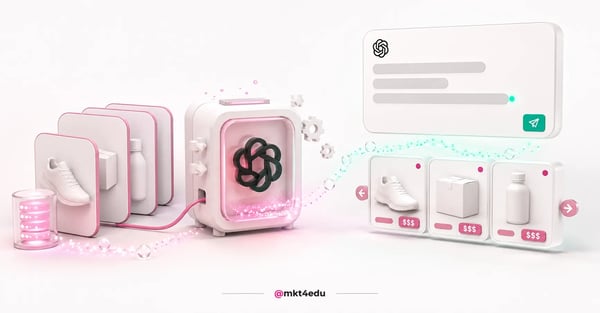 Caption: Automated processing: the product catalog feed powers the OpenAI system to generate the carousel showcase in ChatGPT Ads.
When did the ChatGPT ad carousel go live?
The format was first reported on August 6, 2026, when Digiday confirmed the carousel’s existence based on verified screenshots.
OpenAI did not respond to the publication’s request for comment, which means the launch falls under the category of an observed product change rather than an official announcement by the company.
This distinction matters to those who plan. It’s one thing for the platform to announce a new format with documentation and timelines. It’s another for the format to appear on users’ screens before any official announcement.
The carousel doesn’t appear out of nowhere. It is the third step in a sequence that began months earlier.
In May 2026, OpenAI launched what it called “product feed campaigns,” allowing retailers to generate ads in bulk from their catalog rather than creating them one by one, as Digiday reported at the time.
The display format had also been redesigned to stack ads side by side, which paved the way for multiple ads. The carousel is what happens when these two elements come together in the same position on the screen.
Prior to that, OpenAI had already linked its advertising to cost-per-click and built conversion tracking, with cost-per-action models under development. The entire sequence points toward performance-based advertising budgets, not brand-building budgets.
For timing context, advertising on ChatGPT began testing in the United States on February 9, 2026, with adult users logged into the entry-level plans. In other words, the channel evolved from a static ad to an automated showcase in about six months.
How does ChatGPT build the carousel from the product feed?
The advertiser connects their catalog, sets filters to determine which products are eligible, and the platform generates the ads on its own, using names, images, and attributes that are already in the feed.
There’s no need to create ads on a product-by-product basis, and that’s exactly what makes this channel viable for those with thousands of items.
The required file is nothing new for those who already run performance-based advertising. Retailers can reuse the same structured file they already send to Google, which significantly lowers the barrier to entry and reduces implementation time.
The stated capacity is high. According to executives interviewed by Digiday, the platform supports up to one million SKUs per advertiser.
However, there is an onboarding filter. OpenAI has been asking new e-commerce partners to provide a sample of 100 products before allowing them to submit their full catalog, which serves as a quality control measure prior to scaling up.
The connection can also be made through intermediaries. Criteo was the platform’s first adtech partner, and providers such as StackAdapt have already announced that they forward the advertiser’s feed directly to OpenAI.
Debra Aho Williamson, founder and chief analyst at Sonata Insights, summarized the trend in a statement to Digiday:
"Adding automation to generate ads from a product catalog is basically the bare minimum expected in the age of AI. What OpenAI is doing is similar to what Google, Meta, and Amazon already offer retailers. The difference is that ChatGPT serves ads based on conversational intent, rather than on signals from search behavior, social engagement, or marketplace browsing."
That final sentence is what changes the work of planners. The trigger for the ad isn’t a typed search term—it’s a problem described in natural language.
Here’s how the two formats differ in practice:
|
Element |
Single-product ad |
Product carousel |
|
Items per unit |
One product |
Multiple, from the same retailer |
|
Item source |
Title, description, image, and link provided by the advertiser |
Name, image, and attributes pulled from the feed |
|
Scalable |
Limited to what the team can set up |
Up to one million SKUs per advertiser |
|
Prerequisite |
Approved creative |
Connected catalog and eligibility filters |
Table: Operational differences between single ads and product carousels in ChatGPT Ads, based on Digiday’s coverage of the two formats.
The table is straightforward: the carousel doesn’t require more creativity; it requires better data organization.
What does the carousel take out of the advertiser’s control?
The decision to display a single ad or a carousel lies with the OpenAI platform, not with the media buyer. The advertiser does not select the format, just as they no longer choose which conversations their ad appears in.
This changes the nature of the leverage available. If the format isn’t a choice, the only thing left to influence the outcome is the quality of what goes into the system—not the ingenuity of the person creating the ad.
Three variables now become the focus of the work: which products you make eligible, how the titles and attributes are written, and how accurate the price and availability are at the time of the search.
There’s a useful parallel here. Automated campaigns on other platforms have followed exactly this path, transferring control over targeting and ad format to the algorithm and giving advertisers back control over inputs, budget, and exclusion rules.
Who manages paid traffic has seen this before. The difference is that, with ChatGPT, the dominant input is no longer the creative—it’s now the feed.
It’s worth noting the limitations of this interpretation. OpenAI has not published documentation detailing the carousel’s selection criteria, so what we have today is market observation, not a stated rule.
The data returned is also limited by design. OpenAI states that advertisers do not have access to conversations, history, memories, or personal data, receiving only aggregated information on views and clicks.
Why is the ChatGPT Ads carousel launching before Q4?
The timeline explains much of the urgency. The fourth quarter accounts for the largest volume of advertising spend of the year, and launching the format now gives advertisers time to test it, learn from it, and include the channel in their year-end planning—when brands decide where to allocate their peak budget.
There is a well-known revenue pressure behind this. OpenAI is working toward a stated goal of $2.5 billion in advertising revenue by 2026, with internal projections pointing to more than $100 billion by 2030, according to Digiday’s findings.
Ashley Fletcher, CMO of Adthena, described the situation as follows in a statement to the publication:
"The fourth quarter will be a decisive period for them. The rest of the third quarter looks like it will be all about scale—more advertisers, more ads. But I think there will be even more pressure in the fourth quarter, because advertisers will be planning their budgets for 2027 and asking themselves how much they need to invest in this platform."
The comment about 2027 is the practical part of the statement. Annual budget decisions are typically made at the end of the year, based on what has been tested in previous months, rather than on what was presented in a vendor’s pitch.
Those who fail to generate insights this quarter will arrive at the planning table without their own data on the channel. And without their own data, the budget discussion ceases to be an analysis and becomes a battle of opinions.
An executive at the U.S. agency interviewed by Digiday reported that OpenAI has been providing more guidance to advertisers on feed-based campaigns—a sign that the company wants a large volume of connected catalogs before the season begins.
Is the ChatGPT Ads product carousel already worth it in Brazil?
There is no confirmation that the carousel is currently running for Brazilian users. What is available in the country is the standard sponsored unit, which appears below the organic response, as part of a pilot program that began on August 4, 2026, with ad buys through partner agencies.
The channel’s track record suggests that new formats typically emerge in the U.S. market and then migrate to other markets as each region gains experience. This is not a rule published by OpenAI, but rather a pattern observed in previous stages of expansion.
This does not make the subject irrelevant for those operating in Brazil. Structuring a catalog, reviewing titles, and synchronizing inventory takes weeks of work, and none of this depends on the date the format is released here.
Anyone who wants to understand the mechanics of the Brazilian launch—including who sees the ads, how the separation between responses and advertising works, and what the purchase pathways are today—can find detailed information in the overview of ChatGPT Ads in Brazil.
Caution is advised on both sides. Materials that promise a list of ad formats or cost benchmarks for the carousel in Brazil are based on assumptions, because even the Brazilian self-service platform hasn’t been confirmed as available yet.
How to Prepare the Product Feed for ChatGPT Ads?
The preparation involves data, not budget. Since the carousel is built from the catalog, the key task right now is to ensure the feed is ready to be turned into an ad without manual intervention, which also improves the product’s organic presence within the conversation.
There are five key areas where this effort pays off:
- Write titles that answer questions, not just list features. The input is a question phrased in natural language, so the product name needs to convey the category, attributes, and use—not just an internal code.
- Keep prices and availability in sync. A carousel displaying an unavailable item drives away clicks and erodes trust on the same screen.
- Define eligibility rules before connecting. Decide which product lines to include, with what margin, and within what price range, so as not to display the entire catalog indiscriminately.
- Standardize images. In a showcase format, comparison is visual and immediate, and a poorly photographed product loses out to its neighbor before any sales pitch even begins.
- Handle attribution on your end. Since the advertiser receives only aggregated performance data, tracking must be set up on the destination site, within the parameters, and in the CRM.
Nothing on this list depends on early access to the platform. All of these points can be implemented right now, within your own SEM that already exists.
There’s a side benefit that’s rarely mentioned. A well-structured catalog also feeds ChatGPT’s organic responses regarding prices and availability, which aligns directly with SEO for LLM.
What does the carousel indicate about AI advertising?
The carousel indicates that AI assistants are rapidly converging on the advertising formats that already dominate the web, rather than inventing their own formats.
In just a few months, ChatGPT has evolved from a simple text-based tool to a product showcase featuring auction-style logic and a feed.
This trend is not an isolated one. On that same day, August 6, 2026, Digiday reported that Kroger’s AI shopping assistant launched with product ads right from the start, with no ad-free trial period.
The previous pattern was different. Walmart took about a year to introduce advertising features in its Sparky assistant, and OpenAI waited years before testing ads on ChatGPT, suggesting that the “ad-free assistant” window is shrinking.
For media planners, the implication is one of scope. The channel matrix no longer has a single experimental category labeled “AI” but now includes multiple conversational platforms with active inventory, each with its own intent signals and measurement rules.
There is a link to organic content that remains valid across all of them. The ad buys the position below the response, and the response itself continues to be earned by content that the AI deems trustworthy enough to cite.
That is why Answer Engine Optimization (AEO) and Generative Engine Optimization (GEO) are not replaced by the carousel. They compete for a different space, above the line that separates answers from advertising.
The shift in traffic that had already been observed in search reinforces this point. The change in behavior that is affecting organic traffic is the same one that creates the ad inventory on these screens.
What else do you need to know about the ChatGPT Ads carousel?
Is it worth preparing your operation for the ChatGPT Ads carousel?
Prepare the feed—yes. Set aside a significant budget for a format that hasn’t even been officially announced and hasn’t been seen in Brazil yet—no. These are two decisions of a different nature, and treating them as one is what usually leads to frustration with new channels.
The balance tips in favor of preparation. Organizing your product catalog, titles, images, and inventory synchronization improves results on Google Shopping, marketplaces, and ChatGPT’s own organic search results—regardless of whether the carousel arrives in Brazil in September or January.
What seems largely irreversible is the direction. AI assistants are becoming shopping platforms, and shopping platforms operate using product feeds.
Those who reach Q4 with a connected catalog and defined eligibility rules will have data to bring to the 2027 budget discussion. Those who arrive with their catalog in a spreadsheet will have an opinion.
If you’re still figuring out how the channel works in Brazil—who sees the ads, how purchasing happens today, and what OpenAI has already confirmed here—start with the the complete overview of ChatGPT Ads in Brazil. That’s where you’ll find the foundation for deciding the scope of your test.


.jpg)























 Portugal