





Almost every remarketing discussion starts on the wrong foot. The question in the meeting is “Google or Meta?”, when the decision that moves the result comes earlier: how to slice the base of people who already interacted. Platform is execution. Remarketing audiences are the strategy, and that is where the budget is won or lost.
The symptom of badly designed paid traffic remarketing is well known. The campaign delivers cheap impressions, the report shows volume, and the enrollment never shows up.
In most accounts, the cause is the same: an audience called “all visitors in the last 30 days” receiving the same ad, at the same frequency, with the same creative. Inside it live someone who read a post by accident and someone who abandoned the application payment.
Why does a badly designed remarketing audience waste budget?
A badly designed audience wastes budget because it pays the same price for people of very different value. When someone who viewed a page and someone who abandoned payment land in the same list, the average bid rises to serve the larger group, and the group that was one step from deciding gets the most generic message.
The effect shows up in three places in the report. Cost per lead rises with no auction explanation. Average frequency grows on the wrong audience. And conversion volume concentrates among people who probably would have converted anyway.
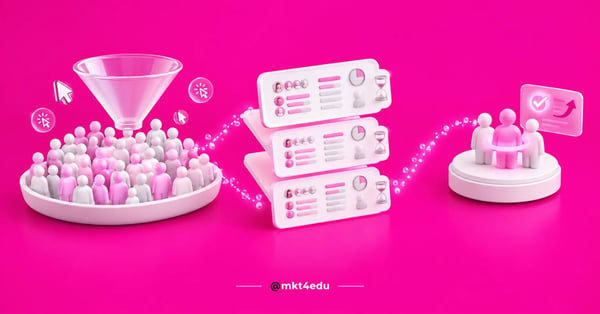 Caption: designing paid traffic remarketing audiences by depth of interaction and recency is what separates cheap impressions from enrollments
There is also a silent cost: reputation. An ad repeated to someone who showed no intent at all burns audience attention and drags down the click-through rate of the whole account.
Remarketing is not a channel, it is a layer. It operates on an audience already won by other efforts, and depends on the quality of the slice far more than on the size of the budget. Good paid traffic strategies treat prospecting and remarketing as separate functions, with separate goals.
There is also the price question. A small, qualified audience usually has a higher CPM, and that alarms anyone looking only at the average. What matters is the cost per enrollment within the layer. It is worth checking how to protect ROI when sizing paid traffic investment before concluding that the layer lost efficiency.
How do you build the audience segmentation matrix by interaction and recency?
The matrix crosses two axes. Vertically, the depth of the interaction, from someone who only opened a page to someone who abandoned payment. Horizontally, recency, which defines how long that interaction still counts as a signal of intent. Each intersection becomes an audience with its own rule.
The logic is easy to justify: a deeper interaction deserves a shorter window and a higher frequency, because the signal is strong and loses value fast. A shallow interaction deserves a longer window and low frequency, because the signal is weak and needs time to mature.
The matrix inverts the instinct to invest heavily at the top just because the audience is bigger. Here is how the layers are organized:
|
Interaction layer |
Recency window |
Weekly frequency cap |
Message angle |
Leaves the audience when |
|
Visited the site without reaching an offer page |
7 to 14 days |
2 impressions |
Awareness and social proof |
Moves into any layer below |
|
Visited a program, product or service page |
14 to 30 days |
3 impressions |
Differentiator of the offer viewed |
Fills in a form or converts |
|
Consumed content (rich material, video, 3+ pages) |
30 to 45 days |
3 impressions |
A concrete next step |
Becomes an identified lead |
|
Opened the form and did not submit |
3 to 7 days |
4 impressions |
Friction removal and deadline |
Submits the form |
|
Identified lead with no stage progress |
30 to 60 days |
3 impressions |
Conditions, support and decision help |
Changes stage in the CRM |
|
Started the application or payment and did not finish |
1 to 3 days |
5 impressions |
Immediate support and completion |
Completes the payment |
Table: Audience segmentation matrix by depth of interaction and recency, with the frequency cap and the exclusion trigger for each layer.
The values above are an operational starting point, not an official rule from any platform. They work as an initial hypothesis and should be recalibrated with your own account data after two or three weeks of reading.
The golden rule when reading the matrix is hierarchy. A person always belongs to the deepest layer they fit, never to two at once. Someone who abandoned payment should not keep receiving the brand awareness ad.
In platform practice, that means using each lower layer as an exclusion for the upper one. Without that cascade, a person enters five audiences, receives five different creatives and the real frequency explodes without any single campaign report showing the problem.
In educational marketing strategies, that hierarchy has a particularity: the enrollment decision cycle is long and seasonal. The identified-lead-with-no-progress layer tends to be the largest and the most neglected, because the sales team already considers it worked.
How do you set the remarketing window for each audience?
The remarketing window is the period in which the interaction still counts as a signal of intent. It should mirror the real decision time of that stage: the closer the person was to converting, the shorter the window, because the signal cools in days, not months.
Three references help calibrate without guessing. The first is the average time between the first click and conversion in your account, which most platforms report.
The second is the calendar. In student recruitment, the useful window ends when the selection process closes, not at a round number of days. Keeping an audience active after the enrollment deadline is pure waste.
The third is return behavior. If most of those who come back to the site do so in the first ten days, a 90-day window only adds cold people.
When the oldest slice of a layer converts well below the recent slice, the window is diluting the average and can be shortened. That is a two-week check, not an end-of-cycle one.
Which ad frequency is too much in remarketing?
Too much ad frequency is the point where repetition produces irritation instead of recall. There is no official number published by the platforms, but the operational signal is reliable: when the click-through rate falls while frequency rises, the audience has seen enough.
The cap has to differ by layer, which is why it appears in the matrix. Five weekly impressions for someone who abandoned payment is useful presence. The same five for someone who read a post once is harassment. Within the cap, creative variety also matters.
It is also worth controlling the combined frequency across platforms. Google and Meta count separately, so a cap of three in each place delivers six to the same person. The number that matters is the total, and it only appears when someone adds it up manually.
When frequency is already at the cap and the result does not come, the problem is rarely the media. It is usually the landing page, and there the lever is conversion rate optimization, not more impressions.
Who has to leave paid traffic remarketing audiences?
Anyone with no pending decision leaves the audience. That includes people who already enrolled or bought, people in advanced negotiation with the sales team, people who asked not to be contacted and people already disqualified on profile criteria. Without those exclusions, the campaign pays to talk to someone who already answered.
Excluding those who converted is the most expensive and the most common mistake. An enrolled student keeps browsing the site, keeps entering the visitor list and keeps receiving application ads, often for weeks.
The damage is twofold. The campaign burns budget on someone who will not convert again and signals carelessness to someone who just trusted the institution.
Exclusion only works if it is automatic. Done manually, it depends on someone remembering to update the list every week, and it is the first task to fall when intake gets tight.
There are four exclusion groups that apply to practically any account:
- Converted. Enrolled students, customers and completed payments, with daily list syncing.
- Advanced negotiation. People already in active human contact, so as not to compete with your own sales team.
- Opt-outs and do-not-contact requests. Permanent exclusion, with no window.
- Incompatible profile. Audiences disqualified by region, age range or admission requirement.
Keeping those groups updated is database work, not media work. Teams using a CRM for educational marketing can turn a stage change into an automatic exclusion, without depending on a spreadsheet export.
The bridge between CRM and ad platform is what sustains the cascade. The rules for lead segmentation and qualification in the CRM feed directly into the list that will be excluded on Google and Meta.
How much of the paid traffic budget should go to remarketing?
The remarketing share should be sized by the size of the base, not by a fixed percentage. The math is direct: a small audience with a large budget generates high frequency and waste. The path is to set the frequency cap per layer, estimate the possible impressions and derive the budget from there.
That calculation avoids the two classic distortions: underinvesting and leaving the hottest layer without delivery to close the cycle, or overinvesting and forcing the platform to repeat the same ad until it blows past the cap. The second is what happens when remarketing gets a fixed share of the budget regardless of the month's traffic.
There is also a scale effect. Since the remarketing base depends on prospecting traffic, cutting prospecting to fund remarketing shrinks the audience itself weeks later. The two budgets are linked.
Also separate prospecting and remarketing into different campaign structures, with their own goals. Mixing the two in the same report hides which of them generates new lead conversion.
How do you prepare site and pixel before paid traffic remarketing?
Before creating any audience, tracking has to be complete and tested. That means the pixel firing on every relevant page, events named by funnel stage, consent configured and lists with enough volume to activate. An audience built on incomplete tracking is born with the wrong data.
The first requirement is minimum volume. Each network has its own, and there is no way to activate the layer before reaching it. The official numbers for the two most used platforms are consolidated like this:
|
Where the audience is used |
Minimum to activate |
Criterion |
|
Google Ads: Search, Display, YouTube and Gmail |
100 |
Active visitors or users in the last 30 days |
|
Google Ads: customer list uploaded or updated after 01/02/2024 |
100 |
Matched users |
|
Google Ads: customer list prior to that date |
1,000 |
Matched users, under the old rule |
|
Audience synced by HubSpot on Meta |
20 |
Users |
|
Audience synced by HubSpot on LinkedIn |
300 |
Members |
|
Audience synced by HubSpot on Google Search and YouTube |
1,000 |
Active visitors in 30 days |
|
Audience synced by HubSpot on Google Display and Gmail |
100 |
Visitors |
Table: Minimum volumes declared in the Google Ads and HubSpot documentation for audience activation.
The minimums explain why the deepest layer almost always needs a more elastic window at first. Few people abandon payment each day, and the list only activates once it accumulates.
HubSpot works with four audience types, including contact segment and lookalike audience, and all of them require a connected ad account and an installed pixel. Without those two prerequisites, nothing syncs, no matter the size of the base.
Before launching the first campaign, five items have to be confirmed:
- Pixel and tag on every funnel page, including application and payment confirmation.
- Events named by stage, not one generic conversion event for everything.
- Consent and legal basis resolved, with the banner honoring the visitor's choice.
- Exclusion lists synced with the CRM, with automatic updates.
- Layers built as a cascade, each one excluding the ones below.
The tracking landscape changed less than expected. On 22 April 2025, Google announced it would not launch a standalone choice prompt for third-party cookies in Chrome, reversing the deprecation announced years earlier.
The Chrome reversal is no reason to relax. The market trend still points to less third-party data and more first-party data, which makes lists built with consent and kept in house more valuable.
Frequently asked questions about paid traffic remarketing
What changes in paid traffic when the audience is well designed?
The order of decisions changes. Instead of discussing platform and creative first, the team discusses who is being reached, how long ago and how many times. Both still matter, but as a consequence of the slice.
The gain shows up on three fronts. The budget stops paying for people who already converted. The message fits the real distance from the decision. And results are read by layer, not by the account average.
None of this requires a new tool. It requires honest tracking, a configured exclusion cascade and the discipline to review the matrix each cycle.
If your account still runs on a single audience of visitors from the last 30 days, the interaction and recency matrix already gives you the initial design. To structure the layers, integrate the exclusions with the CRM and size the budget by frequency, Mkt4edu does that work within the Paid Media service.
Before touching the campaign, a read of the current audiences shows which layer sustains the result. From there, sizing the paid traffic budget by layer stops being an estimate and becomes a calculation.

























 Portugal