


Every regional institution knows the scene: the billboard goes up on the main avenue, the phone rings more that week and nobody can prove one caused the other. The investment keeps happening out of conviction, not data.
Offline marketing has carried the reputation of being unmeasurable for decades, and it stopped being true. The mechanisms that tie a physical asset to a digital record are cheap, simple and available to any student recruitment team.
What is usually missing is agreeing on the tracking before the asset goes to the printer. Once the material is printed and distributed, no tool recovers the source that was lost.
Why does offline marketing still matter in regional recruitment?
Offline marketing still matters in regional recruitment because choosing a college involves local trust. Seeing the institution's name around town, meeting professors at a career fair and visiting the campus in person still influence families who are about to commit years of their budget.
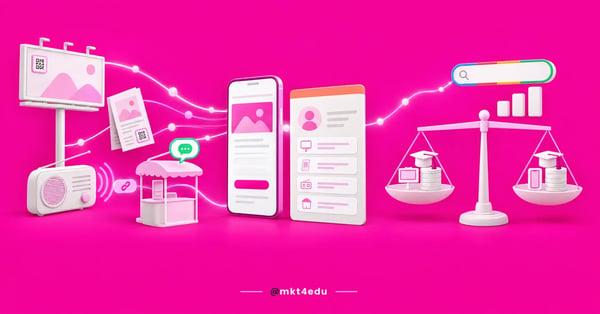 Caption: offline marketing only enters the same table as digital when each asset carries its own tracking mechanism
The private market sustains that picture. The 16th Higher Education Map by Instituto Semesp reports 10.2 million higher education enrollments in Brazil in 2024, with 79.8% concentrated in private institutions, many of them competing for specific local markets.
Regional competition has characteristics of its own. In mid-sized cities, the number of competing institutions is small, a known brand has a real advantage and physical presence works as proof of solidity.
School visits remain among the highest-converting actions. Direct contact with final-year students happens at the exact moment of choice and produces a list of prospects with clear intent.
Campus events have a similar effect. Someone who travels to the institution on a Saturday has already shown above-average interest, and that audience converts better than any purchased list.
Radio keeps its relevance in specific regions. In inland cities and on the commute of workers who study at night, it reaches an audience that social media ads reach with difficulty.
What changed is not the effectiveness of these actions, but the demand for accountability. Today the board wants to see the cost per enrollment of the billboard next to the cost per enrollment of the digital campaign, in the same table.
Which tracking mechanisms work for each offline medium?
Each offline medium calls for a mechanism compatible with how the audience consumes it. Printed assets pair with QR codes, spoken media pairs with a memorable short URL, in-person contact pairs with a dedicated WhatsApp number, and immediate-conversion actions pair with a coupon or promo code.
The QR code has become the most versatile mechanism. It leads straight to a page with the program already selected and identifies the exact asset, as long as each material has its own code.
The short URL solves what the QR code cannot reach. Radio, television and event announcements need an address someone can hear, memorize and type later, such as a page built for that campaign.
A dedicated WhatsApp number works well at fairs and school visits. The conversation starts on site, the contact arrives already identified by source, and the follow-up continues in the days after.
Here is how those mechanisms map to the media most used by educational institutions:
|
Offline medium |
Recommended mechanism |
Data that reaches the CRM |
|
Billboard and panel |
Exclusive short URL |
Local market and flight period |
|
Flyer and poster |
One QR code per asset |
Material, distribution point and program |
|
Radio and television |
Spoken short URL |
Station and time slot |
|
Career fair |
Dedicated WhatsApp and QR at the booth |
Event, date and stated interest |
|
School visits |
Form with the school code |
School, class and visit owner |
|
Campus event |
Pre-registration on a dedicated page |
Confirmed attendance and program of interest |
Table: tracking mechanisms matched to each type of medium in recruitment offline marketing
The rule holding all of this together is uniqueness. A single QR code across ten different assets only tells you someone scanned, not where, which cancels the value of the tracking.
It is worth planning for the applicant who uses no mechanism at all. The “how did you hear about us” question in the form and during the conversation recovers part of that source, with the caveat that an applicant's memory is imprecise.
How do you record the offline source in the HubSpot CRM?
Recording works when each mechanism points to a page or form that writes the source automatically onto the contact. That way, the application from the flyer's QR code and the application from the search ad reach the same CRM (Customer Relationship Management, the system that manages the relationship), with comparable fields and no manual typing.
The source field has to be standardized. Closed-option lists prevent the same fair from being written five different ways and making any later grouping impossible.
In-person events call for extra care with timing. The list collected on Saturday has to be in the system by Monday, because an applicant's interest has a short shelf life.
Importing that list straight into the HubSpot CRM, with the source property already filled in, avoids retyping and the risk of losing the event's attribution along the way.
The HubSpot CRM lets you create custom properties for offline, such as local market, asset and action owner. With those, the report separates the performance of each school visited instead of treating “visits” as a single block.
That standardization also protects the database from duplicates. Under HubSpot's deduplication of records, when a contact with the same email already exists, the new information is added to the existing contact, and the applicant's history stays in a single record.
The CRM that supports student recruitment only returns a reliable report when it receives standardized data at the entry point. Organizing the fields comes before building any dashboard.
The content on hybrid marketing in HubSpot, online and offline shows how those records come to live in the same funnel, with no parallel report.
Video: how to structure the measurement plan that supports budget decisions between offline marketing and digital, on the mkt4edu channel (in Portuguese)
Without that record, the CRM keeps showing only half of the operation. And the invisible half is exactly the one the board questions most in the budget meeting.
How do you compare cost per enrollment between online and offline?
The comparison requires the same formula on both sides: total investment in the action divided by the number of enrollments attributed to it. The care is in including the offline costs that usually get left out, such as production, travel, giveaways, event staff and the hours of whoever organized it.
Comparing cost per lead between online and offline distorts the reading. A contact from a fair is usually more expensive and better qualified than a contact from a reach campaign, and only enrollment puts the two on the same scale.
The measurement window has to be agreed on as well. Offline actions tend to have a longer effect, and closing the math one week after the event underestimates the result.
Deciding the media budget by program in advance solves part of that standardization, because it forces the team to define what counts as an attributed enrollment and in which window before the campaign starts.
The math becomes more useful when the institution already knows the cost of a lost enrollment per program, because then there is an investment ceiling to compare with each local market's result.
A third number deserves tracking beyond cost. How long the student recruited by each channel stays shows whether the source delivers enrollment that holds, and it links the recruitment math to dropout prediction and student retention.
Institutions that run this cross-reading usually find useful surprises. Channels with a higher cost per enrollment sometimes bring students who stay longer, which changes the conclusion about where to cut budget.
Good Educational marketing strategies treat recruitment and retention as a single account. As long as the report stops at enrollment, the cheapest channel will keep looking like the best, even when it is not.
How does offline marketing talk to paid media management?
Offline and paid media reinforce each other when they are planned on the same calendar. A radio or billboard flight raises searches for the institution's name, and the digital campaign captures that demand in the same period, as long as the search budget is ready for the increase.
The signal shows up quickly in reports. A rise in branded searches during an offline flight is one of the most reliable signs that the asset is circulating and being noticed.
That is why paid media management needs to know the offline calendar in advance. Cutting search investment in the very week of the billboard hands the competitor the applicant the institution paid to wake up.
The reverse holds too. Paid traffic audiences can be used to promote in-person events and fairs, segmented by city and age range.
Video: the paid versus organic reading that offline marketing has to follow when splitting budget, on the mkt4edu channel (in Portuguese)
Geographically targeted paid campaigns help fill a campus event at a low cost. The audience lives nearby, already knows the institution's name from the physical asset and only needs a reminder with the date and time.
Social media closes that loop during admission season, when social media campaigns for entrance exams sustain the recall created by the physical asset between one contact and the next.
An educational consultancy used to regional operations usually starts with this calendar alignment, because it improves the result of both fronts without requiring extra budget.
Which attribution mistakes distort offline marketing results?
Four mistakes distort most analyses: using the same identifier across several assets, crediting everything to the last click, ignoring the gap between exposure and application, and relying only on the applicant's answer about how they heard of the institution.
The repeated identifier is the most common and the easiest to avoid. It shows up when production pressure makes every asset point to the same page, and the data is unusable from birth.
Last-click attribution systematically penalizes offline. In the Google Ads last-click model, all conversion credit goes to the last clicked ad and its matching keyword, so the applicant who saw the billboard and then searched for the institution disappears from the physical asset's math. It is worth checking which model the account uses: Google states that the data-driven model is the default for most conversion actions, and that last click is still accepted as an option.
The gap between exposure and conversion fools anyone who closes the math too early. Part of the enrollments from a September action happens in November, and the October report shows a failure that never existed.
The “how did you hear about us” question helps, but it does not decide on its own. An applicant's memory mixes channels, favors the most recent one and tends to underrate assets they saw without conscious attention.
The way out is not chasing absolute precision. It is combining direct mechanisms, the declared answer and the observation of branded search, and accepting a known margin instead of a false certainty.
Recording that margin in the report increases the board's confidence. A number presented with its method explained supports a better decision than an exact number of unknown origin.
Frequently asked questions about offline marketing
Offline marketing or all the budget in digital: what makes more sense?
For regional institutions, the answer is rarely to choose one of the two. Offline marketing builds recognition in the local market and digital captures the demand it generates, and the useful decision is not about eliminating a front, but about measuring both with the same standard before redistributing budget.
Start with tracking the next action. One exclusive short URL, one QR code per asset and a standardized source field in the CRM already produce the first comparable report in your history.
After that, the budget discussion changes tone. Instead of defending the billboard on intuition, the team presents cost per enrollment by local market, and the conversation becomes about adjusting the mix.
Recording the source of each contact depends on having somewhere to record it. The content about the importance of CRM for companies covers the foundation that makes this traceability possible across different channels.














 Portugal