Anyone searching for marketing strategies is usually after the same practical answer: how to turn interest into a qualified contact, with predictability and cost under control. The conversation, though, tends to start with tactics, long before any diagnosis.
A BrightEdge study from May 2019, which became a market reference, found that organic search accounts for 53% of trackable website traffic and paid search for 15%. Direct traffic was excluded from the analysis.
Search behavior has shifted a great deal since then. Clickstream data from Similarweb analyzed by SparkToro indicates that 68.01% of Google searches in the United States ended without a click between January and April 2026, against 60.45% in 2024.
The share of searches that produce at least one click fell 9.51 percentage points between 2024 and 2026, in that same United States sample. The number does not write off search as a channel, but it explains why leaning on a single point of entry became risky.
The design that sustains lead generation today spreads effort across content, search, media and relationships, tied together by a written funnel and by indicators agreed between marketing and sales.
What are marketing strategies for capturing leads today?
Marketing strategies are the design of how a brand attracts, converts and keeps customers, with channels, messages and indicators defined before execution begins. In lead generation, they stop being a list of tactics and start behaving as a system, with a role and a target for each channel.
The difference between strategy and tactics shows up in the question each one answers. A tactic answers what gets done this week, while a strategy answers why that effort comes before another one and what it has to deliver.
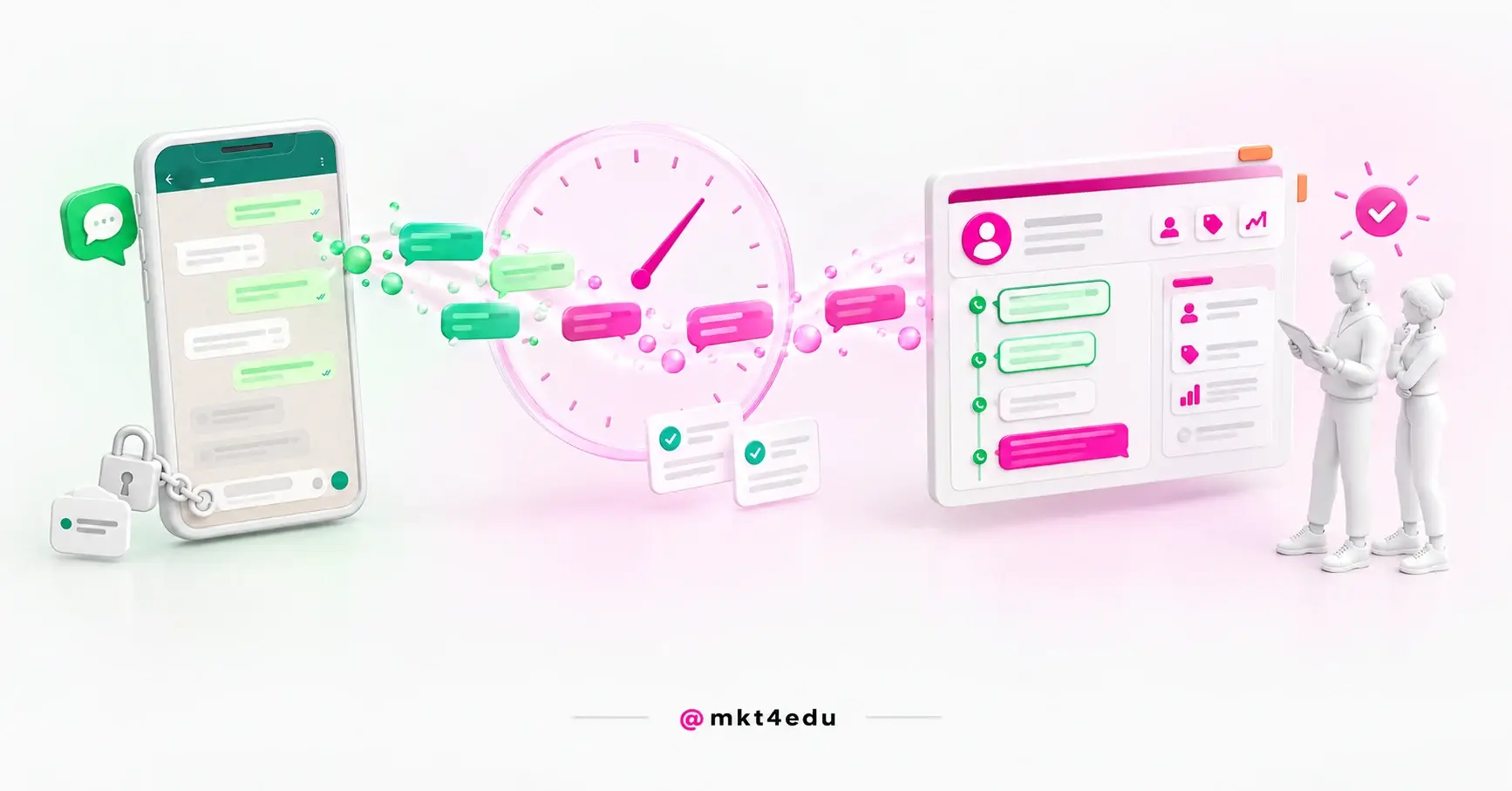
 Caption: Marketing strategies only become leads when content, funnel and measurement run on the same line, from first click to CRM.
The question of how to do marketing inside an education institution is rarely about tools. Almost always it is about order: which front gets time and budget first, which one can wait another cycle, and which one should leave the plan altogether.
The Brazilian education market shows why that choice became harder. The 2024 Higher Education Census recorded 10,226,873 undergraduate enrollments, of which 5,189,391 were in distance learning programs.
Distance learning reached 50.7% of the total and passed on-campus programs for the first time. On-campus enrollments closed at 5,037,482, or 49.3% of the total. Institutions competing for students now face an audience that researches, compares and decides almost entirely online.
A mature digital marketing strategy treats capture as a process shared between marketing and sales. Without that agreement, the sales team receives cold contacts and concludes that marketing only brings in the curious.
Three questions organize the initial design: who needs to be attracted, what that person receives in exchange for their contact details, and who speaks to them afterwards. Answering all three honestly removes most of the improvisation and shortens the argument about channels.
How do you generate leads without relying only on ads?
Learning how to generate leads without relying only on ads starts with building assets that keep working after the budget runs out: content that ranks, an owned contact base, and pages that convert. Paid media accelerates a flow that already exists; it never creates one.
Depending exclusively on ads turns the whole operation into pure variable cost. The day a campaign is switched off, opportunity generation drops with it, and cost per lead climbs every time a competitor raises a bid.
The first asset is search content. An article that answers the right question keeps attracting visitors months after publication, at a marginal cost close to zero.
The second asset is an owned contact base, fed by material with real value. Email and messaging reach people who already showed interest, without entering a media auction for every single contact.
The third asset is the conversion page. Doubling the conversion rate of a landing page doubles lead volume without adding a cent of investment.
Drawing a clear line between the marketing funnel and the sales funnel helps decide which asset to build first. Marketing owns the path up to the raised hand, and sales takes over from there.
Video: an overview of how to organize lead capture into connected stages. Video in Brazilian Portuguese.
Marketing funnel, SMART goals and SWOT analysis: where does it start?
Every strategy starts with a diagnosis, not with a channel. A SWOT analysis shows where the institution is strong and where it is fragile, SMART goals turn that picture into a number with a deadline, and the marketing funnel distributes the target across the stages.
A SWOT analysis applied to marketing tends to expose dependencies nobody admits in a meeting. A recognized brand and an active email base are strengths; weak organic traffic and budget concentrated in one channel are weaknesses that turn expensive at the first surprise.
Opportunities and threats come from the outside scenario, not from the team. Growing demand for distance learning is an opportunity; shifting search behavior and a competitor with a larger budget are threats that sit in the same frame and compete for the same attention.
After the diagnosis, SMART goals remove the ambiguity from the objective. "Increase leads" is not a goal; "double organic leads by the end of the semester while holding the current cost per lead" is one, because it carries a number, a deadline and a constraint.
The marketing funnel organizes the path from first contact to the moment a lead is handed to sales. The top attracts with broad content, the middle moves closer to the problem, and the bottom presents the solution with proof and commercial terms.
The sales funnel continues from there, with qualification, proposal, negotiation and closing. When both teams share one dashboard, the discussion moves from "bad leads" to "the stage where we lose people".
Video: how diagnosis, goal and funnel fit together before any channel decision. Video in Brazilian Portuguese.
How do the AIDA funnel and storytelling improve lead conversion?
The AIDA funnel and storytelling address the same pain: the page gets visits and does not convert. AIDA organizes the sequence of the message, from attention through to action, and storytelling gives that message a shape the reader actually finishes reading.
Attention is the first barrier. A headline that names the reader's specific pain holds the person who arrived from search, while a generic headline loses the visit within seconds.
Interest and desire both run on proof. A student testimonial, a record of graduating classes and a demonstration of what the person walks away with support the promise far better than any adjective.
The action stage calls for a single request per page, with a short form, a clear verb and no alternative route competing with the main button. The sequence of the AIDA funnel, short for attention, interest, desire and action, falls apart when a page offers three exits at once.
Storytelling comes in where the rational argument is not enough. The structure of problem, attempt, turning point and result works because the reader recognizes themselves in the failed attempt before believing in the turning point.
In education, the most effective story is rarely the institution's own. It is the story of a student who changed direction, told with a name, a context and a concrete consequence.
Lead conversion improves when both layers work together, with AIDA handling the order and the narrative holding attention.
Do content marketing and inbound marketing capture qualified leads?
Yes. Content marketing and inbound marketing capture qualified leads because they reach people who were already looking for the subject, instead of interrupting people who were looking for nothing. The filter happens before the form, since someone reading about their own problem arrives closer to a decision.
The logic of inbound marketing is to reverse the order of contact. The institution delivers something useful first, then asks for the data, and the lead accepts the conversation because value arrived first.
Top-of-funnel content attracts volume and educates through career guides, comparisons between study formats and explanations about financing. Middle and bottom content works as a filter: program pages, institution comparisons and tuition simulators attract fewer people, nearly all of them with real intent.
Qualified lead generation also depends on what gets traded for the contact details. Material that solves a specific pain and delivers a quick win converts far better than a generic ebook.
None of this works without frequency. Publishing one article per quarter builds no authority and feeds no nurturing flow, which is why how to do content marketing starts with a calendar rather than a topic.
Video: the role of content in attracting leads with real buying intent. Video in Brazilian Portuguese.
Do SEO strategies and SEO for AI hold your organic traffic?
SEO strategies still hold organic traffic, now under a new condition: part of the answer happens inside the results page itself. SEO for AI is the adaptation of that same work to the format that answer systems extract and cite.
Google states that AI features in search use the same index and the same ranking systems as traditional search. There is no special file and no magic markup that guarantees a citation, and no shortcut replaces well-made content.
What changes is how the writing works. A direct answer at the opening of a section, one idea per paragraph and data from a named source raise the odds of a passage being retrieved. Long-tail queries gain weight here, because a specific question covers the sub-question the system generates.
Visit volume tends to fall while quality rises. According to Semrush research, visitors arriving from AI search convert 4.4 times more than visitors from traditional organic search, although the company publishes neither sample nor period.
The contest is no longer only about position: it now includes being cited inside the answer. Work on SEO for LLM, short for Large Language Model, prioritizes context, intent and readable structure over exact keywords.
Topic clusters help more than isolated posts. A group of articles covering a whole subject answers several sub-questions and raises the chance of the brand appearing in more than one of them.
Video: what changes in SEO strategies with AI-assisted search. Video in Brazilian Portuguese.
Paid media and paid traffic: when do you accelerate lead generation?
Paid media pays off once a validated offer, a page that converts and a team ready for the volume are already in place. Accelerating before that raises cost per lead and burns budget inside a funnel that still loses people halfway through.
Three moments justify switching on paid traffic: an enrollment window with a short deadline, a fast message test, and coverage of bottom-of-funnel terms that organic search has not reached yet.
The BrightEdge study already mentioned helps size the two routes: 53% of trackable traffic comes from organic search and 15% from paid search, with direct traffic left out of the count.
The practical reading of that gap is not to abandon paid search, but to recognize that organic search sustains the baseline while paid media covers peaks, launches and short decision windows.
Measuring paid media by cost per lead alone is misleading more often than not. The indicator that decides is cost per enrollment, because a channel that looks cheap per lead can turn out expensive per student.
Comparing CAC (Customer Acquisition Cost) against LTV (Lifetime Value) by channel keeps that decision honest over a full cycle. A channel only deserves more budget when the student it brings pays back more than it cost to win them.
Paid traffic also works as a laboratory for organic, because within days it shows which promise earns the click. Separating a test budget from a scale budget avoids the most common trap: a test campaign answers a question, a scale campaign answers a target.
Do inbound sales and AI lead qualification lift the conversion rate?
Inbound sales and AI lead qualification lift the conversion rate when they shorten the gap between a contact request and the first useful conversation. The gain does not come from the technology on its own, but from correct prioritization combined with a consultative approach.
Inbound sales starts from a contact who already understands their own problem. The salesperson joins to help with the decision, asking diagnostic questions, rather than presenting a catalog.
AI lead qualification solves the volume bottleneck. Models classify profile and behavior, and the SDR (Sales Development Representative) receives an ordered queue instead of a raw spreadsheet.
Lead scoring is the readable version of that same logic for small teams. A few rules based on pricing page visits, email engagement and job title already separate the curious from the people ready to talk.
Automated first contact widens the response window. AI agents answer outside business hours, collect qualification details and book the conversation with the human team.
The risk of automation is treating every lead the same way. A badly calibrated rule discards people who had intent and warms up people who were only browsing, which pushes the conversion rate down instead of up.
Recording everything in the CRM (Customer Relationship Management) closes the loop. Without a logged reason for each loss, marketing keeps producing the same kind of lead that sales cannot convert.
Video: how the handoff from marketing to sales changes the conversion rate of the funnel. Video in Brazilian Portuguese.
How do you turn this into a 30-day sales funnel plan?
A 30-day plan exists to build the structure, not to harvest the final result. Four weeks are enough to settle the diagnosis, the offer, the conversion page and the indicator dashboard, leaving the sales funnel ready to take volume the following month.
The question of how to generate leads stops being theoretical once it gets a calendar. Each week receives a single focus, a verifiable deliverable and one indicator that will be read at the next meeting.
Week one is about decisions rather than production: a revised diagnosis, a chosen primary persona and a written value proposition prevent rework later. Week two delivers the offer and the page, with the value material defined and the landing page written along the attention, interest, desire and action logic.
Week three switches on the flow, with top-of-funnel content published, a short email sequence and a basic lead scoring rule. Week four closes the cycle: one single-variable test on the page, a meeting between marketing and sales, and a first dashboard with leads, conversion rate and cost per lead.
Each of the four weeks gets its own focus, deliverable and indicator:
|
Week |
Focus |
Deliverable |
What to measure |
|
Week 1 |
Diagnosis |
Revised SWOT analysis, defined persona and written value proposition |
Approved SMART goals and a recorded baseline |
|
Week 2 |
Offer and conversion |
Value material ready and landing page written on the AIDA funnel |
Landing page conversion rate |
|
Week 3 |
Attraction and nurturing |
Top-of-funnel content published, email flow live and lead scoring active |
Organic sessions and leads by source |
|
Week 4 |
Measurement and alignment |
One single-variable page test, a sales meeting and a first dashboard |
Cost per lead and leads accepted by sales |
Each deliverable becomes a SMART goal the moment it gains a number and a deadline. "Publish top-of-funnel content" is a task; "publish three top-of-funnel articles by Friday of week three" is a verifiable goal.
The plan only turns into a routine when the week's indicator reaches the next meeting. Without that reading, the cycle starts from zero again the following month.
Frequently asked questions about marketing strategies
What should you prioritize first in your marketing strategies?
Priority among marketing strategies depends on your current bottleneck, not on whichever channel is fashionable. Low traffic means starting with content and search; traffic with few leads means starting with the offer and the page; leads with few enrollments mean starting with qualification and sales.
The most expensive mistake is attacking all three fronts at once with a team that barely covers one. Choosing one bottleneck per cycle keeps the learning readable.
The order also shifts with the institution's calendar. Close to an enrollment window, paid media moves up the queue; outside that window, the same money returns more when it builds organic traffic assets.
Anyone asking how to do marketing with a small team hears the same answer every time: fewer fronts, more depth. Three channels run well beat eight abandoned halfway, and two decisions hold in any scenario: write the funnel before buying media, and define who answers a lead and how fast.
If the next step is turning this diagnosis into a plan, the mkt4edu team can review your funnel and point out the first priority based on your own numbers.













 Portugal