


Marketing for universities has become more expensive, and the media spreadsheet shows it every cycle: the click goes up, the lead costs more and the same budget brings fewer candidates than it did a few terms ago.
The most common reaction is to change the size of the budget, cutting or raising it, and both miss the target. The problem is rarely the total invested, it is how that total spreads across channels, programmes and moments of the year.
This guide follows the practical route: a quick diagnosis of why the cost is rising and then the fronts that hold the CAC down, from the channel mix to measurement by programme and study mode.
Why is recruiting students getting more expensive?
Recruiting students is getting more expensive because more institutions compete for the same candidates in the same media auctions, while AI answers part of the questions on the results page itself and cuts the clicks that used to reach the site at no cost. The three movements together raise the price of the lead and of the enrolment.
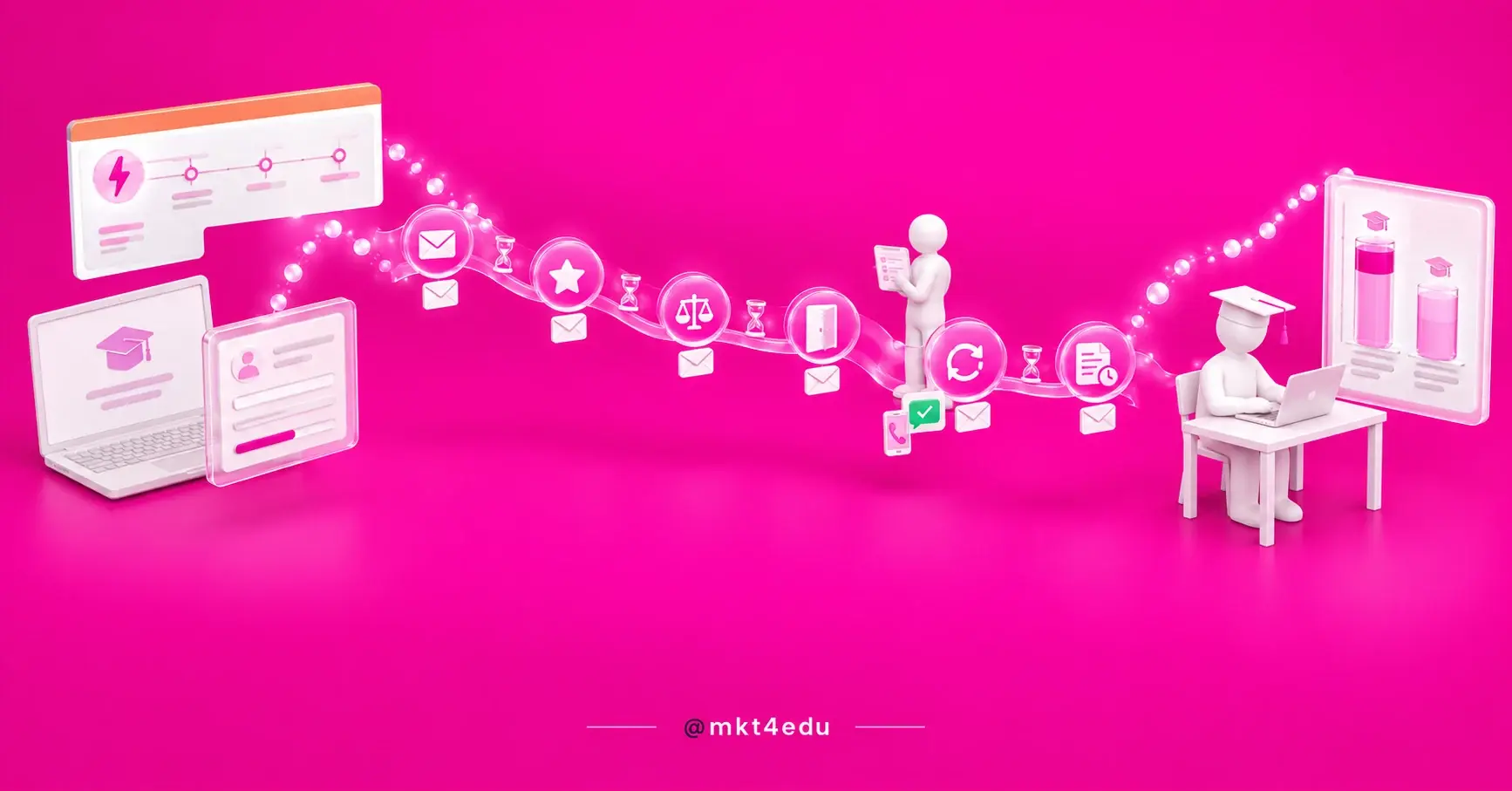
 Caption: marketing for universities holds the cost down when channels, calendar and nurturing feed the same funnel
Competition is the most visible driver. When several institutions advertise on the same keyword, in the same period and the same region, the auction raises the price of the click, and the CPL (cost per lead) follows.
AI in search works the other flank. Ready-made answers at the top of the page tend to reduce the organic traffic that cushioned paid media, and every visit lost there becomes a click someone has to buy.
That is the new starting point for marketing in education: the climb in why recruiting students costs more every term has a full diagnosis of its own, movement by movement, and the summary above is enough to guide the decisions in the next sections.
What changes the game is not complaining about the auction, it is redesigning the operation to depend on it less. The five fronts that follow do exactly that.
How do you market a university?
To market a university without blowing up the CAC, work five fronts at once: a mix of organic and paid channels, campaigns segmented by programme and study mode, a calendar that concentrates budget on the decision peaks, lead nurturing through to enrolment and measurement of cost by channel.
No front is optional, because each one holds the cost down at a different point of the funnel. Here is how the five organise themselves:
|
Front |
What it does for the cost |
Horizon of effect |
|
Organic and paid mix |
Dilutes dependence on the media auction |
Paid in the short run, organic in the long |
|
Segmentation by programme and study mode |
Avoids generic budget across distinct audiences |
Immediate, every campaign |
|
Recruitment calendar |
Concentrates investment on the decision peaks |
Every enrolment cycle |
|
Nurturing and relationship |
Converts leads already paid for, with no new media |
Weeks to months |
|
Measurement by channel |
Reallocates budget to where enrolment costs least |
Continuous |
Table: the five fronts of marketing for universities that hold the CAC down, with each one's role
Together, the fronts become a real education marketing strategy: every unit of budget has a defined job, and marketing strategies stop competing against each other for the same money.
Educational marketing campaigns enter that design as executors, not as the whole strategy. A good ad does not fix a broken funnel, and a good funnel makes the same ad produce more enrolments.
Video: audioblog from the mkt4edu channel with three fronts of marketing for universities applied to recruitment
How do you build the organic and paid channel mix?
A healthy mix uses paid media to generate immediate volume in enrolment periods and the organic channel to reduce the average cost over time. Media delivers speed at a recurring cost, while content takes longer but keeps generating leads after publication and dilutes the initial investment.
On the paid side, being specific is what is cheap. Campaigns on Google and Meta segmented by programme, region and moment of decision tend to cost less per lead than generic brand campaigns.
The daily handling of bids, audiences and creative is the heart of paid traffic in student recruitment, and that is where budget escapes first when management is missing.
When there is no in-house capacity for that handling, a dedicated paid media operation takes over the auction with a cost-per-enrolment target, not just cost per click.
Video: conversation from the mkt4edu channel on the mix that sustains marketing for universities
On the organic side, inbound marketing does the long-term work: content that answers the candidate's questions attracts the lead before the auction and with no cost per click.
Inbound marketing in education turns the blog, gated resources and SEO into a channel of your own, one that grows precisely where AI in search cuts the click for anyone who depends on ads alone.
It is the balance between the two sides that marks mature digital marketing strategies: paid buys time, and organic buys independence from the auction.
How do you segment education marketing campaigns by programme and study mode?
Segmenting education marketing campaigns by programme and study mode means separating budget, message and cost target for each combination, instead of running a single ad for the whole institution. The cost of recruiting for a high-ticket on-campus degree does not compare to that of an online postgraduate course.
The size of each study mode justifies the split. The 2024 Higher Education Census, run by Inep, Brazil's national education statistics institute, recorded distance learning at 50.7% of enrolments and 66.8% of new entrants in Brazilian higher education.
Persistence completes the sum. The 16th Higher Education Map by Semesp, the association representing private providers, records a 2024 dropout rate of 41.6% in distance learning and 24.8% on campus, and that difference changes how much each enrolment returns of the investment made to win it.
In practice the reading is double: distance learning concentrates the volume of new entrants and usually has a cheaper lead, but the higher dropout shortens revenue per student. In education marketing, study mode has become the first question of any media plan.
Online student recruitment has its own dynamic, with a shorter journey and a decision more sensitive to price, which is why it calls for campaigns, pages and nurturing separate from the on-campus side.
The same logic applies by programme: courses with different tickets and competition cannot share the same cost target. Medicine and teaching in the same ad group is one financing the other's waste.
How do you use the recruitment calendar and lead nurturing?
The recruitment calendar organises investment across the year: it concentrates media in application and entrance exam periods, brings organic content forward into the research months and reserves nurturing for the gaps. Budget spent at the wrong moment is the quietest way to blow up the CAC.
A well-built student recruitment calendar says when to accelerate the auction and when to let organic work alone, and it avoids buying media in the panic of the night before enrolment closes.
Nurturing converts what the media already paid for. A lead nurturing flow that answers questions about the programme, financial aid and paperwork keeps the lead warm between the click and the application, with no extra ad spend.
Without the calendar in view, though, nurturing fires the right message at the wrong time, and the lead goes cold before the application window opens.
This is where inbound marketing and inbound sales meet: marketing nurtures until the lead signals a decision, and the sales team approaches with the whole journey as context, instead of starting the conversation from scratch.
In projects run by mkt4edu, the lead's source travels all the way to enrolment through UTM parameters (the codes identifying channel and campaign in the URL) and the form fields.
With that link in place, the cost is read by programme and study mode inside the CRM (Customer Relationship Management, the platform managing relationships with leads and students), where the cycle from lead to enrolment to revenue closes with no parallel spreadsheet.
A CRM implementation designed for recruitment is born with those fields and routines connected, and it is what lets inbound sales work with funnel data instead of guesswork.
How do you measure student acquisition cost by channel?
To measure student acquisition cost, divide each channel's investment by the enrolments it produced, not just by the leads. The cheapest channel on the lead can be the most expensive on the enrolment, and only the segmented view shows where the budget really pays.
The first step is separating the two metrics. Cost per lead assesses the efficiency of the ad, while cost per enrolment assesses the whole funnel, and it is the one that should decide the budget.
The enrolment measure changes the conversation about marketing campaigns: instead of discussing clicks and impressions, the budget meeting compares enrolments and cost by programme, channel by channel.
Digital marketing strategies compare on that same measure, and reading it regularly opens space to optimise: the seven levers to reduce CAC in student recruitment start exactly from a cost measured with criteria.
Frequently asked questions about marketing for universities
Can you hold student acquisition cost down?
You can hold student acquisition cost down, but not with an auction trick: the cost gives way when the organic and paid mix, the segmentation, the calendar, the nurturing and the measurement operate together, cycle after cycle. The marketing for universities that pays less is the one that depends least on media bought in a hurry.
The sequence matters. Measurement first, because it shows where the cost concentrates; then segmentation and the calendar, which reallocate the budget; finally organic and nurturing, which dilute the cost in the following cycles.
It is a marathon of consistency, and that is where an education marketing strategy separates itself from a collection of loose campaigns: the marketing strategies that survive the auction are the ones that build an owned channel.
If there is no in-house capacity to build and run those fronts, an education marketing agency solves the team equation: the operation arrives ready, and each cycle's learning stays recorded inside the institution itself.












 Portugal