


Generating leads for online courses has become easier than converting those leads into students. The form fills up, education marketing campaigns produce applicants, and enrolment does not keep pace. A well-designed lead nurturing flow is what closes that gap between the first flicker of interest and the decision to study.
The logic is direct: instead of depending on an adviser to remember every follow-up, the institution designs a relationship sequence and lets automation run it. Each lead gets the right message, in the right channel, at the moment it has the best chance of moving the decision.
This guide shows how to build that flow in practice for distance learning recruitment: the design of the sequence, the triggers that recover stalled applicants and the metrics that separate automation that wins enrolments from automation that only generates sends.
What is a lead nurturing flow and when should you use one?
A lead nurturing flow is a sequence of automated messages that follows the lead along the funnel, delivering content and decision prompts according to their behaviour. In recruitment for online courses, that flow carries the interested person from first contact to enrolment, with no manual follow-up required.
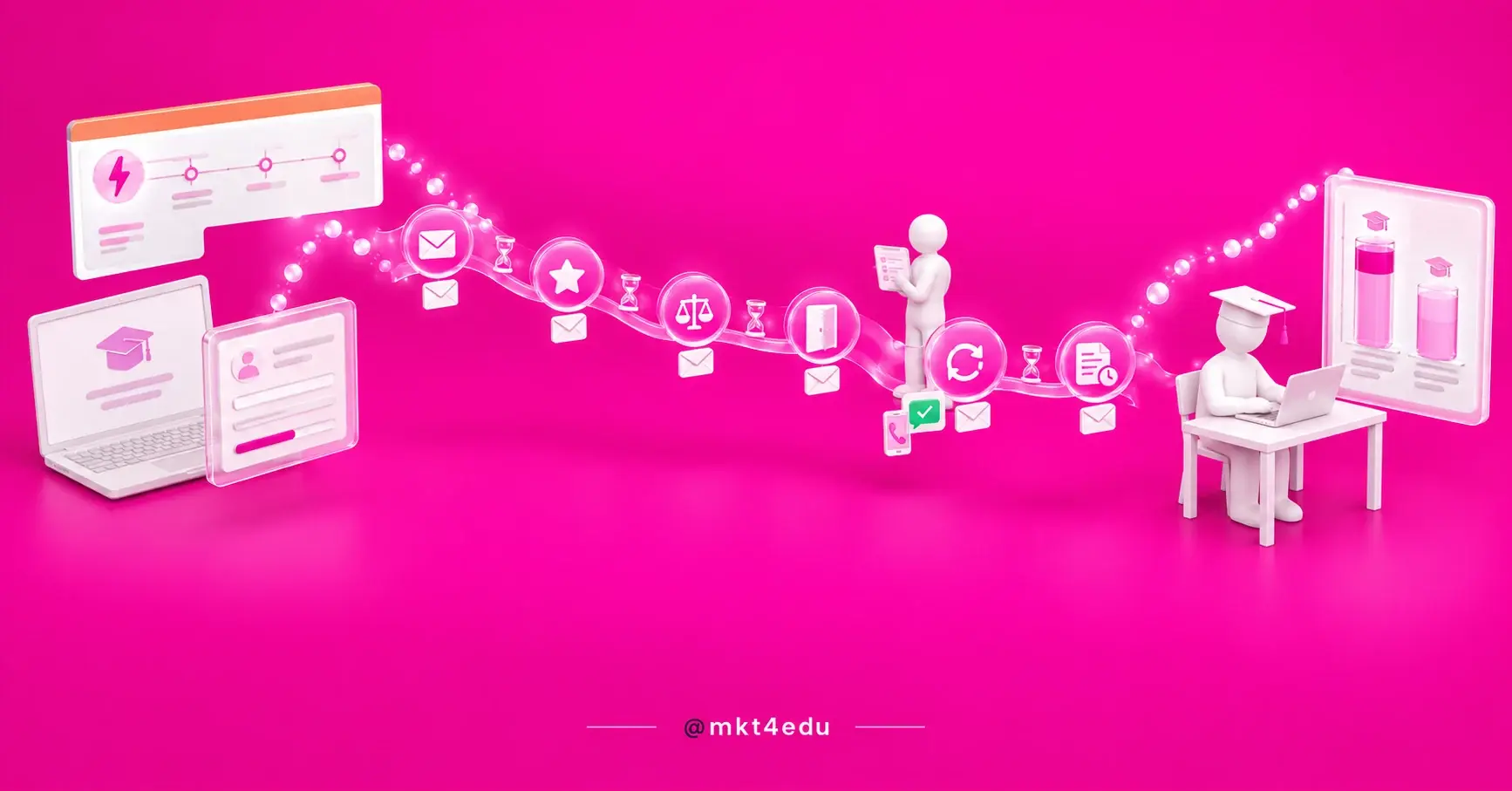
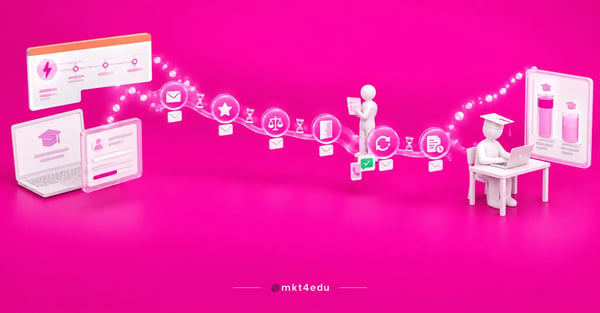 Caption: a lead nurturing flow carries the applicant from first conversion to enrolment without manual follow-up
The technical basis is the workflow. Marketing automation tools let you build flows with enrolment triggers, actions and delays between steps, firing emails, messages and tasks with no human intervention at each stage.
The workflow is the heart of marketing automation for online courses. It differs from a one-off send because it reacts to what the lead does: downloaded a resource, started an application, stopped opening emails. Each behaviour can open, speed up or close a sequence.
The flow is worth it whenever the decision is not immediate. Choosing an online degree or postgraduate course involves research, price comparison and a family conversation, and lead nurturing keeps the institution present through all of it.
Within inbound marketing, nurturing is the bridge between attracting and converting. The logic of triggers and actions is the same as in any marketing automation applied to long funnels, with one important difference: here, the result is called enrolment.
Why does the online enrolment funnel need a different flow?
The online enrolment funnel needs a different flow because the distance learner decides alone, compares several institutions at the same time and can apply and disappear on the same day. Nurturing has to be faster, more segmented and more persistent than in an on-campus funnel.
The size of the market explains the pressure. In the 2024 Higher Education Census run by Inep, Brazil's national education statistics institute, distance learning accounts for 50.7% of enrolments and 66.8% of new entrants in Brazilian higher education.
More new entrants means more competition for the same lead. Educational marketing campaigns fight over the same candidate across several channels at once. Someone researching online courses receives offers from dozens of brands within days, and the institution that takes too long to answer is out of the running before the first conversation.
The other side is persistence. The 16th Higher Education Map by Semesp records a 2024 dropout rate of 41.6% in distance learning, and a student who enrols badly informed tends to leave early. So tackling dropout in online learning starts before enrolment, with expectations calibrated during nurturing.
Video: video from the mkt4edu channel on AI applied to the same funnel a lead nurturing flow travels
There is also a filtering effect. The lead who travels the sequence reaches the adviser already knowing the price, the class format and the study routine, so the final conversation is shorter and early withdrawal drops. Nurturing is not only selling better, it is enrolling people who will stay.
The practical consequence is simple: online student recruitment does not end at a completed form. The real funnel runs through to confirmed enrolment, and the recruitment strategies that work online treat that final stretch as part of the campaign.
How do you design the nurturing sequence for an online lead?
Designing the sequence starts with the map of funnel stages: visitor, lead, applicant, approved and enrolled. For each transition, the sequence defines four elements: the entry trigger, the message, the channel and the deadline. The design comes before the tool, never the other way round.
In the education consultancy work mkt4edu runs, sequences inherited from other tools usually arrive focused on chasing the application fee, not on conversion. Before migrating any flow, the design is redone: fewer invoice reminders, more content that answers the question blocking enrolment.
The second design decision is the channel, validated directly in the CRM (Customer Relationship Management, the platform managing the relationship with the lead). Email is the guaranteed channel, because every lead in the database has an address recorded at conversion. Email marketing is the backbone of the sequence precisely because of that full coverage.
WhatsApp enters as a conditional channel. It only joins the flow when the phone number is valid, with country and area codes filled in, and that condition is agreed with the institution from the start of the project. Promising WhatsApp to a database with no qualified phone numbers is promising a flow that will not fire.
Which email sequence works for online enrolment?
The email sequence for online enrolment works in blocks: an immediate welcome, proof of value in the first days, objection handling in the first week and direct calls to apply and enrol in the weeks that follow. Here is how that design lays out:
|
Stage and trigger |
Message |
Channel |
Deadline |
|
Welcome (form conversion) |
Interest confirmed, course introduced and next steps |
|
Immediate |
|
Proof of value (opened the welcome) |
Curriculum, faculty and a graduate's testimonial |
|
D+2 |
|
Objection handling (clicked but did not apply) |
Price, scholarships, financing and the online study routine |
Email + WhatsApp |
D+5 |
|
Invitation to apply (no application yet) |
Direct call to finish the application, with the form link |
Email + WhatsApp |
D+7 |
|
Partial application recovery (started the form and stopped) |
Resume prompt naming the chosen course, with a task for the adviser |
WhatsApp + CRM task |
D+1 after drop-off |
|
Final stretch (approved, not enrolled) |
Outstanding documents, class deadline and enrolment terms |
Email + WhatsApp |
D+2 after approval |
Table: model lead nurturing flow for online enrolment, with trigger, message, channel and deadline per stage
The deadlines are a starting point, not a fixed rule. Courses with rolling admission allow longer sequences, while an admissions process with a closing date compresses everything. It is the institution's recruitment calendar that sets the rhythm. What does not change is the principle: no stage without a clear trigger and no send without an objective of moving forward.
After enrolment, the same logic becomes the student relationship sequence, covering onboarding, academic notices and dropout prevention. That is how recruitment and retention become a single cycle. The best practices for a student relationship sequence follow the same principles of trigger, channel and deadline.
Video: audioblog from the mkt4edu channel on the logic behind any lead nurturing flow
With the design approved, building it is operational work. The process of nurturing leads in HubSpot runs from creating the lists to activating the workflow, and implementing HubSpot CRM for recruitment is the service where mkt4edu's education consultancy applies exactly this sequence.
Which flows reduce drop-off between application and enrolment?
Four flows concentrate the reduction in drop-off between application and enrolment: partial application recovery, post-application follow-up with a task for the adviser, a document reminder for approved candidates and the revival of stalled leads for the new term.
The partial application is the most profitable case. When the candidate starts the form and names an identifiable course, that data enables recovery triggers: a message naming the chosen course, a direct link to resume the application and an automatic task for the sales team.
Another flow is born out of manual follow-up. In operations that treated D0, D1 and D2 as funnel stages, with the adviser sending mass messages each day, those touches become workflows in HubSpot CRM that generate tasks and communication on their own. The contact standard stops depending on one person's diary.
Between approval and enrolment, the obstacle is paperwork. A flow listing outstanding documents, class deadlines and support channels reduces friction at the moment the candidate has already said yes but could still give up out of fatigue.
The dormant database also produces enrolments. Leads that went cold in previous cycles are revived by automation for the new term, with a short re-engagement sequence. Whoever replies returns to active nurturing, and whoever does not leaves the database on documented criteria. A well-built student recruitment calendar defines when those revivals go out.
This set only works with automation wired to the funnel, not with one-off email blasts. In online courses, where the candidate applies to more than one institution at the same time, the speed and consistency of the reply decide who enrols them.
How do you measure a lead nurturing flow?
Measuring a lead nurturing flow means following three layers: engagement, with opens and clicks per message, progression, with the rate of stage advance within the deadline, and conversion, comparing nurtured and non-nurtured applicants. Only the third layer justifies the investment in automation.
Opens and clicks serve the diagnosis of the message, in the classic email marketing pattern. An email with a low open rate has a subject or sender problem, and an email opened without a click has an offer problem. Those metrics correct the sequence, but they do not prove an enrolment result.
Progression shows where the funnel sticks. If most leads receive an objection sequence and few reach the invitation to apply, the problem is in that block, not in the whole flow. Measuring by stage avoids redoing what already works.
Conversion settles the account. Compare the enrolment rate of applicants who went through the flow with that of applicants who did not, within the same term. The difference between those two rates is the real result of the automation, and it is the number the board understands.
Unsubscribes complete the dashboard. A rising opt-out rate points to the wrong frequency or the wrong content, and it erodes the database inbound marketing took months to build. A good flow wins enrolments without burning the list.
Frequently asked questions about lead nurturing flows
Lead nurturing flow or manual follow-up: which makes more sense?
For an online recruitment operation, the lead nurturing flow makes more sense as the base, with human follow-up reserved for the moments of decision. Automation guarantees no applicant is left without contact, and the adviser concentrates energy on whoever has already shown real intent to enrol.
Purely manual follow-up does work at small volume, but it does not scale. When the campaign doubles the number of applicants, the automated sequence holds the service standard, while the manual operation picks who to abandon, usually with no criteria on record.
The practical route is starting with the stretch that loses most: the gap between application and enrolment. A single recovery flow, with a clear trigger and a short deadline, usually pays for itself before the full sequence even exists, and funds the expansion to the other stages.
To feed each stage of that sequence with the right material, the guide to lead nurturing in student recruitment shows what to send at each phase of the funnel, from the first gated resource to the final enrolment argument.











 Portugal