If you work in marketing or handle student recruitment for an educational institution, you have probably heard someone say that Google is “dead”, that nobody clicks on links anymore, and that the whole budget should move to paid media or social. With AI Overviews answering questions right on the results page and ChatGPT becoming a gateway for millions of people, the question of whether SEO is worth it stopped being rhetorical and became a very concrete budget decision.
The short answer is yes, it is worth it, but not the way it was in 2019. You will understand what changed in search, what the data shows about organic traffic and conversion, and how to adapt your digital marketing strategy to grow inside AI-generated answers too.
Is SEO worth it these days?
Yes, SEO is worth it because search remains the main path between a question and a decision to buy, to enroll or to hire. What changed is the format of the answer, not the behavior of searching.
 Caption: SEO worth it is a compounding question: the same content that ranks in organic search is what the AI ends up citing
Numbers help put the discussion in the right place, as long as they come with a date attached. The BrightEdge channel study, from 2019, which became a market benchmark, found that organic search accounted for about 53% of all trackable website traffic, more than paid media, social and display combined. That is a snapshot from seven years ago, before AI Overviews, and it shows the historical size of the channel rather than today's share.
More recent data changes the tone of the conversation, and it needs context too. In June 2025, Semrush reported that visitors arriving at a site from AI searches convert about 4.4 times more than visitors coming from traditional organic searches. It is worth noting that the figure comes from Semrush itself, published in an outlet owned by the same group, with no sample size or methodology disclosed. The reading still holds: whoever arrives after talking to an AI has already researched, already compared and is closer to deciding.
The other half of the equation is volume. An analysis of 100 sites and 145 million GA4 sessions, published in October 2026, found ChatGPT sessions at 0.62% of what Google organic delivers, with Google still accounting for 96.5% of conversions across every channel combined. The author herself notes that the sample is small and that 45 of the 100 sites had no conversion event configured. Both readings hold at once: the visitor arriving from AI converts better, and there are still very few of them. Whoever decides the budget needs both, because the conversion rate on its own justifies a budget shift that the volume does not support.
In other words, the right question is no longer “SEO or AI?”. It is “how do you do SEO in a way that works for Google and for AI searches at the same time?”. Whoever answers that well harvests qualified traffic from both worlds.
It also helps to split two questions that usually travel together. Whether SEO is worth it is a channel question; whether it is worth investing in SEO now, and how much, is a budget and timing question.
What has changed in SEO with artificial intelligence?
Artificial intelligence changed the gateway to information. Instead of a list of ten blue links, users increasingly get a ready-made, AI-generated answer with a few cited sources. That redistributes attention and demands a new layer of optimization.
- Answers generated inside search: Google's AI Overviews and AI Mode synthesize information from several pages and display it before traditional results. Google itself states there is no exclusive technical trick to appear there: the path remains useful, original and well-structured content.
- New discovery mechanisms: ChatGPT, Gemini, Perplexity and search inside social networks now share space with Google. That new distribution changes where your brand needs to be present and in what format.
- More complex, fragmented queries: Google's AI systems break a question into dozens of simultaneous subqueries, a mechanism known as query fan-out. Very specific pages that answer a subquestion well gain a chance to appear even without ranking first for the main term.
There is also a newer movement: agentic SEO, in which AI agents browse, compare and even execute tasks on the user's behalf. In that setting, a slow, confusing site with no structured data gets in the way of people and of the machines deciding what to recommend.
None of this retires the fundamentals. The official Google Search Essentials guidelines still apply: crawlable, indexable, useful and trustworthy content remains the prerequisite for any AI visibility, on the SERP or inside a generated answer.
The split between types of SEO has not changed either: technical takes care of crawling and speed, on-page takes care of structure and answer, off-page takes care of site authority. What AI added was a fourth front, the citation one.
Anyone who has followed the types of SEO for a while recognizes the pattern: each cycle adds a layer without removing the previous one. Agentic SEO is the current layer, and it asks for what the others already asked, only from a reader with no patience at all.
Video: which on-page fixes pay back fastest when the SEO budget is tight. In Portuguese, on the mkt4edu channel
What are the benefits of doing SEO?
The benefits of investing in SEO go beyond traffic. When the work is done well, it builds a digital asset that appreciates over time, something no ad can offer.
- Decreasing acquisition cost: an ad stops producing the moment the spend stops. Well-positioned content keeps attracting visitors for months or years, diluting cost per lead with every new visit.
- Traffic with intent: someone searching “how to increase student recruitment” or “which CRM should my school use” is declaring a need. SEO places your brand at exactly that moment, without interrupting anyone.
- Brand authority and trust: appearing repeatedly in top positions, in featured snippets and in AI answers builds the perception of being a reference, which makes sales work easier and shortens negotiations.
- AI visibility: the same content that ranks well tends to be the raw material of generated answers. Investing in SEO today is also investing to be cited by ChatGPT, Gemini and AI Overviews.
- Support for the other channels: email, social and paid media perform better when there is a strong blog behind them, with content that nurtures and converts at each stage of the sales funnel.
These benefits do not show up overnight, and that is precisely why they work as a competitive advantage. Whoever starts earlier builds a barrier that is hard to cross. When the question is what are the benefits of doing SEO in a long-cycle business, such as education, that barrier is the most honest answer.
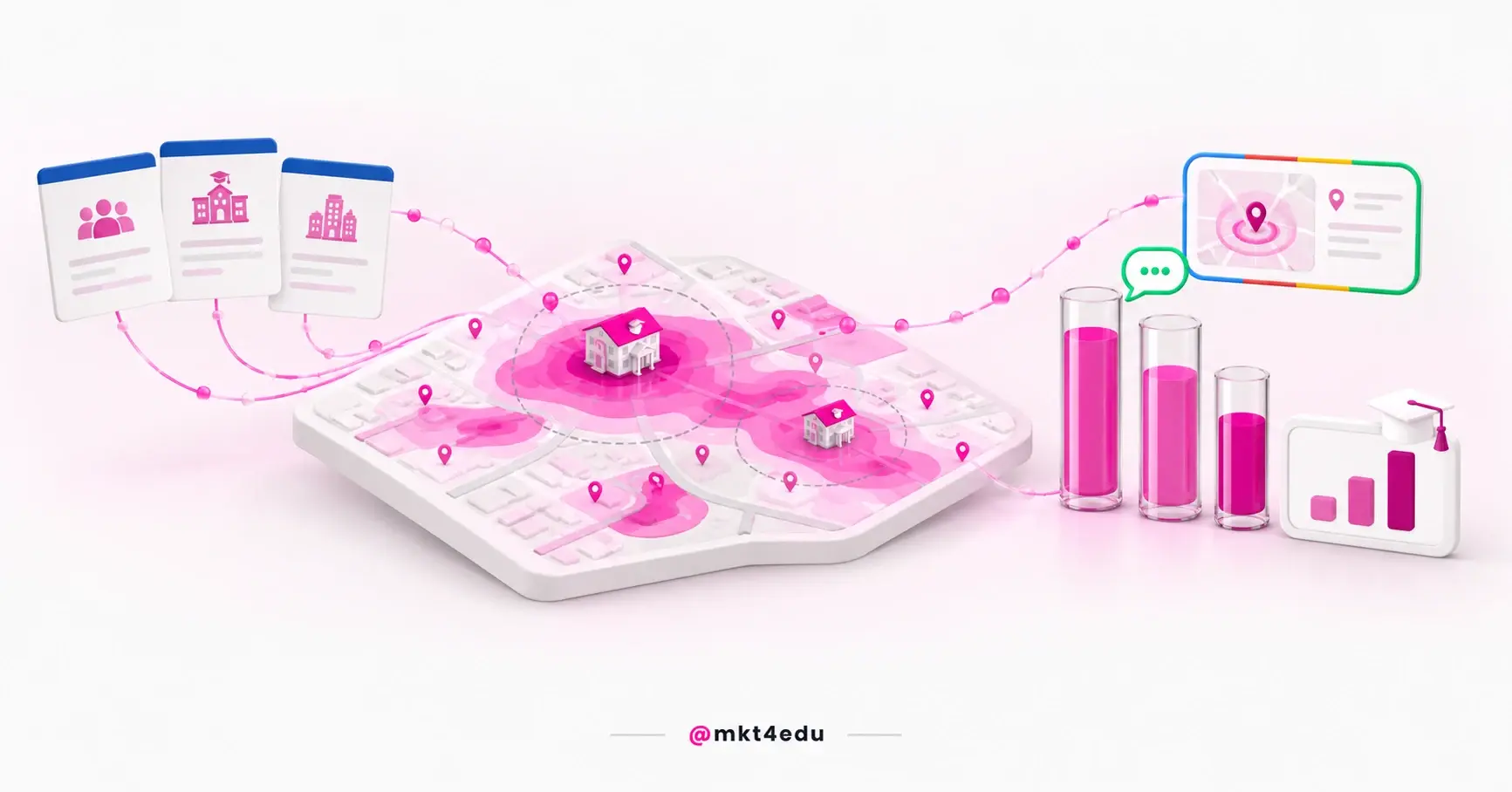
For anyone serving a region, the math has its own chapter: local SEO is worth it when there is a physical campus, because proximity searches concentrate enrollment intent and compete less with a generic AI answer.
There is one more gain that never shows up in a traffic report: brand authority starts being recognized by systems that never visited your site, because they read you cited somewhere else. That is the effect a well-distributed digital marketing strategy produces and that paid media cannot buy.
How to increase organic traffic in the age of AI?
To increase organic traffic today you have to work two fronts at once: keep winning clicks in traditional search and start winning citations inside AI-generated answers.
- Work by search intent, not by isolated keyword. Before producing, understand what the person actually wants to solve: learn, compare or hire.
- Organize content into topic clusters. A deep pillar page surrounded by interlinked satellite articles helps Google and the AIs understand that your domain covers the subject in depth.
- Answer real questions in subheadings. Framing H2 and H3 as questions raises the odds of appearing in PAA and makes extraction by AI systems easier.
- Update what already exists. Revising older content with new data and better structure usually produces faster gains than publishing from scratch, because the page already has history and backlinks.
- Take care of experience and technique. Load speed, clear navigation, structured data and well-distributed internal links still influence ranking and machine reading.
- Diversify your presence. AI systems validate a brand by looking at the site, YouTube, LinkedIn and industry mentions at the same time.
The central point is that traffic volume stopped being the only measure of success. In many cases, fewer clicks with far more intent generate more revenue than a pretty curve in the report. When the movement runs the other way, it is worth investigating the organic traffic drop before concluding the channel stopped working.
How to optimize SEO for AI?
How to optimize SEO for AI means, in practice, structuring content so language models can understand, extract and cite your pages with confidence. This is where two acronyms you will hear more and more come in: GEO (Generative Engine Optimization) and AEO (Answer Engine Optimization).
Both approaches start from the same principle: the unit of optimization is no longer only the page, it is also the paragraph. Each passage has to work on its own as a verifiable answer, with a clear subject, a direct statement and enough context.
- Short definitions at the start of each section: answer in 40 to 60 words first and go deeper afterwards. That is the format snippets, PAA and AI answers prefer to extract.
- Self-contained paragraphs: avoid passages that only make sense if the reader saw the previous one. Language models cut isolated blocks, and confusing blocks do not get cited.
- Lists, tables and comparisons with context: scannable elements help the reader and the models, as long as they come with explanation before and after.
- Structured data: markup such as the frequently asked questions type helps engines confirm what each block of the page represents.
- Entity consistency: brand name, description of what it does and author data have to be coherent across the site, social networks and directories.
- E-E-A-T signals: an identified author, cited sources, visible dates and concrete evidence of experience raise the trust that humans and machines place in the content. The E-E-A-T bar applies to the SERP and to the citation alike.
Optimizing SEO for AI also involves an editing habit that has become routine: knowing how to humanize AI-generated text before publishing. Unreviewed model output repeats formulas, asserts without a source and loses exactly the experience signals that support a citation.
For a deeper dive, SEO for LLM techniques detail how to structure content that stands out in answers from ChatGPT to Gemini. There is no shortcut: Google is explicit that content created primarily to manipulate rankings tends to perform badly, and the same applies to the AIs.
Which content optimization strategies work now?
The strategies that work today combine editorial depth with technical structure. Writing well is not enough, and marking everything up with schema is not enough: the two have to move together inside an effective content marketing strategy.
- Diagnosis: understand what already exists on your site, what ranks, what cannibalizes and where the gaps are against SERP competitors.
- Intent and persona mapping: list the real questions your audience asks at each stage and group them by intent. That map becomes your editorial calendar.
- Pillar pages and clusters: pick the subjects your brand needs to own and structure the content architecture around them.
- Production with a citable standard: direct definitions, question-shaped subheadings, sourced data, concrete examples and an FAQ at the end of each strategic piece.
- Continuous review: content is a living asset. Set a quarterly or half-yearly review cycle to keep data, links and examples current.
|
Aspect |
Traditional SEO |
SEO for AI (GEO and AEO) |
|
Main goal |
Rank links and generate clicks |
Be cited in AI-generated answers |
|
Unit of optimization |
The page and its keywords |
The paragraph and its semantic relations |
|
Winning format |
Complete, optimized content |
Short, direct, verifiable blocks |
|
Central metric |
Position, traffic and CTR |
Citations, mentions and AI referral traffic |
|
Role of authority |
Backlinks and site authority |
Entity consistency across channels |
Table: Comparison between the classic optimization model and the layers that AI answer engines now require
The two approaches do not cancel each other out. Traditional SEO makes content findable and indexable; SEO for AI makes it the piece chosen when an answer is composed. A mature content strategy works both layers at once, and that is what sustains content marketing over the medium term.
A content strategy designed this way feeds the whole sales funnel, not only the top: the same cluster that attracts the generic question answers, three clicks later, the question of someone choosing between two institutions.
How to measure SEO ROI?
How to measure the ROI (Return on Investment) of SEO is to compare the revenue generated by the organic channel with the total cost of the investment, using a direct formula: ROI = (revenue attributed to organic - cost of investment) / cost of investment x 100.
The challenge is not the formula, it is the attribution. Getting to a reliable number takes four steps.
- Define the total cost: add up team or agency investment, tools, content production and technical improvements in the period.
- Track organic conversions: set up in analytics and in the CRM which actions count as a conversion and tag the organic origin of each one.
- Attribute revenue: connect organic conversions to the value they actually generated. In long cycles, such as education, the CRM is indispensable to link the first blog visit to an enrollment months later.
- Account for value over time: content published today produces results for years. Judging ROI only in the quarter of publication understates the channel's real return.
With AI in play, new signals appear: presence in AI Overviews, citations in generated answers, and referral traffic from tools such as ChatGPT and Perplexity, which already show up as a source in analytics reports. Google Search Console itself now offers data on site performance inside AI search experiences.
One important caveat when reading the data: a drop in clicks does not necessarily mean a drop in results. If impressions grow, the brand appears in AI answers and the leads arriving convert more, the channel may be healthier than ever. That is why the recommendation is to anchor the analysis in revenue and pipeline, not only in sessions.
How do you decide how much to invest in SEO?
Deciding how much to invest in SEO is a sizing question, not a price-list question. The starting point is the cost you already pay per lead in paid media: if organic needs twelve months to cover half that volume, the budget has to survive those twelve months without depending on a result in month three.
- Scope: number of pages to produce and revise per month, plus the technical debt to fix.
- Competition: the more site authority competitors have accumulated, the more time and volume the plan requires.
- Desired speed: pulling results forward costs more in production and link building, and still does not compress indexing time.
- Capacity to absorb: there is no point generating organic demand the sales team cannot handle within the deadline.
Understanding how to invest in SEO with predictability means treating the spend as asset building, with growing return over time, rather than an isolated monthly expense. It is the same logic an inbound marketing strategy applies to content and an inbound sales strategy applies to a rep's time.
In practice, how to invest in SEO is a question of order: fixing what blocks indexing usually pays back faster than publishing new volume. An SEO strategy that respects that order avoids paying twice for the same content.
When in doubt about where to start, the diagnosis comes before the budget. An SEO strategy without an initial audit spends money fixing what was not broken and leaves out what was. That is the same reasoning behind a mature inbound marketing strategy, where today's investment answers for demand six months out, and behind an inbound sales strategy that accepts fewer contacts with more context.
Frequently asked questions about whether SEO is worth it
SEO worth it: what to do next week?
It is worth it, and perhaps more now than before. AI did not kill search, it raised the bar. Brands producing clear, structured and reliable content now occupy two spaces at once: traditional results and AI-generated answers. The ones ignoring that movement will gradually disappear from both shop windows.
The best moment to start is exactly this one, while most competitors are still undecided. Whoever structures topical authority now, organizes their content and fixes the technical side of the site tends to hold a position that is very hard to reach for anyone entering a year or two from now.
The first concrete step is knowing where you stand. An SEO audit shows, with data from your own site, what is blocking organic results and what is already ready to be cited by the AIs, and it is what turns the budget question into a plan with an order of priority.













 Portugal