




Every month, thousands of people visit pages for courses, products, and services, read long articles, and leave without providing their contact information. The problem is rarely the traffic—it’s the format.
An interactive funnel solves this by inviting visitors to participate: they answer questions, perform calculations, and make comparisons—and in return, provide the data that the lead generation and sales teams need.
Instead of waiting for someone to read all the way to the end and click on a generic form, you create an experience that qualifies their interest as it unfolds.
In educational marketing and B2B, this shift matters a great deal. The prospect or buyer wants answers about price, duration, scope, and return on investment before speaking with a consultant.
When the page itself provides these answers in a personalized way, the conversation begins much earlier.
This article explains why this model works, how to apply it to student and client recruitment, and how to measure each outcome.
What is an interactive funnel, and how does it work?
An interactive funnel is a conversion path in which the user actively participates rather than just consuming information: they take a quiz, use a calculator, or complete an assessment and receive a personalized result.
This exchange of value transforms passive visitors into qualified leads right within the experience itself.
The logic is simple. At each stage, the visitor provides a small piece of information and receives something useful in return.
For example, they indicate their area of interest and see relevant courses or solutions. They provide their disposable income or company size and discover payment plans and tailored proposals. Each micro-step reduces friction and increases engagement with the process.
Unlike a text that gives everything away at once, the interactive funnel guides the visitor. It asks questions in the right order and adapts the next step based on the previous answer. This creates the feeling of personalized service, even at scale and through automation.
At the end of the experience, the personalized result serves as the reward that justifies the registration. The person wants to receive the complete analysis, simulation, or recommendation, and is therefore much more willing to provide their name, email, and phone number.
That’s why the interactive funnel isn’t just a decorative element on the page. It’s part of marketing strategies that reorganize the customer journey around engagement, and it’s precisely this engagement that drives conversion gains.
Why does the interactive funnel convert better than passive content?
Because engagement fosters reciprocity and immediate results. According to data compiled by Interact on content conversion, interactive content converts moderately or very well in 70% of cases, compared to 36% for passive content.
Those who interact provide information and receive value immediately, which reinforces their decision to move forward.
This difference stems from behavior. Reading a text is a low-commitment activity that’s easy to walk away from.
On the other hand, answering a question requires a small personal investment, and each answer increases the desire to reach the final result.
The interactive format also personalizes the experience. Instead of showing the same message to everyone, it tailors the content to the respondent’s profile. The candidate or customer feels that the content speaks directly to their situation, and this perceived relevance drives higher conversion rates.
There’s also a practical effect on qualification. Passive content yields, at most, a single click. The interactive funnel delivers structured responses that reveal who the person is, what they’re looking for, and what stage of the decision-making process they’re in.
This same principle aligns with that of pages built around the product or service itself, where the user experience becomes the key to conversion. When the tool is the content itself, the value is delivered before the form, not after it.
It’s worth being careful with the language here. No format converts on its own: the offer, traffic, and customer service remain decisive factors. What the data indicates is that, under similar conditions, the interactive experience tends to consistently outperform static content.
Quizzes and calculators: why does this combination boost the conversion rate?
This combination works because it brings together discovery and decision-making. The quiz segments the audience and engages them, while the calculator translates their choice into concrete numbers.
According to the Interact’s quiz conversion report, the average completion rate for lead-generation quizzes is close to 40%, meaning that about four out of every ten people become leads.
The quiz serves both an emotional and a screening purpose. It piques curiosity with lighthearted questions (“Which course is right for you right now?” or “Which plan fits your business?”) and, at the same time, gathers insights into areas of interest, needs, budget, and goals.
The calculator serves a rational purpose. It answers the question that holds up the decision: how much does it cost, and what do I get in return?
In this scenario, simulating monthly payments, completion time, savings generated, or return on investment removes the main source of doubt before sales contact.
Together, the two cover the entire journey. The quiz sparks interest and reveals the user’s profile; the calculator confirms feasibility and provides the final push. One tool sets the stage for the other, and the transition between them keeps the user engaged.
There’s also a data benefit. In the end, you don’t just have a lead—you have a lead with context. You know the desired course or solution, the investment range, and the level of maturity, which allows you to prioritize service and personalize your approach.
There are other useful formats, such as profile assessments, comparison tools, and diagnostics. The repertoire of digital marketing tools available today is extensive, but quizzes and calculators stand out for addressing, respectively, the questions “Is this right for me?” and “Can I afford it?”
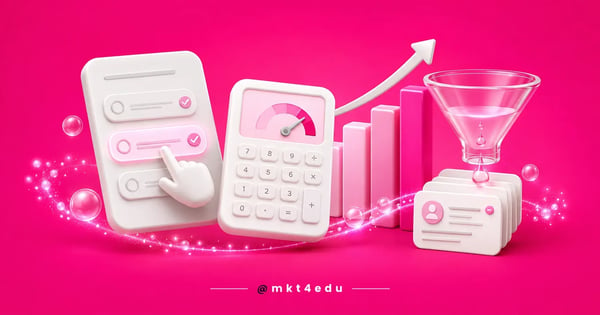 Caption: Combining quizzes and calculators in an interactive funnel increases engagement and accelerates the generation of qualified leads.
How can you use an interactive quiz funnel to attract students and customers?
Use the interactive quiz funnel at the points where the prospective student or buyer hesitates: choosing a course or product, questions about the format, and concerns about the investment.
Place the quiz at the top to attract and segment prospects, use the calculator in the middle to provide financial reassurance, and connect the results to a consultative service that closes the enrollment or sale.
Start with the most common question. Many prospective students don’t know which course to choose, just as many buyers don’t know which plan to sign up for.
A career aptitude or compatibility quiz solves this problem and, as a bonus, provides your team with the applicant’s predefined area of interest.
Next, address the financial objection. A calculator for tuition, scholarships, payment plans, or return on investment shows that the offer fits within their budget. When the applicant or customer sees the actual number, the conversation shifts from price to enrollment or closing the deal.
Where these tools are placed matters. They’re most effective when embedded in a landing page designed for conversion, with a single focus, no distracting menus, and a form integrated into the outcome of the user experience.
Traffic also needs to be planned. Targeted ads drive the right audience to the quiz, and the cost per lead tends to drop when the page converts better. Combining these tools with well-structured paid media campaigns expands reach without inflating the cost of acquisition.
Finally, close the loop with customer service. Leads that emerge from the funnel already qualified should be quickly added to the CRM and contacted in a way that matches the context they provided.
How to convert a lead depends as much on the experience as on the speed of the human response immediately afterward; the same applies to a student recruitment team or a B2B sales team.
It’s worth remembering that part of the journey takes place outside your website, on search engines that already provide answers right on the results page.
Therefore, understanding the behavior of searches that end without a click helps you decide how much value to anticipate before the visit and how much to reserve for further down the funnel.
How do you calculate the lead conversion rate in the interactive funnel?
The formula is: (conversions ÷ visitors) × 100—that is, divide the number of conversions by the total number of visitors and multiply by 100.
If 1,000 people accessed the calculator and 400 became leads, the lead conversion rate is 40%. The same calculation applies to sign-ups, enrollments, and sales at each stage.
Knowing how to calculate the lead conversion rate is what separates intuition from control. Without this number, you don’t know if the tool is working or where the funnel is leaking.
The secret lies in measuring by stage, not just the final result. Track how many people started the quiz, how many finished it, how many opened the calculator, and how many filled out the form. Every drop in numbers between stages points to an area for improvement.
The same logic applies to the sales conversion rate. Once a lead becomes an opportunity, calculate how many opportunities resulted in enrollment or a closed deal. This way, you can see the entire journey, from visitor to student or paying customer.
Always compare with a previous period or with an alternative version of the page, since a single number tells you very little. A rate that rises from 28% to 40% after replacing text with a calculator speaks volumes.
Decisions based on this data become more accurate as the volume increases. Structuring the analysis of these metrics with the support of data science applied to lead generation helps predict results, prioritize channels, and adjust the offering based on evidence.
Traditional funnel or interactive funnel: which one delivers better results?
The traditional funnel delivers ready-made content and waits for the click; the interactive funnel guides the user through a personalized experience and captures data at every step.
The comparison below shows where each model excels, so you can make an informed decision without relying solely on opinion.
|
Criterion |
Traditional Funnel |
Interactive funnel |
|---|---|---|
|
Visitor’s role |
Passive, just reads |
Active, responds and calculates |
|
Personalization |
Low, single message |
High, tailored to the response |
|
Data collected |
Click and generic form |
Profile, interest, and context |
|
Value moment |
After registration |
During the experience |
|
Lead Qualification |
Manual, done afterward |
Automatic, done immediately |
|
Setup effort |
Less at the beginning |
Higher at the start, scalable later |
Table: This comparison is intended as a planning reference, not a hard-and-fast rule: results vary depending on supply, channel, and audience maturity.
The table makes one point clear: the interactive funnel requires more preparation, but yields richer leads that are ready for the sales team. The traditional model remains useful for cold traffic and top-of-funnel content, but it usually stops at the click.
In practice, the two coexist. You can nurture your audience with articles and other materials and reserve the interactive funnel for decision-making moments, when personalization makes a real difference in the conversion rate.
How do you set up an interactive sales funnel step by step?
Set up the interactive sales funnel in five steps: define the goal, choose the right tool, script the questions, integrate the results into the form, and connect everything to the CRM.
Start simple, measure each step, and refine based on the numbers—without trying to automate everything at once.
The first step is to define the business objective—for example, college entrance exam registrations, leads for graduate programs, product demos, or re-engaging those who abandoned their enrollment or shopping cart. The objective determines the tool and the script.
Next, choose the format. Questions about “which course” call for a quiz. Questions about “how much it costs” call for a calculator. Often, the best approach is to combine both into a single experience.
Then, write the questions carefully. Start with light-hearted ones to build momentum, and save the contact fields for the end, once the person has already invested some time. Each question should have a clear purpose: to collect data or increase engagement.
The fourth step is to link the result to the registration form. The visitor only sees the assessment or the complete simulation after providing their contact information. This is the moment when the experience turns into a lead.
Finally, integrate the results with your CRM and customer service. The lead needs to reach the team with all the captured context so that the first outreach is already personalized.
Fitting the funnel into a well-defined inbound marketing strategy ensures that lead nurturing and follow-up sustain what the tool has started.
Don’t underestimate the importance of driving traffic and content around the funnel. Effective content marketing attracts the right audience to the tool and keeps those who haven’t yet converted engaged until they’re ready to make a decision.
What mistakes can derail conversion in an interactive funnel?
The most common mistakes are asking for data too early, unnecessarily prolonging the quiz, promising one result and delivering another, and failing to integrate the lead into customer service.
Each of these breaks trust or disrupts the flow of the experience, and that’s what causes the conversion rate to plummet even with good traffic.
Asking for contact information before delivering value drives people away. If the form appears on the first screen, the person hasn’t had time to realize why it would be worth filling it out, so save the registration for after they’ve engaged with the content.
Long quizzes are tedious. Every extra question is a chance for the user to drop off. Stick to the essentials, cut out anything that doesn’t provide useful data, and show progress so the user knows they’re nearing the end.
Making promises you don’t keep destroys credibility. If you advertise a personalized assessment, deliver a result that truly reflects their answers. Results that are too generic are frustrating and reduce the likelihood that the lead will move forward.
Ignoring response speed wastes your effort. A hot lead cools off quickly. Without a streamlined follow-up routine, the funnel just collects leads that no one acts on in time.
There’s also the mistake of overlooking visibility in AI-assisted searches. Structuring clear responses, aligned with best practices for optimization for response engines and AIhelps attract to the funnel those who are already seeking information to make a decision and are closer to signing up or making a purchase.
Frequently Asked Questions About the Interactive Funnel
Is it worth setting up an interactive funnel right now?
Yes, and for one simple reason: your audience already expects quick, personalized responses before speaking with someone. The interactive funnel delivers exactly that and, along the way, qualifies the lead for you.
While passive content waits for a click, the interactive experience guides the decision-making process and provides data that the sales team can use the very same day.
If your pages get traffic but have low conversion rates, the bottleneck is likely not volume—it’s format. Replacing a long piece of text with a quiz that segments the audience or a calculator that addresses price objections tends to make a noticeable difference in results, whether you’re recruiting students or acquiring customers.
If you want to build this kind of experience systematically, mkt4edu helps you design the funnel, integrate it with your CRM, and turn visits into enrollments and sales.
It’s worth basing your decision on data science applied to recruitment and talk to the mkt4edu team to get your first interactive funnel off the ground.


.jpg)























 Portugal