






Knowing how to run student recruitment matters more every year, and it is a skill fewer teams have than they think. During the application and back to school window, institutions try to solve the same puzzle: how to attract candidates and grow enrollment numbers.
Targets get set and strategies get built to reach them. The problem is that the contest has hardened. In Brazil, the 2024 Higher Education Census shows online programs already in the majority, at 50.7% of undergraduate enrollments, growing 5.6% over 2023, far below the 20%-plus yearly pace of the expansion years. On-campus enrollments fell 0.5% in the same period.
The pattern travels beyond that market. When easy growth ends, every enrollment you win comes out of preference, and preference is built through relationship.
None of the ideas matter, though, if the school or university has no real educational marketing behind them. If your institution has not invested there yet, educational marketing combined with inbound marketing can lift enrolled student numbers considerably.
What follows is how to modernize your communication strategy: the role of digital marketing in student recruitment, and how to sharpen your inbound strategies to attract more students.
Why is marketing essential to student recruitment?
If you are still asking how to attract students to your school, marketing is part of the process that shapes a future student's decision to join your institution. It does not close the enrollment on its own, but it decides who reaches the conversation at all.
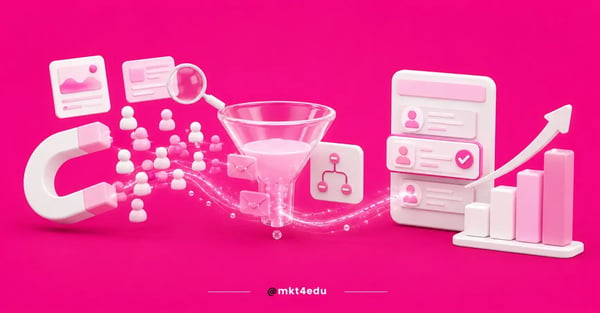 Caption: Student recruitment through inbound is one continuous sequence: attract, nurture and hand a qualified lead to admissions.
Marketing is how you build a bond with a prospective student, and that contact has to be carefully planned. Want to know how to get past indifference, talk to a future applicant and win them over?
The answer is to use inbound marketing strategies. They are what set your institution apart in the education market and win the candidate.
In short, inbound marketing is a strategy built to attract, convert, sell and delight. It is attraction marketing: instead of interrupting the candidate, you show up at the moment they are already searching.
The goal is that, through relevant communication, you create a relationship with the prospective student and lead them along a buying journey known as the sales funnel.
How does the sales funnel carry a candidate to enrollment?
Inside that funnel, the future student starts as nothing more than a visitor, and the content produced through inbound marketing is what moves them forward and turns them into a lead. The candidate's path is long and needs attention, so they do not stall in the funnel and lose interest.
You have to follow them and nurture them with content about the program they are considering, until they become an enrolled student.
What changes from one institution to another is where the funnel leaks. At some, visitors never become leads, because no page offers a reason to convert. At others, leads reach admissions with no history, and the conversation restarts from scratch.
Mapping that leak before raising budget is what separates student recruitment that scales from student recruitment that just gets more expensive. Without the diagnosis, more traffic only widens the same waste.
It also helps to align on how the sales funnel works in education before defining stages, because marketing and admissions need to use the same vocabulary.
How do you do SEO and SEO for AI to build organic traffic?
Doing SEO is what makes the content your institution produces findable by people researching programs. Without organic traffic, inbound becomes content production with no audience, and the top of the funnel never fills.
The starting point is choosing terms candidates actually type. Searches like "evening nursing degree" or "how much does a school administration masters cost" carry less volume than generic terms, but they bring people closer to a decision.
Search behavior itself has shifted. The SparkToro study using Similarweb clickstream data found 68.01% of searches ended without a click between January and April 2026, compared with 60.45% in 2024.
That is why SEO for AI entered the picture. It means optimizing to be cited inside the generated answer, not only to rank a link. In practice, answer the question in the first sentence, use data with a named source and keep each passage self-contained.
SEO for AI does not replace classic SEO, it rests on it. Well structured content, clear headings and a consistent mesh of internal links serve both the crawler and the system assembling the answer.
How does content production support attraction marketing?
Content production is the fuel of attraction marketing. It gives a candidate a reason to reach your institution before they are ready to apply, and it sustains the relationship across the whole cycle.
The most common mistake is producing only institutional content. Program pages and event announcements serve people who already know the school, but they do not attract someone still deciding between two careers.
Content marketing that works in education answers the questions that come before the choice: which career suits a given profile, what the job market looks like in a field, what actually differs between two study formats.
A simple ratio helps keep the balance. For every piece about the institution, produce three about the candidate's question. That is what keeps attraction marketing alive outside the application window.
How does marketing automation accelerate student recruitment?
One technology that helps considerably in student recruitment is marketing automation. Keeping communication with the lead alive through current content matters, and automation is what makes that possible at scale.
Imagine your institution needs to nurture a hundred candidates a day by email and messaging. Now imagine doing it manually: calculate how much time that would take, and how many other processes would fall behind as a result.
This is where automation both speeds up and simplifies the lead nurturing routine. Another advantage is that it runs continuously, every day, without breaks.
While institutions are closed on weekends, enrollment numbers keep moving thanks to the automation that carries the lead through the sales funnel, automatically delivering the content that pushes them to the next stage.
One caution avoids the opposite effect. Marketing automation without segmentation becomes mass mailing, and mass mailing burns the database. The sequence has to react to what the candidate did, not only to the calendar.
How do you build inbound strategies for each program?
Since we are talking about automation, it is worth reinforcing the importance of nurturing the lead. Well crafted content, such as an email sequence, a message flow or a blog post like this one, is what nurtures and wins over your future student.
The more a student learns about the institution and what makes a program different, the stronger their interest in enrolling and starting. At this point, you need strategies built for each program individually.
Do not treat every subject generically. Showing what each program offers is essential to converting the student.
Prioritize answering doubts about each degree, produce content about the job market in each field and invest in ebooks about specialization opportunities.
Treating each program individually shows command of the field and builds closeness with the student, whose questions get answered, which raises the chance they join your institution.
How does a persona improve lead prospecting?
You already know you need emails and communication sequences for your leads, but that content has to be strategic. Think about what your institution publishes: who are you writing for?
Understanding the profile, the difficulties and the desires of your audience is essential to creating content that gets attention and makes a student see themselves in it.
If you do not know who your target audience is and what they need, that is a sign you urgently need a persona.
Built from data collected about your audience, a persona is a profile shaped around their pains and goals. It is what lets you define the language and the format of your communication, and guides sharper content production.
In lead prospecting, the persona has a direct and measurable effect: it decides which questions the team asks on first contact. Asking about schedule and commute qualifies a teaching candidate better than asking about budget.
How do landing pages generate qualified leads?
Landing pages are the pages that turn visitors into leads. The candidate receives something valuable, such as an ebook, a practice test or webinar access, and gives back the details that let the institution continue the conversation.
Lead quality starts with the form. Too many fields lower conversion, too few fill the database with contacts and no context, and the balance usually sits at name, email, phone and program of interest.
The offer is the other decision that separates a qualified lead from a loose one. Generic career material attracts the merely curious, while a comparison between two of your own programs attracts someone already choosing.
Landing pages also have to talk to the rest of the operation. When the data collected feeds marketing automation and reaches the CRM, the admissions team knows what the candidate read before picking up the phone.
How do you measure student recruitment and relationship marketing?
Measuring student recruitment means tracking movement between stages, not just total enrollments. Without a conversion rate per stage, there is no way to tell whether the problem is attraction, page conversion or the admissions conversation.
Four numbers cover the cycle: visitors arriving from organic traffic, landing page conversion rate, the share of qualified leads within total leads, and cost per enrollment.
Relationship marketing comes after that diagnosis. It is the work of staying in touch with people who did not enroll now but might next cycle, and with current students who can refer others.
This is where student recruitment stops being a campaign and becomes a continuous operation. A base kept warm through relationship marketing lowers the cost of the next cycle, because part of the demand already knows the institution.
Anyone who wants to go deeper on reading results will find the detail in what qualified leads are and how to identify them.
Frequently asked questions about student recruitment
Where should you start fixing your student recruitment?
Start with the number that hurts. If the site gets visits and produces no leads, the problem is in the landing pages and the offer. If it produces leads and no enrollments, the problem is in nurturing and in the handoff to admissions.
That diagnosis is worth more than any budget increase, because student recruitment rarely fails for lack of traffic. It fails at the seams between stages, where nobody is looking.
Want to go further on personas and new strategies? Go deeper into inbound marketing and put it to work at your institution. Download our ebook and discover the tools that will help your university innovate and win more students.

























 Portugal