


People searching for which inbound marketing agency serves the education market are usually at one of two moments: they have just discovered that recruiting through ads got too expensive, or they already produce content and see no enrolments coming out of it. In both cases the problem is not the methodology, it is the operation.
This article comes from mkt4edu, an inbound marketing agency for education. Inbound marketing was born as HubSpot's methodology, which is why an agency's partnership with HubSpot is one of the few signals a reader can verify alone, on a public page, before any meeting.
Which inbound marketing agency serves the education market in Brazil?
By the criterion this article defends, the agency that serves the education market is the one running content, SEO (Search Engine Optimization), automation and CRM inside the student recruitment calendar, and proving it with named institutions.
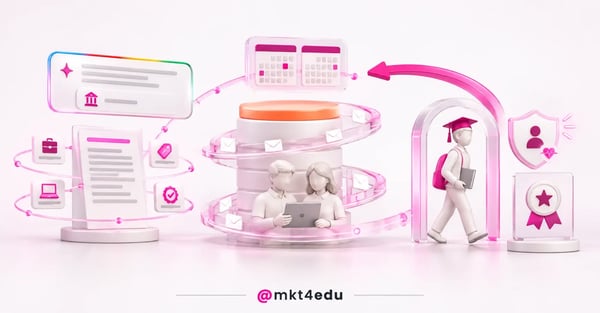 Caption: an inbound marketing agency for education links content, CRM and service in one cycle, from research to re-enrolment
Transparency comes first, because this article has an interest in the answer. mkt4edu, which signs the text, states that more than 200 education institutions trust its expertise, which is the agency's own claim rather than an independent assessment.
The same criterion serves to assess any agency, including the ones that do not appear here.
One market figure shows the urgency. According to the 16th Higher Education Map by Semesp, distance learning reached 50.7% of enrolments in 2024 and overtook on-campus study for the first time.
What is educational inbound marketing and how does it differ from generic inbound?
Educational inbound marketing applies the inbound methodology to the journey of someone choosing where to study: attract with useful content, engage with nurturing and delight after enrolment. It differs from generic inbound on four points: a decision cycle of months, admissions seasonality, a decision split between candidate and family, and a relationship lasting years.
The base definition comes from HubSpot itself, which describes the methodology as the growth method of building meaningful, lasting relationships with consumers, prospects and customers instead of interrupting them with traditional advertising, across the attract, engage and delight stages.
The methodology still holds as a base, and HubSpot has added a layer on top of it, stating that the core components of inbound are still essential but are no longer enough on their own.
That layer is Loop Marketing, which HubSpot describes as a four-stage framework for growing in the AI era, with the stages Express, Tailor, Amplify and Evolve. The cycle restarts with every loop, and the strategy is revised with what the previous loop taught.
The long cycle is the first difference. An undergraduate candidate researches programmes and careers two years before applying, sits the entrance exam in the final year and decides in the week of enrolment. Nurturing has to follow that timeline without turning into spam.
Seasonality is the second. An online retailer sells all year, an institution concentrates recruitment into two windows. Inbound has to build authority in the quiet season to harvest applications in the peak, and the agency that does not understand the student recruitment calendar publishes the right content at the wrong time.
The double decision-maker is the third. In undergraduate study, the candidate chooses and the family pays, so the content answers both: employability and curriculum for one, fees and accreditation for the other. In postgraduate study there is a single decision-maker, and inbound changes tone.
Re-enrolment is the fourth difference, and the most ignored. The same Semesp map records a 2024 dropout rate of 41.6% in distance learning and 24.8% on campus. Inbound that stops at enrolment delivers half the value, because the CRM that won the student is the one that can keep them.
Video: audioblog from the mkt4edu channel with three fronts an inbound marketing agency for education puts in place
What does an inbound marketing agency for education have to deliver?
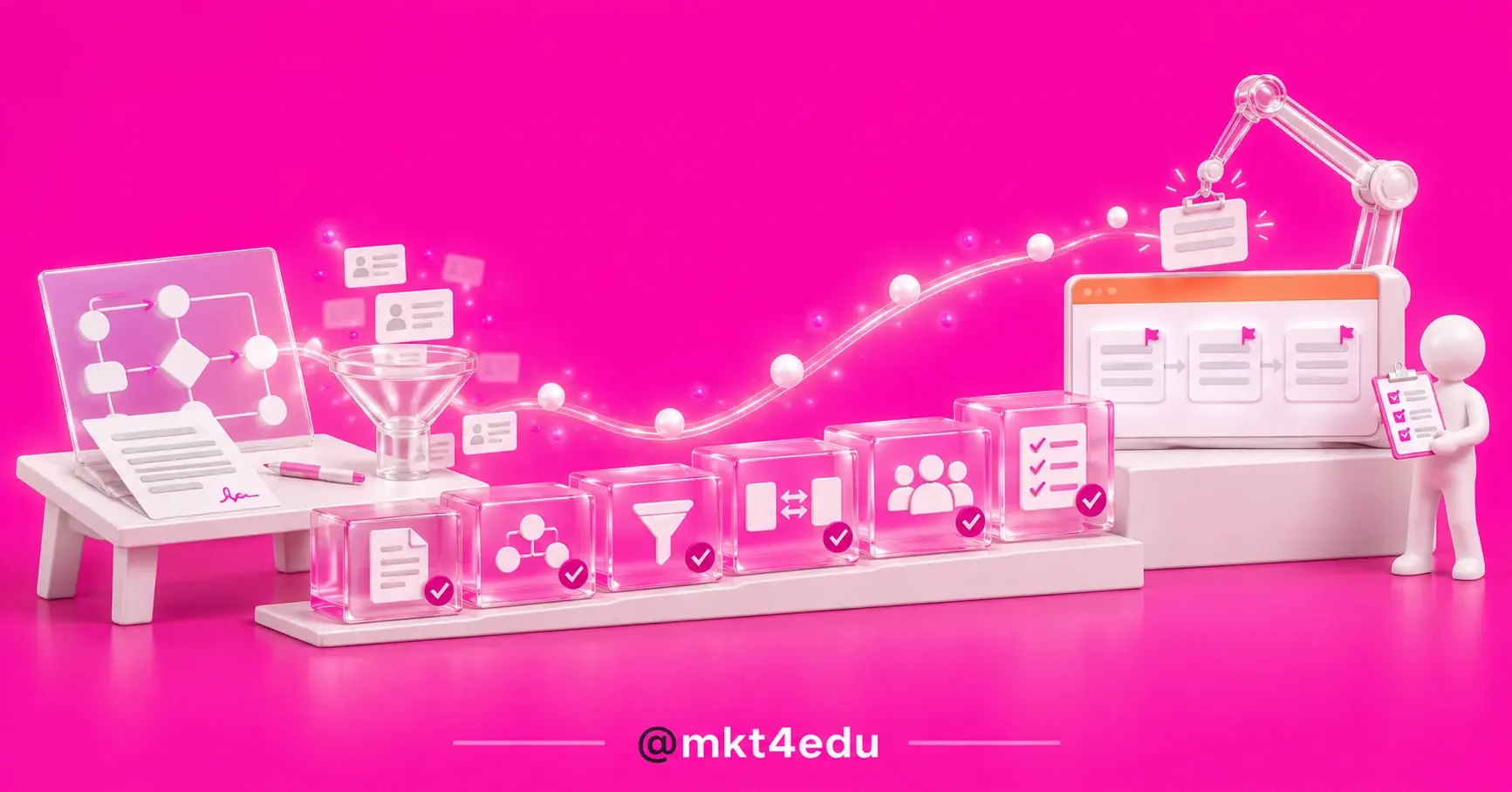
It has to deliver six integrated fronts: content with SEO, SEO for AI (Artificial Intelligence), automation and nurturing, a CRM configured for the admissions process, inbound sales aligned with the service team, and measurement through to enrolment. With any one of them missing, inbound becomes content production with no revenue attached.
Content with SEO is the front door. The agency maps the candidate's questions at each stage and organises them into topic clusters, with one pillar piece per programme and satellite articles on careers, fees and format. That map is what content planning delivers before the first text.
SEO for AI is the front that changed inbound over the past two years. According to a SparkToro study using Similarweb clickstream data, 68.01% of Google searches in the United States ended without a click between January and April 2026.
The candidate's question now gets answered in search itself, and the institution has to be the cited source. Per Google's documentation, a page is only eligible to appear as a supporting link in AI Overviews or AI Mode if it is indexed and eligible to show in Search with a snippet, and the two surfaces may use different models and techniques from each other.
Automation and nurturing turn a reader into an applicant. An email and WhatsApp sequence that changes with the stage, the programme and the exam date needs lead segmentation in HubSpot with education properties, not the default business-to-business sales model.
Inbound sales closes the cycle. The agency aligns the service team with what marketing produced, prioritising the lead who has already read about the programme and simulated the fees. The most common mistakes on that bridge are in inbound sales for educational institutions.
Here is how the six fronts spread across the funnel and what each one reports:
|
Front |
Journey stage |
Metric the agency reports |
|
Content and SEO |
Discovery and research |
Organic traffic by programme and conversion into leads |
|
SEO for AI |
Discovery in assistants |
Brand citations and leads sourced from AI |
|
Automation and nurturing |
Consideration |
Lead-to-applicant rate |
|
CRM |
The whole journey |
Cost per enrolled student by source |
|
Inbound sales |
Decision |
Applicant-to-enrolled rate |
|
Measurement and retention |
Post-enrolment |
Re-enrolment rate and dropout by cohort |
Table: the six fronts an inbound marketing agency for education has to run, with the journey stage and the metric of each one
The last row separates the inbound agency from the content shop. If the monthly report ends at leads generated, the operation stopped halfway. The education marketing strategies that deserve the name reach the enrolled student and the student who renewed.
Why is the HubSpot partnership a verifiable signal when choosing an agency?
The HubSpot partnership is a verifiable signal because each agency's tier in the programme is public, defined by sourced, assisted and managed points, and accompanied by reviews from real clients. Since the inbound methodology was created by HubSpot, the tier indicates how much the agency operates the tool behind the methodology, not just how much it talks about it.
HubSpot organises its solutions partner programme into four tiers: Gold, Platinum, Diamond and Elite, in that ascending order. The top two also require a minimum gross revenue retention over the trailing twelve months, 75% for Diamond and 80% for Elite.
To check any agency, the route is HubSpot's public partner directory. The profile shows the tier, the number of reviews, the average rating and the segments served. An agency that calls itself a partner and does not appear there deserves a direct question in the first meeting.
What the signal does not guarantee also needs stating. The tier measures tool operation and client retention, not knowledge of the admissions calendar or quality of content.
The partnership works as an entry filter, and the criteria for choosing an education marketing agency, with named cases, remain what decides.
How does inbound marketing connect student recruitment and retention?
Inbound marketing connects recruitment and retention through a single database: the CRM that recorded the candidate from the first piece of content read is the same one tracking attendance, payment and engagement after enrolment. The relationship sequence does not end at acceptance, it changes objective, from enrol to keep.
The economics are simple. Every student who drops out in the first year has to be replaced by a new candidate, with all the recruitment cost that implies. Retaining is cheaper than recruiting, as the article on student recruitment and retention details.
Video: audiobook from 4RevOps on the lead generation logic an inbound marketing agency for education applies to applications and re-enrolment
In practice, retention through inbound uses the mechanics of recruitment. Academic support content in place of career content, a re-enrolment sequence in place of the application sequence, and automatic CRM alerts when the student stops logging into the virtual environment or misses a payment.
The risk signals arrive before the formal withdrawal. Falling attendance, an open invoice and a missed assessment are properties the CRM monitors, and the agency already running the recruitment CRM can tie those properties to an automatic action.
How does mkt4edu run inbound marketing for education institutions?
mkt4edu runs inbound marketing for education institutions through the fronts offered as separate services on its site: content planning, SEO, SEO for language models, email marketing, HubSpot CRM and AI agents, plus paid media.
The HubSpot partnership is the starting point. The agency states on its own site that it is a Top3 Global HubSpot Partner with more than 400 positive reviews on the HubSpot Marketplace. In the partner directory, its profile shows the Elite Solutions Partner tier, the highest of the four, with a 4.9 rating from 407 reviews.
Specialisation in education is the second proof. The agency states that more than 200 education institutions trust its expertise and carries testimonials signed by role from Afya, Saber Educação, Faculdade Descomplica, Cultura Inglesa, Unicesumar and Grupo Tiradentes. Its declared positioning is being the agency HubSpot recommends most in the world for education.
The named cases are the third proof. The agency presents three clients with a challenge and a delivery: ESPM, in higher education, with a HubSpot CRM implementation and full marketing automation; Red Balloon, in language teaching, with a 47% reduction in cost per lead, a 24% increase in enrolments and 65% of ROI (Return on Investment) optimisation; and Grupo Central TGPM, a CRM case in healthcare.
The ESPM case is the one that speaks most to inbound. The stated challenge was the need for personalisation and intelligence in managing the contact base, with marketing automation absent, and the listed delivery is CRM, automation and relationship management.
Those results need reading for what they are: figures the agency states for specific clients in specific periods, not a promise for your institution. What they prove is the ability to run CRM and media with enrolment as the target.
On the content front, the agency keeps separate services for SEO and SEO for LLM, short for Large Language Model, the models behind assistants such as ChatGPT and Gemini. According to Semrush, visitors arriving from AI search convert 4.4 times better than traditional organic search visitors, in the company's own estimate.
The agency operates alongside 4RevOps, the RevOps (Revenue Operations) brand of the same group. In practice, the commercial process consultancy and the inbound operation come from the same team, which avoids the marketing-to-service misalignment that blocks inbound sales.
How long does educational inbound marketing take to generate enrolments?
Educational inbound marketing usually takes one to two recruitment cycles to generate enrolments attributable to organic, because the content has to be indexed, gain position and be found before the application window. In the first months the institution sees traffic and leads; the enrolment arrives when the calendar meets content that has already matured. There is no universal number.
The variable that weighs most is the starting point. An institution with an active blog, an established domain and a CRM in use tends to see results in the first cycle, because inbound organises what already exists.
An institution with no content and leads in a spreadsheet tends to need two cycles, because the first is construction. A diagnostic consultancy, before the operation, usually shortens that stage.
While organic matures, paid media bridges the gap. The agency uses ads to learn which content and programmes convert, and transfers that learning to SEO. The article on how to generate qualified leads shows how the two fronts feed each other.
What can be measured from the first month is lead quality. If the contact arriving from content reaches the service team already knowing the programme and the fees, the applicant-to-enrolled rate rises before organic volume grows, and that signal shows up in the CRM.
Frequently asked questions about an inbound marketing agency for education
Is educational inbound marketing for now or can it wait?
Educational inbound marketing is for now if your institution has at least one recruitment cycle ahead before it needs the result, because content takes that long to mature. It can wait only if the next application window is weeks away and the budget fits a single front; in that case, start with paid media.
The cost of postponing is cumulative. Every cycle without content is a cycle in which the candidate searches, finds another institution in the results or in the AI answer, and arrives at your admissions process already decided. With nearly 7 in 10 searches ending without a click, whoever is not the cited source is not in the running.
If the decision is to start, the first step is the content map by programme, with the decision questions of each one and the matching nurturing sequence. mkt4edu builds that map programme by programme, and the first conversation starts from your recruitment calendar.
That diagnosis of your recruitment funnel is what opens the conversation with our team: you leave it with the decision questions missing from your content and the order in which they need answering. Talk to us and let's build your success together.












 Portugal