







Every recruitment results meeting runs into the same question: why does it cost so much to bring in each new student? The media budget goes up, lead volume even grows, but enrollments do not follow. And the pressure from the target stays exactly where it was.
The good news is that understanding how to reduce CAC does not require cutting investment. It requires finding where the money gets lost between the click and the enrollment, and acting on those specific points.
Industry data reinforces that reading. According to the Panorama da Captação, by IPGC, 39% of administrators point to lead quality as the main challenge of the cycle, ahead of volume.
The problem is rarely generating more contacts. It is generating better contacts and making good use of them.
What is CAC and how do you calculate cost per student acquired?
CAC is the cost of acquiring one student: the sum of everything the institution invests in marketing and sales during a cycle, divided by the number of students actually enrolled in that same period.
Media budget, the sales team, tools, and campaign production all count. What did not produce an enrollment does not, because a lead is not a student.
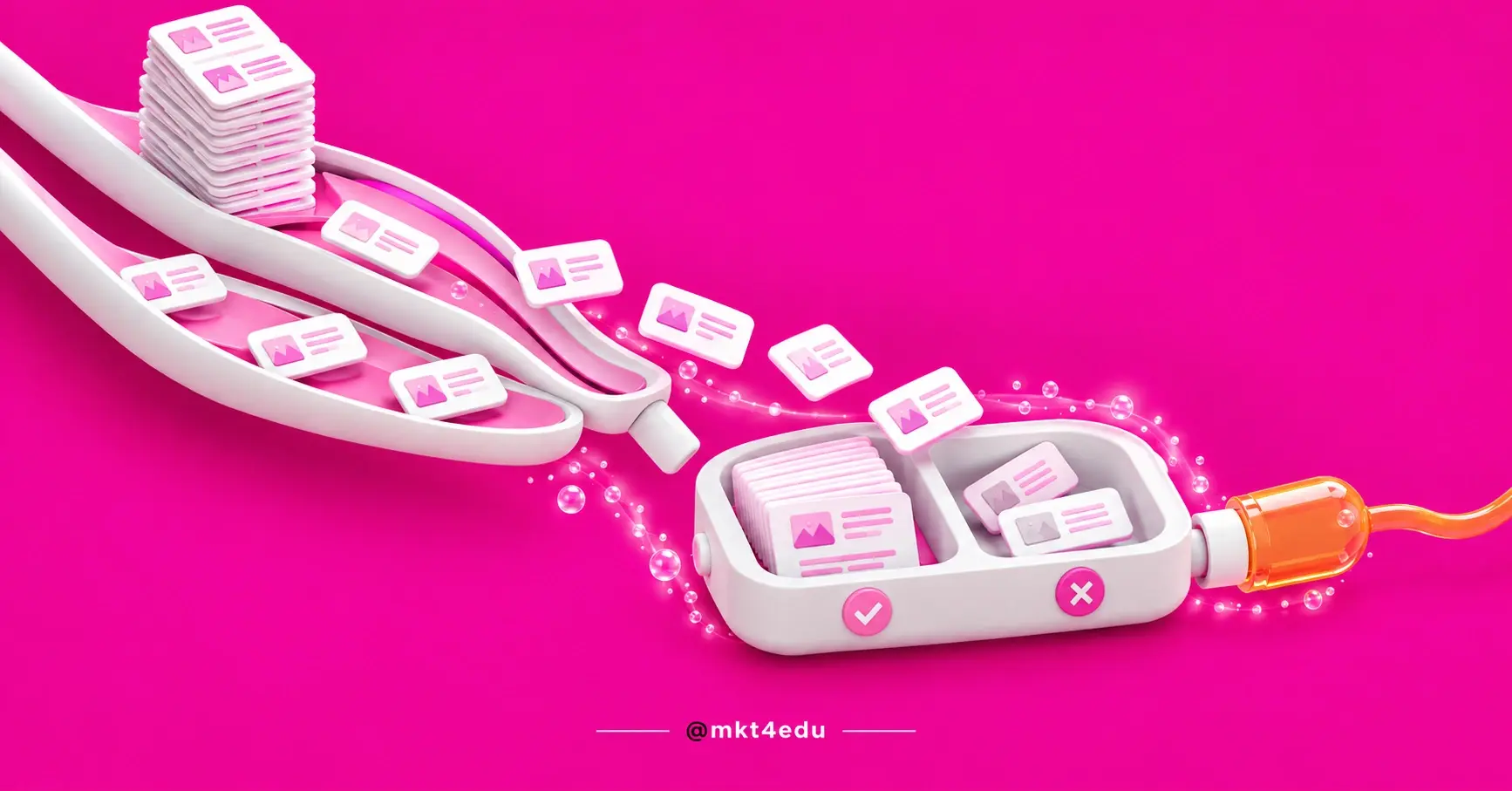
 Caption: High CAC is almost always a funnel leak: the money escapes between the click and the enrollment, not in the auction.
That distinction matters because many institutions manage recruitment by cost per lead. CPL is useful day to day, but it misleads as a final metric: a channel can deliver the cheapest lead in the funnel and, at the same time, the most expensive student.
That is why the most honest reading of CAC separates sources: on one side, enrollments that came from paid media, within the paid traffic strategy for student recruitment; on the other, those that arrived through direct search, referrals, or returning alumni. That separation reveals the real CAC of media and how much the brand already brings in on its own.
Where is your institution's CAC blowing up?
CAC blows up at predictable points: targeting that is too broad, generic creative, a landing page that does not convert, delay in the first response, no remarketing, and a CRM disconnected from media.
Before pulling any lever, it is worth running an honest diagnosis to find out which of those leaks exist in your operation.
The cost of the click weighs in too. Understanding how much paid traffic costs in the current landscape helps separate platform inflation from operational inefficiency.
Use the checklist below, marking each item that is true for your institution. The more marks, the more the problem is inside the house rather than in the auction:
- Campaigns advertise the institution in general, without separating program, format, and region.
- Current and enrolled students are not excluded from acquisition audiences.
- Creatives talk about the institution, not about the career and the life of whoever enrolls.
- A program ad leads to the home page or to an institutional page.
- The form asks for more than four or five fields at first contact.
- The first response to a lead takes hours, or depends on business hours.
- There are no active remarketing campaigns for applicants who did not complete enrollment.
- The CRM does not record the source of each lead and each enrollment.
- Media platforms optimize for leads, without receiving the data on who became a student.
- The CAC target is a single number, with no distinction between on-campus and online.
If you marked three or more items, money is being lost at points the 7 levers below attack directly.
How do you reduce CAC with 7 paid traffic levers?
To reduce CAC consistently, work on seven complementary fronts: targeting, creative, landing page, response speed, remarketing, referrals and brand, and CRM data.
The first four make the qualified lead cheaper; the last three increase the share of enrollments that arrive at a lower cost. None of them requires increasing the budget on its own: start with the most serious leak in your diagnosis.
How does targeting reduce cost per lead in education?
Targeting well is the most direct way to reduce cost per lead in education, because every click from someone who could never enroll is burned budget.
Campaigns separated by program, format, and a realistic geographic radius concentrate the budget on people with a real chance of becoming students.
In practice: respect each campus's area of influence for on-campus programs, work specific hubs and interests for online ones, use exclusion lists to take current students out of the auction, and build lookalike audiences from people who enrolled, not from people who merely filled in a form.
How do better creatives lower CPC and CAC?
Relevant creative pays less for the same space. Ad platforms reward click-through and engagement rates; an ad specific to the program, the career, and the local reality usually costs less per click than a generic institutional piece.
The pattern that tends to work is concrete: the promise of the career instead of the institution's slogan, real testimonials from students and alumni, professors known in the region, and short videos without heavy production.
Treat creative as a hypothesis, test two or three approaches per program, measure, and switch off what lost.
How does the landing page increase ad conversion?
The landing page is where the paid click becomes a lead or waste. A dedicated page per program or format, with a clear offer, social proof, and a lean form, converts more visitors on the same media budget, and that drives down cost per lead without touching the campaign.
The structure of how to create a landing page that converts is simple: one page, one offer, one form, and no distractions. Every extra point of conversion on the page is a direct reduction in CAC.
Why does response speed define CAC?
Because leads cool off fast. An applicant who fills in a form is usually comparing institutions at that very moment, and whoever answers first tends to lead the conversation.
The critical point is that a good share of leads arrive outside business hours, and if the response only starts the next day, the waste is structural.
That is why mature operations put an SDR agent on WhatsApp to answer in seconds, at any hour, qualify the contact, and schedule the next step. The ad stays the same; what changes level is how well it is used.
How does remarketing recover leads you already paid for?
Remarketing reduces CAC because it works with people who already showed interest: visitors to the program page, applicants who did not sit the exam, admitted students who did not enroll. Reaching that audience again can cost a fraction of generating a new lead, and the propensity to enroll is higher.
The common mistake is treating remarketing as a single campaign. The efficient design follows the funnel: one message for someone who visited and did not convert, another for the applicant who went quiet, another for the admitted student stuck on paperwork.
How do referrals and regional brand reduce CAC?
A strong brand is a permanent discount on CAC, because part of the students arrive through reputation, direct search, and referrals, at a much lower cost than the student bought at auction.
The IPGC Educational Tracking study shows groups with strong regional roots operating at around R$414 in marketing spend per student acquired, while others exceed R$670.
For a regional, community, or faith-based institution, that is a structural advantage: constant presence in the community, well-placed alumni, and recognized professors generate demand that advertising can hardly buy.
The part that is actionable in the short term is referrals: a structured program, with a clear benefit for the referrer and tracking in the CRM, turns the current base into an acquisition channel. A referred lead tends to be the highest-quality and lowest-cost one in the funnel.
How does CRM data optimize recruitment campaigns?
The CRM closes the loop. When media platforms receive the data on who actually enrolled, the algorithms start optimizing for students rather than for completed forms.
Without that connection, Google and Meta keep chasing cheap leads, including from profiles that never convert.
In practice: record the source of every enrollment, send funnel conversions back to the platforms, and analyze CAC by channel, program, and campaign.
This is the territory of data science applied to recruitment: models that prioritize leads with a higher propensity to enroll and reallocate budget based on evidence. It is the lever that amplifies all the others.
How does AI reduce cost per enrollment?
Artificial intelligence reduces cost per enrollment by attacking the most expensive losses in the funnel: leads with no response, contacts with no qualification, and abandoned follow-up.
AI agents respond in seconds, at any hour, qualify interest, schedule conversations, and maintain cadences a human team cannot sustain at scale.
The impact on CAC comes from utilization. If the institution is already paying for the lead, every ignored contact is investment thrown away; when leads do not convert, the problem is almost always post-click, not in the ad.
AI also improves prioritization: with propensity scoring, the sales team talks first to whoever is most likely to enroll. The funnel starts enrolling more on the same budget, and CAC falls without the budget going up.
Which CAC targets are realistic by program type?
Realistic CAC targets separate on-campus from online, because ticket size, competition, and funnel are different.
As a reference, Panorama da Captação, by IPGC, indicates that most institutions operate with an on-campus CAC of up to R$750 and a CAC of up to R$350 for online programs. Benchmarks locate your position; the right target comes from your margin and your own trajectory.
Here is how those references organize for the planning conversation:
|
Indicator |
Industry reference |
Source |
|
On-campus CAC |
71% of institutions operate at up to R$750 per student |
Panorama da Captação, IPGC |
|
Online CAC |
75% of institutions operate at up to R$350 per student |
Panorama da Captação, IPGC |
|
Lead-to-enrollment conversion |
Around 2.67% in the education sector |
Panorama de Geração de Leads, Leadster |
Table: References from recent industry surveys; each institution should calibrate targets by its own margin per program and its history of cycles.
Two cautions when using the table: acceptable CAC depends on the value each student generates over the course of the program, and the most useful comparison is with your own trajectory, cycle by cycle, not with the market average.
Also track first-semester dropout by enrollment source. Students who arrive through brand and referrals tend to stay longer. Low CAC with high dropout is a false economy.
What are the most common questions about CAC in student recruitment?
So, how do you reduce your institution's CAC sustainably?
Sustainably, CAC falls when the whole operation improves: sharper campaigns, pages that convert, immediate response to leads, active remarketing, brand working all year, and a CRM feeding media with enrollment data.
There is no single lever, but there is a right sequence, starting with the most expensive leak in your diagnosis.
The checklist in this article shows where the waste is and which of the 7 levers to pull first, without needing more budget.
If you would rather run that diagnosis with people who operate recruitment end to end, combining media, strategic educational marketing, CRM, and AI agents, the mkt4edu team can analyze your funnel and point out where your institution's CAC has the most room to fall. Talk to us and request a recruitment diagnosis.
Cutting CAC without cutting volume is the everyday problem of paid media for schools.


























 Portugal