





Knowing how to generate leads with AI has stopped being a differentiator and become a basic requirement for anyone who needs to enroll students or prospect clients efficiently.
The problem is that many people confuse scale with lazy automation: they blast the same message to thousands of people, swap in a first name and call it personalization. The result is usually the opposite of what they expected. The lead senses the robot, ignores the outreach and cost per lead goes up.
There is a better path. Used well, AI does not replace the human conversation, it gives back the time for that conversation to happen. It researches, organizes, suggests and adapts, while the sensitive decision stays with whoever understands the applicant or the client.
In this article, you will understand how to apply personalization at scale in a way that sounds human, which tools support that work and how to measure whether the strategy is actually converting into more enrollments and more sales.
What does generating leads with AI mean?
Generating leads with AI means using artificial intelligence to attract, qualify and nurture interested contacts, adapting communication to each person's profile instead of treating everyone the same.
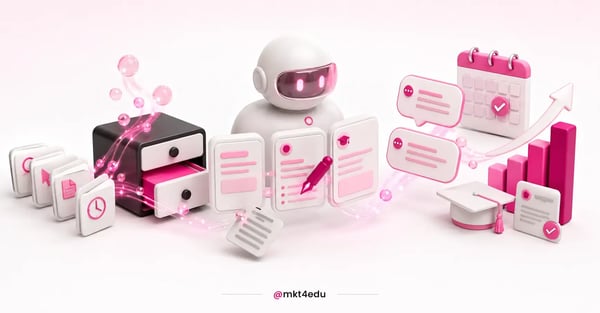 Caption: to generate leads with AI is to organize the volume of contacts so the relevant conversation reaches the right person.
Whether in student recruitment or client prospecting, it means delivering the right message, on the right channel, at the moment the lead is deciding.
AI comes in on three fronts. First, in attraction, generating content and ads better aligned with search intent. Second, in qualification, reading behavioral signals to separate who is ready from who is still researching. Third, in outreach, suggesting what to say and when to say it.
The point many people forget is that AI does not create interest out of nothing. It amplifies what already exists. If the offer is confusing or the audience is wrong, the technology will only speed up a bad process, at a school as much as at a company.
That is why the foundation is still strategy. AI is the engine, not the map. When the two move together, lead prospecting stops depending on the team's brute effort alone and starts scaling consistently.
Why did personalization at scale become the baseline?
Personalization at scale became the baseline because audiences started expecting it as a minimum, not as a courtesy. Someone choosing a university or evaluating a vendor compares options in minutes and reacts badly to impersonal messages.
AI is what makes it possible to personalize for thousands of leads without breaking the budget or the team.
The numbers explain the urgency. According to McKinsey, 71% of consumers expect personalized interactions and 76% get frustrated when they do not get them — meaning the generic message is not neutral, it creates active friction.
The financial impact reinforces the argument. The same research indicates that personalization can cut acquisition cost by as much as 50%, lift revenue by 5% to 15% and increase marketing returns by 10% to 30%.
There is also a growth effect. Faster-growing companies generate roughly 40% more revenue from personalization than slower-growing ones. In practice, that translates into more enrollments or more sales for the same investment.
Without AI, personalizing at high volume was unfeasible. Every tailored message cost human time. AI changes that math, because it takes over the repetitive part of the research and the first draft.
How do you personalize at scale without sounding like a robot?
To personalize without sounding mechanical, use AI to research and adapt real context, not to fill in empty fields.
What gives automation away is not the technology itself, it is the laziness: messages that would fit anyone, an artificial tone and no reference to what the lead actually wants.
The first mistake is the falsely personal greeting. Swapping in only the name in a text that stays templated reads worse than not personalizing at all. The applicant or client sees the mold.
The second mistake is excess enthusiasm. Sentences packed with superlatives and exclamation marks read like a script. Real people write more restrained than that.
The third mistake is ignoring context. If the lead asked about an evening course or a specific plan and the answer talks about something else, no amount of name personalization saves the conversation.
The way out is giving AI the right data: which course or solution they are interested in, where the lead came from, what they have already asked and what stage they are at. With that context, the message starts making individual sense, even though the process runs at scale.
The last piece of care is tone. It is worth keeping a human review over the brand voice, defining what AI may and may not say.
That tone control is what separates outreach that reads like service from outreach that reads like spam, something we discussed when comparing an AI SDR with a human SDR.
There is a clear difference between the two personalization models, and it helps you decide where to invest effort:
|
Criterion |
Manual personalization |
AI personalization at scale |
|
Volume handled |
Low, limited by the team |
High, without growing the team proportionally |
|
Time per message |
High |
Low, with spot human review |
|
Tone consistency |
Varies by person |
Standardizable with good instructions |
|
Use of data |
Depends on each person's memory |
Pulls CRM history automatically |
|
Risk of sounding impersonal |
Low |
Low with context and review, high without |
Table: AI does not remove the human touch, it concentrates human effort where it matters most, which is judgment about tone and context.
Note that the risk of sounding impersonal exists on both sides. Manual personalization fails through fatigue and volume. Automation fails through lack of context. The right combination solves both problems at once.
Which AI tools should you use in lead prospecting?
The most useful AI tools in lead prospecting fall into three groups: those that generate content and messages, those that organize and enrich data in an AI-powered CRM, and those that automate first contact and follow-up. The choice depends on where your bottleneck is today.
The first group is language models, used to write emails, messages and outreach scripts. They cut drafting time and help maintain quality even at high volume.
The second group is the AI-powered CRM. Here, artificial intelligence scores leads, predicts conversion probability and suggests the next action.
That is what turns a dormant database into a prioritized queue, and it is where the integration between data and service actually happens, as we showed by bringing Claude and HubSpot into a single workflow.
The third group is service agents, which take over first contact and nurturing. An AI agent can answer initial questions, qualify and book meetings, freeing the team for higher-value conversations.
To get started, it is worth understanding which AI-powered SDR tools make sense for your volume.
Implementation deserves attention too, because buying the tool is not enough. You need to design the workflow, the rules and the limits, a process we detail in how to implement an AI SDR agent without losing control of the operation.
The channel matters as much as the tool. In Brazil, a large share of the conversation with students and clients happens on WhatsApp, so it makes sense to bring AI there, as we discussed about SDR agents on WhatsApp. The common mistake is adopting many disconnected tools. The right move is to start with the bottleneck, integrate with the CRM and only then expand.
How do you use Claude to write messages that convert?
To use Claude in prospecting, you supply the lead's context and ask for a message in the brand's tone, instead of accepting the first ready-made text.
The model works best as an assisted writer: the clearer the brief, the more natural and specific the output, whether you are recruiting students or prospecting clients.
A good prompt includes four things:
- The lead's profile, such as course or product of interest and source.
- The goal of the message, such as booking a conversation.
- The desired tone, direct and welcoming.
- The rules, such as what not to promise.
It is worth asking for variations. Instead of a single message, request three versions with different angles and pick the one that sounds most human, since that avoids the templated text repeating across every contact.
Claude also helps summarize long conversation histories before a follow-up, so nobody has to reread everything. That way the renewed contact references what was already said, which increases the sense of continuity.
Beyond messages, the model supports top-of-funnel attraction. It structures articles, emails and materials aligned with what the audience searches for, a topic we go deeper into in how to create content with AI for SEO without losing editorial quality.
The principle is always the same. AI writes the draft and organizes the context, but the final review stays human. That layer of curation is what ensures the message represents the institution or the company and does not read as mass-produced.
How do you calculate lead conversion rate?
Lead conversion rate measures how many contacts move to the desired stage, such as enrollment, sale or a booked meeting.
The formula is simple: divide the number of converted leads by the total of leads or visitors and multiply by 100. The result shows, as a percentage, how much of your acquisition turns interest into action.
The math looks like this: (converted leads ÷ total leads or visitors) × 100. If 500 people filled out a form and 40 closed (an enrollment or a contract), the rate is 8%.
The number alone says little. What matters is comparison. Measure the same stage over time and by channel, so you know where AI personalization is having an effect and where friction remains.
It is also worth calculating conversion stage by stage, not just start to finish. That way you identify whether the bottleneck is in attraction, in the initial response or in closing. Each bottleneck calls for a different action.
To do that well, the data needs to be organized and reliable. Without a clean base, any rate is guesswork, and that is why data science work applied to acquisition underpins the correct reading of the numbers.
When the rate rises without lead volume falling, personalization is working. When volume grows but the rate collapses, you have probably attracted the wrong audience, and no automation fixes that on its own.
How do you apply AI to marketing strategies?
In marketing strategies, AI applies when you connect attraction, qualification and service into a single workflow, with data circulating among them.
The goal is not to replace people, it is to let every student or client get relevant attention even during peak periods, such as admissions season, re-enrollment or the end of a sales quarter.
Start with attraction. Use AI to produce content aligned with the real questions of someone choosing a course or evaluating a solution, which feeds the top of the funnel with better-qualified leads from the start.
Then adjust qualification. Let the AI-powered CRM prioritize who is most likely to close, so the team does not spend the same time on everyone. That focus is one of the marketing strategies that most moves the final result.
Next, personalize the outreach. Each lead should receive a message that recognizes the course or product of interest and the moment of the decision, whether by email or WhatsApp.
This whole machine depends on process, not just technology. In education marketing and client prospecting, the sales side needs to be designed to receive the qualified lead and carry the conversation, something we structure in our inbound sales services.
Anyone who wants to speed up that curve without building everything from scratch can rely on a ready-made artificial intelligence operation for acquisition, integrating the three fronts instead of leaving tools disconnected.
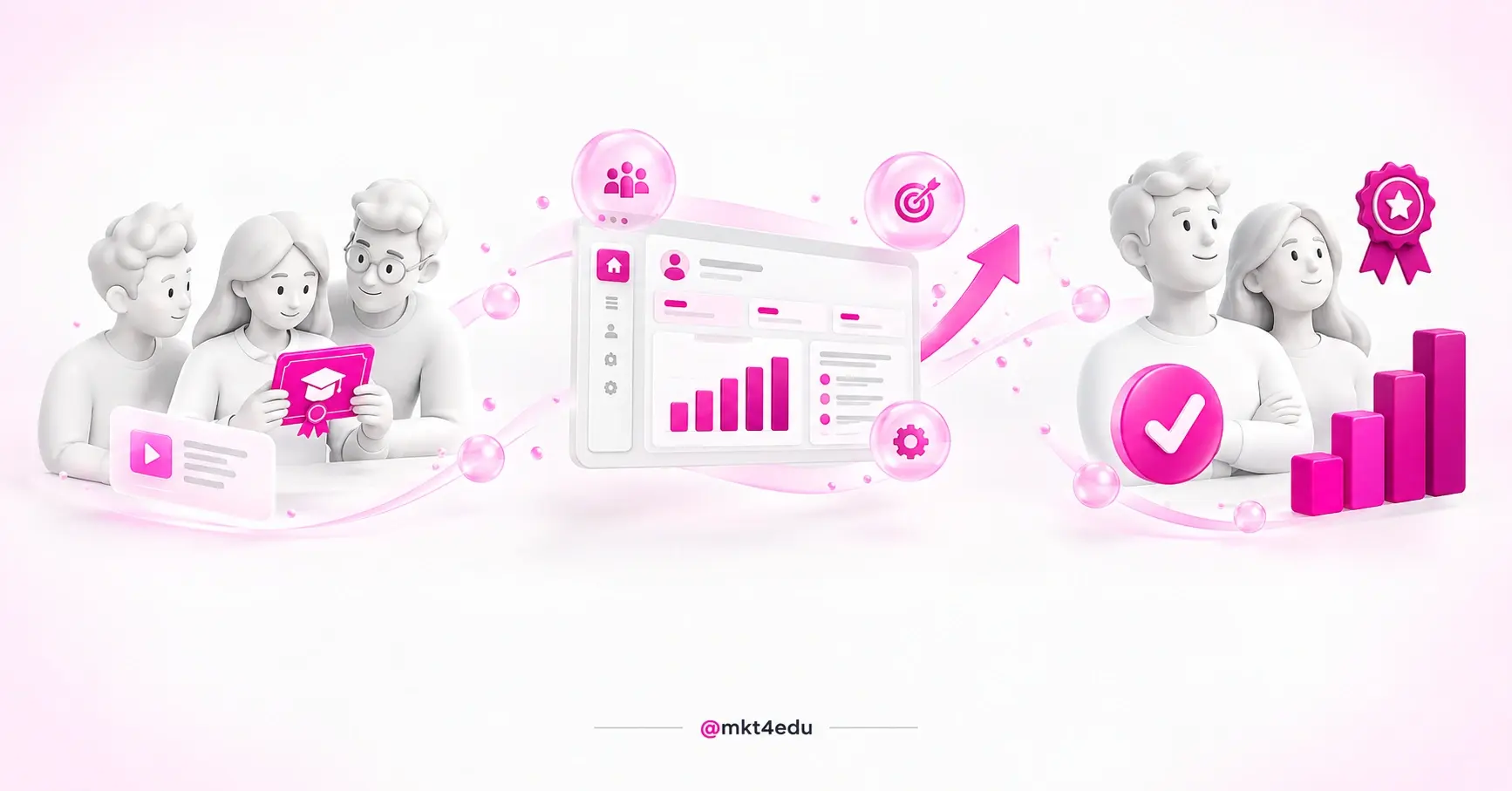
The practical result is acquisition that scales without losing the human touch. AI handles volume and routine. People handle what requires judgment. And the lead feels they talked to an attentive brand, not a robot.
Frequently asked questions about generating leads with AI
Ready to generate more leads without sounding robotic?
If you made it this far, you have already noticed that generating leads with AI is not about sending more messages, it is about sending better ones.
Scale solves volume. Personalization solves conversion. When the two work together, cost per enrollment or per sale falls and the lead's experience improves at the same time.
The most common mistake is treating AI as a shortcut to automate the template. The path that converts is the opposite: it uses AI to scale care, not to replicate the generic.
Those who do it can enroll more students and prospect more clients while spending less energy on repetitive tasks.
If you want to put this into practice, mkt4edu helps combine data, CRM and automation with artificial intelligence for acquisition. Talk to our team to build a lead generation process with AI tailored to your volume.


.jpg)
























 Portugal