


Choosing between educational marketing agencies has become harder because almost every digital agency now offers some line of marketing for schools. The word education in the menu, however, says nothing about whether the team knows admissions cycles, graduate programmes or distance learning regulation.
This content recommends no supplier. It delivers the evaluation grid you apply to any agency under consideration, with the proof that supports each criterion and the red flag that calls for one more question.
The moment calls for that care. According to Semesp's 16th Higher Education Map, Brazil reached 10.2 million enrolments in 2024, with distance learning accounting for 50.7% of them and private institutions for 79.8%. The same survey records, in 2024, a dropout rate of 41.6% in distance learning against 24.8% on campus. Recruiting and retaining students has become a data discipline, not only a media one.
One disclosure before we start: this content is published by mkt4edu, which also operates in this market. No agency is evaluated here, and the examples of good practice quoted are the agency's own statements, such as Top3 Global HubSpot Partner, not independent assessment.
Which criteria separate an educational marketing agency from a generalist one?
An educational marketing agency separates itself from a generalist one on four verifiable points: it declares education institutions as its main segment, delivers the funnel through to enrolment with CRM and sales process integration, names higher education cases with a stated metric, and shows it knows the academic calendar and the sector's regulation.
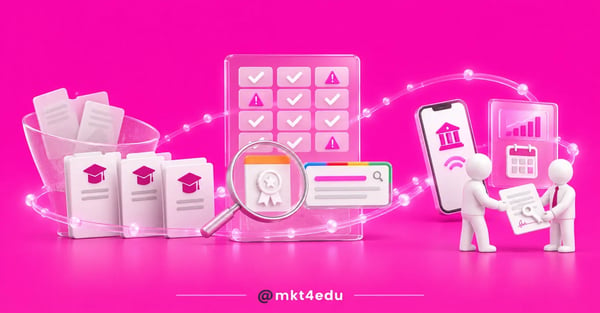 Caption: evaluating educational marketing agencies starts with a grid of verifiable criteria, before the first meeting
The first criterion is declared focus. Many of the agencies that appear in a search for educational marketing describe generalist work on their own site, with cases from retail, industry or B2B (Business to Business) and no education institution at all.
That is not a flaw, it is a different business. The institution simply needs to know it before expecting sector knowledge the agency never promised.
The second criterion is where the service stops. A generalist agency tends to measure success in leads and cost per lead, while student recruitment makes or loses money at the applicant, the approved candidate and the enrolled student.
The educational marketing metrics that matter begin exactly where media ends.
The third criterion is named proof. A site that publicly claims a college as a client creates a commitment that can be checked by reference, and a wall of unlabelled logos allows no such check.
The fourth criterion is regulatory knowledge. In ABMES's reading of Brazil's new distance learning regulatory framework, undergraduate Law, Medicine, Nursing, Dentistry and Psychology programmes are to be offered exclusively on campus.
A distance learning campaign for Psychology, today, is a mistake a sector agency should not make.
There is a fifth, less obvious sign that usually settles the doubt between finalists: vocabulary. Those who operate in education speak of recruitment cycle, applicant, approved candidate, enrolled student and re-enrolment, not only of leads and conversion.
That vocabulary shows up in the first meeting, without being asked for. When the agency translates everything into generic performance jargon, the institution's funnel has not yet entered the conversation.
How to build the evaluation grid for choosing an educational marketing agency?
The evaluation grid for educational marketing agencies turns impression into criterion. It has four columns: the criterion, what to verify, where to verify it without depending on the agency, and the red flag that signals a pending question. Each row becomes an agenda item in the first meeting.
The order of use matters more than the number of criteria. Start by eliminating anyone who does not declare your segment, then check for a platform partnership compatible with your operation, and only then compare scope and cases.
The grid also protects against comparing proposals by charm. A handsome document and a fluent presentation carry more weight than anyone admits, and a criterion written before the meeting reduces that weight. Here is how it is organised:
|
Criterion |
What to verify |
Where to verify |
Red flag |
|
Declared segment focus |
Whether the text names undergraduate, graduate and distance learning, not just education institutions |
The supplier's home page and service descriptions |
A claim to serve schools, short courses and colleges in the same sentence |
|
Funnel scope |
Whether the service reaches enrolment, with CRM, student service and an application system, or stops at media |
Service list and the scope of the commercial proposal |
A contract that ends at the lead and at cost per lead |
|
Platform partnership |
Whether the agency names the CRM platform it runs and its partnership tier |
The platform's own partner directory |
No platform named and nobody responsible for configuration |
|
Higher education cases |
Whether there is a named institution, with a stated metric and period |
Published cases and a reference check with the client quoted |
A percentage with no baseline, no period and no stated measure |
|
Own content and organic search |
Whether the agency generates organic demand for itself, not only for clients |
The supplier's blog, search engines and AI-generated answers |
A presence that depends entirely on paid media |
|
Contracting model |
Whether the contract is a project, a monthly fee or outsourcing, and what each covers |
Commercial proposal and draft contract |
Open scope, with no named deliverable and no exit criterion |
Table: a six-criterion grid for evaluating educational marketing agencies, with the proof for each one and the matching red flag
The column that saves the most time is where to verify. A platform partnership is checked in the software vendor's own directory, and a case in a call with the institution quoted, without depending on what the agency says in the presentation.
Record the answers in the same spreadsheet, with dates. Proposals arrive in different weeks, and memory of what each agency promised blurs quickly when nothing is written down.
The own-content criterion is usually the most revealing. An agency that masters SEO (Search Engine Optimization) shows up in search for the topics it sells, and not only when it pays for them.
SEO for AI (Artificial Intelligence) falls under the same reading. According to Google's documentation, there are no additional requirements or special optimisations to appear in AI Overviews or AI Mode: to be shown as a supporting link, a page must be indexed and eligible to appear in Search with a snippet. Google itself notes that the two surfaces may use different models and techniques.
The selection criteria that come before this grid, such as specialisation, scope and certification, are already detailed in the article on choosing an educational marketing agency. What the grid adds is the proof required for each criterion.
Educational marketing strategies combine media, content, CRM and student service in layers. A proposal that treats media as an isolated service rarely sustains enrolment across a whole cycle.
What changes in the evaluation for undergraduate, graduate and distance learning?
The evaluation of educational marketing agencies changes by segment because the intake rhythm changes. Undergraduate programmes concentrate student recruitment in admissions windows, graduate programmes sell to people who already hold a degree and decide quickly, and distance learning runs on continuous intake, delivery by centre and high dropout.
The numbers size the difference. Distance learning already accounts for 50.7% of higher education enrolments, according to Semesp, and the same survey records a dropout rate of 41.6% in 2024, against 24.8% on campus.
So an agency that only watches recruitment delivers students who leave within six months. Communication sequences, CRM and AI agents in student service are what connect recruitment and retention inside the same contract.
Each segment therefore calls for a different proof within the same grid:
|
Segment |
What changes in the requirement |
Proof to request |
|
Undergraduate |
Admissions peaks, with Brazil's national exam and student funding programmes on a fixed calendar |
A plan for a whole window, with media, application page and student service live on the same day |
|
Graduate |
Continuous intake, a lower ticket per student and a faster decision |
A plan for recurring organic demand and nurturing, with a stated maturation period |
|
Distance learning |
Three delivery formats, segmentation by centre and high dropout |
Campaign structure split by format and a retention plan tied to the CRM |
Table: what changes in the requirements placed on educational marketing agencies depending on the segment the institution wants to recruit for
Admissions campaigns require media, the application page and student service all working from the day applications open. That is the test where declared scope is confirmed or not.
Video: audio post from the mkt4edu channel on the fronts educational marketing agencies have to stand up in each segment
Graduate programmes are the quietest segment on the market's service pages. They tend to appear inside the cases, so asking about them explicitly becomes a mandatory meeting item.
In that segment the decision cycle is short and the bottleneck moves to student service. A reply in hours rather than days shifts the conversion rate more than the advert creative does.
It is also worth checking how the agency handles re-enrolment within the segment. In graduate and distance learning programmes, the student who finishes a course is the cheapest lead available, and most proposals ignore that base.
In distance learning, one simple question separates those who know the subject: how do you handle on-campus, blended and fully online formats in your campaign structure? The answer reveals whether the agency followed the 2025 regulatory change.
One operational detail separates those who have run distance learning from those who have only sold it. The campaign has to distinguish delivery by centre, by format and by authorised programme, because advertising an unavailable format generates leads that never become enrolments.
What proof should you request about CRM, cases and educational consultancy?
Three proofs carry most of the decision: the CRM partnership verified in the platform's directory, the case checked by reference with the institution quoted, and the prior diagnosis that shows how the agency reads a funnel before proposing investment.
CRM proof starts with who owns the account. The institution should hold the HubSpot CRM, RD Station or any other platform account, with the agency coming in as a user.
When the account belongs to the agency, switching supplier means losing contact history, and that loss weighs more than any discount negotiated.
Video: how the CRM sustains the funnel that educational marketing agencies have to deliver through to enrolment
One example of how that standard is described: mkt4edu states it is a Top3 Global HubSpot Partner with more than 400 positive testimonials in the HubSpot Marketplace, figures any reader can check in the platform's own directory.
The same goes for scope. The HubSpot CRM implementation for education institutions describes configuration, automation, integration and training, and that is the level of detail to ask of any supplier.
Case proof calls for a name, a metric and a period. In the results with ESPM, Red Balloon and Grupo Central TGPM, published by mkt4edu itself, each project appears with the indicator that was measured, which makes it possible to ask how each number was calculated.
None of those figures amounts to independent assessment, and this content is published by the agency itself. They serve as a format reference: a named client, a stated indicator and a described scope.
Ask for proof of continuity too. How long an agency contract lasts on average in the education segment, and how many institutions are active today, reveal more than the historical total of clients served.
mkt4edu also states that more than 200 education institutions trust its expertise, and describes itself as a specialist in Revenue Operations and AI for education institutions. That is the agency's own statement, the kind to request from any supplier along with the detail behind it.
The third proof is the diagnosis. Educational consultancy tends to be the step before continuous operation, because it maps where the institution loses students before investment is scaled.
Ask for that diagnosis using your own data. An educational consultancy that only presents market benchmarks, without touching your funnel, says nothing about your operation.
Which red flags call for one more question about the proposal?
A red flag does not disqualify an agency, it only signals a pending question. Five patterns appear frequently in educational marketing proposals and deserve a written answer before signing: a number with no baseline, scope with no deliverable, a platform with no owner, a case with no reference and a deadline with no maturation.
The number with no baseline is the most common. Percentages such as a 300% increase in enrolments circulate without saying what was measured, over what period and from what starting point, which turns them into claims rather than verified results.
Always ask for three data points alongside the percentage: the metric, the time window and the starting point. A number without those three does not survive a single follow-up question.
Scope with no deliverable shows up in proposals selling media management, content management and CRM management without saying how many assets, how many articles or which automations are included each month.
The fix is simple and almost never refused: ask for every line of the proposal to become a number. Four campaigns a month, eight articles, three CRM automations and one funnel report are verifiable commitments.
A platform with no owner deserves to become a clause. The contract has to state, in writing, that the CRM, advertising and analytics accounts belong to the institution, and that access continues after the partnership ends.
A case with no reference is the one that costs most later. A client quoted whom the agency cannot put on a fifteen-minute call usually signals an old project, one that ended badly, or a scope far smaller than the presentation suggests.
A deadline with no maturation closes the list. Organic content and SEO for AI take months to build demand, and a proposal promising organic results in thirty days is selling paid media under another name.
Sound educational marketing strategies live with different timelines by layer, and an honest proposal states that on the timeline itself.
What should you ask before signing with an educational marketing agency?
Before signing with an educational marketing agency, six questions turn the grid into a decision: who executes, how far the funnel goes, who owns the CRM account, which cases can be checked, how SEO enters the scope and what the contracting model is.
Each answer fits in one line of the proposal. If the agency needs an extra meeting to answer, the delay already says something about the clarity of the scope being sold.
On the team, the question avoids the most common surprise. Many agencies sell with one team and operate with another, so ask for the name of whoever will run the account and how long that person has worked with higher education.
The question about the funnel defines the contract's metric. If the agency measures up to the lead, cost per enrolment stays invisible to it, and the results discussion becomes an attribution dispute at the end of the quarter.
The question about cases asks for a reference, not a slide. Pick a name published by the agency and ask for the contact of whoever followed the project inside the institution quoted.
The question about SEO separates renting from building. A budget entirely in paid media rents demand, while the share dedicated to content builds demand that does not disappear when the campaign is paused.
Ask for the maturation period alongside the content plan. An agency that states in how many months it expects the first organic result takes on a commitment that can be reviewed at the quarterly meeting.
The contracting model closes the account. A project, a monthly fee and BPO (Business Process Outsourcing) solve different problems, and the contract has to say which one is being bought.
A good way to tie the six answers together is to ask the agency to calculate, with your data, the path from investment to enrolled student.
What actually reduces CAC (Customer Acquisition Cost) in student recruitment is what is measured in your own CRM, not the percentage displayed in a sales presentation.
Frequently asked questions about educational marketing agencies
Where should the evaluation of educational marketing agencies start?
Start with the grid, not with the meeting. Filling the six criterion rows with what is already published, before any commercial conversation, changes the nature of the encounter: instead of listening to a presentation, the institution arrives with pending questions and asks for proof.
The practical order is short. Eliminate anyone who does not declare your segment, check the platform partnership in the software vendor's directory, verify one case by reference, and only then request proposals from the two or three finalists.
The second step is to measure with your own data. No metric published by an agency describes your institution, and the only calculation that matters is the one that comes out of your own student recruitment and retention funnel.
If you would rather start with the diagnosis, you can map where your funnel loses students between lead and enrolment with the mkt4edu team, using the numbers in your own CRM.
That free diagnosis of your recruitment funnel is what opens the conversation with our team: you leave it with the grid filled in using your own data and with the order of the questions still to ask. Talk to us and let's build your success together.












 Portugal