






Every enrollment goal faces the same question: where will the applicants come from? Organic search and branding build demand over the long term, but it’s paid media that accelerates the funnel at the pace the cycle demands.
That’s why knowing how to use paid traffic is no longer just an agency’s concern—it’s now part of the admissions management team’s responsibilities. The budget for this is included in virtually every private institution’s budget, and what separates those who meet their goals from those who exceed their CAC is the method they use.
The problem is that advertising without a strategy is expensive. Rising bid prices, nationwide competition in distance learning, and leads that disappear after filling out a form cause the cost per enrollment to rise without anyone noticing in time.
This guide outlines what a manager needs to run paid media campaigns with predictability: industry benchmarks, a cycle-based calendar, effective targeting strategies, and CRM integration that converts clicks into enrollments.
How can you use paid traffic to bring predictability to your enrollment goals?
Using paid traffic predictably means starting with the enrollment goal and working backward to determine the investment. You define how many enrollments you need, apply the conversion rates for each stage of the funnel, and arrive at the required volume of leads and budget, broken down by course, program type, and region.
The math is simple and helps organize the budget discussion. If the institution wants 200 enrollments and converts 5% of leads into students, it needs 4,000 leads. At R$ 25 per lead, the investment comes to around R$ 100,000 for the cycle.
The numbers vary by program, format, and region, but the logic remains the same. The unique value that paid media offers is this ability to project results based on the amount invested.
It’s worth remembering that paid media doesn’t replace other channels. A strong regional brand, student referrals, and organic search reduce the portion of the funnel that needs to be purchased, which lowers the overall cost of acquisition.
Competitive pressure explains the urgency. The Semesp Institute reported a 5.5% increase in new students enrolled in on-campus programs and a 3.3% increase in distance learning programs at private institutions—growth that is spread across a larger number of competitors vying for the same prospective student.
There is a second reason to advertise continuously. Prospective students compare institutions for weeks, researching reputation, price, and MEC ratings before applying.
Ads keep the institution top of mind throughout this comparison process, not just at the very end. Before setting up your advertising campaign, it’s important to understand what paid traffic is and how the platforms charge, because the auction mechanics determine the cost of each decision.
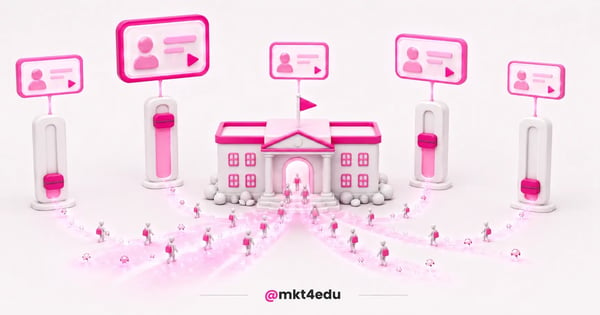
Caption: Using paid traffic means deciding how much to allocate to each channel, because the volume of candidate traffic corresponds to how much you invest in each one.
What conversion and cost benchmarks should you use when recruiting students?
The two most useful benchmarks are the visitor-to-lead conversion rate and cost per lead.
Leadster’s 2025 Lead Generation Overview indicates a 2.67% conversion rate in the education sector, compared to the Brazilian market’s overall average of 2.98%, placing the sector in seventh place among the 17 countries analyzed.
On the cost side, the most comprehensive benchmark is international. The CPL and CAC benchmarks from HubSpot show an average of $84 per lead in B2B across all channels, with Google Ads at $70.11 and LinkedIn at $110.
These figures do not apply to the education sector in Brazil and should be viewed as a rough estimate, not as a target. The benchmark that guides your operations is your own historical data, cycle by cycle.
Before comparing any numbers, it’s worth clarifying the terminology. The cost of acquisition per student is the investment in media and sales infrastructure divided by the enrollments generated from those channels, while the cost per lead is only a portion of that calculation.
The average also masks extremes. Calculate the metric separately by source and by program type, because it is common to find that one channel operates at a loss while another offsets the overall result.
This layered analysis is what transforms a report into a decision, and it is the work of well-defined educational marketing metrics. Without them, the budget is reallocated based on intuition.
One final caveat: a standalone enrollment benchmark can be misleading. An institution that enrolls students at a low cost but loses them in the first semester is not operating efficiently, which is why student recruitment and retention must be analyzed together.
How should paid traffic be used at each stage of the student recruitment cycle?
Each student recruitment campaign is organized by cycles, not by months: first- and second-semester entrance exams, the transfer period, and rolling admissions for distance learning. Within each cycle, there are three phases, and the budget must be distributed among them—never concentrated solely in the final stretch.
The classic mistake is to launch campaigns on the day registration opens. At that point, all institutions in the region are already competing for the same clicks, and bidding is at its peak.
Worse still: a prospective student who has never heard of the institution is unlikely to apply on their first exposure. You’re paying the highest click price of the year to reach the people who are least ready to apply.
The sound strategy is the opposite. The build-up generates brand awareness and low-cost leads; applications convert those who have already been reached; and the final stretch focuses on remarketing and re-engaging applicants who haven’t completed the process.
Here’s how the phases are organized within a cycle:
|
Cycle Phase |
Budget Range |
Objective |
Optimization Focus |
|
Warm-up |
30% to 40% |
Brand awareness and low-cost leads |
Qualified reach and audience building |
|
Sign-ups |
40% to 50% |
Convert those who have already been reached |
Registration completed and bottom-of-the-funnel outreach |
|
Final stretch |
10% to 20% |
Re-engage subscribers who didn’t complete the sign-up |
Remarketing and sign-up event |
Table: Editorial reference ranges; the exact breakdown depends on each institution’s selection process and academic calendar.
Recruiting distance learning students breaks this seasonal pattern. With rolling admissions, distance learning operates as a year-round program, featuring a stable monthly budget, enrollment-based optimization, and nationwide coverage or coverage through regional centers.
One governance detail makes a difference at the end of the cycle. Set aside the final stretch as a buffer during the planning phase, because this is the resource that funds a recovery effort when the goal is at risk.
What targeting strategies and creative approaches work in college ads?
In college ads, a three-tiered approach works best: intent, based on course, program type, and region; profile, based on age, location, and interests compatible with each course; and behavior, based on website visitors, applicants who didn’t complete enrollment, and the CRM database. When it comes to ad creatives, real-life social proof outperforms institutional content.
In the intent layer, the value lies in bottom-of-the-funnel searches. Terms like “nursing program in [city]” or “how much does a psychology degree cost” come from people who are already making a decision.
At the profile level, segmentation must align with the persona for each program. Medical school applicants, adults pursuing a second degree, and high school seniors taking their first college entrance exam respond to different messages, channels, and timing.
A single campaign for all programs dilutes the budget and makes it impossible to interpret the results. You’ll notice that costs are rising, but you won’t be able to identify which program is driving up the expenses.
At the behavioral level, the audiences within the funnel itself are the least expensive and the ones that convert the most. This includes visitors to course pages, leads that have gone cold in the CRM, applicants who haven’t paid the application fee, and accepted students who haven’t enrolled.
When it comes to ad creatives, the pattern that consistently yields the best results has three characteristics:
- Specific social proof: a testimonial from a current student or graduate mentioning the course and a concrete result is more valuable than an institutional slogan.
- Addressing objections: price and payment options, employability, MEC accreditation, and study schedule are the concerns that hold back enrollment.
- Authenticity over production: A short video recorded on campus or by a professor typically performs better than a polished advertising piece.
None of this works if the click lands on a generic page. Each course or program campaign deserves its own landing page, with a short form, a message aligned with the ad, and fast loading times on mobile devices.
How can you integrate paid traffic and CRM to convert clicks into enrollment?
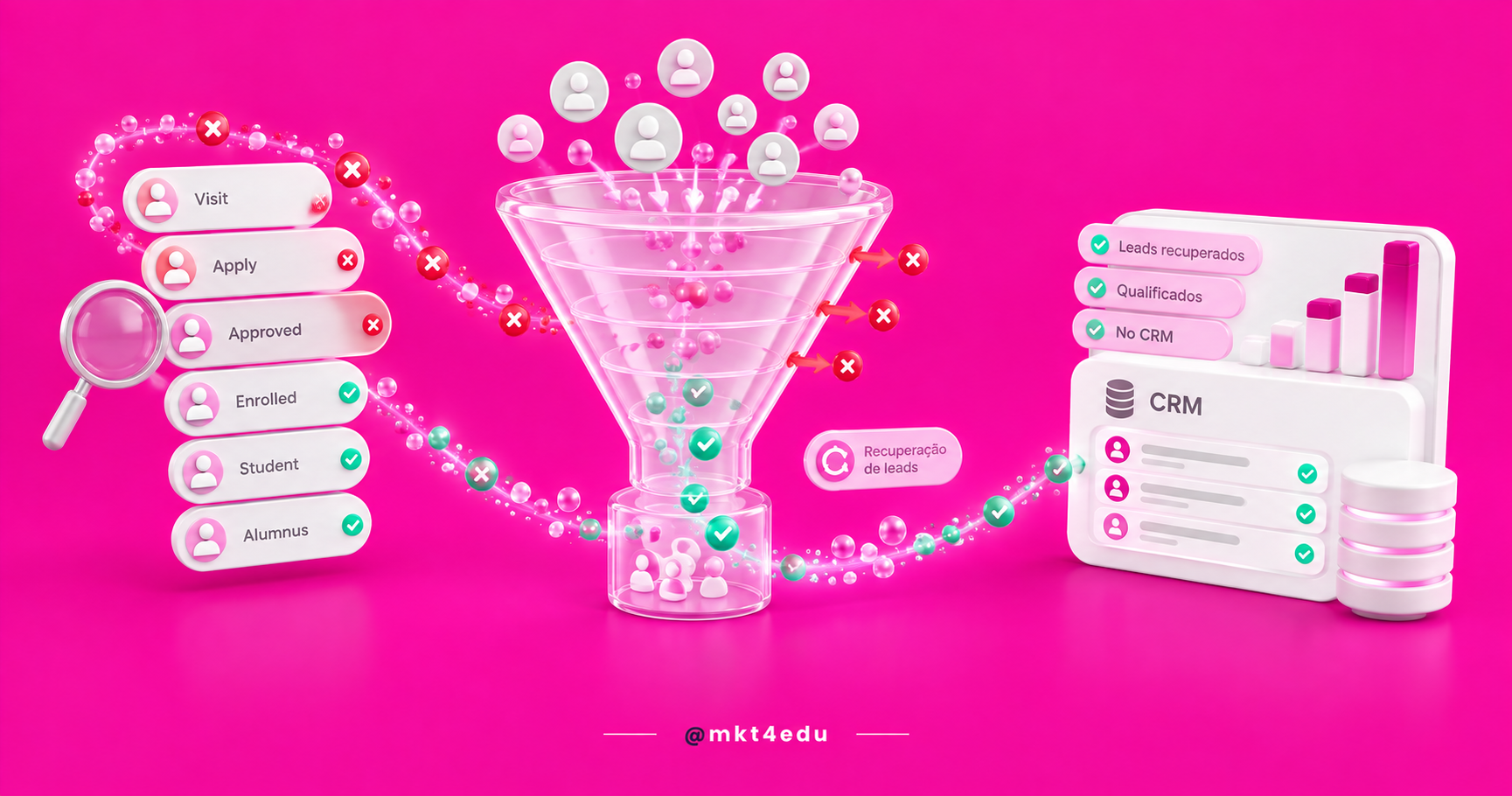
Integrating paid media and CRM means tracking the source of each lead, responding within minutes, nurturing those who haven’t decided yet, and providing the platforms with data on who enrolled. Without this, the institution optimizes based on cost per lead—a metric that doesn’t pay the bill—and remains in the dark about which ad actually brings in students.
The first link in the chain is attribution. Every form submission must record the campaign, the ad, and the referring page in the CRM.
It is this trail that reveals that the campaign with the lowest cost per lead actually generates the fewest enrollments. Without attribution, this distortion remains invisible for entire cycles.
The second link is response speed. The Harvard Business Review study on the short lifespan of online leads is straightforward: “Our research shows that most companies are not responding nearly fast enough.”
Ad-generated leads go cold within hours because they’re comparing institutions at that very moment and proceed with whoever responds first. When leads don’t convert, the problem almost always lies in that interval between the click and the first contact.
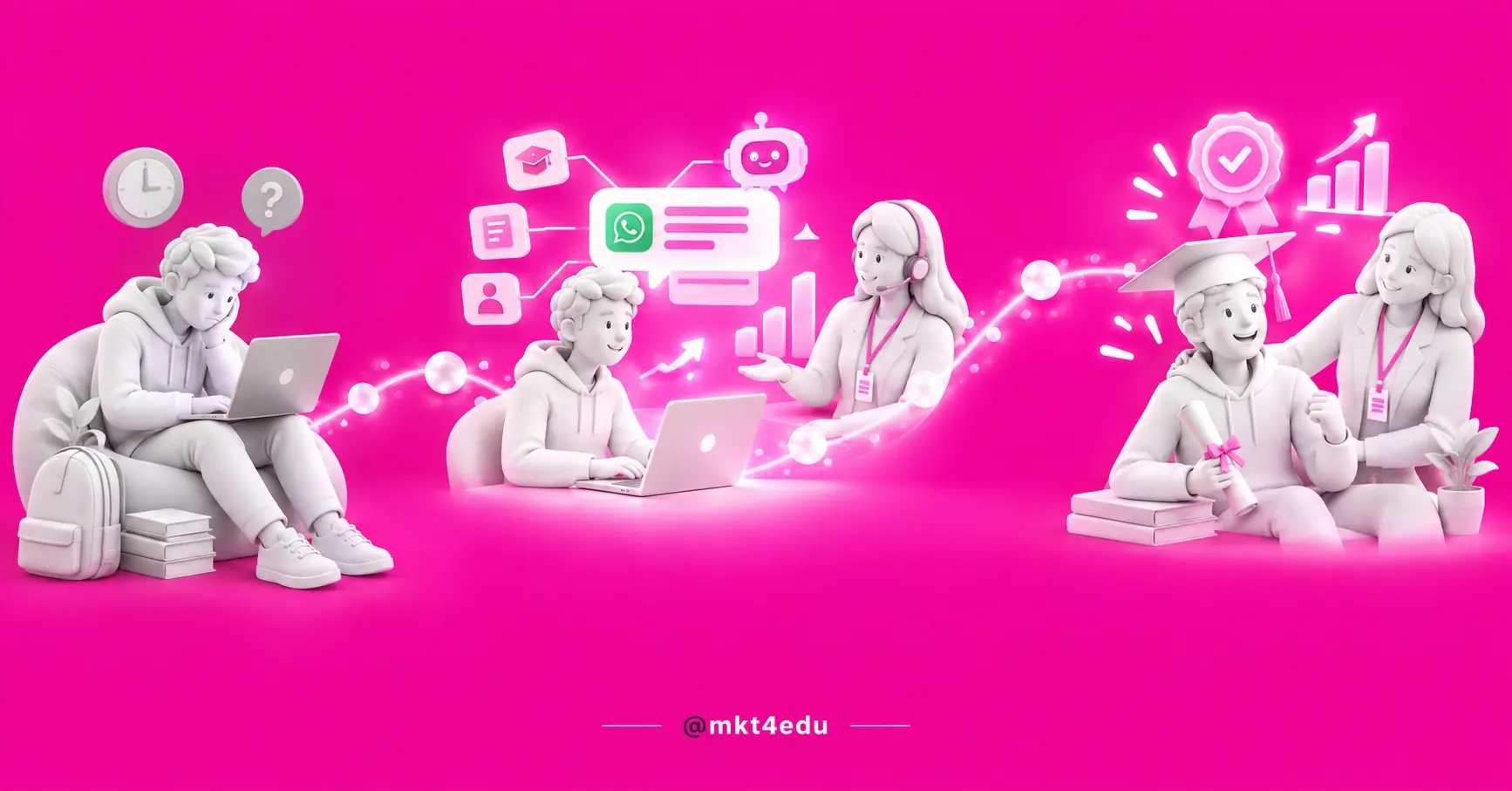
This is where automation changes the game. An SDR agent on WhatsApp responds to the applicant within seconds, at any time, qualifies them based on program, class schedule, admission method, and scholarship eligibility, and passes on to the sales team only those who are ready to move forward.
The third link is lead nurturing. Most leads do not enroll after the first contact, and automated workflows segmented by program and stage in the sales funnel keep the institution top of mind during the comparison weeks, without requiring new media spending.
The fourth link closes the loop. Reporting back to the platforms the events that matter—such as paid registration and enrollment—causes the algorithms to optimize per student rather than per click.
None of this works without a well-structured CRM for education. Standardized funnel stages, reliable enrollment tracking, and a clean history are prerequisites—not technical refinements.
How can you use paid traffic with AI-powered lead qualification?
Using paid traffic with AI means applying automation where volume is high and decisions are repetitive: initial contact, initial qualification, and queue prioritization. The human team focuses on the candidates with the highest potential, and media platforms begin to receive higher-quality conversion signals.
AI-powered AI-powered lead qualification resolves the most costly bottleneck in paid media for education. A high volume of leads in a short timeframe is exactly the scenario where qualified people cannot scale effectively.
An AI SDR agent handles the initial contact at any time. They engage in conversation, understand what the candidate is looking for, and return a structured record to the CRM instead of a loose form.
The division of labor warrants a clear definition. The comparison between AI SDRs and human SDRs usually comes down to the same conclusion: automation for volume and screening, and humans for closing deals with the hottest leads.
The channel changes the outcome. A voice agent makes sense for databases that respond to calls and for re-engaging registrants, while WhatsApp dominates the first point of contact for paid media in Brazil.
Integration is what separates a pilot program from full-scale operations. An SDR agent integrated with the CRM updates the same record the consultant is working on, eliminating the need for a separate spreadsheet and ensuring no lead is contacted twice.
It’s worth estimating the cost before hiring. How much an AI SDR costs depends on the volume of conversations, the active channels, and the depth of integration; the fairest comparison is with the total cost of an equivalent human team.
There’s also the compliance aspect, which is no small matter when it comes to customer acquisition. The topic AI SDRs and the LGPD involves the legal basis for contact, consent records, and transparency regarding whether the user is speaking with an automated agent.
The next step is forecasting. Predictive AI in student recruitment uses enrollment history to estimate who is likely to enroll, and this insight allows institutions to prioritize the service queue and allocate more resources to the audiences that actually convert.
How can you use paid traffic alongside inbound and organic marketing?
Using paid media alongside organic traffic means letting each channel do what it does best. Paid traffic drives volume within the cycle window, while inbound marketing and content build demand, which reduces how much you need to buy in the next cycle.
This effect is reflected in the cost. The more candidates arrive via organic search, referrals, and brand awareness, the smaller the portion of the funnel that depends on auctions.
The content marketing also improves paid media itself. Content that addresses objections regarding price, employability, and MEC accreditation provides input for creative and landing pages, in addition to fueling remarketing efforts with an audience that has already been educated.
There is also a data benefit. Content that attracts the right audience reveals which topics and courses generate leads that go on to enroll, and this insight guides where paid advertising spending yields the best return.
For this reason, paid media used in isolation yields less than paid media used as part of educational marketing strategies. An advertising account disconnected from the rest becomes a cost center.
The operation also requires specialized and ongoing expertise. The management of paid media in education deals with extreme seasonality, dozens of courses, and targets by program type—which is different from running a generic campaign.
What mistakes drain institutions’ paid traffic budgets?
The most common mistakes are concentrating the entire budget during the enrollment window, optimizing for cost per lead instead of cost per enrollment, using a generic campaign for all courses, taking too long to respond to leads, and shutting everything down at the end of the cycle—thereby throwing away the insights accumulated by the algorithms.
It’s worth reviewing your operations against this list:
- Budget allocated only to the enrollment window: bidding is at its peak and the audience is unengaged. Correction: distribute the budget across lead generation, enrollment, and the final push.
- Optimizing by cost per lead: A cheap lead that doesn’t enroll is a waste disguised as efficiency. Correction: Track the funnel all the way to enrollment and optimize for the final conversion.
- Single campaign for all courses: a generic message converts less and prevents targeting by course. Solution: run campaigns by course or field, with custom creatives and landing pages.
- Slow response times: Prospective students proceed with whoever responds first. Solution: Automate the first response and prioritize paid leads in the queue.
- Shutting everything down at the end of the cycle: Starting from scratch makes learning the platforms more expensive. Solution: Keep branding and online courses active at all times on a reduced budget.
- Ignoring brand-specific searches: competitors capture candidates who have already made up their minds. Solution: a permanent, low-cost, high-conversion brand campaign.
None of these points require extra funding. In general, correcting them frees up budget, because the waste was being financed by the media account itself.
The underlying pattern behind all of them is the same. Treating paid traffic as the sole responsibility of the ad platform—rather than as a process that spans media, the website, customer service, and CRM—is what causes the account to go over budget.
Frequently Asked Questions About Using Paid Traffic
After all, is it worth using paid traffic to attract students?
Yes, as long as the institution treats paid media as part of a system that spans from the ad to enrollment. Knowing how to use paid traffic is what makes goals predictable in a market that has become more competitive.
With clear benchmarks, a cycle-based calendar, segmentation by program, and integrated CRM, the institution knows how much it invests and how much it gets back in students. Without this, the budget becomes a cost with no return, and the bottom line only becomes clear at the end of the cycle.
The opposite is also true and more common than it seems. Advertising without a proper landing page, without a quick response, and without tracking through to enrollment wastes funds raised through student recruitment.
If your institution invests in media and doesn’t have a clear picture of these costs, the next step isn’t to increase the budget. It’s to identify where the paid lead is falling through the cracks—and this almost always happens during the first contact.
Since Brazilian applicants respond best via messaging, this is where you’ll see the greatest immediate return. Start by understanding how WhatsApp converts ad leads into enrollments converts ad leads into enrollment, and apply the same logic to your next cycle.






















 Portugal