





Almost everyone working with digital presence has heard they need to install the tool, and most of them do. Then they open it once, find a screen full of context-free charts and never come back. Understanding how Google Search Console works is what separates having the tool from using the tool.
The difference matters because the tool is the only source that comes from inside Google. Every other estimate of organic search, however good, is a reconstruction made from the outside. Here you see what the search engine recorded, with its own data, with no intermediary.
The order that makes sense is the order of real use: what it is, how it works inside, how to install it, what each report answers and how to read the numbers without drawing the wrong conclusion. If your question comes before that and the point is still whether SEO is worth it as an investment, start there.
What is Google Search Console and what is it for?
Google Search Console is Google's own free tool that shows how the search engine sees your site. It reports crawling, indexing and search performance, and it is the only official channel where Google tells you what it recorded about your pages. Installing is free and requires no contract.
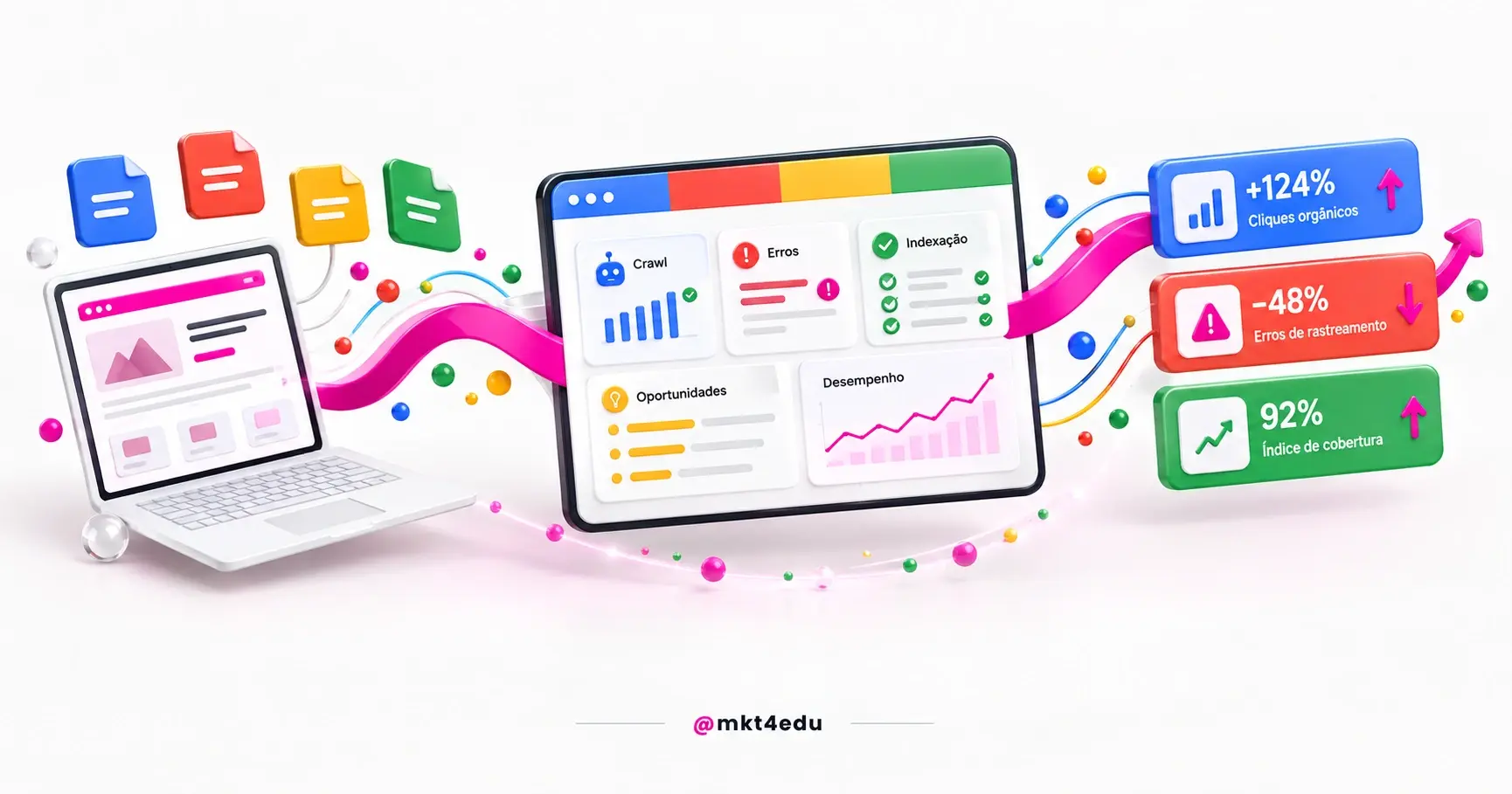
“What is Google Search Console for?” is the question that opens almost every conversation about the tool, and the answer has three verbs: diagnose, measure and discover. Diagnose access problems, measure presence in search and discover what people type before they reach you.
 Caption: each Google Search Console panel answers a different question: crawling, indexing, experience and performance
Marking what it is not matters, because the confusion is common. It does not measure behavior inside the site, does not count sessions, does not track conversions and does not replace an analytics platform.
The boundary is simple: the tool covers everything that happens before the click, and analytics covers everything that happens after. Anyone trying to answer a conversion question by looking at impressions is using the wrong ruler.
That is also why it is the first step in any serious work on visibility on Google. Without it, you optimize in the dark and measure by estimate.
How does Google Search Console work under the hood?
Google Search Console works by reading the record the search engine already keeps about your site. It does not inject a script into the pages or observe the visitor: Google crawls, indexes and displays your content, and the tool simply exposes what was logged in that process. That is why it works even with JavaScript disabled in the user's browser.
That design explains most of the discrepancies that alarm anyone comparing tools. In its documentation about Search Console data, Google states that it runs extra processing steps, among them removing duplicates and bot visits, while analytics platforms record only whoever loads the script.
There is also a time zone difference almost nobody accounts for. The performance report groups daily data by California local time, so your “yesterday” and the tool's “yesterday” do not line up exactly.
Collection is continuous, but publication happens in intervals. Today's data can take from a few hours to a few days to appear, which makes reading very short windows unreliable.
On the crawling side, what the tool reports is Googlebot behavior on your domain. That is where you find out whether a page is blocked, redirects incorrectly or was simply never visited.
Why does Google Search Console underpin SEO strategies?
SEO strategies without Google Search Console become opinion dressed up as method. It is the only source that reports the actual query that generated the impression, and real queries are the input that topic prioritization, technical fixes and result measurement all depend on. Without that data, you optimize for the word you imagine.
The first gain is focus. The query list shows where you already appear without having tried, and those mid-table positions usually pay off faster than any new topic.
The second is proof. When leadership asks whether investing in organic pays off, the impressions and clicks curve is the evidence that carries the conversation, and it is where the honest answer about returns comes from.
The third is defense. A drop in organic traffic has many possible causes, and the tool is what lets you separate a technical problem from an algorithm change instead of treating everything as a penalty.
None of that is fully automatable, and that is exactly what SEO automation does not solve: interpreting business context is still human work.
Anyone starting SEO now has an advantage over those who started five years ago: you can build it considering traditional search and generated answers together, as the guide on how to do SEO and get cited by AIs recommends.
For operations that build growth inside the product or service itself, as happens in product-led SEO, reading this data is what connects page, demand and revenue.
There is also its measurement role inside an inbound marketing operation. The top of the funnel is almost always organic, and without this source the content marketing team does not know which piece attracted whom.
How do you install Google Search Console and verify ownership?
Installing means proving to Google that the site is yours, and the ownership verification documentation lists six official paths for that. Before choosing the method, though, you decide the property type: domain or URL prefix. That choice changes what the tool can see, and switching later means rework.
A domain property covers the entire domain, with every subdomain and both protocols, and can only be verified by DNS. A URL prefix property covers only the exact path entered, without subdomains or protocol variations.
The practical recommendation is to start with the domain property whenever you have access to the DNS provider. That format avoids the classic situation of tracking half the site without realizing it.
Once the type is chosen, the verification method depends on the access you have today:
|
Method |
Works for a domain? |
Who can do it |
|
Domain name provider (DNS) |
Yes, and it is the only one |
Whoever administers the domain |
|
HTML tag in the header |
No |
Whoever edits the site theme |
|
HTML file upload |
No |
Whoever has server access |
|
Google Tag Manager |
No |
Whoever already uses GTM |
|
Google Analytics code |
No |
Whoever already has Analytics active |
|
Google Sites and Blogger |
No |
Automatic on those platforms |
Table: Official ownership verification methods and the access each one requires.
One note that saves a headache: keep the verification active once it is done. Removing the tag, the file or the DNS record during a clean-up drops the property and wipes out access to the history.
After verifying, submit the sitemap and check whether the internal links architecture takes the crawler to the pages that matter. Verification works without a sitemap, but discovery gets slower.
Which reports does Google Search Console deliver?
There are four blocks: Performance answers what appears in search, Indexing answers what Google managed to process, Experience answers how the page behaves and Enhancements answers what your structured data enabled. Each solves a different question, and opening the right panel saves hours.
The performance panel is where most people spend their time, and rightly so. It brings queries, pages, countries, devices and search appearances, and it is the basis of any demand analysis.
The indexing report is the most underused. It lists the pages Google knows about, split between indexed and not indexed, with the reason for each exclusion, which turns assumption into diagnosis.
URL inspection deserves separate attention. It examines a specific page, shows the last crawl date and the indexing status, and lets you request indexing of new or updated content.
There is also the enhanced results panel, which reports what your structured data markup enabled. That is where you confirm whether what was implemented is actually recognized.
The search appearance block reflects formats that changed a lot in recent years, among them People Also Ask boxes and the rise of zero-click search, where the answer happens without a visit to the site.
How do you read the Google Search Console performance report?
The performance report has four metrics, and each one misleads in its own way. Impressions count appearances, clicks count visits coming from search, CTR is the relation between the two and position is the weighted average of the site's best result for each query. Reading all four together is what prevents a hasty conclusion.
Impressions rise easily and mean little on their own. Gaining impressions on queries unrelated to your business is noise, not growth, and it inflates the CTR base without bringing anyone in.
Clicks are the most honest of the four, because they are the only one representing a person who decided to come in. When clicks fall and impressions rise, the likeliest hypothesis is a change in the results screen, not a loss of relevance.
Average position is the most misread. It blends queries with very different volumes into a single number, so an improvement on an irrelevant query can mask a drop on what matters.
The fastest-paying path is filtering for queries where you rank between eighth and twentieth, with high impressions and low clicks. There is existing demand waiting for an adjustment, and that filter leads straight to search intent optimization.
Turning that reading into a routine, rather than an occasional check, is what separates one-off analysis from a habit. Mature operations treat it as part of SEO Ops, with a defined cadence and a named owner.
Which SEO techniques does Google Search Console unlock?
The tool is a work input, not a contemplation dashboard. The SEO techniques that benefit most from it are the ones that depend on knowing what is already happening: topic discovery, cannibalization, refreshing old content and fixing indexing. All of them start from a filter, not from intuition.
Topic discovery starts with queries that generate impressions without a dedicated page. If Google already associates your site with that subject, demand is proven and the content is what is missing.
The cannibalization check comes next. Filtering a query and seeing two or three of your pages taking turns in the rankings means you are competing against yourself, and the fix is usually to consolidate rather than create more.
Refreshing old content is the technique with the best return per hour invested. Pages with stable impressions and falling clicks usually need a title revision and a direct answer up front, not a complete rewrite.
On the technical side, the indexing report feeds on-page SEO work by revealing pages excluded for duplicate content, redirects or blocks. None of that shows up in an audit run only by an external crawler.
What the tool barely covers is off-page SEO. Backlinks and external authority appear in the links report, but in limited form, and that is where the reading needs other sources.
Cross those findings with the E-E-A-T framework, because a lost query is sometimes not an optimization problem but a lack of authority signals in the content.
And there is an ethical limit the tool itself helps you see: scaling pages from query patterns is tempting and dangerous, as the discussion on programmatic SEO shows. Volume without value erodes trust in the entire domain.
For teams producing on a recurring basis, that cycle of discovering, writing and revising is what connects the tool to real content marketing, instead of leaving the editorial calendar to guesswork.
What does Google Search Console show about AI SEO?
The tool already records presence in generative features, but in aggregate. Impressions and clicks coming from answers built by artificial intelligence are added to traditional organic, with no breakdown that isolates the AI effect on its own. You know it happened; you do not know how much.
That limitation has a direct consequence for how AI SEO is measured today. Attributing results to a specific format requires inference, and inference presented as an exact number becomes a problem in the next meeting.
What you can track is indirect behavior. Stable impressions with falling clicks is the typical pattern of content that became input for a generated answer, a theme that shows up in Google AI Mode and in how the AI Overview works.
Google states it explicitly: there are no additional requirements or special optimizations to appear in those features. The usual fundamentals apply, with more rigor.
That does not remove the adaptation work, and the discipline of Generative Engine Optimization exists precisely to organize content so it can be extracted. But it is a layer of SEO, not a substitute for it.
What are the limits of Google Search Console?
Knowing the limits is part of knowing how Google Search Console works, and they are harsher than the interface suggests. According to the official documentation, Google does not log rare queries or queries with personal or sensitive information, stores the top data rows rather than all of them, and displays at most one thousand rows per table.
The practical consequence shows up when you reconcile numbers. The chart's click total almost never matches the table's sum, and that is neither a reading error nor a tool failure: it is anonymization and row trimming working as designed.
The second limit is temporal. The performance report's history is a rolling window, and the period that falls out of it does not come back, which makes periodic exports an operational task rather than a luxury for big teams.
The third is scope. The tool covers Google search and nothing beyond it, so traffic from assistants, social platforms and other search engines is entirely out of the picture.
None of these limits invalidates the tool; they simply define what it can answer. Anyone trying to understand the drop in organic traffic caused by Google's AI has to combine this source with others.
That is why the discussion about the future of SEO with AI and LLMs treats measurement as an open problem. The ruler is still being built, and pretending otherwise gets in the way of the decision.
Frequently asked questions about Google Search Console
What changes when you master Google Search Console?
The origin of your decisions changes. Without the tool, topics are born in meetings and fixes are born from complaints; with it, both are born from evidence. It is the difference between thinking the content is working and being able to show where, for whom and since when.
The internal conversation changes too. The question of whether SEO is worth it stops being a debate of opinions when there is a curve, a query and a page to point at. Organic search's contribution to results becomes a verifiable number, not an estimate.
And the pace changes. Teams that fold this reading into the monthly close find problems in weeks, not quarters, and that head start is worth more than any isolated technique.
The natural next step is the panel that changed the most in recent months. If you want to understand what Google already delivers about presence in generated answers, the path is the AI report in Google Search Console, which details what it measures, what it still does not measure and how to read each breakdown.
If your institution needs to turn this data into enrollment rather than just into a report, Mkt4edu's SEO operation works exactly that bridge between search and enrollment.
Want a read on your account before deciding anything? Talk to our team and we will look together at what your data is already saying.



























 Portugal