


Every enrollment window ends the same way: a list of people who applied, liked what they saw, moved forward and never closed. That list is the most expensive asset the institution holds, because every name on it cost media, support and team time.
Student conversion is decided on that list of pending applicants, in the final weeks of the calendar, not in a new acquisition campaign.
The problem is rarely a lack of interest. It is a confusing deadline, a missing document, a question about financing, an invoice that expired in the middle of a tight month. None of those blockers is solved with more generic program advertising.
Enrollment remarketing exists to handle each of them separately, with the message that matches the step where the person stopped. It is precision work, on a short calendar and with a clear exit criterion, and that is what this playbook organizes.
Why is the applicant who does not enroll the most valuable lead?
The applicant who did not enroll is the most valuable lead because they already walked almost the whole funnel on their own. They chose the program, filled in the form, often sat the exam and talked to the team. One step is missing, and solving it costs a fraction of generating a new applicant.
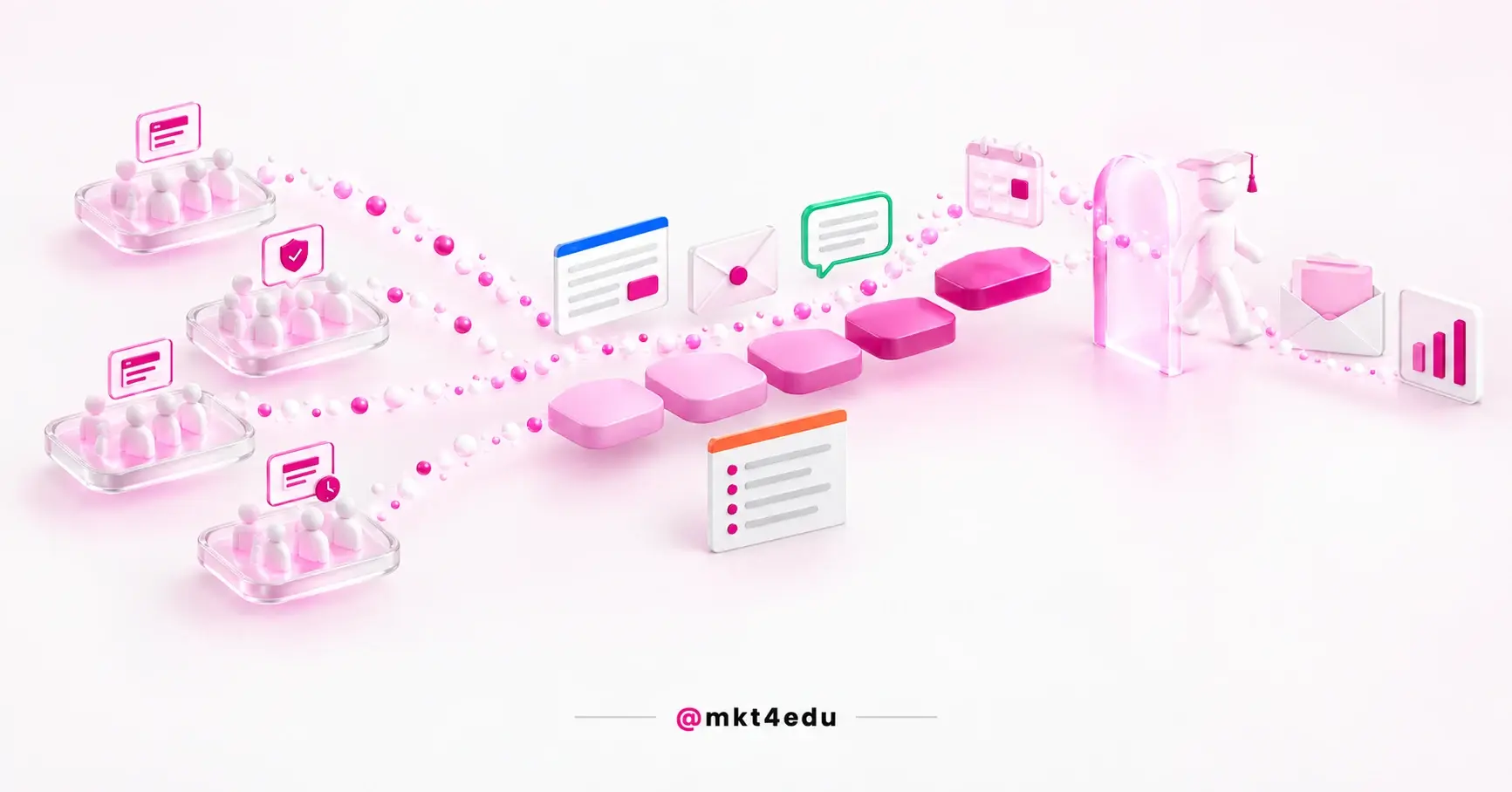
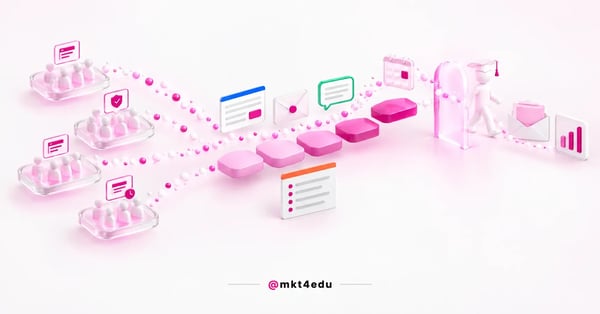 Caption: enrollment remarketing works by the step that is blocked, not by generic program campaigns
The math is direct. A top-of-funnel lead has to be warmed, qualified and convinced before getting anywhere near enrollment. An applicant stuck on an invoice needs a reminder and a payment alternative.
Even so, budget often runs the opposite way. In the final weeks of the intake, target pressure pushes the team toward acquisition campaigns, which bring volume but deliver enrollments after the calendar closes.
Among educational marketing strategies that hold up a short-term target, enrollment remarketing has the fastest cycle. The applicant has already decided on the program, so the communication only works on the operational barrier.
That base is finite and does not renew, unlike acquisition. There is no scale here, which is why it calls for surgical treatment rather than mass sending.
There is also a gain that outlasts the intake. Someone treated clearly during enrollment arrives at the first semester with less friction, and the integration between student recruitment and retention starts at exactly that touchpoint.
How do you build the enrollment remarketing playbook week by week?
The playbook is organized by week, not by creative. Each week of the window has one focus audience, one objective, one main channel and a clear exit criterion. When the applicant meets the criterion, they leave that audience and stop receiving that message, even if the campaign stays live.
The design below assumes a six-week window, counted backwards from the enrollment deadline. Institutions with a shorter intake compress weeks 1 and 2; those with a long calendar extend week 3. The progression logic stays the same:
|
Week |
Focus audience |
Objective of the week |
Main channel |
Exit criterion |
|
W1 (6 to 5 weeks out) |
Applied with the selection step pending |
Complete the exam, essay or grade submission |
Email and reminder ads |
Selection step completed |
|
W2 (5 to 4 weeks out) |
Approved but has not started enrollment |
Start the enrollment process |
Result email and WhatsApp |
Enrollment started in the system |
|
W3 (4 to 3 weeks out) |
Enrollment started with incomplete documents |
Get the documents approved |
WhatsApp and ads with a tutorial |
Documents approved |
|
W4 (3 to 2 weeks out) |
Invoice issued and unpaid |
Payment within the due date |
Transactional email and WhatsApp |
Payment confirmed |
|
W5 (2 to 1 week out) |
Invoice overdue |
Reissue with a payment alternative |
Human support and WhatsApp |
New payment or a recorded refusal |
|
W6 (final week) |
All eligible pending applicants |
State the real closing deadline |
Ads, email and a phone call |
Enrolled or window closed |
Table: reference schedule for enrollment remarketing, with focus audience and exit criterion per week
The exit criterion is the part usually missing. Without it, the applicant who paid keeps getting chased, the approved one who already enrolled sees a results ad, and the cadence burns trust instead of building enrollment.
Two weeks never compete for the same applicant. Each person sits at a single funnel stage at a time, and the cadence follows the real stage, not the calendar date.
Video: the lead capture that fills the base enrollment remarketing will work on, on the mkt4edu channel (in Portuguese)
Which audiences to build: applied, approved, invoice issued and overdue?
There are four audiences, and they come from data the institution already has. Applied is someone who filled in the form and did not move on. Approved passed the selection and never opened enrollment. Invoice issued has an open charge within the deadline. Invoice overdue passed the date without paying.
Each group exists in two places at once: as a contact list in the database and as an ad audience on the platforms. The list is the source of truth, and the ad audience is a synced copy of it.
The technical starting point is the integration between the enrollment system and the contact database. Without that flow, each applicant's status stays locked in the academic system and the communication is days late, which during an enrollment window means losing the applicant.
A CRM for educational marketing solves the hard part by storing each applicant's stage as a contact property, updated by automation. With that, entering and leaving the audiences stops being manual spreadsheet work.
There is a list-size detail that trips up mid-sized institutions. Google Ads documents a minimum of 100 active visitors or users in the last 30 days for the Search Network, the Display Network and YouTube. Gmail is not part of that rule: the page covers who gets added to the segment, not a minimum size.
The figure of 1,000 that appears elsewhere has an explanation, and it is worth checking which case your list is in. Customer lists uploaded or refreshed from February 1, 2024 follow the 100-user minimum on Search and YouTube; lists not refreshed since then remain under the previous requirement of 1,000 matched users.
If the overdue-invoice audience has 200 names, it probably will not run on Search, and that group's cadence has to lean on email, WhatsApp and human support. Social platforms are more permissive on volume: HubSpot's documentation on ad audiences lists much smaller minimums for Meta and LinkedIn, which makes them viable for small segments. Confirm the current number in your account before building the audience.
Prioritizing inside these audiences is possible too. Predictive AI in student recruitment models help separate, within the same group, who has a real chance of closing from who quietly gave up.
Which message should you use for each enrollment funnel audience?
The message changes because the barrier changes. Applied needs a deadline and a next step. Approved needs recognition and a direct link. Invoice issued needs easy payment. Invoice overdue needs an alternative and a person to talk to, not another automated reminder.
What never changes is the framing: the communication informs and resolves, it does not pressure. That distinction is not only about tone. Article 42 of Brazil's consumer protection code states that, when collecting debts, a consumer in default must not be exposed to ridicule nor subjected to any kind of embarrassment or threat.
Here is how that is organized by audience:
|
Audience |
Core message |
Channel |
Maximum frequency |
|
Applied |
The step's deadline and how to finish it in minutes |
Email, Meta, Display |
2 contacts per week |
|
Approved |
Result, a guaranteed seat and the enrollment link |
Email, WhatsApp, Meta |
2 contacts per week |
|
Documents pending |
The exact list of what is missing and how to send it |
WhatsApp, email, Display |
3 contacts per week |
|
Invoice issued |
Due date, payment methods and a second copy |
Transactional email, WhatsApp |
2 contacts per week |
|
Invoice overdue |
Reissue, scholarship, financing and installments |
Human support, WhatsApp |
1 contact per week |
|
Enrolled |
Welcome and the first-day calendar |
Email, WhatsApp |
Removed from all paid media |
Table: reference message, channel and frequency cap per audience in enrollment remarketing
The last row of the table is the most important and the most forgotten. Anyone who has enrolled has to leave every media audience the same day, because advertising to a paying student is wasted budget and noise for someone who just decided.
Financing questions deserve their own treatment. They are rarely solved by a number in a creative, and formats such as an interactive funnel with a tuition simulator get the applicant to the support team with the question already answered.
How do you combine ads, email and WhatsApp without saturating the applicant?
The combination works when each channel has a distinct role. The ad keeps the institution visible and reinforces the deadline. Email carries the complete information and the official link. WhatsApp resolves a specific question and answers fast. When all three repeat the same sentence on the same day, the effect is saturation.
The cadence starts with a contact cap. Across all channels, two to three contacts per week per applicant tends to be the limit before unsubscribe and block rates rise.
Ad frequency needs a cap too. Enrollment audiences are small, so the algorithm repeats the same creative to the same people if nobody rotates them.
WhatsApp deserves extra care, because it is the most personal channel in the cadence. WhatsApp for student recruitment pays off when it opens room for a real conversation, with people on the other side, and not when it becomes a one-way broadcast channel.
Video: the friction-free communication enrollment remarketing has to keep until the window closes, on the mkt4edu channel (in Portuguese)
There is also a silence rule worth writing into the playbook. An applicant who asked not to be contacted leaves everything, including the ad audiences, and that exit has to be technically possible, not merely promised.
Legal grounds help decide. Brazil's data protection authority published a guidance document on legitimate interest, useful for anyone who has to justify communicating with an applicant inside an ongoing selection process. Track complaints and blocks as a campaign metric, on the same dashboard as cost per enrollment: saturation shows up in those numbers first.
When do you cut the audience and reallocate the budget?
Cut when the audience stops producing enrollments and starts producing only impressions. Three signals mark the moment: the group's cost per enrollment exceeds the cost of new acquisition, the audience's conversion rate falls for two weeks in a row, or the remaining volume is too small to sustain media delivery.
The first signal is the most objective. If recovering an applicant costs more than generating and converting a new one, remarketing to that group has stopped being efficient, and the budget works better in acquisition or in the next intake.
Audience fatigue is the second signal. When frequency rises and clicks fall, the group has seen everything, and more delivery only makes the result more expensive.
Volume is a limit too. An audience of thirty people does not sustain a media campaign, and that group's cadence has to move to human support, which converts better on a small base.
Cutting media does not mean abandoning the applicant. Someone who did not close becomes the base for the next intake, with a restart at the beginning of the following cycle.
There is an expensive mistake in the opposite direction. Cutting before the invoice due date because the week ended makes the institution lose exactly the enrollment that was closest to happening, so the payment deadline always outranks the campaign calendar.
What should you measure at the end of the intake?
Measure the passage between steps, not the campaign's isolated performance. The indicators that matter are applied to approved, approved to enrollment started, enrollment started to invoice issued and invoice issued to payment confirmed. That last jump is where most of the loss happens.
The closing indicator is cost per recovered enrollment. It compares the budget invested in the group with the number of enrollments that only happened after contact, and it is the figure that justifies or kills the cadence in the next intake.
The unpaid-invoice rate deserves its own line in the report, because it separates a communication problem from a pricing problem. The two causes call for different decisions.
Record the reason for not enrolling too, collected by the support team. No media dashboard tells you the applicant gave up because they did not get a scholarship, and that information changes the design of the next cycle.
The end of the intake also calls for a short closing checklist, which prevents rework in the next cycle:
- Pause every enrollment campaign and record the exact pause date.
- Export the final audiences with each applicant's status.
- Remove enrolled students from any active media audience.
- Document the reason for not enrolling in the larger groups.
- Save the creative, email subject line and message that performed best.
- Flag in the database anyone who asked not to be contacted, to respect it in the next intake.
That record turns the current intake into the starting point of the next one. Without it, every enrollment window restarts from zero and repeats the same mistakes.
Frequently asked questions about enrollment remarketing
What makes enrollment remarketing convert at the end of the intake?
At the end of the intake, enrollment remarketing converts because it is the only investment in the window that works on people who have already decided. The applicant does not need convincing about the program; they need a clear deadline, resolved documents and a way to pay that fits their budget.
What separates a cadence that converts from one that annoys is structure. Audiences defined by real stage, a message that matches the barrier, a frequency cap, an exit criterion and immediate removal of anyone who enrolled.
None of it works without up-to-date data. When the enrollment system and the contact database talk in real time, the applicant's status changes and the communication follows the same day, which is the difference between warning about an invoice coming due and chasing one already paid.
If your institution is entering the window with the target at risk, the fastest path is to audit the four audiences, build the cadence by week and define where each applicant exits. The most effective bottom-of-funnel educational marketing strategies almost always look like this: less new creativity, more operational precision.
Want to build this playbook with your own base and intake calendar? Speak with a specialist from the Paid Media team and review the schedule for your enrollment windows before the next closing date.












 Portugal