






Digital marketing in education is an established strategy, especially for institutions investing in student recruitment for higher education.
Inbound marketing, link building, content marketing and SEO are some of the tools used in every enrollment campaign that needs to grow application numbers through digital marketing.
What changed is where the competition happens. Search results increasingly answer the question on the page, which means a school can hold its ranking and still lose the visit.
The SparkToro study built on Similarweb clickstream data found that 68.01% of Google searches ended without a click between January and April 2026, up from 60.45% in 2024.
Enrollment growth itself has also flattened in several markets. In Brazil, the 2024 Higher Education Census recorded 10,227,266 undergraduate enrollments, with online programs growing only 1% in the year after expanding 25% in 2022.
The pattern matters more than the country. When new demand stops appearing on its own, an enrollment campaign is no longer capturing a wave, it is winning preference from students who are already in the market.
So how do you actually use these digital marketing strategies at an educational institution? That is what the rest of this article covers.
How do you structure an enrollment campaign from scratch?
An enrollment campaign starts with a diagnosis, not with an ad. Before setting budget and channels, the institution needs to know what sets it apart, who the prospective student is and where last cycle leaked. Without that, marketing strategies become a pile of disconnected actions.
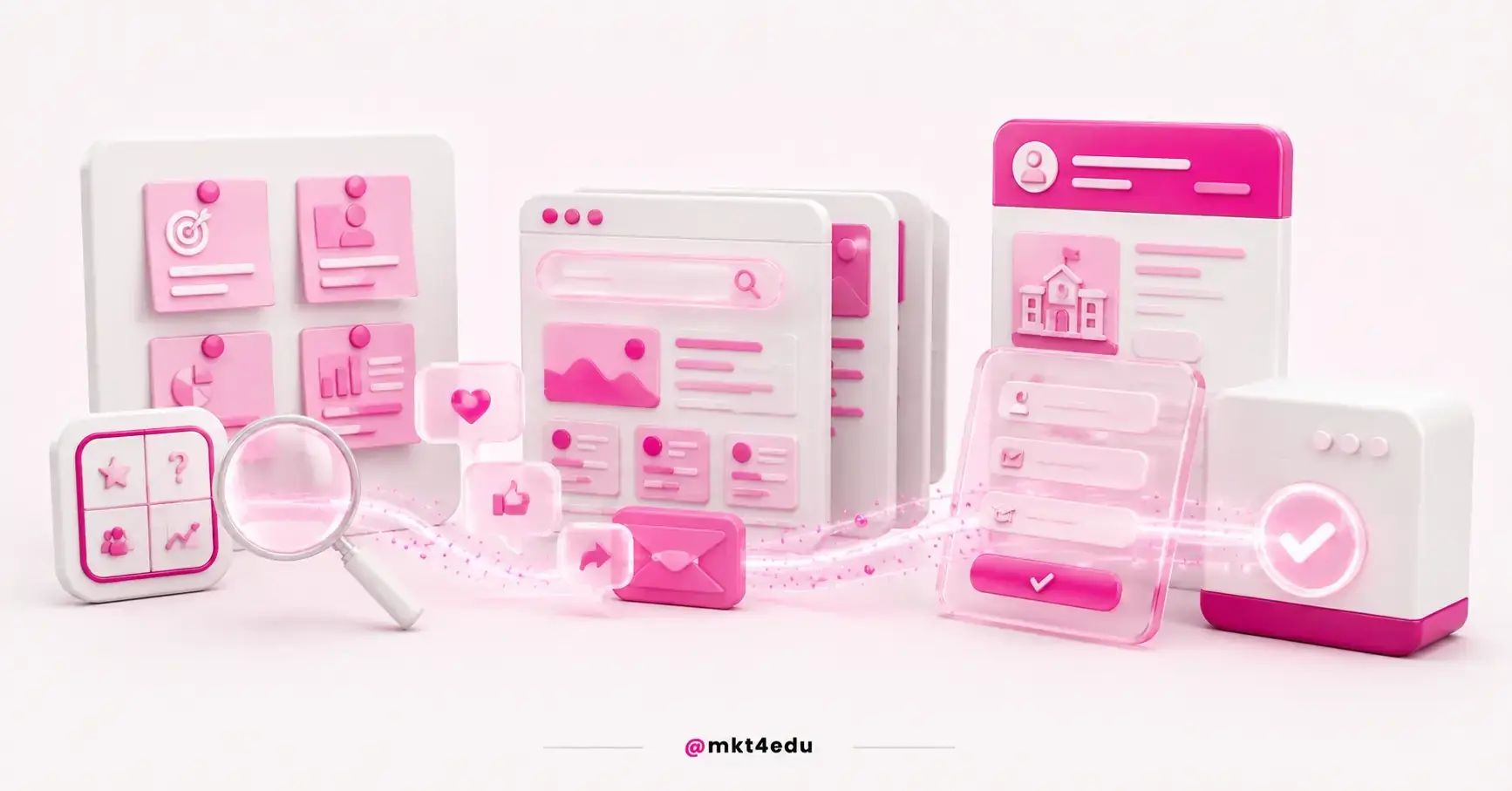
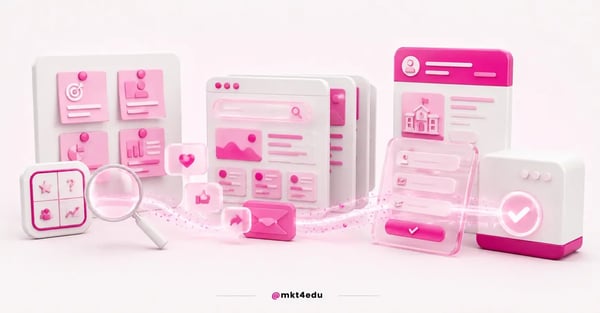 Caption: An enrollment campaign delivers volume when planning, channels and the application system work as one sequence.
The most direct tool for that diagnosis is a SWOT analysis. It puts strengths, weaknesses, opportunities and threats on a single page.
In practice, a SWOT analysis at a university tends to surface uncomfortable and useful things: a well regarded program with a weak landing page, a strong accreditation score nobody communicates, a new competitor a few miles away.
With the diagnosis in hand, the next step is to spread actions across the AIDA funnel, which splits the journey into attention, interest, desire and action. Each stage calls for a different kind of content and a different channel.
In the AIDA funnel of an enrollment campaign, attention comes from social media and top of funnel content. Interest comes from the blog and gated materials. Desire comes from social proof and direct conversation. Action comes from the application itself.
School administration belongs in this conversation from the start. The people who manage class capacity, the academic calendar and scholarship rules define what the campaign is allowed to promise.
Why does website optimization carry the enrollment campaign?
The first step in a successful digital marketing strategy for educational institutions is optimizing the website for search engines, which means using Search Engine Optimization techniques to rank better in Google's organic results.
Website optimization covers three broad areas: technical SEO, on page SEO and off page SEO. Technical work refers to improvements in the site's code, making it faster and friendlier to Google's crawlers.
On page SEO is the optimization of the site's content, choosing the best keywords for ranking and developing content that holds the attention of whoever lands on your pages.
Off page SEO, in turn, relates to external marketing actions, such as link building, which is other sites linking to yours, and social media strategies.
Link building in education has a natural path many institutions ignore. Press relations, partnerships with local outlets and research produced by faculty all earn mentions from sites with real authority.
A site that is well optimized for search engines attracts more visitors, and the site is where the application actually happens. That is why website optimization is not an IT task, it is part of the enrollment campaign.
How does SEO work today, and what is SEO for AI?
Doing SEO today means competing on a results page that answers on its own. Ranking the link is no longer enough: you need to be the source the generated answer cites. That is the difference between classic SEO and SEO for AI.
The same SparkToro study reports that AI Overviews appear in more than 20% of searches and cut click-through rates by roughly 60% when present. For a university, that means losing visits while holding position.
The practical answer is not to abandon organic traffic, it is to change the format. Content that answers the question in its first sentence, with a named data point and a cited source, has a better chance of being retrieved and mentioned.
Internal architecture deserves a review too. A consistent mesh of internal links helps both the crawler and the prospective student move from a general question to a specific program page.
Treat SEO for AI as an extension of what already exists rather than a parallel discipline. Useful content, solid on page SEO and honest link building support both fronts at once.
Does inbound marketing still attract new students?
For a long time, student recruitment in higher education relied on interruption, from flyers handed out on the street to television commercials. Students are no longer interested in that kind of advertising, which is why inbound marketing became the better way to attract new students.
It is a methodology in which you earn the interest of prospective students, leading them to look for your institution on their own.
That happens through producing and sharing relevant, useful content that helps future students solve everyday problems, such as choosing a preparatory course or deciding which career to pursue.
The knowledge you share gives students more confidence in their own decisions, building trust long before they are ready to apply.
By the time the final decision arrives, they know exactly which institution they can rely on: yours. That accumulated trust is what makes each enrollment campaign cheaper than the last.
Artificial intelligence and automation have become pillars of educational marketing strategies. AI tools allow a deeper reading of student behavior, which makes it possible to personalize content and campaigns around individual interests.
Automation of routine processes, such as segmented email sends and real-time campaign management, saves resources and increases the efficiency of student recruitment.
How does content marketing build organic traffic?
Content marketing is the core of inbound marketing, and its main goals are to bring organic traffic to your institution's website and to keep the students who arrive engaged.
To put content marketing into practice, you need an educational blog that works as your knowledge hub. It should be easy to find on your site and updated frequently, so students stay connected to your brand.
Once those pieces are published on your educational blog, it is time to make them known, both to your current community and to people who may become students.
Influencer marketing has established itself as one of the most effective ways to reach and engage younger audiences, education included.
Investment in influencer campaigns keeps rising, driven especially by Instagram and TikTok. That tends to reinforce social proof as a central element, since students discover institutions through creators they consider trustworthy.
A current student with a real audience often outperforms a paid influencer, because the social proof comes from someone who went through the exact process the candidate is evaluating. It is the cheapest form of influencer marketing available to a school.
Which social media channels belong in an enrollment campaign?
Social media concentrates an enormous number of potential students, covering everyone from teenagers to established professionals. Whatever educational niche you focus on, there is a good chance of reaching students there. You just need the right strategy.
Start by finding out which platforms your future students actually use. Audience data by platform lets you prioritize instead of spreading budget thin.
The gap between platforms is usually wider than teams assume. Keeping a profile alive out of habit on a channel that reaches a fraction of your audience costs staff time that would produce more elsewhere.
Once the list is cut, build a publishing calendar so your pages never look abandoned. Some networks reward near daily posting, while others, such as LinkedIn, work fine with a slower rhythm.
The goal is to share the content from your educational blog across the selected channels, adapting each piece to the platform. A blog post does not translate well to Instagram, but it can become an infographic and generate far more interaction.
How do you connect landing pages to the application system?
Landing pages turn visitors into leads. You offer something valuable, such as an ebook or access to an exclusive webinar, in exchange for a few basic details from the student.
As the student interacts with your communications and leaves more information on each new landing page, you build a profile and can develop a personalized offer.
Building landing pages for an enrollment campaign follows a simple rule: one page per offer and per program, with a single exit path. A page offering three things at once splits attention and lowers conversion.
The biggest drop, however, is rarely the page itself. It is the handoff to the application system. When a student fills out a landing page and then has to start the application from scratch, a good share of them quit right there.
The fix is integration. The details the student already provided should arrive prefilled in the application system, and the application status should flow back to the CRM so the team knows who started and did not finish.
That personalized offer then travels through another strategy widely used to win new students: email marketing.
What is the role of email marketing before enrollment?
Email marketing is a versatile direct channel that supports many kinds of message, from a newsletter to a special condition for students who complete their application within the campaign window.
That is why it is central to lead nurturing. Once you capture a lead, you have to keep the conversation going, and email remains the best way to do that.
If a student downloaded an ebook about a business program, you already have a reason for a second contact, whether that is additional content about the program or a talk given by a professional in the field.
Inside an enrollment campaign, email marketing takes on one extra job: recovering the people who stopped halfway. A short sequence for started-but-unfinished applications is often the highest returning automation of the cycle.
When should you use paid ads to enroll more students?
You can also use Google Ads to promote degree programs. Google Ads is Google's paid advertising platform, and it replaced the AdWords brand in 2018.
It is the digital marketing strategy best suited to enrolling more students during campaign periods, when targets have to be met quickly.
With paid ads you reach students who are ready to apply, while inbound marketing keeps feeding everyone else the information that brings them to a decision at the right time.
The calendar rule is straightforward. Organic starts months ahead, because it takes time to mature, and paid enters when candidates are comparing institutions and the deadline is closing in.
Personalizing the student experience has become a competitive advantage. Using demographic, behavioral and engagement data, institutions can build unique journeys, adapting content, communication and offers to individual needs.
How do branding and consulting sustain the results?
A well executed enrollment campaign delivers volume this cycle. Branding delivers a lower cost next cycle. They are different jobs, and confusing them is why some institutions spend the same budget every term without ever making enrollment cheaper.
Branding at a school is built on consistency between channels. If the website promises attentive support and the admissions office takes three days to reply, no media budget makes up the difference.
There is a simple indicator to watch: search volume for the institution's own name. When it grows cycle over cycle, branding is working, and the enrollment campaign starts harvesting demand that arrives already decided.
Educational consulting comes in when method or capacity is missing. An outside reading usually finds the bottleneck the internal team has normalized, whether that is a confusing application system or a promise school administration cannot keep.
Consulting does not replace an internal team. It speeds up the setup of the process, but the people who know the candidate, the program and the institution are still the ones inside it.
Frequently asked questions about enrollment campaigns
What changes in your next enrollment campaign?
There is no shortage of strategies for enrolling more students through digital marketing. What separates a campaign that hits target from one that only spends budget is sequence: diagnosis first, content early, paid media late and the application system connected from end to end.
With demand growth flattening, the contest is no longer for new students entering the market. It is for preference, and preference is built through consistent presence across the whole cycle, not one month of advertising.
If your institution wants to turn these educational marketing strategies into a repeatable process, start by mapping where candidates drop off today. It is almost always between the landing page and the application system.

























 Portugal