






Choosing a course is no longer a decision made at the admissions office counter. Prospective students search on Google, compare institutions on social media, read reviews, and only then consider talking to someone.
It is in this context that educational marketing strategies become crucial, as they shape the institution’s presence at every stage of this journey, from the first click to the signing of the enrollment agreement.
The problem is that many institutions still treat marketing as synonymous with advertising during admissions season. It works for a month and then disappears. This guide shows the opposite, sustainable approach, in whichstudent recruitment and retention become a system that runs year-round.
The good news is that the market favors those who are organized. Brazil has reached 10.2 million students in higher education, according to the Semesp Institute, and the demand for education continues to grow. The question isn’t whether it’s worth investing, but rather how to invest wisely.
What is educational marketing, and why has it changed?
Educational marketing is the application of marketing strategies to the specific context of educational institutions, with two clear objectives: to attract new students and to retain current ones.
It takes into account the lengthy decision-making process, the importance of trust, and the value of an enrollment—which lasts for years—rather than a one-time purchase.
What has changed is the behavior of decision-makers. Today, research comes before human contact, and it takes place across multiple channels simultaneously.
These prospective students are also more widely distributed. For the first time, enrollment in distance learning has surpassed that of on-campus programs, reaching 50.7% of the total, which extends the competition for attention far beyond the institution’s local area.
The private sector accounts for 79.8% of students, according to the Semesp; in other words, competition is fierce, and marketing has shifted from being a competitive advantage to becoming a matter of survival.
Effective educational marketing, therefore, is not just advertising. It is about building relationships and establishing credibility before, during, and after enrollment.
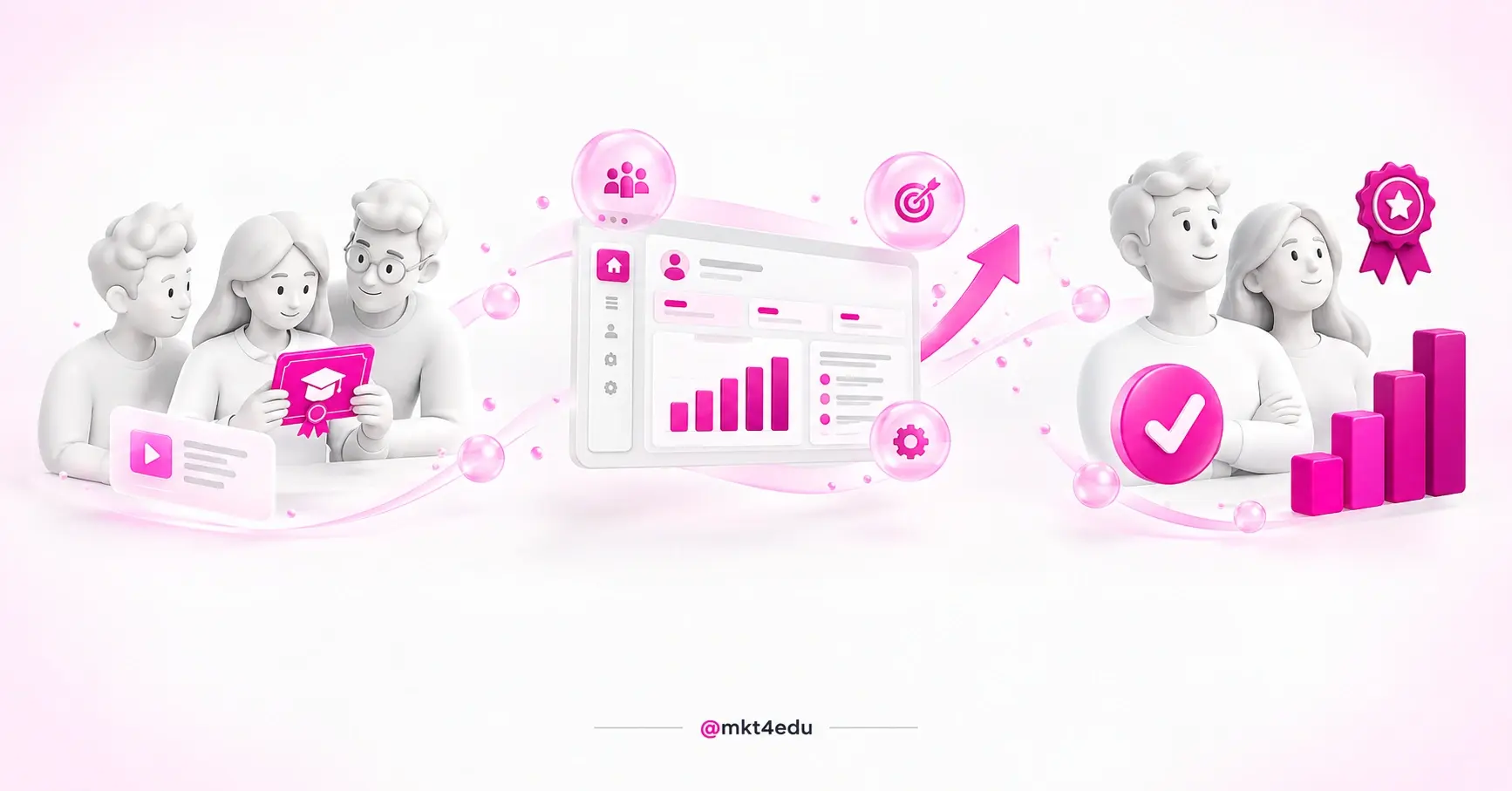
 Caption: The enrollment funnel seamlessly connects search traffic, lead nurturing, and student retention.
How does the enrollment funnel organize student recruitment?
The enrollment funnel is the roadmap that organizes student recruitment into stages: discovery, consideration, decision, and enrollment, with each stage requiring a specific type of content and approach.
Understanding which stage a prospective student is in helps avoid sending sales messages to those who are just beginning their research.
At the top of the funnel, the prospective student has just realized they want to study. They’re looking for general information, such as comparisons of fields of study and questions about their career path.
In the middle stage, they’re already considering specific programs and institutions. This is where more specific materials, social proof, and honest comparisons come into play.
At the bottom, they’re ready to make a decision. They need clarity on costs, scholarships, the admissions process, and prompt customer service.
Each stage involves a conversion to manage, and it’s common for a well-designed page to bridge the gap between interest and enrollment. A good recruitment landing page turns visitors into qualified leads without relying on additional media spending.
The logic is simple: the better you understand each stage, the more targeted your communication becomes, and the lower the cost per enrolled student.
Why is SEO the foundation of educational marketing strategies?
SEO is the foundation because a prospective student’s journey almost always begins with a search.
Therefore, appearing organically in the top search results puts the institution in front of people who are already looking for a course, without any cost per click. It’s the channel that sustains student recruitment after the ad budget runs out.
The power of organic search is well-established. A study by BrightEdge found that 53% of all trackable website traffic came from organic search.
For an institution, this means being found when someone searches for a course, a city, or a career-related question. It’s worth understanding whether, in your case, the investment in SEO is worthwhile given the rising cost of paid media.
Modern SEO depends on trust. Google rewards content with experience, authority, and trustworthiness—principles it calls E-E-A-T and describes in its documentation on useful, people-centered content.
In practice, this means real content, written by people who understand education, rather than generic text created solely to rank higher in search results.
How does content marketing attract and nurture candidates?
Content marketing attracts candidates by offering helpful answers when they have questions, and nurtures them with relevant information until they make a decision.
It’s the driving force behind inbound marketing: instead of interrupting, you educate. Every article, e-book, or video answers a real question along the candidate’s journey and brings them closer to enrollment.
A blog that effectively answers the questions of those choosing a course acts like a salesperson working 24 hours a day, attracting visitors today and continuing to do so for months to come.
The logic behind inbound marketing is to guide people through different stages: attract them with top-notch content, convert them into leads with more in-depth materials, and nurture them until they’re ready to engage.
This approach goes hand in hand with a good content marketing strategy, which plans content topics for each stage of the funnel and distributes them throughout the year.
The benefit is twofold. You reduce your reliance on ads and, at the same time, build the authority that makes candidates trust the institution even before they speak with it.
Which social media platforms work best for student recruitment?
Social media is effective for student recruitment when it’s used to build relationships and demonstrate social proof—not just to post announcements. Instagram, TikTok, YouTube, and LinkedIn capture the attention of the target audience, each with its own unique style.
The choice of platform depends on where your prospective student spends their time and what they’re looking for at each stage.
The reach is enormous. Brazil had approximately 150 million social media accounts by the end of 2025, according to DataReportal’s Digital 2026 report, which makes these channels almost essential.
For younger audiences researching in person, short-form content and student testimonials tend to be more engaging. For graduate programs and distance learning courses, which attract an older audience, career-focused content tends to convert better.
Social media also drives traffic to the website, and optimizing these profiles makes a difference. Applying SEO to social media helps the institution be found within the search platforms themselves.
The key is consistency. An active profile that engages with followers and showcases daily campus life builds more trust than one-off campaigns.
How do automation and CRM support student recruitment?
Automation and CRM support student recruitment by organizing every lead in one place and responding at the right time, without relying on manual effort.
The CRM records the applicant’s entire history, and automation triggers emails, messages, and reminders based on their behavior. Together, they prevent prospective students from falling through the cracks between stages.
The biggest loss in lead generation is a delayed response. A lead who filled out a form and didn’t receive a quick response loses interest within hours.
This is where technology changes the game. An institution that centralizes data and workflows on the HubSpot platform for educational marketing can nurture thousands of applicants at the same time, with messages personalized by program and stage.
Automation also speeds up the initial contact. An SDR agent on WhatsApp qualifies and responds to prospective students in seconds, on the channel the applicant uses most.
Without this foundation, all the effort put into attracting leads is wasted when it comes time to convert them. With it, lead generation becomes a measurable and scalable process.
How does AI change educational marketing strategies?
Artificial intelligence changes educational marketing strategies in two ways: how prospective students seek information and how the institution operates.
People have started asking AI assistants directly, and institutions have gained tools to personalize service, predict behavior, and produce content at scale.
On the search side, appearing in AI-generated answers has become a goal in itself. Optimizing this process is known as Answer Engine Optimization, an evolution of SEO focused on being cited by tools like ChatGPT and in Google’s own answers.
This matters because Google emphasizes that AI should generate useful, people-centered content, in accordance with its guidance on AI features in search. Superficial content is not cited.
On the operational side, AI integrated with CRM expands what the team can accomplish. Connecting an assistant like Claude to HubSpot, for example, helps analyze data and respond to leads with more context.
AI doesn’t replace strategy; it empowers those who already have established processes, organized data, and high-quality content.
How do customer service and retention close the enrollment cycle?
Customer service and retention close the cycle because recruiting a student is expensive, and losing them early on wastes that entire investment. Prompt, personalized customer service leads to more enrollments, and maintaining a good relationship throughout the course reduces dropout rates.
Retention is often cheaper and more profitable than recruiting from scratch.
Customer service begins before enrollment. Responding to questions promptly and clearly during the admissions process increases the conversion rate of applicants to enrolled students.
After enrollment, the focus shifts to the student experience. Supporting students, anticipating problems, and maintaining relevant communication helps prevent them from dropping out during their first semester.
This full-cycle approach—from lead to graduate—is what the Revenue Operations model proposes: aligning marketing, sales, and customer service around the same revenue stream, with shared data.
When these teams work in isolation, students get lost. When they work together, each stage builds on the previous one, and retention is no longer a matter of luck.
How do you develop a strategic plan for educational marketing?
Developing a plan starts with an assessment, not with tactics. Before choosing channels, the institution needs to understand its prospective students’ current journey, enrollment goals, and where the bottlenecks lie.
Only then does it make sense to prioritize SEO, content, social media, automation, and customer service in the order that yields the best results for your specific situation.
A solid plan usually follows a logical sequence. Here’s how the pieces fit together:
|
Plan Stage |
What to Define |
Main Strategy |
|---|---|---|
|
Analysis |
Goals, target audience, and current bottlenecks |
Data Analysis and Customer Journey |
|
Organic foundation |
Search Presence and Website |
SEO and Content |
|
Lead generation |
Conversion materials and pages |
Inbound and landing pages |
|
Customer relationships |
Lead Nurturing and Quick Response |
Automation and CRM |
|
Conversion and retention |
Customer Service and Experience |
Sales and Student Success |
Table: Each row depends on the previous one: without an organic foundation, lead generation becomes expensive; without CRM, the relationship doesn’t scale.
This sequence prevents the most common mistake, which is investing in ads without having a place to direct prospective students. A good digital marketing plan for educational institutions treats these elements as a system, not as isolated actions.
Finally, measure your results. Define metrics for each stage, track the cost per lead and per enrollment, and adjust the plan with each cycle. A strategy without metrics is just an opinion.
Frequently Asked Questions About Educational Marketing Strategies
Does your institution need experts in educational marketing?
If you’ve made it this far, you’ve already realized that an educational marketing strategy isn’t a one-off action, but rather a system that connects search, content, relationships, and customer service around enrollment.
Setting up this system on your own, from scratch, is possible, but it can take time and require multiple attempts—time and resources that the enrollment season simply won’t allow.
This is where relying on educational marketing experts makes all the difference. A team that has already implemented this cycle at dozens of institutions can identify bottlenecks more quickly and prevent you from repeating costly mistakes.
mkt4edu and 4RevOps specialize in exactly this: combining SEO, content, inbound marketing, CRM, and artificial intelligence into a year-round student recruitment and retention operation. Learn more about the strategic educational marketing and see how it fits into your situation.
If you’re ready to move from assessment to action, the next step is simple. Talk to our team and work with experts to develop your institution’s student recruitment and retention plan.
Every tactic is judged by what it produces at the end of the funnel, which in schools means marketing built for enrollment.


.jpg)























 Portugal