






There was a time when few institutions dominated the education market in Brazil. Available seats were fewer than the number of candidates, entrance exams were highly competitive, and institutions worried little about student recruitment.
That time is over, and educational marketing stopped being a differentiator to become a condition of operation.
The shift is relatively recent. Over the past two decades, access to higher education expanded, new institutions entered the market and the options available to prospective students multiplied.
In that scenario, institutions that previously saw no need to invest in marketing and sales were forced to look for alternatives to keep enrollments and win new audiences.
What is educational marketing and why did it change?
Educational marketing is the application of marketing and sales strategies to the reality of an educational institution, focused on recruiting students, retaining students and sustaining revenue across the academic cycle. It changed because the market lost its guaranteed demand and now requires active competition for every prospect.
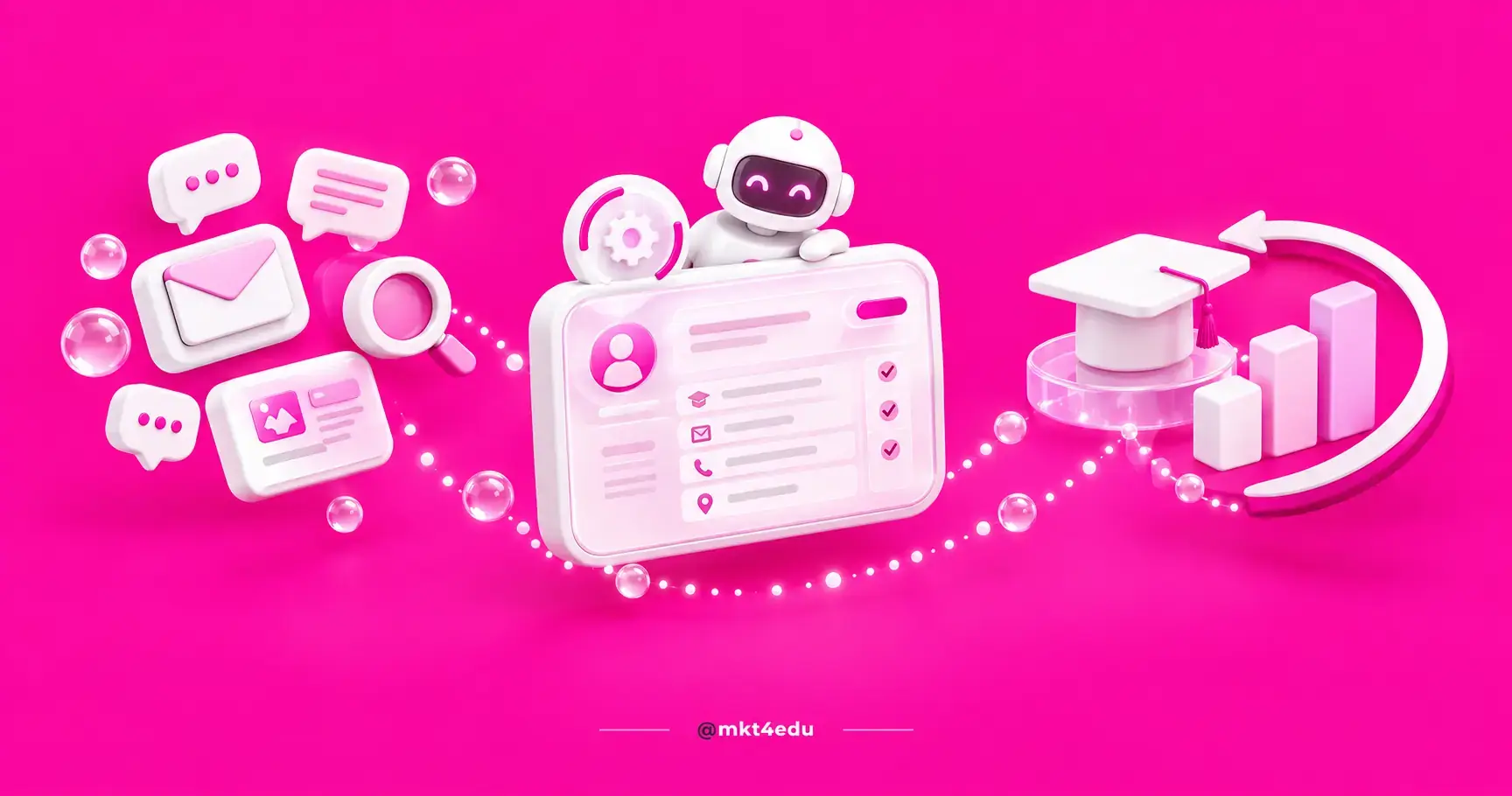 Caption: educational marketing only becomes an operation when marketing and sales work the same prospect record, from the first question to re-enrollment
If treating education as a business was once considered inappropriate, and calling a student a customer was heresy, today that is the natural path for anyone who wants to succeed in the segment.
Understanding education as a business means thinking about how to stay in the market, not only by making money, but by contributing to the growth of a sector that is central to a country's development.
Treating the student as a customer means recognizing that this person needs, and demands, quality service. It is worth working to meet those expectations at every point of contact.
Sector specialists are emphatic that educational institutions need to invest in creativity, technological innovation and diversified recruitment sources. That combination is what we call intelligence in educational marketing.
What does the 2024 Census say about recruiting students?
Brazil's 2024 Higher Education Census recorded 10,227,266 undergraduate enrollments, with distance learning accounting for 5,189,391 of them, or 50.7% of the total. It is the first time distance learning has surpassed on-campus education in the country, according to the Instituto Semesp reading of the Census.
That figure resets a claim that circulated in the sector for years. Distance learning is no longer a trend to watch, it is the majority modality, and marketing for educational institutions has to treat it as the baseline rather than a bet.
Two other numbers from the same survey help size the competition. Private institutions concentrate 79.8% of undergraduate enrollments, and distance learning growth decelerated to roughly 1% in 2024, against 25% in 2022.
The practical read is direct: volume sits in the private network and easy distance learning expansion is over. Winning a student now depends on operation, which is why educational marketing strategies stopped being seasonal.
|
Indicator |
2024 figure |
What it changes in educational marketing |
|
Undergraduate enrollments |
10,227,266 |
The real size of the market to compete for |
|
Distance learning share |
50.7% |
Recruitment without geographic limits |
|
Private network share |
79.8% |
Where enrollment volume sits |
|
Distance learning growth |
around 1% |
End of easy expansion in the modality |
|
Annual on-campus dropout |
24.8% |
Retention enters the same funnel |
|
Annual distance learning dropout |
41.6% |
Higher risk in the majority modality |
Table: Indicators from Brazil's 2024 Higher Education Census and 16th Higher Education Map, with the read for educational marketing.
There is also the retention side. Brazil's 16th Higher Education Map reports annual dropout of 24.8% on campus and 41.6% in distance learning, with a net enrollment rate of 20.8% among people aged 18 to 24.
On how much price weighs in the decision, the market reading is well established, even though percentages vary by study and by year. Financial conditions tend to weigh both on choosing an institution and on abandoning a course, which is why recruitment and retention cannot be separated.
Which student recruitment strategies sustain enrollment?
Student recruitment strategies organize into two complementary fronts: inbound marketing, which attracts prospects through content and search, and inbound sales, which guides that prospect to enrollment with a consultative approach. An active prospecting front completes the set.
To understand your institution's personas and plan effective actions, the first step is grasping the real needs of each program's audience.
The most common mistake at this stage is treating every program as one audience. A first-time undergraduate candidate and a professional looking for a graduate program have different triggers, objections and decision timelines.
In inbound marketing, the work rests on producing content that answers the questions of people who are deciding, with organic presence in search and on social platforms. It builds a database across the year, not only during campaign season.
Inbound sales takes over from there. The team contacts people who already showed interest, understands their situation and helps with the program choice, instead of pushing a seat.
Anyone who wants to see the logic applied to real scenarios will find the full path in student recruitment: how to attract more enrollments.
How do student retention strategies enter the funnel?
Student retention strategies enter the same funnel as recruitment because they share the same database and the same revenue objective. With annual dropout of 24.8% on campus and 41.6% in distance learning, every enrollment lost mid-course cancels the investment made to win it.
The difference is the moment of contact. In recruitment, the institution talks to someone who is not yet a student. In retention, it talks to someone already enrolled and at risk of leaving.
What makes retention operable is the early signal. Attendance drops, late payments, disappearance from the virtual learning environment and grades below a student's own history all appear weeks before a formal withdrawal.
When those signals sit in the same system that holds the recruitment history, the institution can act before the withdrawal request arrives. That continuity is what separates retention from recovering a student already lost.
How does CRM HubSpot connect marketing and sales?
CRM HubSpot connects marketing and sales by keeping one record per prospect, with the full interaction history in a single place. Marketing sees what sales said, sales sees what marketing sent, and both teams work the same list without duplicating contact or losing context.
The gain shows up first in the conversation. A prospect who already downloaded the admissions guide, opened three emails about the same program and visited the tuition page reaches the sales team with context, not as a name on a spreadsheet.
HubSpot software records the interaction history between leads and the institution, and uses that information across the buying journey until the interested person becomes a student. The mechanics are covered in how marketing automation and CRM work together.
One clarification about naming matters, because it changes the conversation with vendors. CRM HubSpot is the shared database, and the marketing, sales and service hubs are the layers that operate on top of it.
In practice, that means the institution does not have to buy everything at once. Many operations start with the CRM and one layer, then expand as the funnel matures.
Where does automation change enrollment conversion?
Marketing automation changes conversion rates at the moments when a prospect is one step from enrolling and only needs an operational nudge. These are simple contacts, triggered at the right time, that a human team cannot deliver at the required volume.
Two examples make it concrete. If a candidate registered for the entrance exam, it is worth sending an email, SMS or message a day before the test, reminding that person to show up at the venue.
If that same candidate was approved, why not make life easier by sending the enrollment payment link by message? These actions look simple, yet they matter enormously to the recruitment result.
The value of automation lies precisely in what looks small. An exam reminder and a payment link at the right moment recover candidates who had already decided and would only be lost to operational friction.
To build those sequences inside the platform, the path is laid out in how to automate enrollment with HubSpot and in marketing automation for educational institutions.
What do AI agents add to educational marketing?
AI agents add the ability to sustain a conversation, not just to send a message. The difference from rule-based automation is that an agent interprets the prospect's question, answers in that person's context and decides when to hand the case to a human.
That layer did not exist when many institutions built their first flows. Decision-tree chatbots answered only what the script anticipated and stalled at the first question outside it.
In recruitment, the most direct use is qualification. An AI SDR agent handles the prospect who arrives outside business hours, captures program of interest, modality and decision timeline, and delivers the context ready for the human team.
In retention, the use is coverage. A student with a question about re-enrollment, payment or withdrawal gets an immediate answer, and the case only reaches the registrar when it requires a human decision.
An honest note on the limits: an AI agent does not replace the conversation that closes a high-value enrollment. The gain is in covering volume and off-hours, freeing the team for the cases that genuinely need them.
What does educational marketing consulting deliver?
Educational marketing consulting delivers the design of the operation, not just campaign execution. The work involves mapping personas per program, building the funnel between marketing and sales, configuring the platform and defining the indicators that show whether recruitment is covering its own cost.
Working with people who understand marketing for educational institutions avoids wasted budget and shortens time to return. Digital remains one of the channels that brings institutions the strongest results, and that is our specialty.
mkt4edu is the first and only Elite HubSpot Partner in Brazil, the highest tier in the HubSpot partner hierarchy, reached through recruitment operations that lowered cost and raised qualified lead volume for educational institutions.
Our scope covers branding, SEO and SEM, content marketing, inbound marketing, inbound sales, social media, mobile marketing, web design, enrollment reopening campaigns and student recruitment and retention programs.
In everything we do, we measure results to refine both the strategy and campaign performance. We use data-driven marketing to guide the planning and execution of every action.
Frequently asked questions about educational marketing
What changes when educational marketing becomes an operation?
Predictability changes. When educational marketing stops being a set of scattered actions and starts running as a single funnel, with data shared between marketing and sales, the institution no longer discovers campaign results at the end of the period and begins correcting course during it.
The effect compounds. Each enrollment cycle leaves a richer base of prospect behavior, and that base makes the next cycle's educational marketing strategies cheaper.
That is the gain separating the institution that invests in strategic educational marketing from the one that rebuilds its plan from scratch every semester.
Want to scale enrollments at your institution at an affordable cost? Schedule a conversation with our team.


























 Portugal