





There is a meeting that repeats itself at practically every educational institution. The enrollment target was missed, and three departments explain the same number in three different ways.
Marketing shows growth in traffic and leads. Automation shows open and click rates within expectations. Sales shows that the lead that arrived had no real intent.
The discomfort of that scene does not come from bad faith, it comes from design. When digital marketing strategies are built without defining where one part's responsibility ends and the next one's begins, each department answers for what it controls and nobody answers for the result.
Which digital marketing strategies sustain sales?
The digital marketing strategies that sustain sales are three and they work in sequence: attracting qualified demand, nurturing with recorded continuity and commercial outreach within the deadline. What separates that set from a list of scattered actions is not the number of channels, it is the explicit handover criterion between one stage and the next.
 Caption: in digital marketing strategies that work, the baton passes from one stage to the next with a written criterion
Most operations have the right parts. Content is being published, a workflow is configured, a team is answering. What is missing is the agreement on what each part delivers to the next.
Without that agreement, each department optimises its own metric. Content chases traffic, automation chases engagement, sales chases closing, and all three numbers can rise without the sale moving.
That is why the question that organises a strategy is not which channel to use. It is whose lead this is at each moment, and what has to be true for it to change hands.
Teams structuring this from scratch will find the build walkthrough in the material on the digital marketing plan, which covers planning and execution. Here the scope is narrower: the division of responsibility.
Video: the symptoms of an operation where the digital marketing strategies do not talk to each other, on the mkt4edu channel (video in Portuguese)
Who is responsible for the sale: SEO, workflow or the sales team?
The honest answer is that none of the three answers for the sale alone, and that is exactly why the question needs to be asked differently. Instead of looking for a single culprit, the operation works when each part answers for a number of its own and for one transition.
SEO, short for Search Engine Optimization, answers for qualified demand arriving at the site. Its indicator is the volume of visits with intent compatible with the offer, not raw visits.
Automation answers for continuity. Its indicator is the share of leads that keep moving forward instead of stalling, and the time it takes until the first human contact.
The sales team answers for conversion into enrollment. The indicator is the close rate on what it received, considering only what met the agreed criterion.
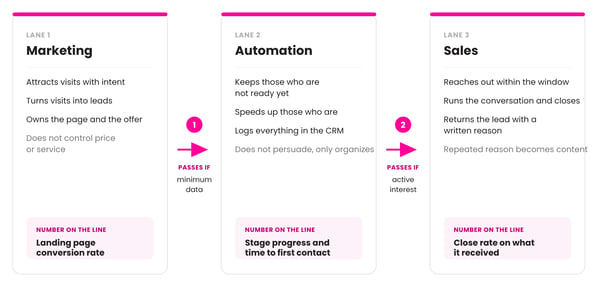 Caption: the relay between the three departments in digital marketing strategies: the baton drops at the handovers, not inside the lanes; the handover criteria are our proposal, and each operation adjusts its own to its offer
The boundary between the three is where the result is lost. A lead that arrives qualified, enters the right workflow and waits two days for a human reply was lost in the transition, not inside any of the three boxes.
That reading also defuses the unproductive argument about channels. The comparison between SEO and paid traffic changes in nature when both are measured by the same handover ruler, and not by cost per lead in isolation.
What does SEO deliver and where does its responsibility end?
SEO delivers presence at the moment someone is searching, and that is a different asset from bought attention. Its responsibility ends when the visitor reaches the site with the right intent, and the page's responsibility begins in converting that interest into a contact.
The weight of that stage is considerable. A 2019 BrightEdge study, which became a market reference, found that 53% of trackable website traffic came from organic search, against 51% in the same measurement in 2014.
What SEO does not do is equally important to bound. It does not control the offer, it does not control the price, it does not control response time and it does not control the service experience.
That means holding search work directly accountable for enrollments produces a wrong reading. When organic traffic rises and enrollment does not follow, the first hypothesis is not an SEO failure, it is a bottleneck after the click.
The check is simple and usually skipped. If lead volume grew in the same proportion as traffic, attraction is correct and the problem lies further along the lead's journey.
The stretch between the click and the form has its own name and its own owner. It is the territory of SXO (Search Experience Optimization), which answers for the experience of whoever arrived, not for how many arrive.
The way to read those numbers without confusing channel with cause is detailed in the material on conversion rate by channel, which deals precisely with the trap of picking a best channel from an average.
Content marketing enters here as a preparation layer. It does not close sales, but it answers objections before contact, which shows up in time to close and in the quality of the conversation, not in raw lead volume.
What does marketing automation solve in lead nurturing?
Marketing automation solves continuity at scale in lead nurturing. It keeps the conversation alive with those who are not ready yet and organises the handover of those who are, without depending on someone remembering to do it manually, lead by lead, every day.
The recurring mistake is asking the sales workflow to do the persuading. A well-built workflow does not turn a disinterested lead into an applicant, it identifies who has already shown interest and speeds up the meeting with a human.
In student recruitment, the variable that weighs most is time. An applicant who filled in a form is comparing institutions that same week, and a nurturing workflow that is too long hands a ready lead to the competitor.
Hence the practical design rule. The closer the lead is to the decision, the shorter the workflow needs to be, up to the point where automation only notifies and gets out of the way.
Automation's second function is less visible and equally valuable, which is recording. Without consistent records in the CRM (Customer Relationship Management, the system that manages the customer relationship), no discussion about responsibility can be settled with data.
The concrete points where that record fails and the lead disappears from the process are mapped in the material on lead loss in the enrollment funnel.
A note on interactive formats is worth adding. Quizzes and calculators qualify better than a long form in many cases, as the analysis of the interactive funnel shows, but they change what you know about the lead, not what the team does with that information.
Where does the sales team take over the pipeline?
The sales team takes over when the lead meets the agreed criterion, and that moment needs to be a written rule, not a perception. The sales pipeline starts where automation stops, and the quality of that handover determines much of the close rate.
The discipline that organises that stretch of the operation has its own name. Inbound Sales deals with approaching people who arrived on their own, and the indicators it tracks, from time to first contact to close rate on qualified leads, are exactly the numbers the sales team starts defending.
The handover criterion is usually the document that does not exist. When it is missing, marketing passes everything along so as not to lose an opportunity and sales sends everything back so as not to waste time, and the lead sits in between.
A functional criterion has three parts: what characterises a ready lead, the maximum time to first contact and what happens to those who do not meet the criterion. The third part is the most forgotten and the one that recovers the most volume.
A lead that does not pass should not be discarded, but returned to nurturing with a recorded reason. That reason, accumulated over a few months, is the best source of editorial topics a content team can have.
There is a useful inversion here. If sales rejects many leads for the same reason, the problem is neither sales nor volume, it is the promise made at the origin, and that goes back to the page and to the ad.
That is also why paid traffic leads often do not become sales: the mismatch between the expectation created in the campaign and the real offer appears at the bottom of the funnel, not in cost per lead.
How do you create a digital marketing strategy with an owner per stage?
Creating a digital marketing strategy with an owner per stage means writing down, for each transition, who delivers, who receives, what the criterion is and what the deadline is. It is a short document, and its value lies in making discussable what used to be opinion.
The build starts with the transition, not with the stage. Teams tend to detail what they do internally and leave the edges vague, which is exactly where the lead gets lost.
See how that division is organised in a recruitment operation:
|
Stage |
Owner |
Number that answers |
Handover criterion |
|
Attraction |
Content and media |
Visits with compatible intent |
Arrival at a program page or resource |
|
Conversion to lead |
Page and offer |
Landing page conversion rate |
Minimum data filled in |
|
Nurturing |
Automation |
Stage progress and time to contact |
Active interest signal recorded |
|
Outreach |
Sales team |
Effective contact rate |
Conversation held within the deadline |
|
Enrollment |
Sales team |
Close rate on qualified leads |
Application completed |
Table: proposed division of responsibility per stage in the digital marketing strategies of a recruitment operation, with the indicator that belongs to each owner
The table is an editorial starting point, not a market standard. Each institution adjusts the criteria to its own offer, and the value lies in having the right-hand column filled in, whatever its content.
One implementation detail decides whether this works. The criterion needs to live in the CRM as a field, not in a separate document, because a rule that is not measured goes back to being an opinion within two weeks.
How does the conversion rate change owner along the lead's journey?
Conversion rate is not a single number, it is several numbers with different owners along the customer journey. Treating it as a single indicator is what makes an entire meeting discuss the same drop without being able to locate where it happened.
The first conversion is visit to lead, and it belongs to the page and the offer. When that number falls with stable traffic, the problem is in the form, the value proposition or the clarity of the next step.
The second is lead to qualified lead, and it belongs to the criterion and to nurturing. A drop here usually means the traffic source changed, or that the criterion became stricter without anyone saying so.
The third is qualified to enrolled, and it belongs to the commercial conversation. That is the only point where service skill weighs more than structure.
Separating the three allows a far more productive question in the monthly meeting. Instead of asking why conversion fell, the team asks which of the three fell, and the answer points to the department without having to accuse anyone.
Reading those indicators together, including what organic does as a first touch rather than a last click, is developed in SEO metrics in the age of AI.
Video: reading those rates stage by stage inside digital marketing strategies, on the mkt4edu channel (video in Portuguese)
What does SEO for AI change in that division of responsibility?
SEO for AI (Artificial Intelligence) changes the profile of what arrives, not the division of responsibility. When part of the questions is answered directly in the search interface or in an assistant, the visitor who clicks tends to arrive further along in the decision and in smaller numbers.
That has a direct effect on internal accountability. Comparing session volume between periods becomes a poor reading, because the same demand can generate fewer visits and more contacts.
There is an indication that this audience converts above average. Semrush's own survey on AI visibility estimates that visitors arriving from AI search convert 4.4 times better than those from traditional organic search.
The number should be read with caution, because it is a market survey, with no sample or period published in the article, and not an official platform statement. The direction, though, is consistent: whoever clicks after reading a summary arrives with fewer basic doubts.
The operational consequence falls on the sales team, and it is rarely anticipated. If the lead arrives better informed, an outreach script that starts by explaining the basics begins to sound out of place.
For the content team, the change is one of format before it is one of topic, as the comparison between SEO, AEO and GEO shows. None of this redistributes responsibility, it only shifts where each one starts to weigh.
Frequently asked questions about digital marketing strategies
What should you prioritise first in digital marketing strategies?
Prioritise the transition, not the stage. Before increasing investment in any channel or reworking any workflow, write the handover criterion between marketing and sales and the maximum time to first contact, because it is at that boundary that most of the result is lost.
The second priority is instrumenting that rule in the CRM. A criterion that does not become a field does not become data, and without data the conversation about responsibility goes back to being a contest of perceptions the following month.
Only after that is it worth discussing channel, volume and budget. Widening the lead intake of an operation that loses leads at the transition increases waste instead of results.
If your operation already has volume, published content and a team in place, but closing does not keep up, the diagnosis starts with the design and not with the media. The symptom is the same in student recruitment, in B2B consultative selling and in a services operation: the lead exists and stops somewhere.
Talk to our team to map where it stops today and which transition gives results back fastest, with support on the CRM structuring that sustains that measurement.



























 Portugal