


A CRM go-live usually arrives with a sense of mission accomplished: data migrated, integrations live, team introduced to the tool. Three weeks later the pipeline is out of date, half the deals have no next task and the forecast is back in a spreadsheet. That gap is where CRM management is decided.
If your company has just flipped the switch, this is the most delicate moment of the project. The system is technically ready, but the habit does not exist yet, and habits are not born in a classroom, they are born from a managed routine.
Over the coming months, the challenge is turning the tool into behaviour: measuring usage, creating pipeline rituals and adjusting the configuration as the team works. That follow-through, applied across implementations run by mkt4edu, separates the CRM that becomes routine from the CRM that becomes a forgotten contact list.
What is CRM management and why does it start after go-live?
CRM management is the set of routines that keep a CRM system useful after implementation: reading usage metrics, running pipeline rituals, encouraging logging and keeping light governance over fields and permissions. It starts at go-live because, from there on, the result depends on the team's behaviour rather than on the configuration.
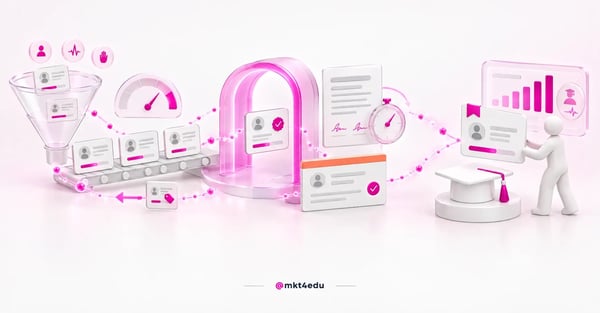 Caption: CRM management turns the team's daily logging into the dashboard leadership actually decides with
The technical side delivers the structure: a HubSpot implementation with the right configuration covers funnels, fields, automations and tested integrations. What it does not deliver is daily use.
The difference between CRM strategies that turn into results and projects that die within six months is rarely the tool. It is the management that exists, or does not, after the switch.
One distinction clears up most of the confusion: training is an event, CRM management is a continuous programme. The event transfers knowledge in a few hours. The programme sustains behaviour for months, with usage metrics, pipeline rituals, incentives and light governance.
Without that programme, the CRM drifts away from the marketing and sales strategies that justified buying it. The funnel that was meant to connect campaigns, leads and revenue becomes a database nobody trusts.
Which metrics show whether the team is using the CRM?
Adoption metrics measure behaviour, not sales results: who logs in, who records activities, how many deals have a next task and how current the pipeline is. They come before commercial KPIs (Key Performance Indicators), because no report is reliable while the data is not going in.
Reading those metrics is the heart of CRM management in the first months. They answer, with data from the system itself, anyone asking how to optimise the CRM right after implementation: first you fix the usage, then you optimise the process.
Across the implementations we run at mkt4edu, the adoption scorecard fits into a handful of indicators, each with a named owner and a short reading cycle. Here is how it breaks down:
|
Metric |
What it reveals |
Reading frequency |
|
Weekly active users |
Whether the team is logging in or working outside the system |
Weekly |
|
Deals created per rep |
Whether the pipeline is born in the CRM or arrives ready from another tracker |
Weekly |
|
Deals with no next task |
Whether follow-up discipline exists or contacts are forgotten in the funnel |
Weekly |
|
Days since last update |
Whether the pipeline reflects reality or is dressed up the night before the meeting |
Weekly |
|
Required field completeness |
Whether the data can support segmentation, reports and automations |
Fortnightly |
|
Activities logged per deal |
Whether calls, emails and meetings are going through the system |
Fortnightly |
|
Source of leadership reports |
Whether accountability runs through the CRM or through parallel trackers |
Monthly |
Table: starter scorecard for CRM management in the first 90 days, with names and frequencies to adjust to your funnel
Three or four of these are enough to start, as long as the reading is constant and visible to the team. Adoption metrics hidden inside a management report change nobody's behaviour.
The same data that measures adoption feeds the rest of the operation. Campaign attribution depends on the source recorded on each deal, and the digital marketing strategies that follow are planned on the fields the rep fills in, or skips, every day.
Without that base, inbound marketing also loses power: list segmentation, nurturing and lead scoring depend on data that only exists once CRM usage becomes routine.
Continuous cleaning of fields, views and automations speeds up the adoption curve, and these essential tips to improve your CRM help order that work. What no technical fix replaces is the weekly read with the team.
How do you build a CRM adoption programme in the first 90 days?
An adoption programme organises the first 90 days into three cycles: stabilise usage in month one, consolidate data quality in month two and optimise the process in month three. Each cycle has its own targets, a weekly read of metrics and configuration fixes made as the team uses the system.
In the first month there is a single goal: all commercial work inside the system, with the deal created on the spot, the activity logged the same day and the pipeline updated before the weekly meeting. Sophisticated reporting can wait, the focus is the habit.
In implementation projects run by mkt4edu, training happens alongside the process switch, never weeks before or weeks after. And it only happens with the integrations working: training a team on an unstable system teaches them, above all, to distrust it.
One recurring example: even with automations ready to move deals between stages, the team keeps advancing everything by hand until they are formally told otherwise at the switch. Old behaviour does not switch itself off, it switches off with clear communication from whoever runs the project.
In month two, the programme tightens quality: required fields reviewed, duplicates handled, views by role and a pipeline meeting with a fixed agenda. Those rituals are the ground where inbound sales gains or loses traction, because a follow-up cadence only exists if the logging exists.
During that period, tool questions are answered live in the daily meetings, with no backlog of tickets for later. No configuration task counts as done without evidence, a screenshot or a link to the record, because configured is not tested.
In month three come the incentives and the optimisation: recognition for people who use it well, usage targets tied to commercial targets and the first fine-tuning of automations. Teams who design HubSpot Onboarding with those three cycles in mind reach day 90 with a formed routine instead of rework.
HubSpot's own official onboarding service organises the start along those lines. The adoption programme is what keeps the rhythm once that initial support ends.
Video: video from the mkt4edu channel on the structure CRM management has to keep alive
That is the model behind mkt4edu's HubSpot CRM implementation and management service: the configuration is born together with the adoption programme, not separately from it.
What is leadership's role in CRM management?
Leadership decides where commercial truth lives. If the manager asks for the pipeline through the CRM, the team updates the CRM; if they accept an answer by spreadsheet or message, they authorise abandoning the system. No adoption metric survives an accountability routine that happens outside the tool.
Consistent accountability shows up in three simple rituals: a pipeline meeting with the CRM on screen, one-to-ones guided by the recorded deals and a forecast pulled from the system, with no parallel version.
The most consistent CRM strategies we follow treat those meetings as non-negotiable. Over time, inbound sales benefits from the same move: follow-up becomes a task with a deadline, lead handover gains criteria and the pass between marketing and sales stops depending on memory.
On the marketing side the gain is symmetrical. When sales leadership reads the funnel inside the system, marketing strategies get planned on the same data, and the conversation between the two areas leaves guesswork behind.
Video: video from the mkt4edu channel on the modules that fall inside the scope of CRM management
Incentives help, but light governance is what holds. Few required fields, clear permissions by role and a single channel for change requests stop the system from bloating until it is unusable. A CRM overloaded with fields is the shortest route back to the spreadsheet.
Does CRM training solve a lack of adoption?
Training does not solve adoption on its own, because it transfers knowledge, not habit. It works as the milestone of the switch and as occasional reinforcement, while CRM management sustains daily behaviour with metrics, rituals and consistent accountability. One without the other produces certified teams still working in a spreadsheet.
Timing weighs as much as content. A group trained weeks before go-live arrives at the switch without remembering the flows, and a group trained weeks after has already built habits that are hard to correct. Well placed, CRM training becomes the milestone that makes the new process official.
After that milestone, reinforcement changes shape: specific questions answered at the pace of the operation, new hires onboarded through a short track and each new feature presented in a focused session. A mature HubSpot Onboarding plans those tracks by role before the first session.
One question separates a training problem from a management problem: does the team not know how to use it, or do they not see a reason to? In the first case, teach it again. In the second, no session will fix it, and it is the adoption programme that needs adjusting.
The same order applies to technical evolution: before studying how to optimise the CRM with advanced automations and integrations, make sure basic usage has become a measured routine. Optimising on bad data only produces the wrong report faster.
CRM management at an education institution: what changes?
At an education institution, CRM management follows the same fundamentals, but the calendar changes everything: the recruitment funnel concentrates volume into entrance exam and enrolment peaks, the team mixes admissions advisers with academic areas, and each academic cycle restarts the pipeline almost from scratch.
That concentrated calendar makes adoption more urgent, not less. A record lost out of season does not compromise just any quarter, it compromises the whole recruitment campaign for the following term.
At one education group we serve, the coordinator and operator permission profiles were defined field by field, and unused modules were switched off at the root. The admissions adviser opens the system and finds only what the role requires, with no dead tabs competing for attention.
The effect shows up directly in recruitment. With programme, shift and entry route recorded from the first contact, inbound marketing can segment nurturing by real interest, and enrolment campaigns stop firing a generic offer at the whole database.
The same CRM supports the post-enrolment stage: student service, retention and relationship all call for optimising the CRM for service, which turns the system into a persistence channel. And the digital marketing strategies of the next cycle grow out of the data that continuous use produces.
Frequently asked questions about CRM management
What should you prioritise first in CRM management?
The priority in the first 90 days is a short, visible scorecard: three adoption metrics read every week, one pipeline ritual run inside the system and the rule that only what is recorded exists. Fine configuration, advanced automation and sophisticated reporting come after the habit.
If your go-live has passed and usage is sliding, treat next Monday as the switch that never happened: announce the end of parallel trackers, name the owner of the programme and open the first meeting with the CRM on the screen.
Once the habit is formed, the challenge becomes sustaining the read month after month. The natural next step is monitoring HubSpot CRM and the tool's performance, turning the adoption metrics of the first 90 days into the dashboards leadership will follow from then on.












 Portugal