





SEO in the AI era was born out of a deep shift in how people access information. Google's dominance is no longer absolute, and new starting points compete for the attention of anyone looking for an answer.
This is not just a change of channel. The distribution of organic traffic, the SEO models and the effectiveness of the content strategies of the last fifteen years changed along with it.
This article splits content discovery into three fronts, ChatGPT, Google and social search, and shows what each one demands from your SEO and content production strategy, with data, updating techniques and a practical routine.
Why has ChatGPT become an AI search channel?
ChatGPT became an AI search channel because it delivers a direct answer, without navigating links, with context and personalization based on the conversation. For millions of people, it is now the first place the question is asked, no longer Google's search box.
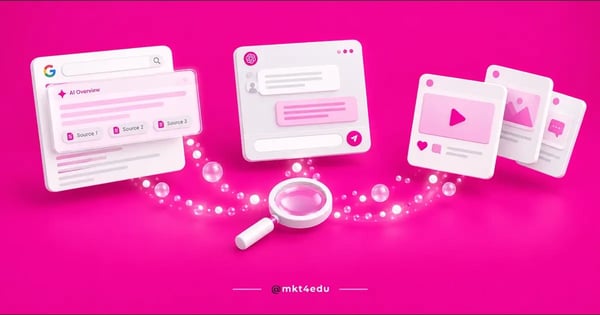 Legenda: online discovery fragmented, and Google with AI Overviews, ChatGPT and social platforms now share the same search journey
The numbers follow that shift. According to a survey published by Voronoi, ChatGPT passed 5 billion monthly visits in April 2025 and reached the position of fifth most visited site in the world.
Among the ten most visited sites, it was the only one to grow in the period, ahead even of X, the former Twitter. The figure shows generative artificial intelligence redesigning the way people look for and consume information.
Three factors explain the mass adoption:
- Instant answers, without having to open several links.
- Context and personalization based on the conversation history.
- Increasingly easy access, with integration across browsers, apps and assistants.
With that, ChatGPT stops being only a text generator and starts working as a search engine, and more than that, as an answer instrument.
What changes for SEO when the answer comes from AI?
When the answer comes straight from AI, the click to the source site may not happen. This is the zero-click search phenomenon, which, according to a survey published in July 2024 by the outlets Swipe Insight and Intelligency Group, accounts for around 60% of searches on Google.
By the same data, 59.7% of users do not click any external link after searching. They stay on the results page because they already found what they wanted.
With AI answering directly, the challenge becomes a different one: getting your content referenced by the model and into the generated answer. That requires authority, consistent semantic structure and frequent updating.
Presence on domains with strong E-E-A-T (Experience, Expertise, Authoritativeness, Trustworthiness) weighs more and more in that selection. It is the same principle behind optimization for language models, SEO for LLM, which adapts content to be understood and cited by AI.
How do you prepare content for conversational search?
Preparing content for conversational search starts with writing it in the format AI uses to retrieve information: real questions and direct answers. Everything else follows from that passage extraction logic.
Here is how the actions are organized:
|
Action |
Description |
|
Question and answer structure |
Use FAQ and H2 subheadings with real search questions |
|
Semantic markup |
Indicate content type, author and date with structured data |
|
Constant updating |
Review content frequently and keep dates visible |
|
Qualified backlinks |
Being cited by authoritative sources increases the chance of reference |
|
Original content |
Bring first-hand information, not a rewrite of what is already indexed |
Tabela: Techniques that strengthen content presence in search with artificial intelligence.
Applied together, these actions increase the chance of the content being retrieved by a generative model and sustain visibility when the click does not happen.
How do Google's AI Overviews change SEO in the AI era?
AI Overviews change SEO in the AI era by placing a generated summary at the top of the Google page, before the list of links. The first answer the user sees stops being an organic result and becomes an AI block that cites a few sources.
Google brought this feature to the general public in the United States in May 2024, under the name AI Overviews. The name replaced the one used for the experiment that ran in Search Labs as Search Generative Experience (SGE). In May 2025, Google also launched AI Mode, a conversational search tab with its own surface.
The change has deep effects on content discovery:
- A drop in click-through rate on the first ten links.
- Greater weight of brand and authority to be referenced in the summary.
- Relevance of well structured content, with semantic markup and E-E-A-T.
This is the same movement detailed in the analysis of how Google's AI affects organic traffic, which separates a drop in clicks from a drop in interest.
What should you do to stay visible on Google with AI?
To stay visible on Google with AI, produce content that answers the question clearly, in a direct and scannable way. The AI block looks for passages that resolve the doubt, and that is where the citation comes from.
Four practices sustain that visibility:
- Answer the question directly, right at the opening of each section.
- Use headings aligned with the questions in the People Also Ask block.
- Diversify formats, with short videos, original images and interactive content.
- Implement structured data for articles, reviews and products.
It is worth understanding how the summary works before optimizing for it. The read on the AI-powered overview shows how the feature builds the answer and why the correct terminology matters when researching. For the conversational format, Google AI Mode covers what changes when search becomes a dialogue.
What is social search and why does it challenge Google?
Social search is the use of social platforms as a search engine. Instead of opening Google, a person looks for a restaurant, tutorial, product or course straight on TikTok, YouTube or Reddit, and finds the answer in the platform's native format.
An Adobe survey from March 2024 found that 64% of Generation Z young people have already replaced Google with TikTok as a search tool. The behavior consolidated and moved from restaurant tips to fashion, technology, tutorials and educational content.
A new type of optimization comes out of that shift, social search optimization, which adapts content to each platform's search logic.
Which social platforms work as search engines?
The platforms that work as search engines are the ones where keyword search combines with algorithmic recommendation. Five stand out in that role:
- YouTube: the second largest search engine in the world.
- TikTok: strong in discovery of products, tips and entertainment.
- Reddit: search supported by authentic discussions and opinions.
- Pinterest: ideal for visual search and planning.
- Instagram: a reference for inspiration and lifestyle.
In all of them, the result comes from the crossing between what the person looks for and what the algorithm recommends.
How do you optimize content for social search?
Optimizing for social search means adapting content to the way each platform reads and recommends what you publish. The base is common, keyword and clarity, but the execution changes per platform.
Here is how the practices are distributed:
|
Channel |
Optimization action |
|
TikTok |
Caption with keyword, trending audio, hashtags and on-screen text |
|
YouTube |
Title as a question, description with keyword and timestamps |
|
|
Name boards and pins with searched terms and organize by category |
|
|
Invest in the description, the image alt text and location tags |
|
|
Produce valuable answers with contextualized links |
Tabela: Optimization best practices for search inside TikTok, YouTube, Pinterest, Instagram and Reddit.
These actions position content in the searches made inside the platforms and increase organic discovery among the institution's audience.
How do you update old content for AI search?
Updating old content for AI search means revising already published posts for the new standards of consumption and citation. Producing new articles is not enough, because a large share of traffic lives on old pages that still rank and can be retrieved by AI.
Keeping that archive updated is what sustains relevance against the new formats. It is also the routine that separates one-off SEO from SEO in the AI era as a continuous operation, with weekly adjustments and revision of outdated content.
Which checklist should you use to optimize old content?
The checklist to optimize old content covers title, structure, data and media, in this order of priority:
- Update the title to real search questions, tested on Google and in People Also Ask.
- Include a FAQ section at the end, with three to five frequently asked questions.
- Insert multimedia content, with video or image and descriptive alt text.
- Add recent data and statistics, with a named source.
- Improve readability, with short paragraphs, lists and descriptive subheadings.
- Implement structured data and review internal and external links.
Following the checklist, content stays competitive both in traditional search engines and on AI platforms and social networks.
Which tools help with that update?
The right tools speed up reading the opportunity and keep content aligned with the most recent search behavior. Three solve most of the work:
- Google Search Console: identifies the pages with a traffic drop.
- Answer the Public: reveals real questions asked by people.
- Semrush or Ahrefs: assess ranking and point out what to update.
With that data in hand, the team monitors performance, captures emerging trends and refines the strategy continuously.
Which practices sustain SEO in the AI era?
The practices that sustain SEO in the AI era are the ones that become routine, not campaign. The work became more fluid, contextual and multimodal, and demands an active cadence from the marketing team.
Six actions sustain consistency over time:
- Map new questions related to your niche every week.
- Optimize one old article per week.
- Create a dedicated FAQ section at the end of posts.
- Repurpose content into carousels, short videos, threads and pins.
- Use AI as a copilot, always with human review and context.
- Invest in quality backlinks, with guest posts, podcasts and partnerships.
Adopted continuously, these practices prepare the brand for changes in search behavior and expand presence across several discovery channels.
Why does integration between teams sustain modern SEO?
Integration between teams sustains modern SEO because no single area delivers complete content for AI search on its own. SEO, content, UX, design and video need to think about topic clusters together.
Three moves help with that integration:
- Bring SEO, UX, content, design and video professionals together around the clusters.
- Align actions with business metrics and real user behavior.
- Build a dashboard with indicators beyond pageviews, such as time on page and share of voice.
That collaboration expands the capacity for innovation and makes the operation more responsive to changes in algorithm and format. It is the basis of SEO work that connects content, technique and business.
How do you measure AI's impact on organic traffic?
Measuring AI's impact on organic traffic requires looking beyond pageviews, because part of the value happens without a click. The central indicator stops being visits alone and starts including presence, retention and citation.
Four indicators show that impact clearly:
- Impressions against clicks: separates a drop in interest from a drop in clicks.
- Time on page and scroll depth: measure the engagement of those who arrive.
- Share of voice: shows how much the brand appears in the niche's answers.
- Traffic source: identifies visits coming from AI and from social platforms.
Traffic coming from AI tends to arrive with more mature intent, which sustains better conversion per visit. Reading volume alone therefore underestimates the channel's return.
Following these numbers closely is what turns the change in behavior into a content decision, instead of letting the drop in clicks look like a performance problem.
Frequently asked questions about SEO in the AI era
How do you turn SEO in the AI era into more traffic and citations?
Turning SEO in the AI era into results starts with accepting that discovery no longer lives on Google alone. ChatGPT brings speed and personalization, AI Overviews keep structure and trust, and social platforms deliver authentic opinion and native formats.
Bringing these three fronts together is the challenge for anyone producing content today. The path is to move from isolated technical SEO to SEO as an integrated experience, centered on the user, connected to the brand and sensitive to context.
Whoever masters that logic does not only rank better, but builds a longer lasting relationship with the audience, on every channel where it searches.
If your institution wants to prepare content to be found and cited in AI search, the Mkt4edu team can help build that operation. Talk to us and start with a diagnosis of your presence across discovery channels.

























 Portugal