




For months, the topic remained in the realm of speculation. Agencies put together presentations, media teams drafted scenarios, and everyone repeated the same phrase: when it arrives, everything will change.
The wait is over. ChatGPT Ads in Brazil is no longer just a promise—it’s now available, with a launch date, named partners, and published guidelines.
The difference between an announcement of expansion and an actual launch is that Brazilian users are now seeing ads within their conversations with the AI. And this reshapes the debate over media budgets for the second half of the year.
What is ChatGPT Ads, and when did it launch in Brazil?
ChatGPT Ads is OpenAI’s advertising platform that displays sponsored ads within ChatGPT conversations. In Brazil—the eighth market to receive the solution—advertising began on August 4, 2026, according to a press release from the company itself.
This timeline helps explain the current situation. OpenAI began testing ads on ChatGPT in the United States on February 9, 2026, with adult users logged into the entry-level plans.
Next came Canada, Australia, and New Zealand, followed by the United Kingdom, Japan, and South Korea. Brazil rounds out this list, alongside Mexico, which is in the same phase of expansion.
It’s worth noting a distinction that many people missed along the way. On May 7, 2026, OpenAI merely announced its intention to expand to Brazil, the United Kingdom, Mexico, Japan, and South Korea. An expansion announcement is not a launch.
What happened in August was different: Brazilian users began actually seeing the ads, with named launch partners and display rules in effect.
 Caption: The arrival of ChatGPT Ads in Brazil opens new avenues for advertisers on artificial intelligence platforms.
Who sees ChatGPT Ads, and who continues to see no ads?
At this stage, ChatGPT Ads reaches only users over 18 on the Free and Go plans—the cheapest in the paid lineup. Subscribers to Plus, Pro, Business, Enterprise, and Education remain ad-free, as confirmed by OpenAI in its material about the test.
This restriction isn’t an operational detail—it’s an audience definition. Media planners need to take into account that the current inventory targets users who do not pay for a premium subscription or who pay the lowest subscription fee.
There is also a layer of thematic exclusion. OpenAI stated that it does not display ads on accounts of users identified or predicted to be under 18, and that ads are not eligible to appear near sensitive or regulated topics, such as health, mental health, and politics.
The Free plan also offers users an option: they can choose not to see ads in exchange for a lower daily message limit.
For advertisers, this means a more targeted and higher-quality ad inventory than the raw volume of users might suggest. Less indiscriminate reach, more context.
How do ads appear within ChatGPT?
The ad appears after the organic response, separated by a visual divider and always clearly labeled as sponsored content. OpenAI calls this principle “response independence,” meaning the model’s response does not change because of the advertisement.
Dave Dugan, head of global ads solutions at OpenAI, explained the mechanics in an interview with Meio & Mensagem:
"The user asks a question and receives an organic answer, without any changes due to advertising. After that answer, there’s a gray line, and below it there may be an ad, but it’s very clear that it’s an ad, since there’s always a label saying ‘sponsored’ or ‘ads.’”
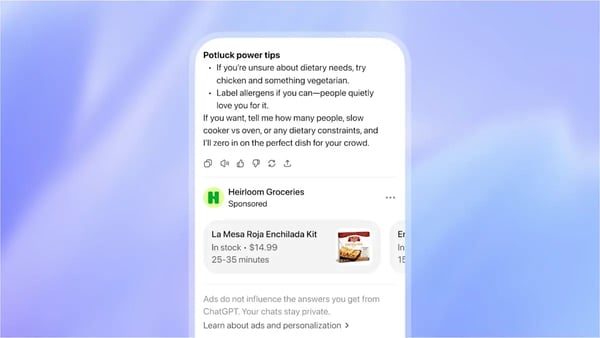 Image 01: Example published by OpenAI on its help center: the sponsored card appears below the end of the answer, visually separated and clearly labeled. Image: Reproduced from OpenAI
Ad selection combines the conversation topic, chat history, and the user’s previous interactions with advertising. When there is more than one eligible advertiser, OpenAI displays the one most relevant to that context first.
According to Dugan, about 20% of the questions asked of ChatGPT have a direct commercial intent. This is where advertising comes in, but personal questions and requests for advice are excluded.
Regarding privacy, the published policy is clear on a point that often raises questions. Advertisers do not have access to conversations, history, memories, or personal data. They receive only aggregated performance data, such as views and clicks.
Users also retain control, being able to opt out of ads, provide feedback, understand why they saw a particular ad, delete their advertising data, and manage personalization.
How do advertisers access ChatGPT Ads in Brazil?
There are three ways, and all of them are already active: OpenAI’s Ads Solutions team, the pilot’s agency and technology partners, and the self-service platform at ads.openai.com, where advertisers create, manage, measure, and optimize campaigns on their own. The official Ads Manager availability page began listing Brazil on August 6, 2026, and OpenAI confirmed the activation with all three routes on August 17.
This arrangement differs from how earlier markets were sequenced. In the United Kingdom, users saw ads 16 days before local advertisers got self-service; in the United States, the February launch required a reported minimum commitment of between US$200,000 and US$250,000, a floor that only disappeared for good in May. Brazil and Mexico received the mature access model on day one.
The Brazilian pilot program launched with strong support from the local market. BETC Havas, Monks, Omnicom, Publicis, and WPP are among the partners in the initial phase, as reported by Meio & Mensagem at its launch.
Companies that want to join the access queue can sign up to receive updates on the OpenAI’s page for advertisers. This is the official channel recommended by the company at each stage of expansion.
Self-service delivered on its promise of giving advertisers of all sizes autonomy, without the need for an agency, featuring investment management, reports, metrics, and billing. What Exame reported as scheduled for the days following the launch has been confirmed.
And the product that reached Brazil is considerably deeper than the standalone sponsored unit of the American launch. There are now four buying models — CPM, CPC, CPA, and conversion-optimized campaigns — plus geographic targeting, custom audiences built from uploaded emails and phone numbers (with a floor of 25,000 matched users before a list becomes usable), product feed campaigns supporting up to one million SKUs, and measurement through OpenAI’s own pixel, a Conversions API, and third-party integrations such as LiveRamp, Triple Whale, and Hightouch. The multi-product carousel, which displays several items from the same advertiser in a single unit, entered testing in August.
The caution has moved, but it hasn’t disappeared. What does not exist is a local benchmark: every public figure for this channel comes from English-language inventory in the United States, with an average click-through rate of 0.68%, CPM between US$25 and US$60, and a recommended CPC of US$3 to US$5. Brazil and Mexico were the platform’s first Portuguese and Spanish language markets, and OpenAI has published nothing about how context-based targeting behaves in those languages.
This matters because ChatGPT Ads targeting does not run on keywords. It runs on context hints: short phrases, defined at the ad group level, that describe the kind of conversation where the brand wants to appear. The system matches those phrases against the subject of the conversation in progress. There is no documentation on how to write hints in Portuguese, or whether hints written in English will match Portuguese conversations. Anyone entering now is calibrating that in practice.
Why did OpenAI choose Brazil for ChatGPT Ads?
Brazil ranks among ChatGPT’s top three markets in terms of weekly active users, alongside the United States and India. Add to that a large advertising sector known for its rapid adoption of new technologies, and the choice comes as no surprise.
There is also revenue pressure that explains the pace. OpenAI has reached approximately $25 billion in annualized revenue, but projects a loss in the billions by 2026, driven by the cost of training and running models.
The bottleneck is conversion. Of the more than 900 million people who use ChatGPT every week, less than 3% pay for a subscription. Advertising is the classic way to monetize the other 97%.
Initial figures suggest genuine market interest. The U.S. pilot reached $100 million in annualized revenue in six weeks, with more than 600 advertisers. The stated goal for 2026 is $2.5 billion in advertising revenue.
For media planners, the key takeaway is different: OpenAI has a strong incentive to make this channel work. This is likely to translate into investment in product development, measurement, and advertiser support in the coming quarters.
Here’s how the expansion phases unfolded leading up to the launch in Brazil:
|
Stage |
Markets |
Milestone |
|---|---|---|
|
Initial Test |
United States |
Starting February 9, 2026 |
|
First Expansion |
Canada, Australia, New Zealand |
Announced in March 2026 |
|
Second expansion |
United Kingdom, Japan, South Korea |
United Kingdom in June 2026 |
|
Third expansion |
Brazil, Mexico |
Brazil on August 4, 2026 |
|
Fourth expansion |
31 European countries |
Serving from August 24, 2026 |
Table: Timeline of ChatGPT Ads’ expansion, based on updates published by OpenAI and press coverage of the Brazilian launch.
The pattern is consistent: each market enters a pilot phase, with local learning before any broad rollout. The pace, however, has accelerated. Six days after the Brazilian launch, OpenAI announced its largest expansion yet — 31 European countries, serving from August 24 — bringing the total to 40 markets. In Europe, unlike Brazil, self-service did not open alongside it: buying started only through Ads Solutions, agencies, and partners, and ad personalization launched switched off because of GDPR.
How does ChatGPT Ads change the competition with Google Ads and Meta Ads?
The key difference lies in the type of signal. With ChatGPT, the user’s intent is stated in natural language, with context, rather than inferred from browsing behavior or click history.
This shifts the timing of the ad. Instead of appearing the moment a term is searched, the brand can appear during the thought process leading up to the decision, when the person is still formulating the problem.
Paulo Barros, chief investment officer at Omnicom Media, summarized the trend in a statement cited by Exame:
"Brands are now competing for relevance not only at moments of discovery, but also during the process leading up to a decision."
ChatGPT is now effectively operating as a third gatekeeper of digital traffic, alongside Google and Meta. For those who already set up a paid traffic, this means a new line in the channel matrix, with its own measurement logic.
However, there’s an important link between paid media and organic traffic that’s often overlooked in this discussion.
If ChatGPT’s organic response remains independent of advertising, then continuing to be mentioned organically by the AI remains valuable. The practices of Answer Engine Optimization (AEO) and Generative Engine Optimization (GEO) are not replaced by sponsored ads; rather, they compete for space above the gray line.
In other words: the ad buys the position below the answer. The answer itself is still earned.
How can you prepare your campaign for ChatGPT Ads without sacrificing organic traffic?
Preparation starts with structural decisions, not budget. Before setting aside a budget, it’s worth identifying which of your conversions stem from questions with direct commercial intent, because that’s exactly the segment ChatGPT Ads targets.
Five steps will help you enter the channel with a strategy, not just by trial and error:
- Identify the actual commercial questions. Pinpoint the questions that precede a purchase decision in your industry, using the exact words your audience uses. These are the building blocks of contextual relevance.
- Separate testing from operations. Treat the initial budget as a learning budget, with a written hypothesis and defined success criteria established before the first dollar is spent.
- Define your metrics before the campaign. Since advertisers receive only aggregated view and click data, attribution must be handled on your end, within your CRM and destination parameters.
- Maintain organic efforts. The quote in the search results and the ad below it are distinct spaces. Abandoning one to fund the other reduces your overall presence.
- Review the landing pages. Anyone arriving from an AI conversation has already read an overview. The page needs to continue the conversation, not start from scratch.
None of these steps require advance access to the platform. All can be done now, which reduces the time between the launch of self-service and the first campaign that has any chance of being seen.
There is a broader context that reinforces the urgency. The transformation of search by AI is already affecting the dynamics of organic traffic, and SEO practices for SEO for LLMs have moved beyond the experimental stage to become routine in mature operations.
Anyone who wants to delve deeper into the mechanics of the channel itself—including labels, eligibility, and brand preparation—can find detailed information in the ChatGPT Ads guide.
What risks and limitations does ChatGPT Ads still have?
The main risk lies in the user experience, not the technology. ChatGPT gained traction by being a commercial-free environment, and the introduction of advertising tests precisely that implicit agreement with the user.
OpenAI states that the initial results of the pilot showed no impact on consumer trust metrics, with a low ad rejection rate. This is an encouraging sign, albeit preliminary and based on the company’s own data.
The industry is divided on the way forward. Anthropic, the owner of Claude, took the opposite approach and turned the absence of ads into a marketing platform, with a Super Bowl ad campaign warning that “ads are coming to AI.”
On the operational side, three limitations are worth noting. The inventory excludes sensitive and regulated topics, which restricts entire categories. Measurement relies on aggregated data in the platform’s reporting, which requires proprietary attribution in your CRM. And there is no published benchmark for Portuguese-language inventory: anyone investing today is extrapolating from American figures.
The pixel changed behavior on its own: review before scaling
On August 17, 2026, automatic advanced matching became the default on ChatGPT Ads pixels already installed. In practice, the pixel begins collecting and sending user identifiers — email and phone number among them — to match conversions, without anyone having touched the implementation. OpenAI communicated the change by email to advertisers in early August, with a ten-day window for those who wanted to opt out.
Anyone already running the pixel needs to check two things before increasing budget. First, whether the legal basis declared in your privacy policy and consent banner covers this transmission, because Brazil’s LGPD treats a direct identifier differently from aggregated data. Second, whether the custom audience you plan to upload has consent for that purpose, since uploading emails and phone numbers for targeting is a processing operation, with all the obligations that come with it.
The regulatory context is worth recording. Brazil’s ANPD became a full regulatory agency in late 2025, added the protection of children and adolescents to its 2026-2027 enforcement priorities, opened a public consultation on age verification in May and, five days before ChatGPT Ads was activated in Brazil, ordered Discord to disable a feature for all Brazilian users. There is no public statement from the authority about ChatGPT Ads, but this is not a passive enforcement environment.
None of this disqualifies the channel; it simply defines what is reasonable to expect from a pilot program that has only been live in the country for a few weeks: learning, not scale.
One final word of caution regarding information. Much of what’s circulating as the “definitive guide to ChatGPT Ads in Brazil” was written before the launch, based on the May announcement. It’s worth checking the date and source before deciding to invest based on these materials.
What else do you need to know about ChatGPT Ads?
So, is it worth investing in ChatGPT Ads right now?
It depends on what you mean by “investing.” Setting aside a budget for testing—with a written hypothesis and defined success criteria—makes sense for those who rely on informed purchasing decisions and have their own measurement framework.
Shifting a significant portion of your budget away from channels that are already performing well—no. The platform matured quickly, but Brazil still has not a single published benchmark, and context-based targeting has never been documented in Portuguese. It’s a pilot with a good tool and no yardstick: plenty to learn, nothing to forecast.
What seems largely irreversible is the direction this is taking. The search for commercial information is shifting toward conversations with AI, and now those conversations have advertising inventory. Those who understand the mechanics early on will buy time—not just impressions.
It’s worth remembering what doesn’t change: organic results remain the prime real estate on the screen, and they aren’t for sale. They’re earned through content that AI deems trustworthy enough to feature.
If you’re evaluating how to incorporate ChatGPT Ads into your plan without cannibalizing what already works, or if you’d like to discuss the test design before allocating budget, talk to our team. The conversation starts with understanding your operation, not with selling a channel.


.jpg)























 Portugal