






In 2020, mkt4edu knocked on the digital door of the 500 largest higher education institutions (HEIs) in Brazil to find out which of them would actually answer a prospective student on chat. The result stood out for what was missing, because most of them had no conversational channel at all.
Six years later, the question about chatbots in education is no longer how many institutions have one. It is what the channel does with the person who arrives.
That shift matters because the technology changed in kind. The chatbot of that era followed a fixed script, and today's AI agent runs the conversation, qualifies and records it. Measuring chat adoption alone would say very little about an institution's ability to recruit.
The difference shows up in the funnel. A channel that only answers questions ends the contact at information, while a channel that qualifies hands the admissions team a prospect with program, schedule and decision window already defined.
What are chatbots in education and how do they work?
Chatbots in education are automated conversation systems that serve prospective students, enrolled students and families across an institution's digital channels. They take the question, identify the intent, deliver the answer and log the contact. How much autonomy they hold varies widely: some follow a fixed menu of options, others read free language and decide the next step.
The gap between those two levels is both technical and commercial. A decision-tree chatbot handles repeated questions well, such as tuition amounts and exam dates. Outside the script, it returns the same generic message and loses the prospect.
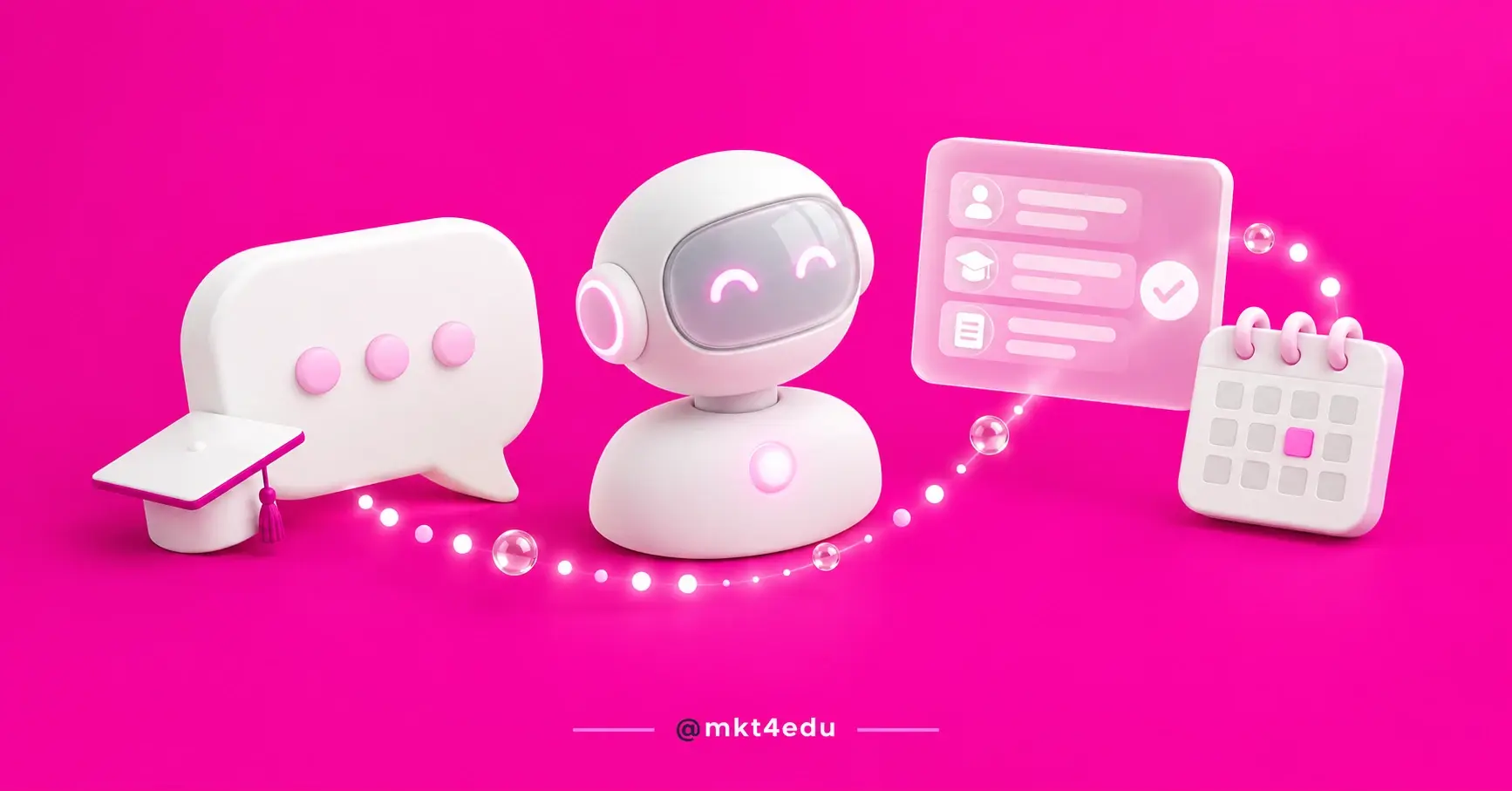
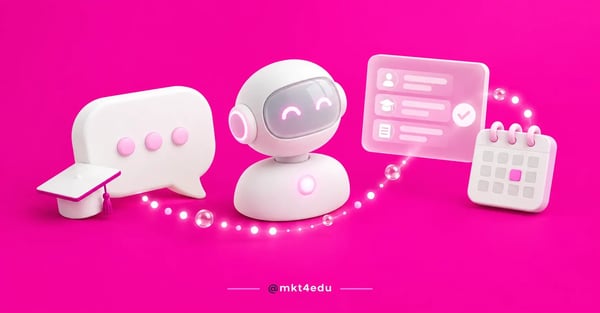 Caption: Chatbots in education start in the conversation and only pay off when the record reaches the CRM organized.
A model built on natural language understands the question however it is typed. It asks for the missing detail, confirms what it understood and continues the conversation without forcing anyone to pick from numbered options.
The channel's place in the journey has moved as well. Chat used to sit in the website footer as a last resort. Today it appears at first contact, in the ad, on the program page and above all on WhatsApp for student recruitment.
How many institutions in Brazil were using chatbots?
The mkt4edu study "Use of chat for student recruitment at the 500 largest higher education institutions in Brazil", published in 2020, found that 66% of the institutions analyzed had no chat tool whatsoever. Among the roughly 34% that did have the channel, more than half offered no real-time interactivity.
Within that subset of institutions with chat, 42.4% were running genuine chatbots. Applied to the full universe of 500 institutions, that works out to roughly 14% with a working chatbot in 2020.
The distinction matters because the 42.4% figure circulated as if it described the total, when it described only the slice of chats identified. Those are different bases, and mistaking one for the other doubles the apparent size of adoption.
The finding is a 2020 snapshot and holds as a historical marker, not as a measure of today's market. No conclusion about the present can be drawn from it, because the baseline aged alongside the technology it measured.
One signal of how much the picture moved comes from outside the education sector. A Salesforce survey of 3,075 service professionals, fielded between March and April 2026, found that 66% of service organizations already use AI agents, against 39% in 2025.
The two figures of 66% do not belong to the same series and should not be added or compared. One measures Brazilian institutions without chat in 2020, and the other measures global service organizations already using AI agents in 2026.
In the same survey, 70% of respondents reported measurable value within 60 days of adoption. That number points to speed of return in customer service, and not to a promise of results in student recruitment.
Which chatbot platforms did institutions use most in 2020?
The 2020 study also mapped which technology powered each chat it found. WhatsApp led, followed by HubSpot and ZenDesk. The ranking describes the choices of that year and serves to show that WhatsApp was already the center of the conversation, not to guide a purchase decision today.
Here is how the top three positions lined up:
|
Platform |
Share |
Position |
|
|
23.4% |
1st |
|
HubSpot |
18.3% |
2nd |
|
ZenDesk |
14.1% |
3rd |
Table: Share of each platform among the chats identified at the 500 largest higher education institutions in Brazil, in 2020.
WhatsApp leading that survey anticipated what settled in afterwards. The channel stopped being an alternative and became the place where the conversation starts, which entirely changes how you design an SDR agent on WhatsApp.
HubSpot, second in the study, has grown considerably since. The company reports more than 306,000 customers in more than 135 countries for the quarter ended June 30, 2026.
mkt4edu was HubSpot's first Diamond partner in Brazil. Part of the work with the institutions it serves runs precisely through the integration between an SDR agent and the CRM, which is where a conversation turns into a usable record.
The tool choice, however, comes after all of that. It only makes sense once an institution already knows which conversation it wants to have and which data it needs to capture by the end of it.
Why does round-the-clock service still carry recruitment?
Permanent availability remains the most concrete benefit of a conversational channel. Prospective students research programs late at night, on weekends and during work breaks, when the call center is closed. Whoever answers at that moment makes the shortlist.
The gain is not only in the instant reply. A channel that answers after hours can complete a pre-application, capture the program of interest and route the case to the right department before the team arrives the next morning.
That routing avoids the most common waste in recruitment, which is a lead going cold in a queue. When a structured record reaches the CRM, the admissions team starts the day with context instead of starting with a bare name.
Reading the audience by generation helps explain the habit, as long as it does not turn into a stereotype. People who grew up inside messaging apps find long forms and phone calls off-putting, and they tend to abandon a process when the answer takes too long.
Not every forecast on the subject aged well. The 2018 Juniper Research report projected savings of up to US$ 11 billion a year by 2023 across retail, banking and healthcare, plus 2.5 billion working hours saved.
Those figures belong to the debate of 2018, and the deadline they set has already passed. They show the expectation of that moment, and they do not work as a valid projection for a decision today.
How do chatbots in education help retention after enrollment?
Automated service usually stops at enrollment, and that is exactly where it starts to be worth more. Student portal questions, re-enrollment, invoices and academic calendars generate high, repetitive volume. Solving that in the conversational channel frees the team and reduces the friction that precedes dropout.
Retention responds to early signals, not to a recovery campaign at the end of the term. A student who stops logging into the portal, falls behind on payment or opens the same ticket three times is already saying something.
The conversational channel is where that warning tends to appear first. The records piling up there feed models for AI to predict student dropout, which rank who needs human contact and how soon.
The math works on the financial side too. Keeping a student usually costs far less than recruiting a new one, and the ROI of student retention shows up in the same cycle in which service starts working properly.
What is the difference between a rule-based chatbot and an AI SDR agent?
A rule-based chatbot answers, and an AI SDR agent conducts. The first delivers information inside a scripted path and ends the contact there. The second asks qualifying questions, understands a free-form reply, books the appointment and returns a CRM record with program, schedule and decision stage.
That difference decides who works for whom. With a rule-based chatbot, the team receives raw volume and sorts it by hand. With an SDR agent, the team receives a contact already qualified and spends its time on the conversation that closes.
Automated qualification is not machine guesswork. It applies the same criteria the institution would use in human triage, run consistently across every contact. That is what supports AI-powered lead qualification.
The comparison with the human team is often framed badly. The agent does not replace the sales team, but takes over first contact and repetition, and the debate between an AI SDR and a human SDR is more useful when treated as a division of labor.
Market forecasts point the same way, and they belong here as attributed predictions, never as settled fact. Gartner predicted, in a press release dated March 5, 2025, that agentic AI will autonomously resolve 80% of common customer service issues without human intervention by 2029, with a 30% cut in operational costs.
The forecast is credited to Daniel O'Sullivan, senior analyst in Gartner's customer service and support practice. That kind of reading indicates a likely market direction, and not a commitment to results at any specific institution.
How do chatbots fit into educational marketing strategies?
The conversational channel comes after strategy, never before it. Defining the audience, the offer, the service promise and the qualification criteria comes first, and the tool only executes what was already decided. An institution that buys a platform and then works out what to say usually ends up repeating a competitor's generic script.
Within educational marketing strategies, a chatbot occupies a very specific place. It is the touchpoint that turns diffuse interest into a recorded conversation, with a name, a program and a moment in the decision.
Four decisions need to be settled before any technology is chosen. They define what the channel will do, with which data and under which measure of success:
- Service promise. What the institution guarantees to answer, how fast and on which channels.
- Qualification criteria. Which information makes a contact ready for the admissions team.
- Destination of the data. Where the conversation record is stored and who works with it the next day.
- Measure of success. Which indicator confirms that a conversation became an application and then an enrollment.
Without those four definitions, any tool becomes an automated inbox. With them, even a simple chatbot produces results, because every conversation is born with a destination and an owner.
Cost enters the discussion at this point, and not at the start. Knowing how much an AI SDR costs only helps once an institution knows how many contacts it needs to qualify per recruitment cycle.
How do you roll out chatbots in education in the right order?
Rollouts fail less often when they start with the conversation flow and end with the technology. Mapping the real questions arriving today, writing the answers in the institution's voice, defining the handoff point to a person and only then configuring the tool cuts rework and avoids a dead script.
The first step is to listen to the history. The questions the call center, WhatsApp and web forms already receive make a far better starting script than any internal assumption.
The second is deciding where the human enters. Conversations about scholarships, tuition negotiation and delicate academic cases need a clear handoff, with context preserved, rather than a new waiting queue.
The third is integration. Without the conversation record inside the CRM, the data dies in the channel, and that is the point most likely to stall the implementation of an AI SDR agent.
Compliance runs alongside the process from the start. Collecting personal data in conversation requires a legal basis, a stated purpose and a retention period, and the relationship between an AI SDR and Brazil's data protection law has to be settled before the first message goes out.
Finally, you have to measure. Response rate, qualification rate, time to first human contact and conversion into applications say far more than the volume of messages exchanged.
The metrics of an AI SDR agent only work when they are defined before the channel goes live.
Frequently asked questions about chatbots in education
Where should you start with chatbots in education?
The starting point is not picking a tool, it is deciding which conversation the institution wants to have with whoever arrives. Answering that question quickly reveals whether the case calls for a frequently asked questions chatbot or for an agent that qualifies, schedules and returns the record to the CRM.
For most institutions, the shortest path runs through three opening moves. List the real questions already arriving, define the qualification criteria and make sure the conversation record reaches the CRM.
After that, choosing a platform becomes a consequence rather than a bet. That is where the AI agents built by mkt4edu come in, connected to the CRM and to the educational marketing strategies the institution already runs.
The 2020 study measured who had chat. The question now measures who turns conversation into enrollment.
If your institution already has conversation volume and wants to convert it into applications, talk to the mkt4edu team to review the current flow and design the next step.
























 Portugal