






A student question rarely arrives during business hours. It arrives at midnight, the day before a tuition due date, on the Sunday before an exam, when the service team is not available.
That gap between question and answer is where insecurity grows. A chatbot for student retention exists precisely to shorten that gap, without requiring human coverage across every channel around the clock.
What it does not do is replace the conversation that changes a decision. A student determined to withdraw is not convinced by automation, and treating the bot as a complete solution is the most common way to waste the investment.
What is a chatbot and how does it act in student retention?
A chatbot is a program that runs automated conversations in text channels such as websites, WhatsApp and service centers. In student retention it occupies the front line of contact: it receives everyone, answers what is objective and organizes the rest for the team.
The operational advantage is scale. A human agent talks to one person at a time, while a chatbot handles hundreds of simultaneous conversations with no queue.
The data advantage is less obvious and more valuable. Every conversation records what the student asked, when they asked and how often, painting a picture of what is bothering the base.
That record feeds the relationship strategy. When questions cluster around one course or one procedure, the institution has a localized problem to fix rather than a vague impression of dissatisfaction.
Keep in mind that automation runs on the same base that supports student recruitment and retention as an integrated operation. Without an organized record, the bot answers without knowing who it is talking to.
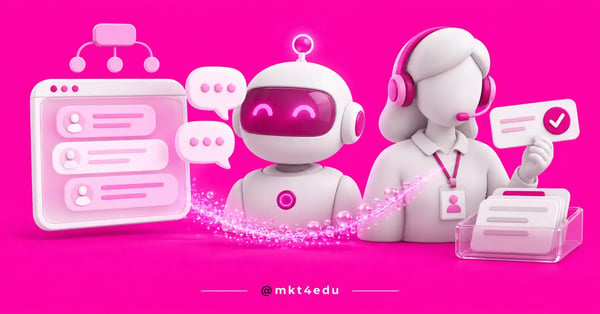 Caption: Chatbot, AI agent and person in the same queue: the handoff between the three layers is what the student notices.
Chatbot, AI agent or human service: which one for each case?
The choice between chatbot, AI agent and human service depends on three variables: how predictable the question is, whether systems must be queried and how emotionally charged the conversation is. In practice the three layers coexist, and the handoff design defines experience quality.
The flow-based chatbot handles the predictable at low cost. The AI agent deals with open questions and data lookups. A person steps in when there is an exception, a negotiation or declared discomfort.
AI agents widen that design because they execute tasks rather than only answering: they look up records, update them and open a human conversation when the case calls for it.
Here is how the three layers divide the work:
| Layer | Best use | Limit |
|---|---|---|
| Flow-based chatbot | Frequent questions and initial triage | Stalls outside the scripted path |
| AI agent | Open questions and system lookups | Requires data governance and review |
| Human service | Negotiation, exceptions and complaints | Capacity limited per hour |
Table: How student service divides between flow automation, AI agent and the team.
The handoff between layers is what the student actually notices. A transfer without conversation history forces the person to repeat everything, and the experience ends up worse than having no automation at all.
Institutions running service inside the CRM have a shorter path here. Native chatbot configuration features are born connected to contact history and ticket records.
Which student questions does a chatbot resolve on its own?
A chatbot resolves on its own the questions with a single verifiable answer: academic calendar, re-enrollment deadlines, required documents, platform access, duplicate invoices and where to find information on the portal. Those categories account for most of the volume and almost no exceptions.
The rule changes when the answer depends on the individual student's case. Financial situation, course credit transfer and institutional transfers require lookup and judgment, even when they look like simple questions.
There is also a behavioral limit worth respecting. Gartner research with 5,728 consumers found that only 14% of customer service issues are fully resolved in self-service, and that 43% of consumers could not find content relevant to their own problem.
The practical reading of that data is not to abandon automation. It is to size expectations: the bot delivers speed and volume, and the human team remains responsible for the cases that decide whether a student stays.
For scope design, the material on artificial intelligence in retention service details how to separate what to automate from what to keep with people.
How do you measure whether the chatbot is helping retention?
A chatbot shows its effect on retention through four indicators: containment rate, time to first response, escalation with context and satisfaction at the end of the conversation. Conversation volume on its own says nothing about results.
Containment rate measures how many conversations end resolved without human involvement. It grows as the bot's repertoire absorbs the questions that came up the week before.
Time to first response is the most sensitive indicator in retention. It explains why a student with a tuition question on Sunday does not spend the weekend considering withdrawal.
Escalation rate does not need to be low to be good. High escalation with complete context is a sign that triage is working, not that automation failed.
To build the dashboard, the criteria described in AI agent metrics provide the base, swapping conversion into enrollment for student persistence.
It is also worth tracking the formal service flow. When sensitive cases become tickets with an owner and a deadline, Service Hub applied to customer service closes the loop between the automated conversation and human resolution.
When is it worth investing in a chatbot at your institution?
It is worth investing in a chatbot when repetitive contacts consume hours of your team's time, first response time stretches into hours and there is enough knowledge base to train the bot. Without those three elements, the gain is small.
The first criterion is volume. Institutions with a few hundred students and service under control gain more from organizing the process than from automating it.
The second criterion is the nature of demand. If most contacts require case-by-case analysis, automation only covers triage and the return is smaller.
The third criterion is ownership. A chatbot with nobody responsible for reviewing answers and tracking indicators ages quickly and starts failing silently.
The fourth criterion is integration. Automation isolated from the CRM creates an island of conversations disconnected from student history, which makes the retention effect hard to prove.
Frequently asked questions about chatbots for student retention
So, does a chatbot solve your institution's retention problem?
A chatbot does not solve retention on its own, and it does solve an important part of it: making sure no question goes unanswered and that serious cases reach whoever can act, quickly. Student persistence is still built by people.
The safest path starts small. Pick the ten most frequent questions, put them live, track containment for two weeks and expand scope based on what the operation itself shows.
If the goal is to build that front with channels, escalation rules and indicators designed for educational institutions, that is the work behind chatbots for retention at mkt4edu.
Talk to our team to assess your service volume and the right automation scope.
A chatbot only holds a real conversation when it is built as part of a wider set of AI agents.

























 Portugal