





The question "Bilibili vs YouTube" showed up in planning meetings in August 2026, when the Chinese app got a Portuguese interface and started hiring in São Paulo. It usually comes up poorly framed, as if it were a choice between two equal platforms.
It isn't, because one is the second most visited site in the world and the other is a niche community just starting to operate outside China.
The useful comparison isn't "which is better," but "which wins in each dimension of marketing." Reach, discovery, community, monetization, advertising and SEO have different answers, and that grid is what defines how much production time and budget each channel deserves.
What's the difference between Bilibili and YouTube?
The difference between Bilibili and YouTube is in the role each one plays for its audience. YouTube works as a search engine and video library open to any topic and any age; Bilibili works as a community of interests, with an entry barrier to comment, its own culture, and an audience concentrated in one age range.
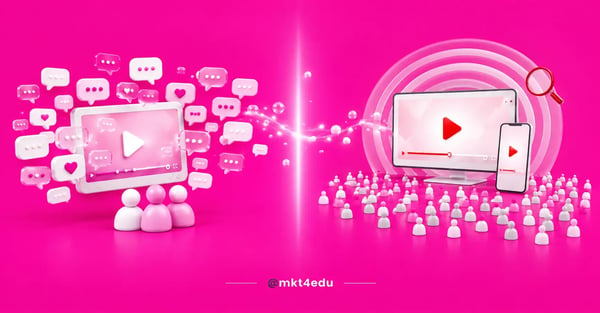 Caption: Bilibili vs YouTube: a niche community against the world's largest video library.
YouTube is the second most visited site in the world, behind only Google, according to Similarweb. The platform has become infrastructure: it's on TV, in the car, in the classroom and in AI answers. What the audience expects from it is to find anything.
Bilibili was born in 2009 as an anime fan community and evolved into a platform for long-form video, live streaming and games. In the second quarter of 2026, it reported 371 million monthly users and 113 minutes of daily use. What the audience expects from it is to belong to something.
That difference in role explains all the others. YouTube optimizes for retention and reach; Bilibili optimizes for participation and the same person coming back. Once you understand this, you stop comparing app features and start comparing strategic roles, as detailed in what is Bilibili.
Who reaches more people in Brazil: Bilibili or YouTube?
YouTube reaches far more people in Brazil than Bilibili does, and the gap will last for years. YouTube ads reach 81.1% of the country's 185 million internet users, according to DataReportal, while Bilibili just got a Portuguese interface and doesn't disclose audience by country.
YouTube also won the battle for the big screen. At Brandcast 2025, Google said more than 80 million Brazilians watch YouTube on connected TV, and that TV overtook mobile as the primary screen. For brands, that means long-form video in a living-room setting, with shared attention.
Bilibili, in turn, has 371 million monthly users concentrated in China. In Brazil, the international app has more than 10 million downloads on Google Play, a global cumulative figure that doesn't indicate active Brazilian users. Any estimate of local audience today is a guess.
The right way to read it is by profile, not volume. Bilibili describes its international target as "Gen Z Coded, affluent and well-educated", according to job postings revealed by Semafor, and has an average age of 26.5 on its Chinese base. For brands speaking to that audience, density makes up for part of the lack of scale.
How does video discovery work on each platform?
Discovery on YouTube happens through three doors: algorithmic recommendation, internal search, and external search on Google and AI tools. On Bilibili, discovery happens through recommendation and internal search, inside a community organized by interests, without the weight of external indexing that YouTube has.
The external door is what most differentiates the two. YouTube videos show up in Google's organic search and are the most cited source in AI answers.
A 5W study of 46 million AI Overviews citations put YouTube as the number-one domain, with 23.3% of citations, ahead of Wikipedia. Bilibili doesn't show up among the domains cited in those surveys.
Within the platforms, Bilibili's search is growing in commercial importance. In the Q2 earnings call, the company reported that search ad revenue doubled in a year. That's a sign users turn to the platform to look things up, not just to scroll the feed.
For planning purposes, that weight on search means the rules of SEO for social media apply to both: title with search intent, a full description, chapters and tags. The difference is that on YouTube this work pays off outside the platform too, while on Bilibili it pays off inside the community.
Danmaku or comments: which community engages more?
Bilibili engages more per session, and YouTube engages more in absolute volume. Danmaku, comments that float over the video synced to the exact second, create a collective experience that YouTube's comment section doesn't reproduce. In exchange, YouTube has billions of interactions spread across every topic and age group.
Bilibili's numbers back up the intensity thesis. The company reported 17.4 billion monthly interactions and a 67% jump in long comments in Q2 2026, with official-member retention near 80% over twelve months. The community comes back, and comes back to talk.
The entry filter helps explain the quality. In China, commenting requires passing a 100-question test on etiquette and pop culture. On the international app, identity verification was dropped, but the comment culture built over fifteen years remains the house standard.
For brands, the implication is twofold. Danmaku is a free heat map: it shows the exact second the audience reacts, laughs, disagrees or gives up. At the same time, it's a real-time rejection window for advertising disguised as content, which demands more care with video production than on any other network.
How do creators make money on Bilibili and YouTube?
On YouTube, creators earn mainly through the ad-revenue split from the Partner Program; on Bilibili, they earn through a combination of view-based incentives, audience rewards, live-stream gifts and platform-brokered sponsorships. The difference in model defines who pays the creator: the advertiser or the community.
YouTube is transparent about the math. The program pays 55% of net ad revenue shown in videos, 45% of the Shorts pool, and 70% of subscriptions and Super Chat. To join, today's requirements are 1,000 subscribers and 4,000 watch hours or 10 million Shorts views.
The bar is going up. In August 2026, YouTube announced that, starting February 2027, new entrants will need 8,000 hours or 20 million Shorts views. The program already has more than 3 million creators, and the platform describes it as the only one that pays "consistently, transparently, and at scale."
Bilibili doesn't publish a revenue-split table. What the company discloses is the outcome: more than 3 million creators earned income in 2025, with average income up 21%. Times Brasil cites requirements of 1,000 followers or 100,000 views to monetize, but there's no official Portuguese-language page confirming the rules.
For brands, the practical difference is the nature of the partnership. On YouTube, the creator has guaranteed base revenue and negotiates sponsorship as a bonus. On Bilibili, the community pays directly, and the creator tends to protect that relationship more strictly, which demands more editorial and less advertorial collaborations.
Paid social: what does each platform offer advertisers?
For paid social in Brazil, YouTube offers the full Google Ads ecosystem, and Bilibili doesn't offer a local ad product in 2026. Bilibili's ad revenue grew 28% in a year and is the company's biggest line, but the products run in China; outside it, the sponsored-content marketplace is still "in development."
On YouTube, Brazilian advertisers get video formats, search-intent targeting, remarketing integrated with the site, and measurement in the same dashboard as search ads. It's the same allocation logic that shows up in the comparison between Google Ads and Meta Ads: video enters as a funnel stage, not an island.
On Chinese Bilibili, the platform runs its own sponsorship and boost tools, such as Huahuo, the official marketplace for brand-creator collaboration. That's the model the global expansion intends to replicate, according to the job postings revealed by Semafor, but with no date for Brazil.
Until the product arrives, the paid social option available on Bilibili is a direct partnership with creators already publishing in Portuguese. That requires a contract, an editorial brief and agreed metrics, without the convenience of an auction. For teams managing paid traffic by CAC, it's an investment in learning, not scale.
The side-by-side comparison helps close the budget decision:
|
Dimension |
YouTube |
Bilibili |
Who wins |
|
Reach in Brazil |
81.1% of internet users |
No local data; Portuguese app since Aug/2026 |
YouTube |
|
External discovery (Google and AI) |
Most cited domain in AI Overviews |
Doesn't show up in citation studies |
YouTube |
|
Community and participation |
Comments below the video |
Danmaku, 113 min/day, 80% retention |
Bilibili |
|
Creator monetization |
55% of ad revenue, public rules |
Community pays directly; no official rules page in Brazil |
YouTube (predictability) |
|
Paid social in Brazil |
Full Google Ads |
No local product; direct creator partnerships |
YouTube |
|
Audience profile |
All ages and topics |
Average age 26.5, defined interests |
Depends on the brand's audience |
Table: Bilibili vs YouTube comparison by marketing dimension, based on public data as of September 2026.
The table shows why "which is better" doesn't settle it. YouTube wins in five of six dimensions because it's consolidated infrastructure. Bilibili wins in exactly the dimension YouTube can't buy: community participation inside the content.
Where does video earn more organic traffic and AI citation?
Video earns more organic traffic and AI citation on YouTube, with no comparison possible in 2026. AI-powered search tools cite YouTube videos with growing frequency, and Google indexes every video as a page. Bilibili doesn't show up in AI citation surveys, and indexing outside China tends to carry less weight.
The size of the gap is measurable. An Otterly.ai study of more than 100 million citations found that YouTube accounts for 38.7% of citations on Perplexity and 36.6% on Google AI Overviews. The same study showed that 94% of those citations go to long-form videos, and only 5.7% to Shorts.
That data changes the video production brief. Long-form video, with a question-format title, chapters and a transcript, is what AI can read and cite. The short vertical format serves reach in the feed, but not organic traffic from search. The rule of SEO for YouTube still holds, now with AI as the reader.
Bilibili still has an indirect SEO angle. Content published there and repurposed on the brand's own site, with transcript and context, enters organic search like any page. And the AI dubbing in multiple languages offered by the international app can extend the same video's reach to audiences the brand wasn't serving.
How does education marketing split the two channels?
In education marketing, YouTube handles reach, search and conversion, while Bilibili handles community and connection in courses tied to technology, games and pop culture. It's one sector example: the same split works for any brand that needs to educate its audience before selling and keep the relationship after the purchase.
In student recruitment, YouTube answers active search. Someone researching "is it worth studying software engineering" finds the video on Google, in AI Overviews and in internal search, and the institution converts with remarketing ads and a sign-up page. That's the logic already behind video content for recruitment.
On Bilibili, recruitment is indirect and happens through community. An animation or game-development course publishes student projects, open classes and behind-the-scenes content, and danmaku shows what sparks doubt and interest. The lead doesn't click an ad; they start following the institution and arrive at enrollment with the decision half-made.
In student retention, Bilibili offers something YouTube doesn't prioritize: a real-time sense of belonging. Q&A live streams, series with veteran students and career content reinforce the bond with those already enrolled. Since retention costs less than recruitment, the community channel can deliver a high return with lean production.
The practical split for any brand follows the same design. Produce the long-form video with YouTube and AI in mind, publish the version on Bilibili for the community, and use what danmaku teaches to improve the next script. One piece of content, two roles.
Frequently asked questions about Bilibili vs YouTube
Bilibili or YouTube: what makes more sense for your case?
YouTube makes sense for every brand that depends on reach, search and AI citation, which in 2026 includes practically any marketing strategy in Brazil. Bilibili makes sense for brands whose audience is under 30 with defined interests, and that have depth of content to offer instead of ads.
The budget decision comes out of the table. Keep YouTube as the base for video production, organic traffic and paid social. Set aside team time for Bilibili, not media budget, and treat the coming months as a community lab while the ad product and creator marketplace haven't arrived in Brazil.
If the decision is to test Bilibili as a community lab, the first obstacle is getting found inside it: title, tags, cover and search signals are different from YouTube's. The SEO for Bilibili guide shows what makes a video show up in the platform's search, and it's the next step after this comparison.


.jpg)























 Portugal