


The campaign runs, cost per click is cheap, the audience re-engages, and the quarter closes with no new deal attributed. That report is common at companies selling to other companies.
The diagnosis is almost never the channel. What is usually wrong is the cadence: B2B remarketing inherited the window and frequency of digital retail, where the entire decision fits inside a week.
In a corporate purchase, the decision passes through several people, a budget, legal and competing priorities. When the 30-day window expires, the audience empties exactly in the phase where the company starts comparing vendors.
The starting point here is different. Treat the campaign as sustained presence with a buying committee, not as a chase for conversion. The difference shows up in the window, the content, the frequency and, above all, in what you measure.
Why does B2B remarketing look like it does not work?
B2B remarketing looks broken because it is judged by the e-commerce ruler. The campaign is built to capture an almost-made decision, when its role on a long cycle is different: sustaining recall and reducing friction across months of internal evaluation that no ad controls.
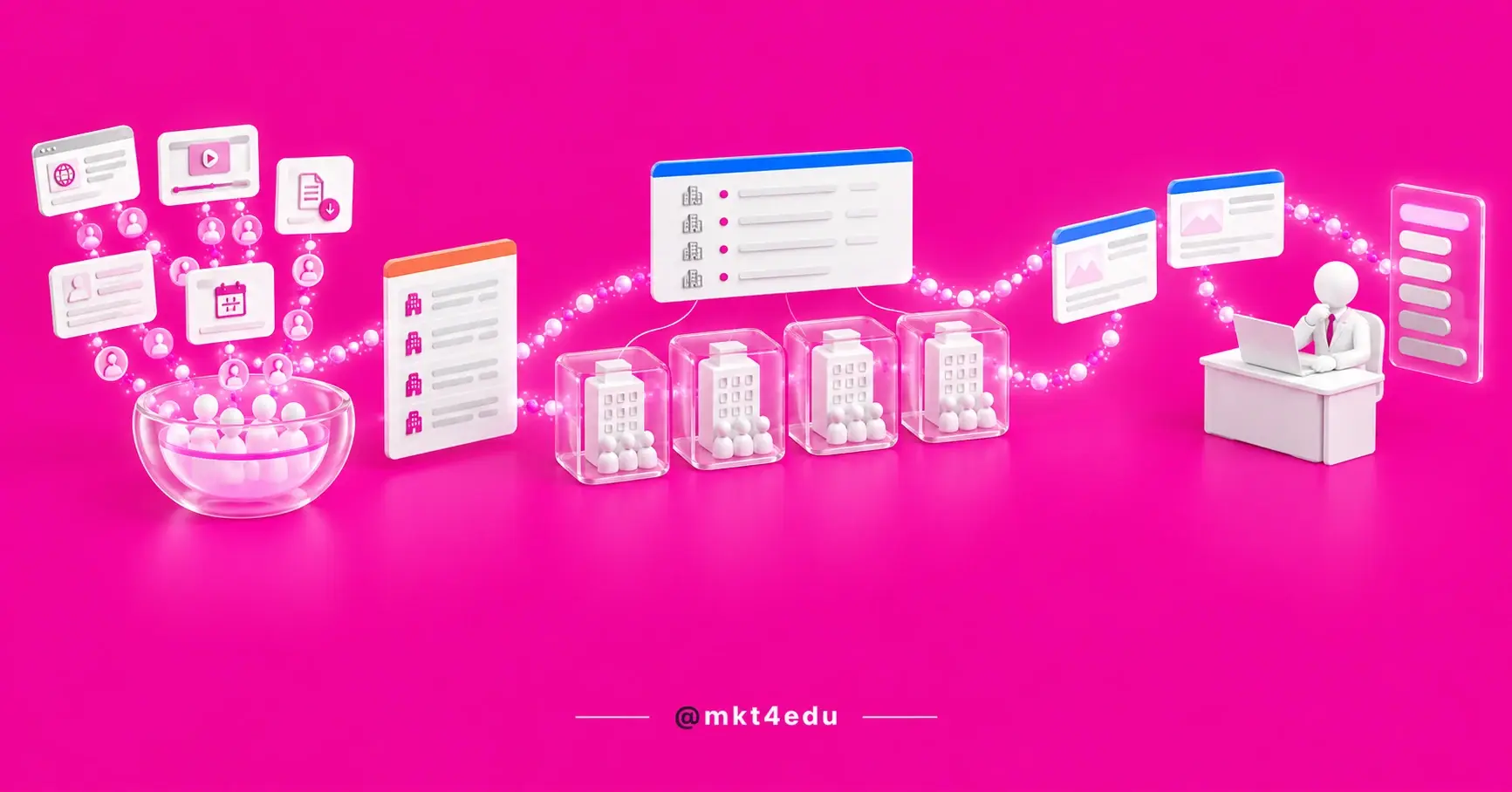
 Caption: B2B remarketing sustains presence with the buying committee for months, instead of chasing conversion in days
The first symptom is the audience shrinking on its own. With no new visits, a list defined at 30 days loses members every day and arrives almost empty the following month.
The second symptom is concentrated frequency. The whole budget is spent in two weeks on the same few hundred people, and the ad becomes noise before the company opens a budget.
The third symptom is the target. The campaign talks to whoever clicked, not to the group that will make the call inside the company.
Much of the evaluation happens away from the vendor. According to Gartner's research on the B2B buying journey, 75% of B2B buyers prefer a rep-free buying experience. A re-engagement ad is one of the few active touchpoints during that silence, and treating it as a click chaser wastes the only presence the brand keeps while nobody replies.
Two discussions are worth separating, because they get mixed. Contact volume is a top-of-funnel topic, and quality is solved at the source, with criteria to generate qualified leads without inflating volume.
How does a long sales cycle make the 30-day window sabotage the campaign?
A long sales cycle makes the 30-day window sabotage the campaign through simple arithmetic. If the decision takes months, the visitor enters the list, expires and leaves before the company forms an opinion. The campaign ends up reaching only people at the beginning, and never those close to signing.
List duration is a parameter, not a constant. In Google Ads, the maximum membership duration for a data segment is 540 days for Search and Display, with a 30-day default, and anyone past that ceiling is removed from the segment. That is far beyond what most accounts leave configured.
On Meta, the ceiling is different. The website custom audience documentation states a maximum duration of 365 days, with the member removed after that period unless they meet the audience rule again.
The limit, then, is rarely technical. What shows up in the report is the result of a setting inherited from retail and kept without review.
Calibration improves when the window stops being single. Instead of one 30-day list for everything, each phase of the cycle gets its own window, frequency and objective. The duration reference below is editorial and has to be adjusted to your real cycle, measured in the CRM (Customer Relationship Management):
|
Cycle phase |
Signal that forms the audience |
Suggested window |
Frequency pressure |
Objective of the message |
|
Awareness |
Read top-of-funnel content, came from search or social |
120 to 180 days |
Low and constant |
Keep the problem and the category in mind |
|
Consideration |
Visited a solution page, downloaded an asset, saw pricing |
90 to 180 days |
Medium |
Offer criteria for comparing vendors |
|
Active evaluation |
Requested contact, attended a meeting, received a proposal |
30 to 60 days |
High, for a short period |
Reduce risk with proof, cases and technical answers |
|
Stalled decision |
Proposal parked, deal with no activity in the CRM |
90 days |
Low and paced |
Address the objection that jammed the committee |
|
Recycling |
Lost deal, former customer, inactive contact |
365 days on Meta, up to 540 on Google |
Very low |
Re-enter the conversation in the next budget cycle |
Table: window, pressure and objective per phase in B2B remarketing, within the 540-day Google Ads and 365-day Meta ceilings
Two readings jump out of that split. Long phases call for low, continuous pressure, and short phases concentrate budget on proof and risk reduction.
No number in the window column is a market rule. The distribution is a starting point until your own pipeline history shows how long each stage actually takes.
How do you reach the decision makers and influencers in the buying committee?
The buying committee is the group that decides together: who pays, who will use it, who approves it technically and who can block it. Effective B2B remarketing talks to that whole group, not only to the contact who filled in the form, because approval depends on internal consensus.
Consensus is the real bottleneck. A Gartner survey of 632 B2B buyers, run between August and September 2024, found unhealthy conflict during the decision process in 74% of buyer teams, and the same study reports that buying groups reaching consensus are 2.5 times more likely to say their deal was high-quality.
One finding runs against media instinct: content focused on individual-level relevance can create conflict within the buying group, with a 59% negative impact on consensus, while tailoring for buying-group relevance improves consensus by 20%.
According to Delainey Kirkwood, Principal of Research in the Gartner Sales Practice, commercial leaders need to prepare their sellers to drive agreement and alignment across diverse buying groups.
The practical consequence is direct. Over-personalizing for one person can hinder a collective decision, and messages that help the group understand each other tend to move better.
Hence the importance of reaching people who will never fill in a form. The end user who will operate the tool and the security specialist rarely convert, but they can block or unblock the purchase. Each role enters the conversation with a different question, and the audience has to reflect that:
|
Role in the committee |
The question they ask |
How they show up in your audience |
Message that helps the group |
|
Economic sponsor |
Does this fit the budget and return results? |
Contact in the CRM, company audience |
A case with numbers, payback period, cost of not deciding |
|
End user |
Will this make my day easier or harder? |
Visits operational content, rarely converts |
A short demo, the real routine, time to adopt |
|
Technical approver |
Does it integrate with what we have and is it secure? |
Visits documentation, integrations and security pages |
Architecture, data policy, compliance requirements |
|
Procurement and legal |
Do the contract and the vendor clear our bar? |
Almost invisible in media, enters through the account |
Solidity, references, cost predictability |
|
Internal skeptic |
Why change what already works? |
Shows up as repeated visits with no progress |
Honest comparison, product limits, transition plan |
Table: roles in the buying committee, the digital signal each profile leaves and the argument B2B remarketing has to deliver
Not every role is addressable by a person list. When the CRM does not identify who is evaluating, the path is the company audience, where remarketing and ABM overlap.
Large accounts require one more care. A company with fifteen people evaluating produces many weak signals, and treating each visit as an individual lead breaks the reading of the deal.
What content should you use at each phase of a long sales cycle?
Remarketing content changes function with the phase of the cycle. Early on, it keeps the category alive for someone who has not prioritized the problem yet. Later, it reduces perceived risk, with proof, numbers and answers to objections about security, timing and integration.
A sequence that holds up for months separates four distinct functions:
- Framing the problem: names the cost of staying as things are, without talking about the product.
- Choice criteria: shows how to compare alternatives, including the ones that are not yours.
- Proof: a case, an auditable number, a reference of similar size.
- Risk reduction: implementation, support, security, contract exit.
Media and email do not compete on this journey. The ad reaches people who never open email, and the lead nurturing in HubSpot cadence carries the conversation with those who already identified themselves. Email talks to the known contact, and the ad keeps the brand visible to their colleagues who never left any data.
Video: the nurturing B2B remarketing complements when the buying committee does not open email, on the mkt4edu channel (in Portuguese)
That is the stitching that inbound marketing integrated with the CRM allows: the same deal stage governs email, content and the media audience, with no three different truths about the same lead.
Lead conversion also changes shape on a long cycle. The bottom-of-funnel offer is rarely “talk to sales”, but an assessment, a calculator or a criteria comparison that helps the group decide together. Repeating the same creative for six months tires any list, so plan three to five creatives per phase, with the same argument in different formats.
The basis for all of it is the design of the sales process. A more effective sales funnel defines the stages media will mirror, and without that map the targeting is guesswork.
How do you avoid saturating a small B2B remarketing list?
A small list saturates fast because the budget is divided among few people. Control comes from three combined adjustments: a weekly frequency cap, excluding anyone who moved stage and rotating creatives, so the same person sees different arguments.
Before that, there is an eligibility floor. Google Ads documents a minimum of 100 active visitors or users in the last 30 days for the Search Network, the Display Network and YouTube. Gmail is not part of that volume rule.
The figure of 1,000 that appears in other references is not a contradiction, it is history: customer lists uploaded or refreshed from February 1, 2024 follow the 100-user minimum on Search and YouTube, and lists not refreshed since then remain bound to the previous requirement of 1,000 matched users. Check which case your list is in before sizing it.
With a small list, exclusion matters more than targeting. Anyone who became an opportunity leaves the top-of-funnel audience, and anyone who closed leaves everything except the recycling list.
Frequency is the brake most accounts lack. In awareness, a few weekly impressions per person preserve the list for months; in active evaluation, pressure can rise for a short, defined period.
It is also worth staggering the investment. Spending everything in the first month of a 180-day window leaves the decisive phase with no budget.
What do you measure in B2B remarketing when conversion takes months?
Measuring by last-click conversion does not work when closing takes months. The useful dashboard tracks committee coverage, re-engagement, stage movement in the CRM and influenced pipeline, read by entry cohort rather than closed month.
Four indicators move before any revenue appears:
- Target account coverage: how many companies on the priority list were actually reached in the period.
- Committee penetration: how many different people from the same company were reached.
- Re-engagement per account: how many accounts came back to the site without a new form conversion.
- Stage velocity: how long the deal takes to leave one stage and enter the next.
Cohorts solve the calendar problem. Grouping contacts by the month they entered the list and following that group over time avoids comparing the month of investment with the month of closing.
Attribution remains imperfect, and it is worth saying so honestly. No model isolates the contribution of a re-engagement ad inside a collective decision that lasts months, so the reading is a trend, not a cause.
Video: the indicator-by-indicator monitoring that supports reading B2B remarketing on a long cycle, on the mkt4edu channel (in Portuguese)
Indicator governance helps more than a new tool. A lean set of RevOps KPIs keeps marketing and sales discussing the same number in the pipeline meeting.
The cheapest leading signal is re-engagement per account. If three people from the same company returned to the site this month, the decision is moving, even with no new form. One warning closes the subject: a re-engagement campaign with a small budget and a long window produces small weekly numbers, and cutting the line because of one weak month usually destroys the quarter's reading.
Frequently asked questions about B2B remarketing
What should you review before raising the B2B remarketing budget?
Before raising the budget, review five points: list duration, exclusion rules, frequency cap, content by buying committee phase and cohort-based measurement. On a long decision cycle, the channel pays off as a presence layer, not as the last push before signature.
The cheapest fix is the first one. Reviewing list duration and exclusion rules costs an afternoon and changes the basis of everything that follows.
The second fix is about data. With no reliable deal stage, there is no audience per phase, and the campaign goes back to saying the same thing to everyone.
That is where the CRM operation decides the Paid Media result. mkt4edu implements and organizes HubSpot CRM so that stage, audience and message stop diverging between marketing and sales.
If your remarketing re-engages and does not convert, the cadence comes before the budget. The stage map is the first item in that cadence: a sales funnel with named stages lets you separate who is evaluating from who is negotiating, and talk to each at the right time.












 Portugal