






Every dropout has a backstory. The student stops attending classes for a few weeks, stops turning in assignments, falls behind on tuition payments, and stops logging into the portal. By the time enrollment is canceled, the dropout had already been foreshadowed by data that no one read in time.
This is exactly the kind of analysis that AI for predicting student dropout rates aims to perform. Instead of discovering the problem at the end of the semester, artificial intelligence cross-references attendance, grades, engagement, and financial status to identify early on which students are at risk of dropping out.
For administrators and directors of educational institutions, this is a game-changer. Retention shifts from being a reactive measure to a proactive one, and becomes the centerpiece of data-driven educational marketing.
In this article, you’ll learn what the technology detects, why this issue is urgent, and how to set up, in practice, a predictive process that drives action.
What is AI for predicting student attrition, and how does it work?
AI for predicting dropout rates involves the use of artificial intelligence and predictive analytics to estimate the likelihood that a student will drop out of a course.
The model learns from the history of students who have already dropped out, recognizes the patterns that preceded their departure, and flags current students who exhibit those same patterns.
The logic is similar to that of a preventive screening. No single indicator is conclusive, but the combination of several signals paints a picture of risk.
The model does not make any decisions on its own. It calculates a risk score for each enrollment and organizes a priority list for the staff to follow.
This is the heart of predictive analytics applied to education: looking back to act ahead. Instead of reports that describe what has already happened, the goal is to anticipate what might happen if nothing changes.
It’s worth distinguishing between two approaches. Descriptive analysis counts how many students dropped out last semester, while predictive analysis identifies which of today’s students are at risk of dropping out next semester. It is the latter that opens the door for intervention.
Most institutions already have the necessary components scattered across different systems. The role of AI is to bring this data together and analyze it as a whole—something similar to what a Revenue Operations framework does by integrating previously isolated areas around a single, reliable data source.

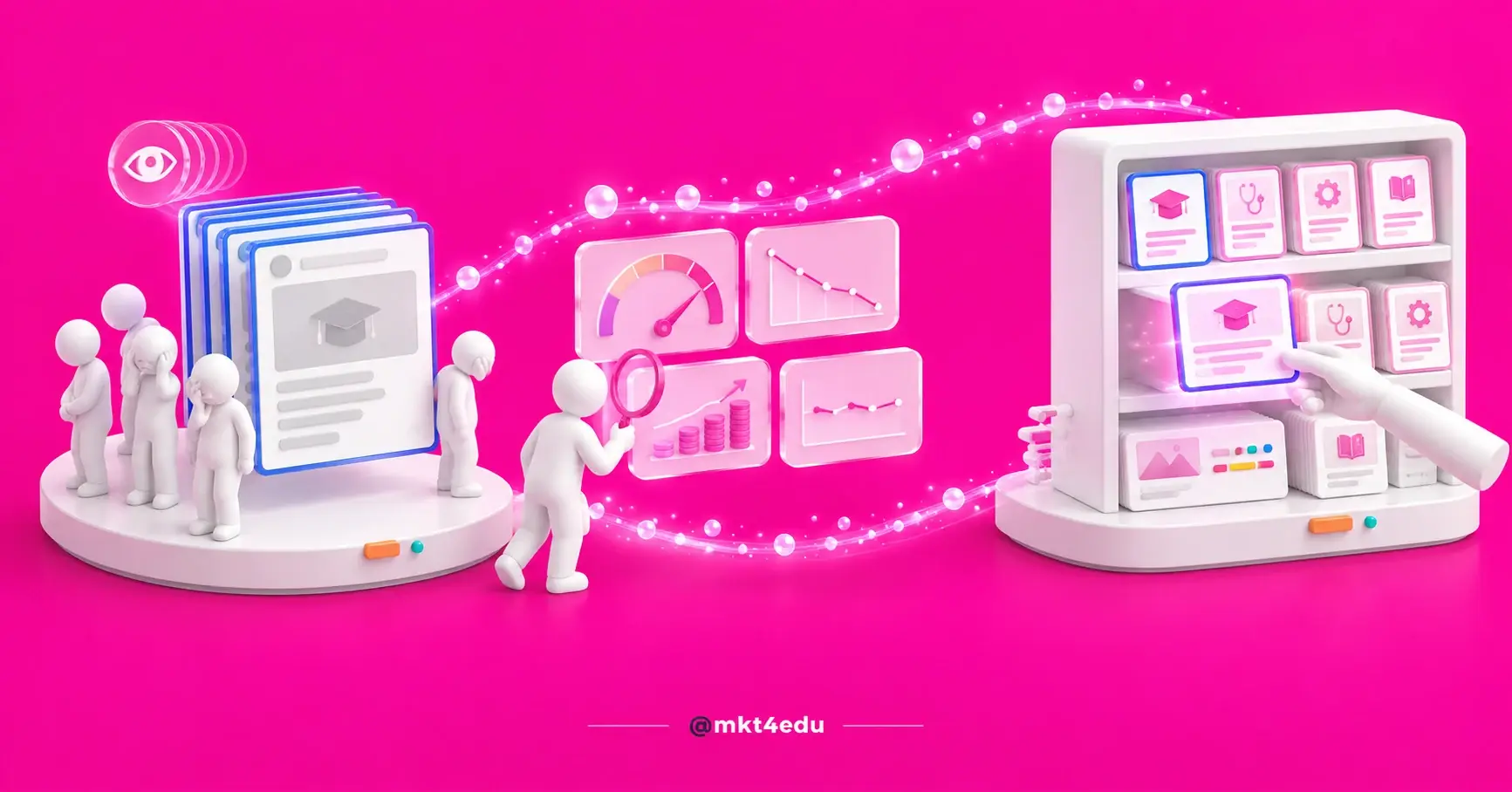
Caption: The predictive cross-referencing of academic and financial data enables early detection of student attrition, facilitating effective retention strategies.
What signs of student dropout does artificial intelligence detect?
AI for predicting dropout works with four major categories of indicators: attendance, academic performance, engagement, and financial situation.
On their own, each one tells us very little. When combined and observed over time, however, they reveal the pattern of disengagement that typically precedes dropping out.
The first group is attendance. Accumulating absences, absences from specific courses, and sudden drops in attendance are among the most reliable signs of dropout, because they show that the student is drifting away from the course routine.
The second is performance. Falling grades, recent failures, accumulated course repetitions, and unhanded-in assignments indicate that the student’s connection to learning is weakening.
The third is digital engagement. This includes logins to the virtual learning environment, session duration, downloads of materials, participation in forums, and responses to emails and messages. A student who logs into the portal less frequently each week is, almost always, drifting away.
The fourth factor is financial. Delays in tuition payments, frequent renegotiations, and recurring requests for discounts usually precede a request to take a leave of absence. It is a sensitive sign—one that requires care to avoid stigmatization—but it is highly predictive.
There are also contextual variables that qualify this analysis, such as age, program type, course duration, and admission history. To organize all of this, it helps to view each group of signals side by side:
|
Signal Group |
Data Examples |
What it typically indicates |
|---|---|---|
|
Attendance |
Cumulative absences, attendance by course |
Deviation from the course routine |
|
Performance |
Falling grades, failing grades, courses that must be retaken |
Weakening of the academic bond |
|
Engagement |
Logins to the learning management system (LMS), forums, and responses to messages |
Loss of connection with the institution |
|
Financial |
Delays, renegotiations, requests for discounts |
Economic pressure regarding continued enrollment |
Table: Each family gains strength when it works together with others, rather than in isolation.
Digital engagement deserves special attention because it is the easiest to track in real time.
Automated conversation tools, for example, help keep the channel open and track reactions—something that retention-focused chatbot solutions do while conversing with the student.
Why is student attrition so costly for educational institutions?
Dropout is costly because every student who leaves takes with them several semesters’ worth of projected revenue, in addition to the cost incurred to recruit them. In Brazil, the problem is widespread, making any improvement in retention significant for the institution’s financial health.
Industry figures help put this into perspective. According to the 16th Map of Higher Education in Brazil, published by the Semesp Institute, the dropout rate for in-person courses was 24.8% in 2024, reaching 26.6% in the private sector.
In distance learning, the situation is even more challenging. The same Semesp survey shows a total dropout rate of 41.6% in distance learning in 2024, with the private sector recording 41.9%.
In financial terms: losing a student at the beginning of the program means forfeiting all revenue from subsequent semesters. A student who completes their undergraduate degree generates revenue over the course of several years, in addition to opening doors to graduate programs, continuing education, and non-degree courses.
Add to that the cost of acquisition. Retaining a student who is already part of the student body tends to cost far less than acquiring a new one from scratch—a logic that also applies to students and makes retention one of the most efficient financial levers for an educational institution.
There is also the reputational impact. Classes that lose students, high dropout rates in official statistics, and negative word-of-mouth all put pressure on future student recruitment.
Effective retention, therefore, protects current revenue and the institution’s image for upcoming enrollment cycles—a strategy that is an integral part of any mature educational marketing strategy.
That is why treating retention with the same data rigor as that applied to student recruitment makes sense. The same intelligence that underpins data science for student recruitment can be redirected to predict and prevent the departure of current students.
How do you build a predictive analytics model to forecast student attrition?
Building a predictive analytics model for student attrition involves five steps: gathering and cleaning the data, defining what constitutes attrition, selecting the variables, training and validating the model, and deploying it with alerts. The rigor of each step matters more than the sophistication of the algorithm.
The first step is to collect and organize the data. Attendance, grades, logins to the virtual learning environment, and financial status are typically stored in different systems. Consolidating everything into a single, reliable database is half the work—and the most time-consuming part.
The second step is to clearly define what counts as dropout. Withdrawal, cancellation, and silent dropout are distinct phenomena. The model needs to know exactly which outcome it is trying to predict, within a defined time window.
The third step is to choose the variables—that is, the indicators used in the calculation. Start with the categories we’ve already discussed and avoid using sensitive data indiscriminately, to prevent educational institutions from making decisions that disadvantage certain groups of students.
The fourth step is training and validation. The model learns from historical data on students who stayed and those who left, and is then tested on a period of data it has not seen before. The goal is not to get everything right, but to get it right early and with few false alarms.
The fifth step is to put it into production. The model runs on a recurring basis, generates a risk score for each student, and delivers a prioritized list to the teams. Ideally, this alert should go directly to the CRM or the academic system the team already uses.
Here’s how the steps link together from raw data to action:
|
Step |
Main Focus |
Expected Result |
|---|---|---|
|
1. Data |
Integrate and clean the databases |
A single, reliable database |
|
2. Definition |
Defining what constitutes evasion |
Clear target and time frame |
|
3. Variables |
Selecting the signals |
Set of relevant indicators |
|
4. Validation |
Train and test |
Model that identifies issues early |
|
5. Production |
Generate alerts in the workflow |
Prioritized risk list |
Table: The strength of the process lies in the sequence, not in jumping straight to the algorithm.
You don’t have to start big. An initial model with a few well-chosen variables, running on historical data, already delivers value and teaches the team to trust the alert.
Integrated AI and CRM platforms, such as those that combine artificial intelligence with HubSpot, reduce the technical effort required for this integration.
How should we address at-risk students identified by AI?
Predicting without taking action won’t retain anyone. Once the AI flags at-risk students, the value lies in the intervention: the right contact, at the right time, by the right person. The alert sets the priority; the human response and engagement channels make retention happen.
The first step is to classify the risk into tiers. High-risk students require prompt, personal contact, provided by the academic advising office or a tutor. Medium-risk students can be managed through lighter communication channels. Low-risk students continue with routine monitoring.
Each category requires a different approach. A student with declining attendance needs an academic discussion; a student with financial arrears needs renegotiation and support options, not cold collection tactics.
Speed matters. An alert that takes weeks to turn into actual contact loses almost all its value, because the decision to drop out may already have been made; therefore, the workflow between the system, the team, and the student must be streamlined.
Scalability comes from automation combined with a human touch. Automated messages handle ongoing follow-ups and the less serious cases, freeing up the team for the cases that truly require a conversation.
Channels such as a WhatsApp customer service agent help maintain a high volume of interactions without losing that personal touch.
Finally, close the loop by measuring the results. Track which interventions worked, feed these insights into the model, and adjust your approaches. AI-driven retention improves every semester because every action becomes new data.
What mistakes should you avoid when using AI to predict student dropout rates?
The most common mistake is treating AI for predicting dropout rates as a technology project rather than a management one. Without reliable data, a clear definition of risk, and a human-driven intervention process, even the most advanced model won’t retain a single student. A few precautions can prevent most frustrations.
The first mistake is relying on dirty or incomplete data. Delayed attendance records and outdated student information lead to false alerts. If the data is unreliable, the prediction will be as well.
The second is to predict but not act. Many institutions set up attractive dashboards that no one uses to make decisions. Without a designated person in charge, a deadline, and a follow-up plan, the alert becomes a forgotten report.
The third is ignoring the context. Using sensitive variables without discretion can harm vulnerable groups and turn a forecast into a self-fulfilling prophecy. Transparency about what the model uses is essential.
The fourth is expecting perfection from the algorithm. No model gets every case right. The goal is to prioritize effectively and act early, not to eliminate 100% of the uncertainty before getting started.
The fifth is to isolate the initiative to a single area. AI-driven customer retention involves academic, financial, marketing, and customer service teams.
When data flows between these areas, within a strategic Educational Marketing framework, forecasting becomes a coordinated action rather than a scattered effort.
Frequently Asked Questions About AI for Predicting Student Dropout Rates
Is it worth adopting AI to predict student dropout rates at your educational institution?
Yes, as long as the institution is willing to treat retention as a data-driven decision rather than a last-minute reaction.
In more mature educational marketing strategies, AI used to predict dropout rates provides early warning; what turns that warning into a retained student is the process, the integration of departments, and swift action by trained staff.
The math is simple. On one hand, dropout rates exceed one-quarter in in-person programs and surpass four in ten in distance learning programs. On the other, there’s the opportunity to identify who is falling behind while there’s still time to take action.
You don’t need to start with the perfect model. You need to start by organizing the data you already have, defining what counts as a risk, and mapping out who does what when an alert appears. The rest will fall into place with practice.
If your educational institution wants to stop discovering dropouts too late, the educational marketing experts at mkt4edu can help you combine data, artificial intelligence, and relationship management into a process that anticipates dropouts and takes action to prevent them.
Talk to our team and find out how to turn your attendance, grade, engagement, and financial data into real retention.

























 Portugal