






An educational institution's ad is communication and a document at the same time. What is written in it can be enforced later, because Brazil's Consumer Protection Code establishes that the published offer becomes part of the contract signed with the consumer.
That characteristic puts admissions campaigns in an uncomfortable position. They have to compete for attention in a crowded market and, at the same time, back every claim with documentary evidence.
The difficulty grows because the rules come from three distinct places and nobody gathers them into a single manual. Legal knows the CDC, the agency knows CONAR and the registrar's office knows MEC's requirements.
Which rules govern advertising in admissions campaigns?
Admissions campaigns answer to three simultaneous layers of rules: the Consumer Protection Code, which treats the offer as part of the contract; the Brazilian Advertising Self-Regulation Code, applied by CONAR; and MEC's rules on program disclosure, authorization acts and the admissions process.
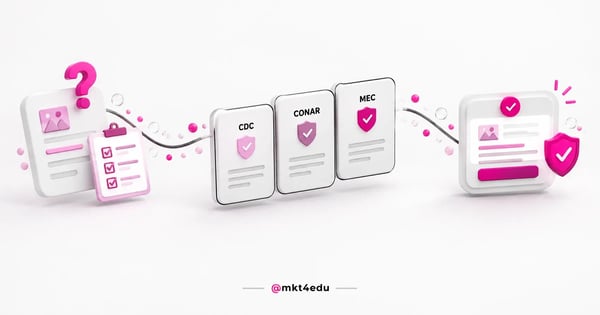 Caption: admissions campaigns pass through three layers of rules, consumer, advertising and education, before the ad can go live
The first layer carries the heaviest consequences. The Consumer Protection Code establishes, in article 30, that any sufficiently precise information published about a service binds the supplier and becomes part of the contract eventually signed.
The same code prohibits, in article 37, misleading advertising, including deception by omission. An ad can be literally true and still mislead when it leaves out a condition that determines the decision.
There is a detail marketing teams often miss. Article 38 places the burden of proving the truthfulness of the communication on whoever sponsors the ad, meaning the institution itself.
The second layer is ethical and sector-specific. The Brazilian Advertising Self-Regulation Code has a specific annex on education, courses and teaching, with recommendations on official recognition, diploma validity, duration and total program cost.
CONAR decisions do not carry the force of law, but they matter. CONAR's Ethics Council judges ads against the code and orders changes or suspensions, and member outlets tend to follow the decision, which pulls the ad off the air without a court case.
None of the three layers cancels the others. A phrase can comply with the CDC, respect CONAR's annex and still create a problem because the program named did not yet have its authorization act published.
What does MEC require to appear in program disclosure?
The regulatory requirements fall on institutional documents, the website and the admissions notice. The rule in force is Normative Ordinance 23, of 2017, whose article 99 requires keeping visible each program's authorization act, the results of the latest MEC evaluations and the current value of financial charges.
It is worth correcting a confusion common in internal manuals. Normative Ordinance 40, of 2007, which created e-MEC, was revoked by article 105 of the 2017 rule, and citing the old text makes the team work with requirements that no longer apply.
The admissions notice has its own rule on deadline and content. Under paragraph 2 of article 99 of Normative Ordinance 23/2017, it must be published at least 15 days before the selection takes place and must state each program's name, the authorization act, the number of places and the access rules.
The rule speaks about institutional documents, not about campaign creative. That does not mean the ad is out of reach, because the information published in it is the same information the applicant will demand at enrollment.
That is why the defensible practice in the education market is simple. The ad carries the essential information or points, directly, to the page where it is complete and up to date.
Another sensitive point is modality. Decree 12,456/2025 reserved Law, Medicine, Nursing, Dentistry and Psychology to an exclusively in-person format. Correctly naming in-person, blended and distance programs stopped being a copywriting detail and became information subject to oversight.
The consequence for student recruitment is direct. A complete program page, with course load, authorization act, modality and current price, reduces questions during service and lowers drop-off between application and the first tuition payment.
Which promises do the CDC and CONAR prohibit in college advertising?
The dividing line is evidence. The CDC prohibits false, partially false or omissive claims capable of misleading the consumer, and CONAR's education annex recommends caution with claims about official recognition, diploma validity and job guarantees.
Translated to the daily work of whoever approves the ad, the problem is rarely deliberate lying. It is the catchy phrase that promises a result the institution does not control.
An unsupported superlative is the most common case. “The best college in the region” only holds up when there is an external source, with defined criteria and period, and that source has to be cited in the ad itself.
Guaranteeing a result is the second case. Employment, passing a public exam, starting salary and career progression depend on the student and the market, and no institution can assure them.
Omitting a condition is the third case, and the quietest. A promotional price advertised without its validity period, without the number of installments or without the full tuition after the first term is deception by omission, even if the number itself is correct.
Here is how phrases common in campaigns can be rewritten without losing commercial force:
|
Risky phrase |
Why it creates risk |
Defensible alternative |
|
Graduate and get hired |
Promises a result outside the institution's control |
72% of 2024 graduates were working in the field one year after commencement, per proprietary research |
|
The best college in the region |
Superlative with no source or criteria |
Score 5 on MEC's Institutional Concept, the highest in the city |
|
Tuition of R$ 199 |
Omits the period, the condition and the full price |
R$ 199 for the first six months, then R$ 499, for 2026/1 entrants |
|
Internationally recognized diploma |
Recognition depends on each country |
Diploma recognized by MEC, with a dual degree in partnership with institution X |
|
New program, applications open |
Advertises a program with no published authorization act |
Program authorized by Ordinance X, published in the Official Gazette on that date |
Table: Possible rewrites for common claims in admissions materials, with the reason for the risk in each case.
The alternatives in the right-hand column share one trait: they swap adjectives for verifiable numbers. That is the move that reduces legal risk and, at the same time, improves conversion, because concrete data convinces more than a superlative.
A warning about the channel. In paid search ads for admissions season, the ad space is short and the temptation to cut the discount condition is strong, which turns saving characters into deception by omission.
How do you claim employability and MEC scores without risk?
The practical rule is turning a promise into dated evidence. Instead of guaranteeing employment, state the percentage of employed graduates, the year of the survey, the sample size and the origin of the data. Instead of saying the college is the best, cite the official indicator, the scale and the year.
MEC indicators help here, because they are public. The Preliminary Course Concept, the General Course Index and the Enade Concept are expressed on a continuous scale and in five levels, according to Inep's quality indicators. The Institutional Concept and the Course Concept follow the same 1-to-5 scale.
The care lies in precision. A course score of 4 does not license the phrase “MEC score 4 college”, because course concept and institutional concept measure different things and are awarded through distinct processes.
Year and scope matter too. An old indicator presented without a date suggests current performance that may no longer exist, and that omission is exactly the kind of detail that sustains a complaint.
Proprietary employability research is allowed and useful, as long as it is documented. Keep the questionnaire, collection period, number of respondents and method, because the burden of proof is on the institution, not on whoever complained.
A safe and persuasive alternative is shifting the subject of the sentence. The institution does not guarantee employment, but it can show active internship agreements, laboratories, faculty working in the market and partnerships with regional employers.
How do you use student and alumni testimonials in an admissions campaign?
Testimonials are allowed and effective, with three conditions: they have to be true, they have to reflect the real experience of whoever is speaking, and they have to be documented. CONAR's annex on testimonials requires verifiable authenticity, and the CDC keeps on the institution the duty to prove what the testimonial claims.
Authorization to use image and voice is the first item in the process. Without a signed release, the testimonial becomes an image and personal data liability, even if the student recorded it spontaneously.
The content of the testimonial inherits the same restrictions as the ad. If the student says on camera that they got a job because of the program, the institution now backs that claim as if it were its own.
There is a consistency point that goes beyond the rules. A testimonial that promises an experience different from what the student finds in the classroom hurts student retention, because the frustration shows up in the first weeks of class.
That expectation alignment is part of brand work, not only of legal review. Institutions that treat student recruitment and retention as a single branding thread tend to make promises the program can keep.
Discounts, scholarships and free tuition: what can a college advertise?
A financial offer can be advertised, as long as every condition affecting the final price appears with comparable prominence. Validity period, eligible audience, number of discounted installments, the full price after the promotional period and the criteria for keeping the benefit all need to be legible in the same ad.
The word “free” deserves extra attention. It only describes what costs nothing under any circumstance, and an enrollment fee, course materials or charges starting in the second term undo the advertised free status.
A merit scholarship also calls for clarity about maintenance. If the benefit drops when the student fails a subject, that condition determines the decision and needs to be in the ad, not only in the contract.
In educational marketing strategies, paid media management has to carry those conditions along with the creative. A paid traffic ad that leads to a page with a different offer creates noise in customer service and feeds public complaints.
How do you fold the checklist into your educational marketing strategies?
The checklist works when it becomes a mandatory step in the approval flow, with a named owner and a deadline, rather than a list someone consults when they remember. In educational marketing strategies that hold up across the year, that check happens before the creative is produced, not the day before it runs.
Seven questions resolve most cases, and the ad only goes live when all of them have a documented answer:
- Authorization. Does the program advertised have a published, valid authorization act?
- Full price. Does the price stated include the period, the condition, eligibility and what happens when the promotion ends?
- Superlative. Is there an external source, with criteria and a date, for every superiority claim in the ad?
- Promise of a result. Does the ad guarantee employment, salary or admission, or does it present graduate data with the methodology stated?
- Evidence storage. In which folder is the document backing each number kept, and for how long will that folder stay accessible?
- Consistency across channels. Do the ad, the program page and the service script say the same thing about price, modality and entry route?
- Approval record. Who approved it, when they approved it and which version went live are facts that only exist when approval runs through a tool.
Teams working with inbound marketing applied to student recruitment usually have an advantage here, because they already produce a complete, documented program page before opening the campaign.
When the operation involves many units, programs and simultaneous offers, educational consultancy helps standardize that flow between marketing, legal and the registrar's office, keeping each campaign from reinventing its own approval criteria.
Frequently asked questions about admissions campaigns
What should you prioritize when reviewing admissions campaigns?
Start with the paid traffic assets already live with a financial offer, because that is where omitted conditions appear most often and where the applicant complains first. Adjusting the period, eligibility and full price usually takes an afternoon and eliminates the most common exposure.
Then review the superiority and employability claims scattered across the site. They age quietly, because nobody revisits a sentence written three admissions cycles ago.
Next, standardize the handoff between ad, program page and customer service. When all three say the same thing, risk drops and student recruitment and retention improve for the same reason, which is less doubt at the moment of decision.
Finally, turn the check into a routine with an owner and a record, with an internal team or with consultancy support. A rule that depends on individual memory fails precisely at the peak of the admissions cycle, when the volume of creatives rises.
Well-built admissions campaigns are not the most cautious ones, they are the ones that swap promises for proof. That is the same principle behind good results in social media marketing for admissions season, where reach amplifies both the win and the slip.
With the ad within the rules, the next job is the page receiving that click. The content on landing pages and lead conversion shows what has to be on the page so the campaign does not stop at the visit.



























 Portugal