


Anyone studying the consumer journey wants the same practical answer: when to talk to an applicant, with which message and through which channel. The question is old, and the path to enrollment has changed a lot since most institutions last drew it.
A BrightEdge study from May 2019, which became a market reference, found that organic search accounts for 53% of trackable website traffic and paid search for 15%. Direct traffic was left out of that analysis.
Search behavior has changed since then. Similarweb clickstream data analyzed by SparkToro indicates that 68.01% of Google searches in the United States ended without a click between January and April 2026, against 60.45% in 2024.
For an education institution, the message is direct: much of the journey happens before any visit to the website. The applicant has already formed an opinion about study format, price and reputation by the time they finally click on something.
The classic definition of the journey still holds, and what changed is the ground it happens on. Understanding that shift is what separates educational marketing strategies that walk alongside the applicant from campaigns that only speak once the decision is made.
What is the consumer journey in the education market?
The consumer journey in the education market is the path a prospective student takes from the first contact with a need to the decision to enroll. The concept separates buyers by stage of awareness and points to the message that makes sense at each moment of the choice.
Content produced for a mass audience returns very little here. Applicants arrive segmented by study format, region, price range and available time, and communication has to follow that cut.
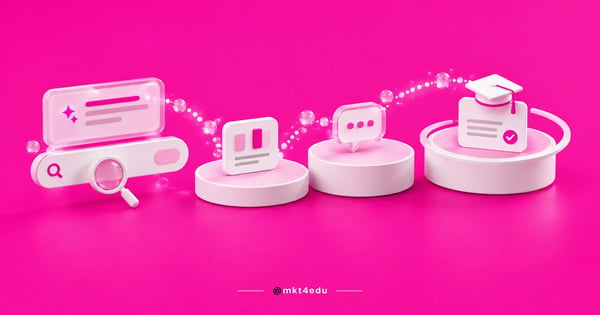 Caption: The consumer journey in education starts before the first contact with the institution, inside the results page itself.
Reaching the right audience is not enough either when the approach ignores the applicant's moment. Offering an enrollment discount to someone who has not yet decided to study at all is the most common mistake and the most expensive one.
The original logic of the journey splits the path into three stages of awareness. In the first one, the consumer has a potential problem and has not named it yet, so trying to sell a solution there tends to be fruitless.
In the second stage, consideration, the consumer already recognizes the problem and weighs the possible solutions. The institution shows the options that exist, including the ones it does not sell, without forcing the sale.
In the third stage, the purchase decision, the applicant compares providers and weighs concrete differentials. Commercial persuasion is welcome at this point, because the applicant asked for it.
Mapping that path is what turns intuition into process. Structured work to map the customer's purchase journey reveals which doubts appear in each phase and which content answers them.
The practical result is the waste that stops happening. Educational marketing strategies built on the journey stop spending budget talking about entrance exams with someone who is still researching which profession to follow.
What does the education market today change in the journey?
The education market today comes down to a single shift: distance learning overtook on-campus study in Brazil. The 2024 Higher Education Census counted 10,226,873 undergraduate enrollments, of which 5,189,391 were in distance learning.
Distance learning reached 50.7% of the Brazilian total and overtook on-campus study for the first time. On-campus programs accounted for 5,037,482 enrollments, or 49.3% of the whole.
That number changes the journey at two points. The first one is geographic: someone choosing distance learning is not limited to institutions in their own city, so the competition stopped being local by definition.
The second point is the channel. A distance learning enrollment often starts, matures and closes without a single physical visit, which puts the full weight of the decision on the website, on search, on social media and on remote service.
The consequence for recruitment teams is that applicants move between channels without warning. They discover a course in a video, ask the price on WhatsApp, compare on the website and go back to Google before filling in a form.
An omnichannel consumer journey stopped being a differential and became a basic operating condition. The information has to match at every point, with a history visible to whoever answers.
What are the stages of the consumer journey up to enrollment?
The stages of the consumer journey up to enrollment are five: awareness, consideration, decision, enrollment and retention. The first three come from the classic split by stage of awareness, and the last two exist because, in education, the sale does not end when the applicant says yes.
In the awareness stage, the future student feels a restlessness they cannot name. They want to change their life, earn more or leave a job they dislike, and they have not yet connected that to a specific course.
In the consideration stage, the future student has accepted that studying is part of the answer. They now compare study formats, course loads, fields and schedules, leaning on career guides and student testimonials.
In the decision stage, the question itself changes. The applicant already knows what to study and starts comparing institutions by price, reputation, accreditation, location and flexibility.
The enrollment stage is operational and tends to be the most neglected. A document that is hard to upload, a payment slip that takes days and a long form all knock out applicants who had already said yes.
The retention stage starts on the first day of class. A student who feels lost in the first week drops out, and dropout costs more than any recruitment campaign.
The classic example helps to see the whole sequence. Felipe has finished high school, is considering further study and also needs to work, without knowing whether college or a technical course is the right path.
Felipe decides to keep studying and sees the technical course as a viable option. He still wants to understand how to combine work and study, how long the course takes and what kind of job it opens.
Felipe chooses the technical course, but does not know where to take it. He now researches institutions and compares prices, and teaching method, facilities and employability records weigh more than any advertisement.
Video: an overview of the stages an applicant goes through before choosing an institution. Video in Brazilian Portuguese.
Each stage asks for a different kind of content and a different kind of patience. Digital marketing strategies that treat all five stages with the same offer end up converting only the people who had already decided.
How has AI search shortened the consumer journey?
AI search shortened the consumer journey by solving inside the results page what used to require visiting three or four websites. The applicant gets a comparison, a definition and a ready list without clicking, and reaches the institution's website already at the end of consideration.
The size of that effect shows up in the Similarweb clickstream data analyzed by SparkToro. In the United States, the share of searches producing at least one click fell 9.51 percentage points between 2024 and 2026. The figure covers the United States, so it reads as a direction of travel rather than a measurement of the Brazilian market.
Google states that AI features in search use the same index and the same ranking systems as traditional search. There is no special file and no magic markup that guarantees a place in the answer.
The visits that remain tend to be better qualified. According to Semrush research, a visitor arriving from AI search converts 4.4 times more than a visitor from traditional organic search, although the company does not publish a sample size or a period.
The combined effect is less volume with more intent. Anyone watching session counts alone concludes that Google AI is affecting organic traffic in purely negative terms, and misses the good half of the story.
For the consumer journey, the concrete change is one of position. The awareness stage and much of consideration moved outside the institution's own channels, into answers it does not control.
The shift calls for a change of target. Instead of competing only for the click, an institution needs to be the source the answer cites, which depends on clear content, attributed data and an objective definition at the top of every page.
Do SEO strategies and local SEO put the institution early in the journey?
Yes. SEO strategies put the institution early in the consumer journey because they reach the applicant while the problem is still being researched, long before any brand enters the comparison. Local SEO does the same job for people searching for a course by city or neighborhood.
Organic traffic has a property that advertising does not have: it keeps working after the budget runs out. A well ranked career guide attracts applicants the following year at close to zero marginal cost.
Knowing how to do local SEO for colleges changes the result in searches with visit intent. An updated business profile, a consistent address, a page per campus and recent reviews decide who shows up on the map.
How to do local SEO also matters for institutions running distance learning hubs. Each hub is a physical contact point with its own name, address and opening hours, and treating all of them as a single page wastes long tail searches.
SEO for AI is the layer that sits on top of that work. A project on SEO for LLM, short for Large Language Model, prioritizes a direct answer, a readable structure and data with a named source.
SEO for AI and traditional SEO strategies share the same technical base. What changes is the priority: a self-contained paragraph, a heading written as a real question and broad topic coverage are worth more than repeating the keyword.
The return on organic traffic arrives slowly and compounds, which is why mature digital marketing strategies keep organic and paid work on the same plan.
Paid traffic and entrance exam campaigns: where do they fit?
Paid traffic enters the consumer journey where time is short and intent already exists: open applications, scholarship deadlines, the last week of enrollment. Entrance exam campaigns are built around that window, because they press a decision that was already ripe before the ad appeared.
Turning on advertising before there is a clear offer and a page that converts only speeds up the waste. Paid traffic amplifies a flow that already works, and amplifying a leaking funnel raises the cost per enrollment.
Entrance exam campaigns tend to concentrate budget in a few weeks. The recurring mistake is talking only to people at the end of the journey and abandoning the top, which leaves the next cycle without a base of applicants.
Student recruitment campaigns with a longer horizon fill that gap. They sustain presence in the awareness and consideration phases, so the entrance exam campaign meets a warm audience instead of a cold one.
The BrightEdge study cited above puts that balance in proportion: 53% of trackable traffic comes from organic search and 15% from paid search, with direct traffic out of the count. The reasonable reading is not to abandon paid media, but to recognize that it covers peaks while organic sustains the base.
Measuring student recruitment campaigns by cost per lead misleads more often than it helps. The indicator that decides is cost per enrollment, because a channel that looks cheap per lead can turn out expensive per enrolled student.
How do you increase the conversion rate at each stage?
How to increase the conversion rate along the consumer journey depends on measuring each stage separately. An aggregate conversion number hides the bottleneck, because a funnel that loses people at enrollment and one that loses them at consideration show the same final figure and need opposite fixes.
The question of how to increase enrollment rarely gets solved with more budget at the top. In most operations, the volume of interested people is already enough and the problem sits in the move from one stage to the next.
Serious work on how to increase the conversion rate starts with a stage-by-stage reading of the funnel. Only after that does it make sense to choose where to put effort and money.
Each of the five stages gets its own channel and indicator:
|
Journey stage |
What the applicant does |
Channel that answers |
Metric |
|
Awareness |
Researches professions, salaries and the job market |
Blog content, organic search and video |
Organic sessions and citations in AI answers |
|
Consideration |
Compares study formats, course loads and schedules |
Comparison guides, email and social media |
Leads generated and nurturing open rate |
|
Decision |
Compares institutions by price and reputation |
Course page, local SEO and paid traffic |
Page conversion rate and cost per lead |
|
Enrollment |
Sends documents, negotiates terms and signs |
Human service, WhatsApp and applicant portal |
Enrolled students over applicants |
|
Retention |
Starts classes and tests the promise that was made |
Onboarding, tutoring and first semester communication |
Dropout in the first semester |
With the five indicators side by side, priority stops being a matter of opinion. The stage with the largest relative drop gets the effort in the next cycle, and the other four stay under observation.
People asking how to increase enrollment usually find the fastest gain in the enrollment stage itself. Fewer form fields, documents accepted as photos and same day replies lift conversion without any new media budget.
The handoff to the sales team is the other half of that gain. Knowing how to capture leads with inbound sales keeps the applicant inside one conversation instead of restarting the pitch at every contact.
When does educational consulting help map the journey?
Educational consulting helps when the internal team already has data but cannot see the whole funnel from the outside. The gain does not come from a new tool; it comes from a diagnosis that crosses marketing, recruitment and the registrar's office to find the stage that is costing enrollments.
Three signals usually mark the moment to look for outside help. The first is high traffic with flat enrollment, the second is an internal argument about lead quality, and the third is the feeling that every cycle starts from zero.
Deciding whether educational consulting is worth the investment means defining the deliverable before the contract. A journey map, indicators per stage and a correction plan are verifiable deliverables, and a generic report is not.
An educational marketing agency usually takes on execution as well. The practical difference is scope: consulting designs and advises, while the agency runs content, media and measurement day to day.
Video: how an outside diagnosis finds the journey stage that is blocking enrollment. Video in Brazilian Portuguese.
The selection criteria are simple and far from glamorous. Ask for the method, the indicator that will move and when the first reading is due, because reliable Educational marketing strategies start from the funnel the institution already has.
Frequently asked questions about the consumer journey
Where do you start mapping the consumer journey?
Mapping the consumer journey starts with an inventory of real questions, not with buying a tool. List the questions that reach your service team, spread each one across the five stages and mark which ones already have content and which ones are uncovered.
The second step is measuring the passage between stages with the data you already have. Even a spreadsheet with applicants, leads, enrolled students and dropouts shows where the losses concentrate.
The third step is picking one bottleneck per cycle. Attacking all five stages at once with a small team tends to produce five half improvements and no readable learning.
Two decisions hold for any size of institution: write the map before buying media, and define who answers the applicant and within how long. Marketing strategies without those two answers depend on luck.
AI search makes this work more urgent, because the awareness stage moved outside your own channels. An institution that does not appear in the answer loses the chance to be considered before the comparison even starts.
If the next step is turning this diagnosis into a plan, the mkt4edu team can review your institution's journey and point out the stage costing you enrollments today.










 Portugal