Every company investing in digital marketing reaches the same question sooner or later: what does each new customer actually cost? The number that answers it is customer acquisition cost, and it usually reveals that the problem is rarely the media budget alone.
In most cases CAC rises because the operation loses leads between the first click and the signed contract. An expensive ad is a symptom, and the cause tends to sit in weak content, slow follow-up, no nurturing, or marketing campaigns optimised by the wrong metric.
So reducing CAC is less about cutting investment and more about method. The marketing strategies that work attack both sides of the equation: they lower the cost of attracting and raise the number of customers that come out of the same investment.
What is CAC in marketing, and why does it decide growth?
CAC in marketing, the cost per customer acquired, is how much your business spends on sales and marketing to attract a new customer. It decides growth because it shows whether each sale pays for itself: when the cost of winning a customer exceeds what that customer gives back, growing means losing more money with every contract.
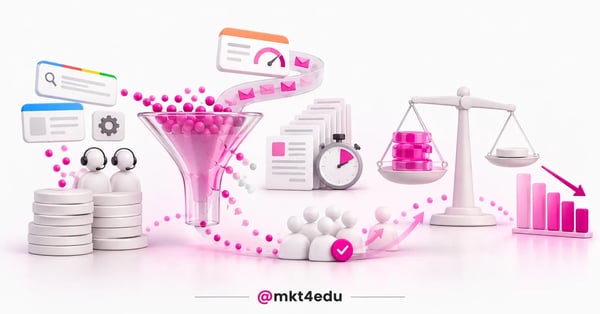 Caption: to reduce customer acquisition cost you need the funnel, CAC by channel and the LTV-to-CAC balance in the same reading
CAC is not CPL (Cost per Lead). CPL measures what it costs to generate an interested contact, while CAC measures what it costs to turn that contact into a paying customer. A campaign can have a low CPL and a high CAC if it attracts plenty of leads who never buy.
That difference explains why so many companies celebrate lead volume and watch their margin shrink at the same time. CAC is the metric that connects marketing to cash, which is why it is usually the first one finance asks about.
How do you calculate customer acquisition cost?
To calculate customer acquisition cost, add up all marketing and sales spending for a period and divide it by the number of new customers won in that same period. The formula is CAC = total marketing and sales investment ÷ number of new customers. The period and the scope have to match on both sides.
The figure includes paid media, salaries and commissions for the marketing and sales teams, agencies, freelancers, content production and tools such as the CRM (Customer Relationship Management), automation and analytics.
It leaves out costs unrelated to acquisition, such as support for existing customers and product development. Mixing those in inflates CAC and hides what winning each customer really costs.
The breakdown of what belongs in the figure and what does not, with the mistakes that distort it most, is in the guide on what goes into customer acquisition cost. Here, the focus is on using the result to decide where to act.
Here is how the calculation looks in a hypothetical month of operation:
|
Cost item |
Value in the month |
|
Paid media (Google Ads, Meta Ads, LinkedIn Ads) |
BRL 30,000 |
|
Tools (CRM, automation, analytics) |
BRL 5,000 |
|
Marketing and sales team (salaries and commissions) |
BRL 25,000 |
|
New customers in the month |
40 |
|
CAC (BRL 60,000 ÷ 40) |
BRL 1,500 |
Table: hypothetical monthly calculation showing what you need in order to reduce customer acquisition cost, with every acquisition cost added up
Knowing how to calculate average CAC is only the start, and the next step is breaking that number down by channel. The average hides highly efficient channels sitting next to channels that burn budget without closing a contract.
How do you calculate CAC by channel?
To calculate CAC by channel, divide each channel's investment by the number of customers it generated, using the source recorded in the CRM. Without a reliable source in the CRM, CAC by channel becomes an estimate and is no basis for a budget decision.
Shared costs, such as team and tools, can be apportioned by each channel's share of leads or customers. The criterion matters less than the consistency: pick one and keep it in the following months so the comparison means something.
In long sales cycles it is also worth calculating CAC by cohort, attributing the customer to the month they entered as a lead. That way a contract closed in March is not credited to March's investment when a January campaign generated it.
What is LTV (lifetime value) and how does it compare with CAC?
LTV (Lifetime Value) is the average revenue a single customer generates across the whole relationship with the company. Set against CAC, it answers whether it is worth paying what you pay for each new customer.
The simplest calculation multiplies the average ticket by the gross margin and by the average length of the relationship. In the previous example, a customer paying BRL 500 a month, with a 60% margin and an average stay of 24 months, has an LTV of BRL 7,200.
The LTV:CAC ratio comes from dividing LTV by CAC. With an LTV of BRL 7,200 and a CAC of BRL 1,500, the ratio is 4.8 to 1. The most cited market rule of thumb is 3 to 1 as a healthy ratio, and HubSpot describes the healthy band as typically between 3:1 and 5:1, though the ideal number varies by sector and by company stage.
A ratio that runs too high also deserves attention. The same analysis notes that a ratio higher than 4 to 1 might indicate you are not spending enough on sales and marketing, missing chances to attract new customers the margin could afford.
How long does CAC take to pay for itself?
CAC payback is the number of months the margin a customer generates takes to cover the cost of winning them. Divide CAC by the customer's monthly margin: in the example, BRL 1,500 ÷ BRL 300 gives five months. The shorter the payback, the less cash the company ties up in order to grow.
Which digital marketing strategies reduce customer acquisition cost?
The digital marketing strategies that reduce customer acquisition cost act on both sides of the formula: they lower the spend needed to attract each lead, or they raise the share of leads that become customers. Inbound marketing, content marketing, automation, inbound sales, CAC-optimised campaigns and retention are the most consistent levers.
When deciding how to reduce the cost of acquiring a customer, the priority depends on where the funnel loses most. A company that generates many leads and closes few gains more from qualification and automation. A company that depends only on paid media gains more from building organic content assets.
How do inbound marketing strategies bring CAC down?
Inbound marketing is a business methodology that attracts customers by creating valuable content and experiences tailored to them, rather than interrupting the audience with ads. Inbound marketing strategies bring CAC down because the lead arrives out of their own interest, already educated about the problem, and tends to convert with less commercial effort.
The methodology works in three stages: attract, engage and delight. Attract is being found in search and on social. Engage is offering the right answer at the moment of decision. Delight is keeping the customer satisfied enough to recommend the company to other people.
The CAC gain comes from the compounding effect: an ad stops generating leads when the budget runs out, while well-positioned content keeps attracting visits for months. Over time, the share of customers from organic sources grows and pulls the average cost down.
HubSpot itself now proposes an evolution of the methodology for the AI (Artificial Intelligence) era, Loop Marketing, with the stages Express, Tailor, Amplify and Evolve: express the brand's story, tailor it to each audience, amplify it across channels and evolve it in real time. The underlying logic is the same, attracting through the value delivered.
Why does content marketing make each new customer cheaper?
Content marketing makes each new customer cheaper because it turns one-off investment into an asset that keeps generating traffic and leads. An article that answers a real buyer question can be found for years, with no cost per click, and it prepares the lead for the commercial conversation.
To work, the content has to cover questions across the whole funnel: from the generic problem to the comparison between suppliers. Top-of-funnel content alone builds an audience that does not buy. Bottom-of-funnel content, such as comparisons, pricing and cases, attracts people already close to a decision.
Today that content also has to be readable by LLMs (Large Language Models, the models behind AI tools), with direct answers and clear sources. The walkthrough on doing content marketing for Google and for LLMs covers that adaptation.
Without a calendar, though, content becomes scattered production and the effect on CAC takes longer to show. Content planning tied to the keywords buyers actually search shortens that wait.
How does marketing automation reduce the cost per converted customer?
Marketing automation is the software that handles routine marketing tasks without human action, such as sending nurturing emails, segmenting contacts and alerting the rep. It reduces the cost per converted customer because it makes use of leads that would otherwise be abandoned, without needing more media to refill the funnel.
Most leads are not ready to buy at the first contact. Without automation those contacts go cold in the database. With nurturing workflows they receive relevant content until they show purchase intent, and only then move on to sales.
Another gain comes from lead scoring. Automation adds up interest signals, such as pages visited and materials downloaded, and prioritises whoever is most likely to close. The commercial team starts spending its time with people who buy, and the cost per contract falls.
The first workflows to build and the most common rollout mistakes are in the guide on what marketing automation is and how to implement it.
Video: mkt4edu audioblog on sales workflows, one of the levers that reduce customer acquisition cost
How do inbound sales strategies raise conversion without raising the budget?
Inbound sales strategies raise conversion without raising the budget because they adapt the sale to the buyer's moment: the rep approaches someone who has already shown interest, with context on what the lead consumed. The result is more contracts from the same volume of leads, and every extra contract reduces CAC.
The starting point is a clear agreement between marketing and sales about who is ready to be approached. In HubSpot, the lifecycle stages mark that handover: the marketing qualified lead, or MQL, is the contact marketing has qualified as ready for the sales team, and the sales qualified lead, or SQL, is the contact sales has confirmed as a potential customer.
When that handover is undefined, reps waste time on browsers and good leads wait days for a reply. The criteria for each stage are in the comparison between MQL and SQL and the right moment to pass a lead to sales.
Response time is the most neglected variable. A lead who asks for contact and waits days tends to go to a competitor. Setting a response SLA (Service Level Agreement) and measuring it in the CRM usually pays off more than increasing the media budget.
The sales methodology that joins inbound sales and CRM organises those steps into a single process, from first contact to closing.
How do you tune paid campaigns by CAC?
To tune paid marketing campaigns by CAC, optimise each campaign by the cost of a closed customer, not only by cost per click or per lead. That means feeding Google Ads and Meta Ads the conversions that matter, such as opportunity and sale, from CRM data.
In Google Ads, Target CPA bidding is the automated strategy in which you set the average cost you want to pay per conversion. The target CPA (Cost per Action) can be derived from the maximum CAC your LTV supports.
Four adjustments tend to have the biggest effect on marketing campaigns:
- Targeting by audiences that match the customer profile, not by click volume.
- Creative refreshed often, to avoid the fatigue that drives the click price up.
- Landing pages with a single offer and a short form, to raise conversion on the same traffic.
- Retargeting for whoever already visited decision pages, such as pricing and cases.
Each of those adjustments improves the conversion rate of traffic you already pay for, which is why they reduce CAC without requiring more investment.
Why does retention also reduce the cost of acquiring a customer?
Retention reduces the cost of acquiring a customer indirectly: a customer who stays longer raises LTV, buys again with no media cost and refers new customers. Harvard Business Review, citing research by Frederick Reichheld of Bain & Company, records that increasing customer retention rates by 5% increases profits by 25% to 95%.
The same article notes that acquiring a new customer is anywhere from five to 25 times more expensive than retaining an existing one. In other words, every cancellation avoided is a customer who does not have to be replaced with fresh acquisition spend.
Referral programmes, post-sale relationship cadences and proactive service are marketing strategies that link retention to acquisition. The tactics for improving customer retention with HubSpot show how to structure that follow-up in the CRM.
Here is how the strategies compare by the side of the formula they act on and by how long they take to show an effect:
|
Strategy |
Where it acts on CAC |
Typical time to effect |
|
Inbound and content marketing |
Lowers the cost of attracting each lead |
Medium to long term |
|
Marketing automation |
Raises lead-to-customer conversion |
Short to medium term |
|
Inbound sales and qualification |
Raises conversion and cuts commercial cost |
Short term |
|
CAC-optimised campaigns |
Cuts wasted media spend |
Short term |
|
Retention and referral |
Raises LTV and generates customers with no media |
Medium term |
Table: comparison of the strategies that reduce customer acquisition cost, by the side of the equation they act on and the time to effect
The short-term strategies hold the result up while the medium and long-term ones mature. Combining both fronts avoids depending on media alone and, at the same time, does not push the quarter's result into second place.
How much should you invest in marketing without blowing up CAC?
How much to invest in marketing depends on your new-customer target and on the CAC your LTV supports, not on a fixed percentage copied from another company. As a benchmark, Gartner's CMO Spend Survey of 402 CMOs and marketing leaders reported that 2025 marketing budgets remained flat at 7.7% of overall company revenue.
In 2026, with 401 respondents, Gartner reported that awareness and conversion now account for 62.6% of total media spend, with digital media passing two thirds of the total. Companies are concentrating budget on acquisition, which makes controlling CAC even more important.
Those figures are averages across companies in many sectors, surveyed in North America, the UK and Europe, and they serve as comparison, not as a rule. A company growing fast can invest well above that, as long as the LTV:CAC ratio stays healthy and the cash supports the payback. Knowing how much to invest in marketing therefore starts with the maths of each customer, not with a percentage.
Video: 4RevOps audioblog on the marketing budget, the spend that decides whether you reduce customer acquisition cost
How do you invest in marketing without losing control of CAC?
To invest in marketing without losing control of CAC, start from the customer target, set the maximum acceptable CAC from the LTV and only then split the budget across channels. That path inverts the usual logic of setting the budget first and discovering the result afterwards.
A practical routine for building the investment:
- Define how many new customers the business needs in the period.
- Calculate the maximum acceptable CAC by dividing the LTV by the ratio you want to keep, such as 3 to 1.
- Multiply the customer target by the current CAC to estimate the budget needed.
- Split the budget across the lowest-CAC channels, reserving a smaller share to test new ones.
- Review CAC by channel every month and move budget away from the ones that got worse.
The same reasoning appears in the material on optimising the marketing budget, which details the periodic budget review. What matters is that the budget is adjusted by the real CAC, not by last year's inertia.
Which mistakes push customer acquisition cost up?
The mistakes that push customer acquisition cost up most are optimising campaigns by cost per lead, leaving leads without a reply, ignoring retention and measuring CAC without reliable source data. What they have in common is that they all make the company pay for opportunities that never become customers.
The most frequent operational slips:
- Celebrating lead volume without tracking how many became customers.
- Taking too long to answer hot leads, who end up closing with a competitor.
- Putting the whole budget into paid media, without building organic assets.
- Calculating CAC from media alone, leaving team and tools out of the figure.
- Cutting investment across the board, without looking at each channel's CAC.
The last two mistakes are about measurement, which is why the CRM is where the fix starts. Without each customer's source recorded, any budget decision is a bet.
CAC also behaves differently by sector. In educational institutions, for instance, the seasonality of recruitment weighs more, and the specific levers are in the guide on how to reduce CAC in student recruitment.
Frequently asked questions about customer acquisition cost
Where should you start to reduce customer acquisition cost?
The first step is measuring properly. Before touching campaigns or content, the company needs to know its total CAC, its CAC by channel and its LTV, because those three numbers are what show where the waste sits.
With the diagnosis in hand, the priority usually goes to the short-term levers: response time, qualification between marketing and sales, and campaigns optimised by closed customer. They free up budget to fund the content and automation that reduce CAC more durably.
The digital marketing strategies that work lean on each other. Content attracts, automation nurtures, the commercial team closes and retention multiplies the value of every customer won.
All of it depends on a CRM that is genuinely fed, with the source, stage and outcome of every lead recorded by the team. When people do not use the system, CAC by channel stays in the dark, and knowing how to use the CRM when the team resists is what unlocks that reading.













 Portugal