


Most institutions do not have a lead volume problem. They have a triage problem: the database grows, the sales team calls everybody, and the enrollment rate does not follow. That is why qualified lead generation became the central conversation in student recruitment, well above the count of submitted forms.
Artificial intelligence entered that conversation as a triage tool, not as a replacement for the process. It scores the database, answers within the first minute, enriches records and separates who is ready from who is still browsing. What it does not do is decide what counts as a good lead.
That decision is human, written down and reviewed by the people who know the program, the price point and the admission calendar. This article shows how to build that rule, how AI works on top of it and how to measure the result.
What is qualified lead generation?
Qualified lead generation is the set of actions that attracts contacts whose profile, interest and timing match the offer, and that separates those contacts from the rest of the database. The difference lies in the test applied: what counts is the probability of enrollment, not the number of records.
A lead is anyone who traded a contact detail for something. A qualified lead also shows signals of fitting the offer and of being close to deciding. The difference between a prospect and a lead already settles much of the vocabulary confusion.
 Caption: Qualified lead generation combines attraction, triage and fast contact in a single operation.
What are the types of leads?
- Lead: handed over a contact detail, with no confirmed profile and no declared intent.
- Marketing qualified lead (MQL): matches the profile and consumed decision-stage content. Telling a marketing lead from a sales lead defines who moves forward.
- Sales qualified lead (SQL): confirmed a program, delivery mode or admission route, and joins the sales contact queue.
Why has qualified lead generation changed since 2022?
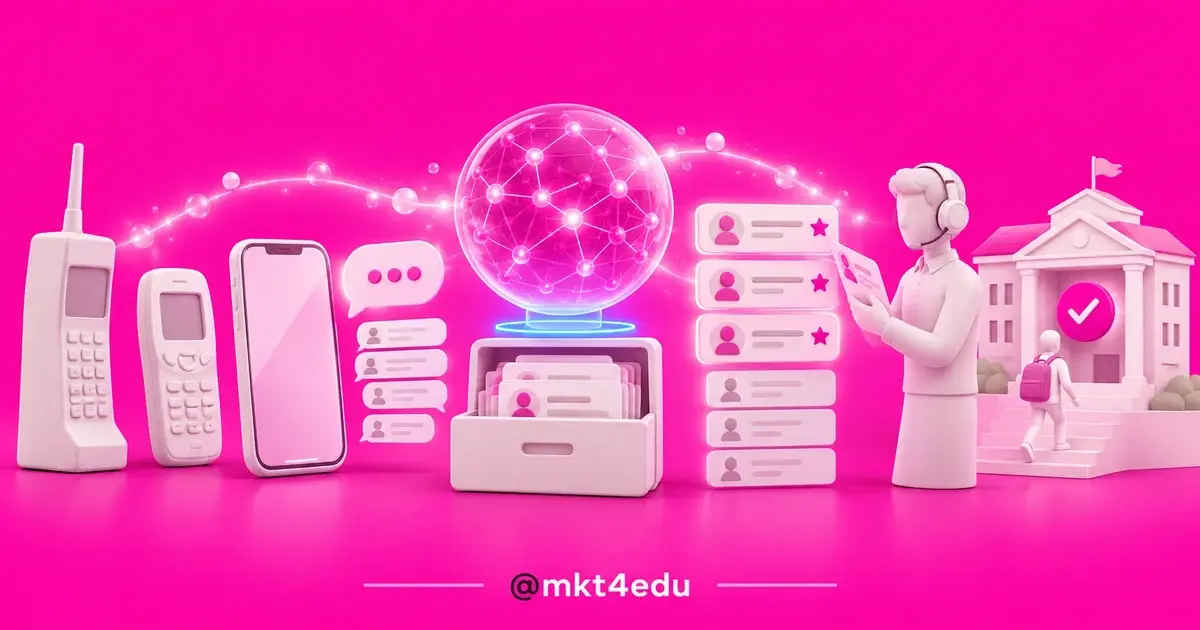
Qualified lead generation changed because the technology that used to be a differentiator became table stakes. The first commercial mobile phone weighed nearly a kilogram and cost a fortune; the device in a candidate pocket today does far more. The same happened with AI, in less time.
Corporate use stopped being the exception. In McKinsey The State of AI survey published in 2026, nearly nine in ten respondents report regular AI use in at least one business function, and revenue gains are attributed to marketing and sales more often than to any other area.
Owning the tool is not the same as getting results. The same survey shows that only 37% attribute to AI any impact on EBIT, earnings before interest and taxes, and that the high performer share stayed flat at 6%. The bottleneck moved to process.
In Brazilian higher education, the pressure arrived alongside it. The 2024 higher education census recorded ten million students and showed that distance learning accounts for 50.7% of undergraduate enrollments, up 5.6% in a year. Competing for candidates in that market means competing for attention beyond the campus catchment area.
This is where an educational marketing strategy stops being ad distribution and becomes the design of criteria, response and measurement.
Educational marketing guide
Fill in your details and open the interactive e-book right away.
Done! The e-book opened in a new tab.
Open the e-book →Which criteria define a qualified lead in education?
Three criteria carry qualification in education: profile, interest and timing. Profile says whether the person fits the offer, interest says how far they engaged, and timing says whether the admission cycle allows enrollment now. If one is missing, the lead goes to nurturing, not to sales.
The rule has to fit in one sentence the whole team repeats the same way, and every condition becomes a field in the CRM, the customer relationship management system. Here is how it breaks down:
|
Criterion |
What it answers |
Observable signal |
|
Profile |
Does the person fit? |
Program, delivery mode, city and admission route |
|
Interest |
Did they really engage? |
Program pages, tuition simulator, reply to a message |
|
Timing |
Can they enroll now? |
Admission calendar, high school completion, exam score |
|
Reachability |
Can we talk to them? |
Valid phone, messaging opt-in, preferred time on file |
Table: Qualification criteria and the signals each one produces in the CRM.
Turning criteria into a handoff rule
A criterion becomes a rule when it gains a numeric threshold and an owner. Instead of “engaged lead”, write “visited two program pages and replied to a message within seven days”. Lead qualification in education becomes auditable when the rule fits on one line.
How does predictive lead scoring work in qualification?
Predictive lead scoring is a score calculated by a statistical model that learns from the history of who already converted. Instead of adding up points set by hand, the model finds which combinations of behavior and record data preceded enrollment, and applies that pattern to the open database.
The difference from traditional lead scoring is who sets the weight. Under a rule-based model, a person decides that opening an email is worth five points. Under a predictive one, the weight comes from history, and it shifts when audience behavior shifts.
HubSpot describes the feature as machine learning algorithms that estimate the probability of an open contact closing as a customer within 90 days, drawing on web analytics, CRM activity and firmographic data. It sits in the Marketing and Sales Enterprise plans.
What the model needs to work
A predictive model is the consequence of an organized database, not a shortcut around one. Four conditions separate the rollout that works from the one that stalls.
- Recorded outcomes: enrollments and losses logged in the CRM, not only in a sales spreadsheet.
- Consistent fields: program, delivery mode and source stored as standard values, with no free text.
- Enough volume: past cycles with known outcomes, so the model has something to learn from.
- Periodic review: the 2024 pattern does not describe the 2026 candidate, and a stale score misleads.
Video: The mkt4edu AudioBlog explains when a lead is ready for sales, at youtu.be/GbceHcRVDGU. Narration is in Portuguese.
Which AI tools support qualified lead generation?
Four tool categories support qualified lead generation: a CRM with AI features, a conversational agent, predictive lead scoring and data enrichment. Thinking in categories rather than brands saves rework, because product names in this space changed a great deal since 2022.
- CRM with AI: centralizes history, records outcomes and feeds any model. It is what mkt4edu runs in HubSpot CRM projects.
- Conversational agent: answers on the site, on messaging or by voice, runs the first triage and hands the contact back with fields filled in, as in AI agents projects.
- Predictive lead scoring: ranks the database by probability of closing and sets the contact queue.
- Data enrichment: completes partial records with public or vendor data, cutting blank fields on the form.
Why a list of brand names ages so fast
Three products cited here in 2022 changed name, owner or home in under four years. Recording the current state of each one is worth the space, because naming confusion trips up whoever is buying.
IBM Watson Assistant was renamed watsonx Assistant in October 2023 and is being absorbed into watsonx Orchestrate. The release note dated 20 September 2026 records an automatic upgrade on selected plans and states that creating new instances is now limited. There is no end-of-support announcement.
Chatlayer is no longer an independent product. Sinch announced in March 2020 the agreement to acquire Chatlayer BV, for 6.9 million euros, and the technology moved into the buyer portfolio.
Dialogflow now appears in Google Cloud documentation as Conversational Agents (Dialogflow CX), with the old console replaced by a consolidated interface. The product continues; the name on screen changed.
Aito and Jumper, also cited in the earlier version of this article, no longer have a findable product page of their own. A missing page is not a shutdown announcement, so the absence is recorded as an absence, with no conclusion beyond that.
What does an AI SDR agent do in lead qualification?
An AI SDR agent, short for sales development representative, makes the first contact, runs triage through questions and records the answers in the CRM. It covers the window a human team cannot: overnight, campaign peaks and weekends.
Adoption is already the majority among sales teams. The Salesforce State of Sales report published in 2026 surveyed more than four thousand sales professionals across 22 countries and found that 55% use AI for prospecting and 54% have used agents, while the average seller spends 40% of their time actually selling.
What the agent handles well
- Immediate first contact: replies while the person is still on the page, with no queue.
- Question-based triage: confirms program, delivery mode and admission route before handing off.
- Field completion: returns the lead to the CRM with the data sales would have had to ask for.
- Re-engagement: reopens contact with people who went quiet, at a scale humans cannot match.
What stays human work
Scholarship negotiation, questions about program accreditation and any conversation carrying an emotional objection stay human. Comparing an AI SDR with a human SDR helps design that split without overpromising on either side.
Compliance is the other layer. Automated outreach involves personal data, consent and opt-out records, and the question of AI SDR agents and data protection law gets settled before the first send, not after the first complaint.
Teams about to roll one out will find the sequence in how to implement an AI SDR agent, with the scope, integration and measurement decisions in the order they appear.
What role does relevant content play in qualified lead generation?
Relevant content is the cheapest filter in the operation: it attracts people with the right question and turns away people who are only browsing. Top-of-funnel material brings volume; decision-stage material brings people who already chose the program and are comparing institutions, deadlines and price.
The rule is simple. If the content answers “what is it”, it feeds the top of the sales funnel in education. If it answers “which one”, “how much” or “how do I apply”, it produces qualified leads.
In practice, the top is career guides and field comparisons; the middle is annotated curricula and what the program is like week to week; the decision stage is tuition simulators, application deadlines and comparisons between delivery modes.
Distributing that content takes both channels. SEO work, or search engine optimization, builds the base that performs all year, and paid traffic covers the admission calendar peak.
The two channels deliver leads that behave differently, and measurement has to reflect that. It is common for paid traffic leads not to convert at the same pace as organic ones, without meaning the campaign is bad.
Organizing that production by funnel stage, rather than by posting calendar, is what mkt4edu delivers in content planning projects.
AI agents in marketing and sales
Fill in your details and open the interactive e-book right away.
Done! The e-book opened in a new tab.
Open the e-book →How do AEO and GEO fit into qualified lead generation?
AEO (Answer Engine Optimization) and GEO (Generative Engine Optimization) address the same question: how your content gets used when the answer arrives ready-made, with no click. For student recruitment, that decides whether the institution is cited or ignored.
There is no separate technical trick. Google states that there are no additional requirements to appear in AI Overviews or AI Mode, nor other special optimizations necessary, and that no specific schema is required: the page must be indexed and eligible to show with a snippet.
Markup stopped being a shortcut. The FAQ rich result stopped appearing in Google Search as of 7 May 2026, and the matching documentation was retired in June. A question block still earns its place through long-tail search and citation, not through SERP decoration.
Traffic arriving through assistants tends to be further along. Semrush estimates that AI search visitors convert 4.4 times better than traditional organic search visitors, a reading consistent with people who compared options before clicking.
What AI covers and what it does not
AI does not cover the enrollment decision. Your actual tuition, the application deadline, the scholarship on offer and how fast your team replies all sit outside the generated answer, and that is exactly where conversion happens.
Separating SEO, AEO and GEO avoids the most expensive mistake in this debate, which is treating presence in AI answers as a replacement for the funnel instead of a new entry point into it.
For teams that want to measure and work that layer with a method, mkt4edu structures it in SEO for LLM projects.
SEO in the AI era
Fill in your details and open the interactive e-book right away.
Done! The e-book opened in a new tab.
Open the e-book →How do you build a qualified lead generation process?
A qualified lead generation process is built backwards: first the definition of a good lead, then measurement, and only then the tool. Reversing that order produces an expensive CRM on a dirty database and an AI agent answering the wrong question.
The sequence below fits inside a single recruitment cycle and can be revised every term.
- Write the criteria: profile, interest and timing in one sentence the whole team repeats identically.
- Clean up the CRM: standardized fields, recorded outcomes and campaign source filled in.
- Define the handoff rule: what moves a lead out of marketing and into the sales queue.
- Turn on automated triage: a conversational agent on the highest-volume channel, with a clear handoff.
- Score the database: rule-based at first, predictive once there is enough history.
- Measure lead to enrollment: the dashboard only counts if it ends in enrollments, not in form fills.
The admission calendar drives the schedule. Fitting these steps into an enrollment campaign plan avoids the trap of switching on automation the week of the entrance exam.
Which metrics show that qualified lead generation works?
Four metrics answer whether qualified lead generation is working: cost per qualified lead, time to first contact, enrollment conversion and cost per enrollment. Taken alone, each one misleads; read together, they show where the funnel jams.
It helps to pin down what each number answers and which reading raises the alarm:
|
Metric |
What it answers |
Warning sign |
|
Cost per qualified lead |
What a lead in criteria costs |
Falls without enrollments rising |
|
Time to first contact |
How long the candidate waits |
Hours, on the busiest channel |
|
Enrollment conversion |
How much of the funnel enrolls |
Flat while volume climbs |
|
Cost per enrollment |
What each new student costs |
Rises while cost per lead falls |
Table: Qualified lead generation metrics and the reading each one requires.
The cost per lead line is the one that fools reports most often. Cost per lead drops every time the criteria loosen, and the dashboard looks great while sales complains about the database.
Response time deserves daily attention, not monthly. Student conversion depends on how long the institution takes to reply, and that delay rarely shows up in a campaign report.
Which mistakes sink qualified lead generation?
The mistakes that sink qualified lead generation are not technical: they are about definition and routine. A team without shared criteria, a stale database and a slow reply cancel out any investment in tooling.
- Measuring volume instead of enrollments: the report climbs, revenue does not follow.
- Leaving the criteria in people heads: every hiring round reinvents the rule.
- Treating every lead the same: price comparers get the message written for first-time browsers.
- Automating before fixing the CRM: the agent replies fast and logs to the wrong field.
- Ignoring what sales sends back: a rejected lead is the cheapest correction data you will get.
That last item is the most underrated. Understanding what causes lead loss in the enrollment funnel usually returns more than raising media budget mid-cycle.
It is also worth remembering that recruitment and retention share the same database. Treating student recruitment and retention as separate processes makes an institution celebrate enrollments that drop out in the first term.

Frequently asked questions about qualified lead generation
Where should you start with qualified lead generation?
Start with the definition, not the tool. Writing in one sentence what your institution counts as a qualified lead, then checking whether marketing and sales repeat the same sentence, fixes more in the first week than any software purchase.
With the criteria written down, fix outcome recording in the CRM and measure time to first contact. Those two corrections carry everything that comes later, from predictive scoring to the triage agent.
If the next step is reviewing the criteria your institution uses today, the guide to AI lead qualification covers ideal customer profile, scoring and triage methods. And if the conversation is about your own operation, with your numbers and your calendar, the mkt4edu team can run that diagnosis with you.
















 Portugal