Before every soccer match, the team gathers to agree on who takes the field, what each player does and what the strategy is. The kick-off meeting plays that role in a project: it is the session where the team stops working on assumption and starts working on a recorded agreement.
The problem is that this session is often treated as a formality. An hour is booked, a welcome slide is shown, everyone agrees to “sort out the details later”, and the project starts with each person carrying a different version of the scope.
What follows are the four steps that hold a productive kick-off together, the structure of the minutes that record what was decided, and the follow-up ritual that keeps the agreement from dissolving in week two.
What is a kick-off meeting and why does it decide the project?
A kick-off meeting is the session that marks the official start of a project and aligns goal, scope, roles, deadlines and risks before the first deliverable. It exists to turn expectation into an explicit agreement, with an owner and a date on every item, and to leave that agreement in a document the team can go back to.
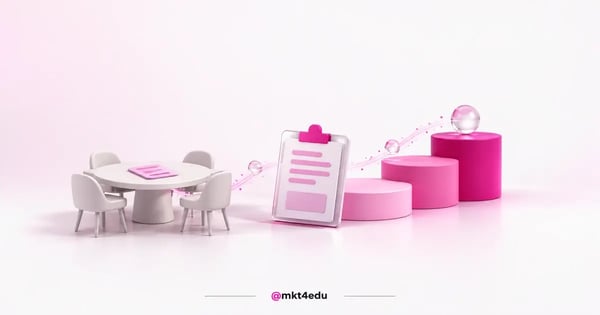 Caption: The agenda, the minutes and the follow-up are the three supports of a kick-off meeting that holds a project together.
The session is not there to present the project, it is there to close what is still open. Among the benefits of a well run kick-off, the most immediate one is that nobody leaves the room without knowing what they will deliver, by when and who they depend on.
Complexity has become the rule rather than the exception: in the Pulse of the Profession 2026 report from PMI (Project Management Institute), 97% of professionals managed at least one complex project in the past year, and more than half classified those projects as significantly complex.
In a complex project, every point left implicit at the start charges interest later. That is why the kick-off stopped being an opening ceremony and became a work stage.
- Goal: the result the project has to produce, in one sentence everyone would repeat the same way.
- Scope: what is inside the delivery and, above all, what is outside it.
- Roles: who decides, who executes, who approves and who only needs to be informed.
- Schedule: the dates that cannot move and the ones that can be negotiated.
- Initial risks: what is already known to cause delay, with an agreed plan for each item.
What are the risks of a poorly run kick-off meeting?
The risk of a poorly run kick-off is that the whole project inherits the misalignment of its first hour. When goal and scope leave the room with different readings, the team executes different versions of the same plan, and the correction only shows up once the deliverable is finished and wrong.
The numbers help size what is at stake. About a third of complex projects fail, nearly twice the 13% failure rate of projects overall.
It is like following a recipe and getting the first steps wrong. The mistake does not show up right away, it shows up at the end, when undoing it means doing everything again.
The most common symptom is the game of telephone. A decision agreed between two people reaches the third member half complete, and reaches the fourth already changed.
- scope that grows without anyone approving the increase
- a task with no owner, which becomes someone's problem the day before the deadline
- an approval discovered late, once the asset has already been produced
- rework that eats the time reserved for the next delivery
- a client or internal team surprised by a result that was not what was agreed
None of these symptoms is expensive on its own. The cost shows up in the sum, and the sum starts on the day the kick-off ended without a record.
How do you run a productive kick-off meeting in four steps?
A productive kick-off meeting rests on four steps: an agenda written and sent in advance, attendance from the people who decide and execute, a presentation with visual support, and minutes distributed right after. None of them depends on a tool, all of them depend on preparation.
1. Write the agenda before booking the session
The agenda is what keeps the session from turning into open conversation. It organizes the reasoning into a beginning, a middle and an end, and it shows, before the invitation goes out, whether there is enough substance for the meeting to exist.
A kick-off agenda covers goal, scope, roles, initial risks, schedule and next steps, and reserves time for questions. If a topic does not fit one of those six blocks, it probably belongs to another meeting.
2. Invite the people who decide and the people who execute
The absence of one approver turns a decision into an open item. The cost of that gap does not appear in the session, it appears two weeks later, when the delivery stops waiting for a sign-off nobody requested in time.
It is up to the project owner to treat the team as an audience to be convinced, not as spectators. As Michael Jordan put it, “talent wins games, but teamwork wins championships”.
3. Use visual support, not speech alone
Combining words and pictures improves understanding when the material avoids overload and integrates the elements well, which is what the multimedia learning theory of Richard E. Mayer, at the University of California, Santa Barbara, shows.
In a kick-off, that means a slide with little text plus a spoken explanation, or a visual demonstration plus a written summary. One main stimulus at a time, never all three at once.
4. Record everything in the minutes
Assign one person the job of recording what was decided, the agreed deliverables, the deadlines and the owners. Without that record, the memory of the project depends on whoever remembers best.
Send the minutes to every attendee within one business day. That short window is what lets you fix a misunderstanding while it is still a misunderstanding, and not a wrong deliverable.
What are meeting minutes and how do you start them in a project?
Meeting minutes are the formal record of what was discussed and decided in a session, with owners and deadlines. In project meeting minutes, that document stops being bureaucracy and becomes the reference the team checks to know what was agreed, by whom and by when.
How to start meeting minutes is the most common question, and the answer is simple: begin with the identification header, before any content. Project, date, time, place or link, who ran the session and who attended.
Only then comes the agenda and, item by item, what was decided. Decision and discussion stay separate: what was debated has the value of context, what was decided has the value of commitment.
A meeting minutes template that works for projects comes down to seven fields, in this order:
|
Field |
What to record |
Why it is mandatory |
|
Identification |
Project, date, time and format of the session |
Lets you find the right version when there is more than one meeting |
|
Attendees |
Who was present and who was invited but missing |
Shows who agreed to the decision and who needs to be updated |
|
Agenda |
The planned items and the ones raised during the session |
Separates what was planned from what came up, and reveals new scope |
|
Decisions |
What was agreed, written as a statement |
This is the commitment the team will execute, with no room for reading |
|
Open items |
What was not decided and still needs an answer |
Keeps an unresolved topic from disappearing until it becomes urgent |
|
Owners |
One person per task, never a department |
A task owned by everyone has no owner and does not get done |
|
Deadlines |
A date for each task and each open item |
Turns intention into something trackable at the next meeting |
Table: The seven mandatory fields of the project meeting minutes produced by a kick-off meeting.
The last three fields are what separates minutes from a summary. A decision with no owner and no deadline cannot be tracked, and what cannot be tracked is never chased.
How do you write meeting minutes in less time? Write them during the session, in a shared document projected on the screen. Each decision is then validated at the moment it is recorded, and the review afterwards stays short.
How do you lead a team meeting at a campaign kick-off?
Leading a work meeting means controlling time and focus, not filling the booked hour. At a marketing campaign kick-off, that means arriving with the diagnosis ready, presenting what is already known and using the session to settle what is not settled yet.
That diagnosis usually comes from a diagnostic assessment run before the session, with lead generation numbers, historical results and bottlenecks already mapped.
Without that preparation, the kick-off spends half its time gathering information that already existed in some report. With it, the room discusses choices rather than data.
It is also worth defining there which marketing strategies enter the cycle and which stay out, because a campaign with no defined boundary grows in fronts and disappears in results.
When the project involves lead generation, the kick-off has to put marketing and sales in the same room. Inbound marketing strategies define the volume and the quality of the leads; inbound sales strategies define what happens to them next.
- Open with the goal, in one sentence, and ask someone to repeat it in their own words.
- Follow the agenda in order, with a time box per block and a warning when a block runs over.
- Record the decision on the spot, out loud, so everyone hears the version that goes into the minutes.
- Close with the next steps, reading the owner and the deadline of each item before you end.
What comes after the project kick-off meeting?
After the kick-off comes the follow-up, and that is what decides whether the agreement survives. A short, regular status ritual, with the minutes open on the table, reviews deliverables, risks, blockers and communication with the people involved, and allows a course correction while it is still cheap.
The return on that care is measurable: professionals who manage complexity effectively are five times more likely to succeed in the project.
In practice, follow-up works better when the minutes do not sit alone in a file. Moving owners and deadlines into the same tool the team works in, as in project management on HubSpot, removes the double check between document and task.
When the project runs inside HubSpot CRM, the same record serves both the meeting and the progress report, with nobody rewriting what has already been decided.
The status does not have to be long. It has to be frequent enough that no deviation goes more than a week without someone noticing.
Frequently asked questions about the kick-off meeting
Where should you start structuring your next kick-off meeting?
Start with the agenda, because it exposes what has not been decided yet. As you write the six blocks, goal, scope, roles, risks, schedule and next steps, it becomes obvious which ones you still cannot fill in, and those are exactly the ones that need a conversation before the session.
The second step is the invitation list. For each block of the agenda, ask who decides that point and make sure that person is in the room, even if only for 15 minutes.
The third is the minutes template, opened before the session with the seven fields already created and empty. Filled in live, they spare the team the job of reconstructing afterwards what was agreed.
Once that is in place, the kick-off stops being an opening meeting and becomes the document the project leans on over the following weeks.
To turn that preparation into a routine, see how to start a project with five kick-off best practices and apply the full script to your next cycle.














 Portugal