





YouTube announced, on September 23, 2026, the series feature inside YouTube Shorts. Creators can now group short videos into seasons and episodes, with sequential playback and easier discovery inside the app itself.
The news arrives at a moment when short video is already routine in any digital marketing strategy, from selling products to educational marketing. Understanding how the feature works, what the format's technical limits are and where it fits avoids the common mistake of adopting a new tool with no plan.
This article explains the feature, the official figures from the launch, the step by step for posting YouTube Shorts as a series and how to apply that logic to both product campaigns and student recruitment campaigns.
What is the new series feature in YouTube Shorts?
The feature lets you organize YouTube Shorts into seasons and episodes, with the app playing the next video in the sequence automatically and showing a custom thumbnail for each series. YouTube's official announcement says the rollout to creators starts on September 23, 2026, across web, mobile and TV.
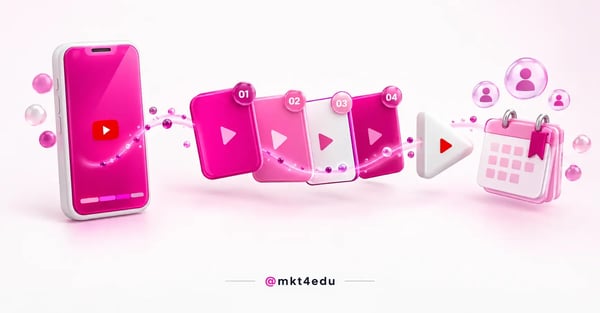 Caption: with the new feature, YouTube Shorts can be published as a season, with numbered episodes and sequential playback
YouTube justified the launch with audience data from the serialized format itself. Microdramas, fiction videos told in short episodes, surpassed 6.5 billion views in the first half of 2026.
Views of that kind of content grew by more than 50% in a year, and views on TV screens rose by more than 90% over the same period.
That data comes from serialized entertainment, not from institutional marketing or educational marketing. Even so, it shows something relevant for any digital marketing strategy: audiences already accept following a story in parts inside YouTube, including on the television screen.
The feature also does not require new production from scratch. Anyone already publishing YouTube Shorts can reorganize existing videos into a season, as long as they share a central theme and an order that makes sense to the viewer.
How do you create YouTube Shorts as a series?
Creating YouTube Shorts as a series starts by defining the season's theme before recording the first episode. Without a clear thread, the sequential playback feature loses its point and the viewer does not understand why that video belongs to a continuation.
The next step is planning the order of the episodes. Posting YouTube Shorts as a series works by season and numbered episode, so it is worth writing the full sequence in advance, even if publication happens gradually over the weeks.
The thumbnail for each series also has to be treated as a unique visual identity, different from the default thumbnail of a standalone Short. It is what shows up for someone who discovers the series midway, not only for someone watching from episode one.
Finally, each episode has to work on its own. Someone who watches the third episode without having seen the first two still has to understand what it is about, even while missing the season's accumulated context.
The title and description of each episode count too, with good SEO for video practices. That helps the algorithm understand what the series is about, the same principle behind any SEO for YouTube strategy.
What is the maximum length of a YouTube Short?
The maximum length of a YouTube Short is 3 minutes, according to YouTube's official help center. That is also the time limit of a YouTube Short inside a series, since the series feature does not change the duration rules for each episode.
There is no minimum length for a YouTube Short in the official documentation. What defines the format is the video being in vertical or square orientation and fitting within the 3-minute limit, not a starting duration.
In market practice, most creators use between 15 and 60 seconds per video, even though the official limit allows up to 3 minutes. For a series, that means you can vary the length from episode to episode, as long as none goes over the 3-minute ceiling.
That flexibility in timing is what makes the series feature viable for denser content, such as explaining an admissions process across three or four short episodes, instead of forcing everything into a single 60-second video.
How do serialized Shorts fit into digital marketing strategies?
Serialized Shorts fit into digital marketing strategies as a way of holding attention across several days, instead of competing for everything in a single post. A well-closed episode creates the urge to watch the next one, which raises the total time of exposure to the brand.
The format serves both products and services. A retail brand can show the development of a collection in episodes, and a service provider can turn a complex process into a sequence of short, instructive videos.
The format is not exclusive to any sector. The same educational marketing strategies an institution applies in a Shorts series, such as showing behind-the-scenes footage and telling a journey in parts, work for retail, healthcare, technology and any other segment that already uses short video.
What changes from sector to sector is the season's theme, not the logic of the feature. While a store can narrate a product launch, an institution can narrate the routine of a course across a term.
How do you do student recruitment with serialized video?
Doing student recruitment with serialized video means turning a moment in the funnel, such as choosing the course or the routine of the first term, into a sequence of short episodes published over weeks. That keeps the applicant coming back to the institution's channel instead of watching a single isolated video.
A practical example: a season about "first-year routine", with one episode a week showing classes, the library, the lab and campus life. The prospective student follows along as if it were a short drama about the very decision they are making.
That kind of series also fits the institution's student recruitment calendar. Publishing episodes in the weeks leading up to the opening of applications creates familiarity with the campus before the applicant even fills in the form.
The advantage of using serialized video at this moment is that each episode can answer a different question about the admissions process, without turning the content into a long, tiring video about rules and regulations.
Do serialized Shorts work in admissions campaigns?
Serialized Shorts work in admissions campaigns because the selection process is already divided into stages by nature, such as application, exam, results and enrollment. Each stage becomes a natural episode of the series, without forcing an artificial script.
An institution can plan an admissions campaign season with one episode per stage: what to study, how exam day works, what to do when the results come out and how to complete the enrollment. That organizes the student recruitment calendar around a single video format, instead of loose, disconnected pieces.
This kind of admissions campaign also takes advantage of the audience growth YouTube recorded in serialized content, although that data comes from entertainment and does not guarantee the same result for institutional content. What it does confirm is that audiences are already used to that consumption format inside YouTube.
The series feature is very recent, and there is still no published case study of an educational institution using the format. Treat the strategy as a test, with its own metrics, not as a ready-made formula.
Is it worth hiring an agency to produce YouTube Shorts?
Hiring an agency to produce YouTube Shorts is worth it when the in-house team has neither the time nor the repertoire to plan a whole season, from the script to the metrics of each episode. A poorly planned series loses the viewer at the second episode, which is worse than never having tried a series at all.
An educational marketing agency follows the institution's student recruitment calendar and knows which week each episode has to go live to reinforce the right campaign, whether that is admissions, online courses or postgraduate programs.
A student recruitment agency that also handles video production can turn the same raw footage into content for Shorts, for viral content on other networks and for the rest of the YouTube channel, without redoing the editing work from scratch for each format.
For those already producing video in-house, hiring an agency for educational marketing usually makes more sense at the strategy stage, such as content planning and defining the theme per season, than at the recording stage itself.
Frequently asked questions about YouTube Shorts
Are serialized YouTube Shorts for now or can they wait?
Testing serialized YouTube Shorts now costs little, because the feature reuses videos that already exist, with no new production budget required. The risk of waiting is smaller than with other platform launches, since there is no mandatory ad spend to experiment with the format.
Anyone working in social media marketing gains by testing a short season, of three or four episodes, and watching retention and requests for a continuation before committing a whole plan. The same holds for anyone handling student recruitment: a small season about a single course already shows whether the format speaks to that audience.
If the decision is to postpone, the real cost lies in letting competitors occupy that series space on the YouTube channel first. Since the feature is new, there is still time to test without competing for attention with dozens of similar seasons.
Fitting that season inside a broader digital marketing plan keeps it from becoming an isolated action, with no calendar and no metrics to follow.


























 Portugal