






The same scenario plays out in almost every admissions office. A prospective student sends a message at 9 p.m. asking about the program, no one responds, and by the next day, they’ve already enrolled at another institution.
WhatsApp in student recruitment is no longer a unique selling point; it has become the battleground where enrollment is won or lost, often in a matter of minutes.
The problem is almost never the channel itself; it’s the lack of a method. Without a sales funnel, a consistent follow-up cadence, and a CRM system, WhatsApp becomes a jumble of scattered conversations across different cell phones, and the lead that cost so much to acquire simply vanishes.
In educational marketing, this is one of the most costly leaks in the student recruitment sales funnel.
This article shows you how to organize this journey from start to finish. You’ll learn how to structure the funnel, set the pace of messaging, use automation without sounding robotic, put an SDR (Sales Development Representative) to work, qualify those who are actually likely to enroll, and integrate everything into the CRM so you never lose track of a prospect again.
Why has WhatsApp become the decisive channel for student recruitment?
WhatsApp has become crucial for student recruitment because that’s where prospective students are already active and where they expect a quick response.
In Brazil, the app is installed on virtually every cell phone and is the preferred channel for communicating with companies; therefore, it’s essential to offer enrollment to whoever responds first.
According to Statista, WhatsApp is among the platforms most used by Brazilians online, with a presence on nearly every smartphone in the country. It’s a reach that no other customer acquisition channel offers.
And it’s not just about presence. The Opinion Box survey on WhatsApp in Brazil shows that most users already communicate with companies through the app, and a significant portion uses the channel specifically to ask questions and request information. That’s exactly what a prospective student does before deciding on a program.
The key factor is speed. A classic study published by the Harvard Business Review on response times to leads showed that companies that reach out within the first hour are much more likely to qualify the lead than those that take longer.
On WhatsApp, where the expectation is for an almost immediate response, that window is even shorter.
This is where the problem lies for most institutions. The prospect arrives through the right channel but encounters delays, generic responses, and no follow-up; as a result, the lead goes cold, and the competition reaps the benefits.
Having a WhatsApp presence, therefore, is the bare minimum. What sets those who capture leads apart from those who merely chat is backing up the channel with well-defined educational marketing strategies: a funnel, a consistent contact schedule, and a place to track everything.
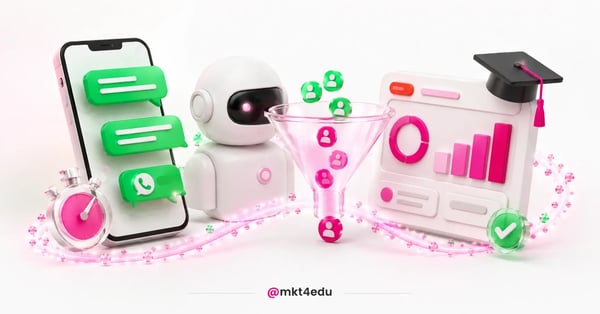 Caption: From the first “hi” to enrollment: WhatsApp in student recruitment only becomes predictable when it includes a funnel, a cadence, an SDR agent, and an integrated CRM.
How do you structure the enrollment funnel on WhatsApp?
The WhatsApp enrollment funnel organizes the conversation into stages, each with a clear objective: capture the contact, respond quickly, gauge interest, present the course and its terms, and guide the student toward enrollment.
Each step has a defined action, and no one moves on until the previous step is completed.
Think of the funnel as a roadmap for the applicant’s journey. Without it, each agent has to improvise, and the outcome depends entirely on the memory and goodwill of whoever is on duty.
-
The first stage is entry. The lead arrives via an ad, a form, a link in the bio, or a button on a well-designed landing page optimized for conversion. The goal here is simple: to start the conversation within seconds, before interest wanes.
-
The second stage is the initial contact. It’s the greeting, the confirmation of the program of interest, and a question that opens the door to dialogue. Never say “Hello, how can I help you?”—because that shifts the burden back to the applicant.
-
The third step is qualification. Here , you understand who the applicant is, what they’re looking for, and where they are in the decision-making process. It’s the filter that directs the team’s energy toward those who actually have a chance of enrolling.
-
The fourth step is presenting the offer. Course , format, costs, scholarships, and admission options—all tailored to what the applicant said they need. A generic approach doesn’t convert.
-
The fifth step is closing the deal. This includes providing the applicationlink , assisting with documentation, and following up until enrollment moves from “almost done” to “done.”
See how the steps connect:
|
Funnel Stage |
Objective |
Main Action on WhatsApp |
|---|---|---|
|
Lead Generation |
Capture the contact |
Start a conversation within seconds of the lead arriving |
|
First contact |
Build rapport and guide |
Greet, confirm the course, and ask the first question |
|
Qualification |
Understand the candidate |
Ask about their goal, program type, and decision timeline |
|
Offer |
Present the solution |
Show the course, prices, and customized terms |
|
Closing |
Convert to enrollment |
Send registration link and track documentation |
Table: The steps function as a workflow: the applicant only moves forward once the previous step is completed, which prevents pushing the offer onto those who are still undecided.
With the funnel mapped out, it’s clear where each lead stands and what’s needed for them to move forward. It’s this overview that allows you to maintain a steady pace and measure results, rather than just hoping the conversation goes well.
What is the messaging cadence from initial contact to enrollment?
Message cadence is the planned rhythm of contact that keeps the prospect engaged without overwhelming them. It combines a quick initial response with spaced-out, purposeful follow-ups.
The golden rule is simple: respond within minutes and never let a conversation fizzle out without scheduling a next step.
The first contact is the most critical, because the sooner you respond, the greater the chance the conversation will move forward. Waiting until the next day is practically handing the lead over to whoever responded right away.
After the initial contact, follow-up comes into play. It’s necessary because most candidates don’t make a decision during the first conversation: they ask for time, disappear, or come back. Without a planned follow-up sequence, that lead is simply forgotten.
A healthy rhythm involves keeping in touch a few times over the next few days, each time for a genuine reason. A reminder about the scholarship, a question about the course schedule, a notice about an application deadline. Never a “So, have you decided yet?” repeated until it becomes annoying.
The spacing between contacts matters just as much as the frequency. Contacts that are too frequent come across as desperate; contacts that are too infrequent let the institution slip from your mind. The right balance respects the decision-making process without letting you lose sight of the institution.
Every message needs to end with a hook—something that invites the applicant to respond or take the next step. A conversation that ends with an open-ended question.
And there’s a time to stop. A good recruitment process has a maximum number of attempts and a polite closing that leaves the door open without burning the bridge.
This pacing is one of the strengths of an SDR agent working on WhatsApp, who maintains the rhythm without overlooking any leads or wearing the prospect out.
How can you use customer service automation without losing the human touch?
Customer service automation on WhatsApp handles repetitive and urgent tasks: it responds immediately, performs initial screening, collects data, and schedules follow-ups. The human touch comes into play when there’s a genuine question, objection, or decision to be made.
The right balance is to automate the speed and reserve the team for building relationships.
The biggest benefit of automation is eliminating wait times. No one can respond to hundreds of messages in seconds, at any time, every day. An automated workflow can, and that’s what ensures no lead goes unanswered at 10 p.m. on a Sunday.
Automation also handles the repetitive tasks—confirming interest in a course, collecting names and email addresses, sending registration links, and reminding people of deadlines—which are tasks that take up the team’s time without requiring human touch.
A common mistake is trying to automate everything. When a candidate has a specific question about their career, a concern about pricing, or uncertainty about the program format, they need a human touch. A bot at that moment will only push them away.
The good news is that mature automation already understands the context and can sustain a natural conversation without sounding like a rigid script. It screens applicants, qualifies them, and passes the baton to a human at the right moment, with the entire history already on record.
The sign that the balance is right is this: the candidate never has to wait, but always feels like they’re talking to someone who understands what they need.
How does the WhatsApp SDR agent handle student recruitment?
The WhatsApp SDR agent is an AI-powered pre-sales assistant that automatically manages the student recruitment funnel: it responds instantly, qualifies the applicant, maintains a consistent pace, and hands off to the advisor at the decision-making stage.
It combines the speed of automation with the care of human service.
SDR stands for Sales Development Representative, the pre-sales professional who makes the initial contact, qualifies, and prepares the lead before forwarding it for closing.
When this role is taken on by an AI-powered SDR agent, they operate 24 hours a day, with no backlogs and no leads left behind.
On WhatsApp, this agent is particularly effective because it operates on the channel where the candidate is already active. An SDR agent operating on WhatsApp leads the conversation from the very first “hi,” maintains a flawless follow-up cadence, and logs every interaction, while the human team focuses on those who are ready to enroll.
This doesn’t mean replacing people with robots. The comparison between AI SDRs and human SDRs shows that the best results come from a combination of both: AI ensures speed, scale, and consistency, while the consultant addresses objections, career questions, and finalizes enrollment.
In practice, the WhatsApp SDR agent is what makes the sales funnel, the cadence, and the qualification happen simultaneously and at scale, without relying on the memory of a live agent.
It’s the difference between an operation that grows and one that stalls when lead volume increases.
How do you qualify leads via WhatsApp?
Qualifying leads via WhatsApp is the process of determining, during the conversation, who has a genuine intention and ability to enroll.
It involves asking natural questions about their goals, program type, decision-making timeline, and fit with the course profile—with the aim of prioritizing those who are ready and nurturing those who aren’t yet.
Not every contact is a prospective student. Some are just researching, others have chosen the wrong course, and still others won’t decide for months. Treating everyone the same wastes the team’s time on the wrong leads.
Qualification begins with simple, conversational questions: Which course interests them, whether they prefer in-person or online learning, what their goal is for the program, and when they plan to start. All these answers reveal a lot about the lead’s level of interest.
The tone makes all the difference. Qualifying isn’t an interrogation. The questions need to sound like a genuine interest in helping, woven into the flow of the conversation, rather than a form fired off all at once.
With the answers in hand, the lead is assigned a priority. Those who want to start right away and fit the course profile go to the top of the queue and receive immediate personal attention. Those who are still in the early stages enter a lighter nurturing process.
This screening is where automation shines. An agent qualifies dozens of conversations simultaneously, applies the same criteria to all of them, and never misses an important question due to fatigue or distraction.
The result is a lead generation team that focuses its energy where it counts. Less time chasing casual inquiries, more quality conversations with those who are actually going to enroll.
How can you integrate WhatsApp with your CRM for student recruitment?
Integrating WhatsApp with your CRM means recording every conversation, every piece of data, and every stage of the funnel within a single system. This way, no lead is left solely on a representative’s cell phone.
The CRM provides visibility into the entire sales funnel, ensures follow-up, and transforms WhatsApp into a predictable channel rather than a black hole for messages.
Without a CRM, WhatsApp is a ticking time bomb. Conversations are scattered across different devices, the history disappears when someone leaves the team, and no one knows how many leads are stuck at each stage.
With integration, everything changes. Each contact becomes a record with a name, course of interest, stage in the funnel, and complete conversation history. Anyone on the team can take over the conversation without starting from scratch.
The CRM is also what makes follow-ups actually happen. It reminds you who needs a follow-up, flags leads that have gone cold, and shows where the journey is stalling. It’s the difference between actively following up and just hoping for the best.
For institutions that use marketing tools, the integration between AI and HubSpot shows how WhatsApp conversations can feed into the CRM in real time, updating stages and triggering tasks without manual data entry.
More than just record-keeping, the CRM provides predictability, revealing how many leads come in, how many move forward, and how long it takes from the first contact to enrollment. You can predict the outcome and fix bottlenecks before lead generation gets out of hand.
This is the heart of a mature operation. Connecting channels, data, and processes into a single workflow is the foundation of what’s called Revenue Operations, or RevOps—the discipline that, in educational marketing, aligns marketing, sales, and customer service around the same revenue goal.
Frequently Asked Questions About Using WhatsApp for Student Recruitment
Is it worth investing in WhatsApp for student recruitment?
Yes, and more and more so. Prospective students are already on WhatsApp; they make quick decisions and expect an immediate response. The question isn’t whether your institution should use WhatsApp for recruitment, but whether it’s doing so systematically or losing enrollments due to delays and disorganization.
The difference between these two scenarios lies in the process: a clear funnel, a defined cadence, SDR agents in the right roles, intelligent lead qualification, and integrated CRM. That’s what transforms a conversation channel into a predictable enrollment machine.
Setting all of this up from scratch, however, is hard work and requires experience in educational recruitment. This is where mkt4edu comes in, as specialists in educational marketing.
Using artificial intelligence applied to student recruitment, we structure the entire journey on WhatsApp—from the first contact to enrollment—ensuring no lead is lost along the way.
If your institution feels it responds too slowly, forgets to follow up, or doesn’t have a clear view of the funnel, now is the time to act—before the next enrollment window opens. Talk to the mkt4edu team and find out how to use WhatsApp to actually recruit students.
A signed enrollment agreement, however, is not the finish line.
The same care that guided the prospective student from that first “hi” all the way to enrollment must continue after they become a student; otherwise, the institution will have to spend money again to replace those who dropped out during the first semester. It’s worth understanding why student recruitment and retention yield better results whenoperated as asingle, integrated process—with shared data and goals—rather than as two separate teams taking turns.
























 Portugal