





Ranking well and converting poorly is one of the most common problems for anyone investing in organic search. The page shows up, gets the click and loses the visitor in the first few seconds, because it takes too long to load, does not answer what was asked or hides the action at the end of a long form.
SXO was born to close that gap between the click and the conversion. Instead of treating SEO, UX and CRO as three teams with three goals, search experience optimization starts from a single question: did the person who searched find what they wanted and manage to do what they came to do?
The question became more urgent with AI search. According to the SparkToro study with Similarweb, 68.01% of Google searches in the United States ended without a click between January and April 2026. Every remaining click is worth more, and wasting it on a poor experience costs more than it used to.
What is SXO (Search Experience Optimization)?
SXO, or Search Experience Optimization, is the discipline that optimizes the complete experience of someone who reaches a site through a search: being found, delivering the right answer, allowing frictionless navigation and leading to conversion. In practice, SXO is the sum of SEO, UX and CRO applied to the same page, with a single goal: the outcome of the visit.
 Caption: SXO follows the visitor from the search result to the conversion, without treating each stage as a separate project
The term emerged in the search market as a response to a separation that never made sense to the user. Someone searching does not distinguish "the page ranked" from "the page solved my problem". For that person, there is only one search experience, which begins in the search box and ends when they get what they wanted.
The definition of UX helps explain the scope. For Don Norman and Jakob Nielsen, in the reference text from the Nielsen Norman Group, user experience "encompasses all aspects of the end-user's interaction with the company, its services, and its products". SXO frames that experience starting from search.
Google's position reinforces the logic. The helpful content documentation asks that the site offer "a great page experience in many aspects", rather than focusing on one or two. SXO is the practical answer to that guidance.
One caveat: SXO is not a ranking system or an official seal, it is a way of organizing optimization work around the user. Google recognizes the components, such as relevance and Core Web Vitals, and SXO brings them together.
How does SXO work on the journey from click to conversion?
SXO works by following the visitor through five moments: choosing the result on the search page, loading the page, reading the answer, navigating to the action and completing that action. Each moment has its typical friction, and the search experience improves when they are removed in the order the visitor encounters them.
The first moment is choosing the result. The title and description promise something, and the page has to deliver on the promise. When the title promises "pricing" and the page delivers "request a quote", the person goes back to search and the click was wasted.
The second moment is loading. If the main content takes too long to appear or the page jumps while loading, the visitor gives up before reading. This is where Core Web Vitals come in as an objective measure of speed and stability.
The third moment is reading. The answer has to be at the top, in language that matches the search intent, with subheadings that let people jump straight to the point. Someone arriving with a specific question does not want a preamble.
The fourth moment is navigating to the action. The path between "I get it" and "I want it" has to be short and visible, with internal links that lead to the next logical step and not to a maze of categories.
The fifth moment is the conversion. A long form, an unnecessary field and a hidden button are the most expensive frictions, because they happen when the person has already decided. SXO treats that moment with the same care it gives the title.
A figure from the Baymard Institute research shows the size of the opportunity in that last moment. The average cart abandonment rate documented across 50 studies is 70.22%.
The same research shows that the average checkout displays 23.48 form elements, when the ideal sits between 12 and 14. The pattern repeats in any conversion form.
What are the pillars of SXO?
The pillars of SXO are six: satisfied search intent, speed and stability measured by Core Web Vitals, clear architecture and navigation, scannable content with a quick answer, frictionless conversion, and engagement signals plus AI search. None of them is new in isolation; SXO treats them as a system, assessed on the same page at the same time.
The first pillar is satisfied search intent. Every query carries an expectation, which may be to learn, compare, find or buy, and the page has to match it. Search intent optimization is the starting point of any SXO work.
The second pillar is speed and stability, measured by the Core Web Vitals defined by Google on web.dev: LCP (Largest Contentful Paint, the time until the largest element appears), with a 2.5-second target; INP (Interaction to Next Paint, response to interaction), with a 200-millisecond target; and CLS (Cumulative Layout Shift, visual stability), with a target of 0.1.
These targets are assessed at the 75th percentile of loads, separating mobile and desktop.
Google's page experience documentation confirms that Core Web Vitals are used by the ranking systems. The same page states that there is no single page experience signal.
The third pillar is architecture and navigation. The visitor needs to know where they are, where they can go and how to get back. A well-designed structure of internal links plays that role for people and crawlers at the same time.
The fourth pillar is scannable content with a quick answer: question-shaped subheadings, a direct answer in the first paragraph of each section, lists and tables when they help comparison. That format serves the hurried reader and the search systems that retrieve passages, not whole pages.
The fifth pillar is frictionless conversion: a form with the fewest possible fields, a button visible without scrolling, text that explains what happens after the click and a thank-you page that guides the next step. It is the part of SXO that leans most on CRO.
The sixth pillar brings together engagement signals and AI search. A distinction is worth making here: Google does not confirm time on page or bounce rate as ranking factors. Those numbers are useful for UX diagnosis, not as a direct lever on position.
AI search, on the other hand, changes what the page needs to offer. According to Google's AI features documentation, AI Overviews and AI Mode use the same index and the same ranking systems as traditional search, with no extra requirement.
SEO for AI, therefore, is not a separate discipline. What changes is that self-sufficient passages have a better chance of being cited.
The GEO (Generative Engine Optimization) study, from Princeton and partners, measured what raises visibility in generative engines: citing named sources, including expert quotes and bringing in verifiable statistics, with gains of up to around 40% in the experiment. All three tactics are also good search experience practice for human readers.
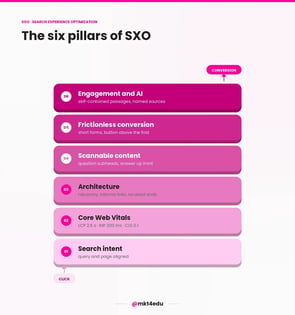 Caption: each SXO layer rests on the one below: without search intent resolved, the five pillars above do not sustain the conversion
What is the difference between SXO, SEO and CRO?
The difference between SXO, SEO and CRO lies in the stretch of the journey each one optimizes and in the success metric. SEO optimizes visibility and the click, measured by impressions and organic traffic. CRO optimizes the action inside the page, measured by conversion rate. SXO covers the whole path, measured by the conversion of organic traffic.
CRO + SEO + UX: optimization techniques explained, on the mkt4edu channel.
The three disciplines overlap, and it is common for the same person to handle two of them. What SXO adds is the obligation to look at all three metrics on the same page, so that gaining traffic does not mean losing conversion. Here is how that is organized:
|
Criterion |
SEO |
CRO |
SXO |
|
Stretch of the journey |
From the query to the click |
From the page to the action |
From the query to the completed action |
|
Main metric |
Impressions, position, clicks |
Conversion rate |
Organic traffic conversion per page |
|
Question that guides the work |
Is the page found? |
Does the page convince? |
Did the person who searched do what they came to do? |
|
Typical tools |
Search Console, keyword research |
A/B tests, heat maps |
Both lists, cross-referenced by page |
|
Risk when acting alone |
Traffic that does not convert |
Conversion on a page nobody finds |
Requires more coordination between teams |
Table: Comparison between SEO, CRO and SXO by stretch of the journey, metric, guiding question, tools and risk of acting in isolation.
The last row is the real cost of adopting SXO: it demands coordination between people who today answer to different goals. The benefit is that the "traffic or conversion" argument stops existing.
How do you do SXO step by step?
Doing SXO comes down to a cycle of four stages: diagnosing the pages that receive organic traffic and convert below expectation, prioritizing by potential outcome, fixing the frictions in the order the visitor encounters them and measuring the effect with search, engagement and conversion data. The cycle runs page by page.
The first stage is diagnosis. Cross the pages report in Google Search Console with the conversion rate per landing page in Google Analytics 4. Pages with many clicks and low conversion are the candidates, because the traffic already exists and the problem sits after the click.
For each candidate, record the main query that leads to the page, what the person expects to find, the state of the Core Web Vitals and the number of steps to the action. That record becomes the correction script.
The second stage is prioritization. Rank the pages by the product of organic click volume and the distance to the conversion target. A page with 5,000 clicks and 0.5% conversion deserves more attention than one with 200 clicks and 1%.
The third stage is correction, in the order of the journey. First the alignment between title, description and search intent; then speed and stability; next the answer at the top and the subheadings; then navigation to the action; finally the form.
That order matters because fixing the form on a page that takes eight seconds to load changes nothing. Traditional SEO strategies usually stop at the third friction, and SXO carries on to the last.
When the page is a capture page, the work of how to create a landing page that converts covers a good part of frictions four and five. Multi-step forms or an interactive funnel reduce perceived effort without hiding information.
The fourth stage is measurement, with a minimum window of four weeks for each correction. Without that interval, the natural variation in traffic gets confused with the effect of the change, and the team starts fixing what was not broken.
When the volume of pages is large or the team is small, structured CRO work usually speeds up diagnosis and prioritization, because it starts from behavioral data that Search Console does not show.
How do you measure SXO?
Measuring SXO requires four cross-referenced sources per page: clicks and position in Google Search Console, engagement and conversion in Google Analytics 4, Core Web Vitals in the Search Console report or in PageSpeed Insights, and the conversion rate of organic traffic per landing page. None of them alone shows the search experience; the combination does.
Search Console answers for the first part of the journey. Impressions, clicks and click-through rate per query show whether the title's promise is working. The Core Web Vitals report in the same Search Console points to the URLs with LCP, INP or CLS outside the target, using real user data.
Google Analytics 4 answers for the second part. Engagement rate per landing page shows whether the people who arrived stayed, and conversion events show whether the people who stayed acted. Filtering by organic channel isolates the effect of SXO from the effect of paid media.
PageSpeed Insights complements this with lab and field data. Field data, coming from the Chrome UX Report, is what counts for diagnosis, because it reflects real connections and devices. Lab data is useful for testing fixes before publishing.
The fourth source is the conversion rate of organic traffic per page, which is the SXO metric proper. It should be tracked as a time series, with each correction annotated, so the effect of every change stays visible.
Two numbers help calibrate expectations. According to Semrush, a visitor arriving from an AI search converts 4.4 times more than a traditional organic visitor. The BrightEdge study, from 2019, which became a reference, attributed 53% of trackable traffic to organic search.
How do you apply SXO to a course page and an application form?
Applying SXO to a course page means aligning the page with the intent of whoever searches the course name, loading fast on mobile, answering the most frequent questions above the fold and leading to the application in few steps. The application form is the point of greatest friction, because it asks for data the applicant does not always have at hand.
The intent behind "nursing course" or "postgraduate degree in people management" is to compare: duration, format, price, curriculum and accreditation. A course page that opens with an institutional video and hides that information in tabs loses the visitor to the next institution in the search results.
Speed weighs more in the education sector because the research happens on mobile, often on a cellular connection. A course page with heavy images and third-party scripts usually blows past the LCP target, and the applicant gives up before seeing the tuition.
Local search adds a layer. Someone searching "law school near me" wants the address, transport and hours, and the search experience needs to include that data on the campus page. The tactics of local SEO for colleges deal with that part of the journey.
The application form calls for its own care. Splitting it into steps, asking first only for name, phone and course, and leaving documents for later reduces abandonment at the moment the decision has already been made.
The applicant who stopped halfway needs to be able to resume where they left off. CRO applied to the form is usually the cheapest correction in SXO.
Finally, the thank-you page is part of SXO, not a detail. It should say what happens now, how long until someone gets in touch and through which channel. Without that, the applicant fills in the form and opens another search, because they do not know whether it worked.
Frequently asked questions about SXO
What changes in traffic and conversion when you master SXO?
When SXO starts organizing the work, organic traffic stops being a number celebrated on its own and becomes raw material that converts. The same page, in the same position in the search results, starts delivering more applications, more contact requests or more sales, because the frictions between the click and the action were removed.
The effect on traffic shows up indirectly. Pages that match search intent and load well tend to hold their position more steadily through Google's update cycles.
Self-sufficient passages, in turn, have a better chance of being cited in AI answers. SEO for AI and SXO converge on the same kind of page.
The effect on the team is the most lasting. Content, development and conversion start looking at the same metric per page, and the question "did the person who searched do what they came to do?" replaces the dispute between goals.
To understand how search is changing and what that demands from pages, the read on SEO in the AI era shows the scenario in which SXO became necessary.




























 Portugal