





Asking a question out loud has become an ordinary habit, and the answer that comes back is no longer a page read aloud.
Someone asking which business school sits closest to home hears a summary assembled on the spot. That is where voice search SEO changed shape, because the prize moved from the blue link to the sentence the assistant speaks.
Marketing teams at higher education institutions felt the shift in a concrete way. Pages keep collecting impressions, the assistant keeps answering, and the click does not always follow.
The backbone of the work is the same: clear content, fast pages and phrasing that matches how people ask. What changed is the room where the answer gets assembled, and that separates who shows up from who disappears.
How does voice search work after the switch to AI assistants?
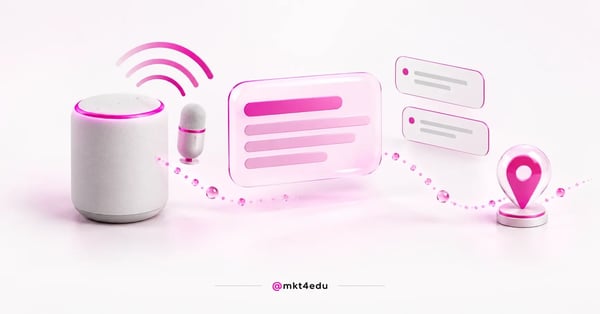 Caption: Voice search SEO competes for the short answer an assistant reads out loud, not only for the first position on the list
Spoken search runs today through assistants that changed hands in a short window. At Google, Gemini took the place of Assistant. At Microsoft, Cortana was retired in stages. Alexa and Siri are still standing, each one leaning on its own search engine. Reading that map is the first step of voice search SEO.
The most recent move came from Google, which started removing access to Assistant on September 4, 2026, reaching Android phones and tablets, Wear OS watches, compatible earbuds and Android Auto in projected mode. Cars with Google built-in keep working as before.
Cortana left earlier. Microsoft ended the standalone Windows app in the first half of 2023, dropped support in Teams and in Microsoft 365 mobile in the second half of the same year, and switched off voice search in Outlook mobile in June 2024. Copilot and Voice Access took over those jobs.
The size of the market explains the attention. Grand View Research projects the global voice and speech recognition market at USD 31.7 billion in 2026 and USD 53.7 billion by 2030, a compound annual growth rate of 14.6%.
Anyone who wants the behavioral picture of people who search by speaking finds the conceptual base in how voice search changed the way people look for information, which frames the habit before the tactics.
Voice search and SEO: what changes when AI writes the answer?
Voice search and SEO have always moved together, and what changed is the currency. The assistant used to read a snippet from the best-ranked page. Now it returns text assembled by a language model that consults several sources and cites a few of them. The goal stopped being first place and became the citation.
Artificial Intelligence is the layer that rewrites the answer before anyone hears it. The name this discipline carries in the market is AI Search SEO, and it covers both the spoken and the written answer.
Google's documentation on AI features in search states that there are no additional requirements to appear in generated answers and no specific optimizations for them. The page needs to be indexed, eligible for snippets and genuinely useful to whoever asked.
That statement kills the search for a shortcut. No magic file guarantees presence in AI search, and AI Search SEO ends up being the same craft as before, with far less tolerance for sloppy writing.
What really changes is the unit of retrieval. AI search systems break the page into passages and retrieve passages, not whole pages. A paragraph that answers on its own survives the cut, while a block with three ideas glued together arrives in pieces.
The mechanics of the AI-powered overview explain why some sources make it into the generated answer and others stay out on the very same topic.
When the target is being quoted by assistants and chatbots, the work gets its own name. The tactics of SEO for LLM, where LLM stands for Large Language Model, apply to the spoken answer and to the written one without much translation.
How do you write for people who speak instead of type?
People who speak use whole sentences, and people who type use fragments. The same person writes "business administration night classes" and asks "which college offers business administration at night close to where I live". Writing for voice means accepting that long form and giving it back the way it was asked.
The most direct path turns the spoken question into a subheading. A heading written as a real question gives the assistant a clean target to extract and gives the reader an honest clue about what comes next.
Right under the subheading comes the direct answer, in four or five lines. That opening block is the one that usually gets quoted, so it has to make sense when read outside the page, without leaning on the paragraph above it.
Blocks of frequently asked questions still pay off, although for a different reason. The visual rich result for FAQ was discontinued by Google, so the block no longer earns the accordion on the results page. It earns its place by covering real questions and handing over passages that are easy to cite.
None of this demands a new team. The adjustment fits inside the marketing strategies an institution already runs, because it changes how the text gets organized rather than how much text gets produced.
Why do long-tail keywords carry spoken search?
Long-tail keywords are multi-word terms that describe a specific intent instead of a broad subject. They carry spoken search because a spoken phrase is naturally longer than a typed term, and because that specificity cuts the number of pages competing to be the answer.
Compare the two formats side by side. "Admissions exam" has hundreds of pages competing for it, while "how does the online admissions exam work for someone who already holds a degree" has one honest answer.
For an education institution, the list of long-tail keywords comes straight out of the questions the admissions office already hears every day. Enrollment deadlines, credit transfers and class schedules turn into content with very little adaptation.
The common mistake is treating the long tail as a list of strings to sprinkle through the text. Artificial keyword repetition is useless or harmful in AI search, and what works is covering the whole intent with depth.
The method behind search intent optimization shows how to separate the person who wants to learn, the person who wants to compare and the person who is ready to apply.

Do speed, HTTPS and user experience still weigh in voice search?
Yes, for a plain reason: the page has to be read by a machine before it becomes an answer. Speed, security and user experience are still the ground that SEO strategies stand on, and they are the first place where an institution loses position without noticing.
The most quoted reference about speed in voice search SEO is showing its age. The Backlinko study published on February 28, 2018, covering ten thousand results from what was then Google Home, found an average load time of 4.6 seconds and reported that 70.4% of the pages used as answers ran on HTTPS, short for Hypertext Transfer Protocol Secure.
The 2018 numbers work as a historical portrait, not as today's average. The device changed names, the assistant changed engines, and the web as a whole has become considerably faster since then.
The current benchmark is Core Web Vitals, Google's set of page experience metrics. The thresholds considered good are LCP up to 2.5 seconds, INP up to 200 milliseconds and CLS up to 0.1, measured at the 75th percentile of page loads.
The acronyms are worth spelling out. LCP, or Largest Contentful Paint, measures how long the biggest visible element takes to render. INP, or Interaction to Next Paint, measures the response to a tap. CLS, or Cumulative Layout Shift, measures how much the layout jumps.
HTTPS, in turn, stopped being a differentiator and became a floor. The "S" marks an encrypted connection, and an education website without a valid certificate loses trust well before it loses position.
How does voice search widen access to your content?
Voice removes reading and typing barriers at once. People with low vision, limited motor control, little familiarity with keyboards or fewer years of schooling find in speech a shorter path to information. For an education institution, that stops being a technical detail and becomes part of the mission.
Picture a candidate who wants to know whether an application fee waiver exists. Typing means finding the website, hunting through a menu and reading a dense page. Asking out loud settles it in one sentence, as long as the answer exists somewhere in your content.
Accessibility is one of the few fronts where the human call and the visibility call point in the same direction. Accessible writing improves user experience and widens the odds of being cited.
How do you use local SEO to win nearby spoken searches?
Local SEO is the work of showing up when somebody searches for something close by. A large share of spoken questions carries an address inside, as in "nursing school near me" or "where is the university campus". Without a well-maintained local profile, the institution never enters that conversation.
The center of this work is the Google Business Profile, formerly Google My Business. It gathers the address, phone, opening hours and category of the institution across Search and Maps, which is exactly the kind of data an assistant reads to answer quickly.
Google itself explains how local results are ranked on three factors: relevance, meaning how well the profile matches the search; distance, meaning how close the person asking is; and prominence, which gathers mentions, links and reviews.
Of the three, the one most inside your control is relevance, which is why SEO optimization for local results starts with filling everything in. The right category, special hours, accessibility attributes and a full description match the profile to more real questions.
The full routine sits in the step-by-step guide to local SEO for colleges, which handles Maps and AI-generated answers in the same flow.
Which AI SEO strategies protect your organic traffic?
AI SEO strategies are the content choices that raise the odds of a page being cited inside a generated answer. They protect organic traffic because, when the answer arrives ready-made, the brand that gets named earns recall and direct searches even without the immediate click.
One data point helps calibrate expectations. In February 2026, Semrush compared four AI platforms and found that only 44.3% of the pages in Google's top 10 showed up in at least one generated answer.
The practical reading is direct: a high position in organic search helps but guarantees nothing. That gap opens room for whoever writes better about a narrow slice of the topic, even from outside the top ten.
Three tactics show consistent effect across studies on AI citation. The first is quoting named sources, with origin and date. The second is bringing in direct quotes from specialists. The third is using verifiable statistics with the source visible.
Social engagement deserves care in AI search. Likes and shares are not ranking factors declared by Google, although heavily shared content tends to accumulate links and mentions, and those do carry weight.
The analysis of how Google's AI is affecting organic traffic shows where the loss of clicks is concentrated and which pages keep converting.
How do you measure voice search SEO without counting clicks?
No tool today cleanly separates what came from spoken search and what came from typed search. Measuring voice search SEO therefore works by approximation, crossing indicators that tend to move together once the SEO strategies start paying off.
The first indicator is impressions on long queries. In Google Search Console, filtering queries with more than five words and those starting with "how", "where", "which" and "how much" isolates the slice closest to the way people talk.
The second is the ratio between impressions and clicks on those same queries. Impressions climbing while clicks stay flat usually means your page is feeding the answer without receiving the visit, which is the footprint of a citation.
The third is branded search volume. When a name gets quoted inside generated answers, part of the audience searches for that name afterwards, and the movement shows up in branded organic search.
These three indicators are editorial curation, not an official market standard, and they need calibration by the size of the institution and by how much content it already publishes.
Frequently asked questions about voice search SEO
Where should you start with voice search SEO?
Start with an inventory of questions, not with the website. List the thirty questions your team hears most often by phone and by messaging app, write each one the way a person would say it, and mark which ones already have a published answer. That map tends to reveal more opportunity than any technical audit.
With the list in hand, the second step is hygiene. Check for a valid certificate, measure LCP, INP and CLS on program pages, and confirm that the Business Profile is complete for every unit. Without that base, the best text in the world never reaches the assistant.
The third step is rewriting. Turn each question from the list into a subheading, put the direct answer right below it, and cut the long introduction that today stands between the reader and the information.
From the fourth step onward, the work becomes calendar routine. New questions appear with every admissions cycle, and marketing strategies that ignore that renewal grow stale within a single term.
It is worth naming what nobody knows yet. There is no way to predict which assistant will dominate spoken search, or how models will display their sources from here on. What is known is that specific, fast and verifiable content has been cited in every phase so far.
If your institution wants to speed up that cycle, optimization for AI-generated answers begins with a diagnosis of the questions already bringing people to your site and the ones another school is answering in your place. The conversation ends with a prioritized list of topics.


























 Portugal