


TikTok Symphony, the AI creative generation suite built into TikTok Ads Manager, has gained the Dreamina Seedance 2.5 model. With it, generated videos jumped from up to 15 seconds to up to 30 seconds, and the number of accepted multi-modal references rose from up to 9 to up to 50.
For anyone running the digital marketing strategy of an HEI, or the client acquisition of a B2B (business to business) company, and already testing social media as an acquisition channel, the natural question is whether this upgrade changes anything in practice, and whether it changes it for the better.
The answer has two layers. The first is technical: what the update delivers and where it is available, a point on which TikTok itself is vague and press coverage contradicts itself.
The second layer is editorial. Even where the tool is accessible, a fully AI-generated ad video calls for different caution depending on the audience: an HEI deals with institutional trust and minors, while a B2B company deals with a buying committee that weighs proof of results before any decision.
What is TikTok Symphony and what does Seedance 2.5 change in it?
TikTok Symphony is the AI creative generation suite inside TikTok Ads Manager, used by advertisers to create ad script, voice, image and video without leaving the platform. With the Dreamina Seedance 2.5 model, the tool extended the maximum length of generated video and the volume of references it accepts as input.
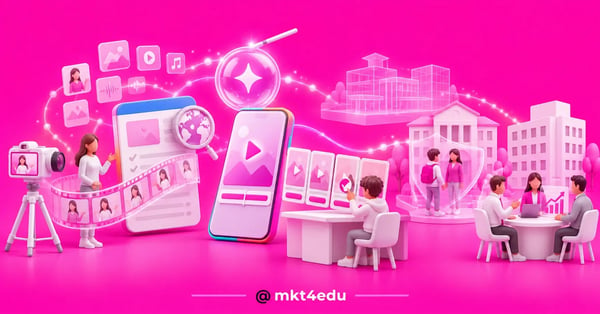 Caption: TikTok Symphony speeds up ad video generation, but human review is still the step that protects the brand
In the post announcing the integration, published on August 3, 2026, TikTok for Business says the tool now supports up to 30 seconds of video generation, up from a 15 second maximum before.
The same announcement states that advertisers can now upload up to 50 multi-modal references across image, video and audio to guide generation, up from the 9 accepted until then.
The story got fresh coverage in November. In a report dated November 11, 2026, bylined by Dragomir Stojkov, Net Influencer records that TikTok is also expanding the Symphony API and opening paid token purchases through BytePlus, the AI infrastructure provider behind Seedance. Those tokens are what let advertisers buy generation capacity beyond the tool's own quota.
The source distinction matters: the video length and the references come from TikTok's own announcement, while the API expansion and the token access appear in press coverage, which in turn cites a statement from the platform.
For anyone following digital marketing strategy in education or B2B acquisition, the practical point is this: Symphony is no longer a tool limited to very short clips and now supports formats closer to a complete ad, with more multi-modal input to steer the result.
Is TikTok Symphony already available to advertisers in Brazil?
The availability of TikTok Symphony with Seedance 2.5 in Brazil is not confirmed, and that is the most important caveat before any marketing team plans to use the tool.
TikTok itself is vague in the announcement. The text says Symphony integrated with Dreamina Seedance 2.5 "is now rolling out to select paid advertiser in select markets", without naming a single country.
Press coverage, which is where geographic detail appears, does not settle the question either: it contradicts itself within the same report. The Net Influencer piece opens by saying advertisers "outside North America" can buy BytePlus tokens, while the body of the article describes availability in all countries where TikTok Ads Manager and BytePlus operate, "excluding the United States".
The two versions do not match. "Outside North America" would leave Canada and Mexico out; "excluding the United States" would keep both in. The report does not reconcile the two statements, and TikTok has published no country list.
Brazil is not mentioned in either text. That does not mean the country is excluded, but it is also not evidence that it is included. Treating the tool as "already live in Brazil" on that basis would be getting ahead of information nobody has published.
The practical recommendation, for any marketing manager weighing the feature, is to check directly inside their own TikTok Ads Manager account whether Symphony and Seedance 2.5 appear as available.
That check applies both to teams using TikTok Ads Manager to recruit students and to teams using it to acquire B2B clients, since availability depends on the account rather than on the advertiser's industry.
It costs minutes and keeps the team from planning a campaign or a creative budget around assumed availability, which is worth more than any generic press note about the launch.
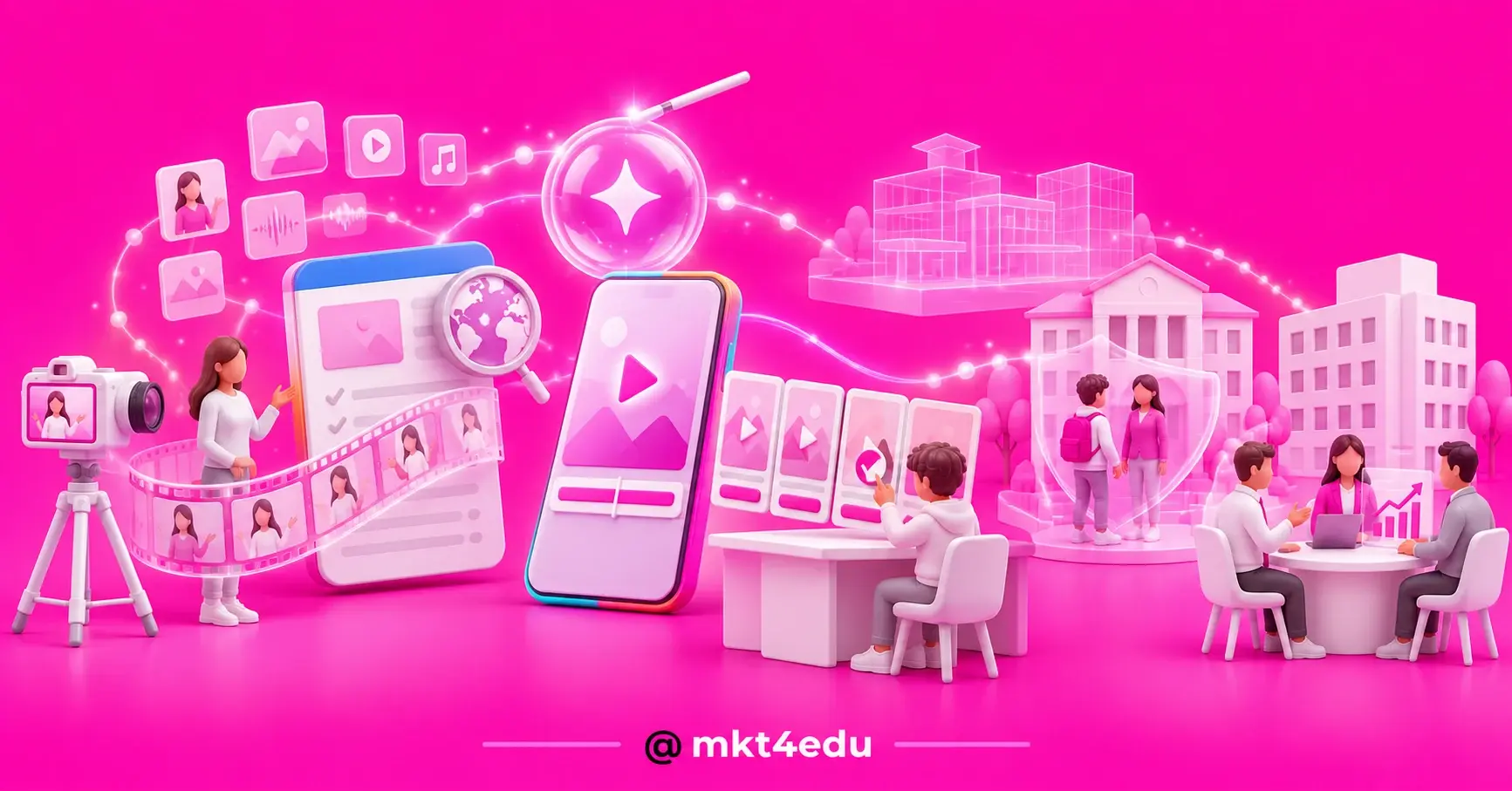
How does TikTok Symphony fit into an HEI's education marketing strategy?
TikTok Symphony fits into an HEI's education marketing strategy as a creative acceleration tool, not as a replacement for institutional storytelling. AI-generated ad video calls for more caution in this sector than in e-commerce, because what the institution sells is the very trust it builds with families and applicants.
Is AI-generated ad video safe in an HEI's education marketing strategy?
It is safe with a caveat, and that caveat weighs more here than in a standard e-commerce ad. A higher education audience includes teenagers under 18, families deciding on a long-term investment and applicants assessing whether they can trust that brand with the next years of their own education.
An e-commerce ad that gets the tone wrong, or that uses an obviously synthetic face and voice, generates at most a brief moment of discomfort with that product.
An institutional HEI video that feels artificial, or that shows an AI-generated "campus" and "professor" without disclosure, puts at risk the trust that underpins the institution's entire marketing strategy, because the product being sold is the credibility of the educational brand itself.
This is an editorial reading from mkt4edu on the subject, not an official TikTok position nor a closed verdict: the skepticism here is a qualified recommendation shaped by the specific context of education, not a categorical rejection of the tool.
The same caution already shows up in the choice between brand video and creator video when speaking to Generation Z: that audience quickly notices when institutional content imitates native creator language without being genuine, and the same risk applies to undisclosed AI-generated video.
How should you test TikTok Symphony inside the student recruitment calendar?
Testing TikTok Symphony inside the student recruitment calendar works better when it is confined to a specific campaign, such as the entrance exam application window, rather than entering the institution's whole communication cadence at once.
That narrower scope limits the risk to a known window and a known audience, which makes it easier to isolate the effect of the AI-generated creative from any other campaign variable, such as a change in budget or in the offer.
After running that controlled test, the team decides with data, rather than with impressions, whether it is worth extending the feature to other campaigns in the same cycle.
What changes in student acquisition strategies with this kind of creative?
Student acquisition strategies gain speed in producing creative variations, but they do not gain an exemption from human review before publishing. Seedance 2.5 accelerates generation, not the validation of what is generated.
The marketing team's role shifts from "producing each variation" to "approving each variation", with extra attention to institutional tone, representation of people and accuracy of information about courses and campuses.
Does AI-generated video have a place in student retention strategies?
It does have a place, with a different tone from the one used with first-year recruitment. Video aimed at alumni, student ambassadors or a graduate programme campaign already speaks to people who know the institution, which reduces part of the trust risk that weighs on an AI-generated first contact.
Even so, student retention strategies still require that an alumni testimonial or an invitation to a new stage of study be grounded in something real, not in a fully synthetic scene.
When is it worth hiring a student acquisition and retention agency for this test?
It is worth hiring a student acquisition and retention agency when the in-house team has neither the time nor the criteria to review every AI-generated creative variation while entrance exams, enrollment and graduate campaigns are all running at once.
An agency specialized in education marketing, such as mkt4edu, helps design that test with a defined scope, a conversion metric per course and a clear rule on what can and cannot be AI-generated on the institution's behalf.
How can TikTok Symphony help with B2B client acquisition?
TikTok Symphony can also support B2B client acquisition, such as an agency's or a service company's pipeline. The risk here weighs less than at an HEI and more than in a standard e-commerce ad, because the buying committee assesses proof of results before trusting a supplier.
Does AI-generated ad video make more sense in B2B acquisition than in student recruitment?
It makes more sense at an intermediate point on the risk spectrum. A B2B ad does not involve minors or a long-term decision as emotionally loaded as choosing where to study, but it still has to sustain technical authority in front of the people who sign the contract.
An AI-generated video that feels generic in a B2B campaign compromises institutional trust less than the same mistake would at an HEI, but it still compromises commercial credibility, because the decision-maker associates weak creative with the quality of the service on offer.
How do you use TikTok Symphony in corporate client acquisition content without sounding generic?
Using TikTok Symphony without sounding generic means feeding the generation with real references from the company, such as a client testimonial, a delivered result figure or a specific case, instead of asking for an entirely new piece with no input of your own.
The more multi-modal reference material from the actual operation the advertiser loads into Symphony, the more the generated variation carries real signal from the company, and the less it looks like any other generic B2B service ad in the feed.
What differs between selling a degree to an applicant and selling a B2B service to a company?
Selling a degree to an applicant is an emotional, family-level decision, with a longer consideration cycle and an audience weighing belonging, not only price or return. Selling a B2B service to a company is a more rational decision, with multiple decision-makers and an explicit demand for proof of ROI (Return on Investment).
That difference changes what the AI-generated video has to communicate in each case. For the applicant, the creative has to convey belonging and confidence in the journey; for the B2B buying committee, it has to convey technical competence and measurable results in very little screen time.
Where can TikTok Symphony help without becoming an institutional risk?
The most defensible use of TikTok Symphony, whether for student or B2B acquisition, is testing variations of creative that already exists as human-shot video, not replacing original video production with fully AI-generated content. That distinction changes the risk of the application without giving up the speed the tool offers.
In practice, that means using Symphony to generate cuts, script recombinations and alternative calls to action from footage the institution or the company has already filmed, with real people, real settings and real testimonials.
The source material carries the credibility; the AI only multiplies formats for A/B testing across different audiences and funnel positions.
A use that calls for more caution is generating, from scratch, a fully synthetic "classroom", "student" or "office" scene to advertise a course or a service. In that case, the video has no grounding in any real experience of the brand.
The risk also grows: the audience may notice the artificiality, or the piece may sound generic next to a decision as personal as choosing where to study, or as scrutinized as choosing a supplier.
Here is how that distinction breaks down in practice:
|
TikTok Symphony use |
Institutional risk |
Recommendation |
|
Cut variations of existing human-shot video |
Low |
Recommended for A/B testing |
|
Alternative script and call to action over the same footage |
Low |
Recommended for campaign scale |
|
Fully synthetic campus, classroom or office scene |
High |
Avoid as a primary asset |
|
Full replacement of institutional or commercial video production |
High |
Not recommended |
Table: editorial reading from mkt4edu on applying TikTok Symphony to creative for HEI and B2B client acquisition, not an official classification of the tool
This rule of thumb follows the same logic as any well-structured marketing strategy: testing creative variations is ordinary campaign optimization, and using AI to speed up that test is different from using AI to build the brand narrative from scratch.
How does TikTok Symphony fit into social media management for HEIs and B2B companies?
TikTok Symphony enters as one more tool inside the institution's or the company's social media management, not as a change of strategy. It helps produce creative variations faster, but it does not replace the persona, calendar and tone decisions that already guide the operation's social media marketing.
Anyone who has already structured social media marketing that generates enrollment knows creative is only one piece of that whole, not the whole itself, and the same principle holds for teams building social media aimed at corporate clients.
The same applies to social media SEO, which is about how video content is found and recommended inside the social platforms themselves. No extra production speed fixes a weak caption, a generic hashtag or the absence of structured data that helps the video be understood by the algorithm and by search.
What Seedance 2.5 accelerates is the generation of the video itself, not the optimization layer that makes that video perform, whether on an HEI account or a B2B company's.
That care is the same one behind college social media with real engagement, with or without AI-generated video in the mix.
The choice between accelerating paid creative and investing in organic reach is part of that equation too, and it is the subject of the video below:
Video: mkt4edu braintalks on paid media and organic reach, the decision that comes before using TikTok Symphony
So any digital marketing strategy that brings Symphony in should keep the same good practices already applied to the operation's social media: a controlled test, a conversion metric tracked by course, campus or client segment, and human review of every asset before publishing, even when generation was partly automated.
Teams already using AI to generate leads in a human way have an advantage here: the same care in keeping the brand voice recognizable, even with AI support, applies to the ad video generated by Symphony.
Frequently asked questions about TikTok Symphony
TikTok Symphony with Seedance 2.5: now or can it wait?
It can wait, with one condition: check availability in your own TikTok Ads Manager account now, even if actual campaign use comes later. That check costs minutes and keeps the marketing team from planning around a feature that has not yet appeared for the account.
Once the tool is confirmed in the account, the recommended entry point is not replacing original video production, but testing variations of existing human-shot creative, with conversion tracked by course or by client segment.
That is a low-risk application, one that captures the speed gain of Seedance 2.5 without exposing the trust that underpins acquisition, whether of students or of B2B clients.
Deciding this inside a broader marketing strategy, one that already combines social media, SEO and content production, tends to produce more consistent results than adopting an isolated tool because it is having a moment.
In the same spirit, it is worth looking at how to use TikTok comments in a human way: that is the part of the operation where real conversation matters more than any volume of creative.














 Portugal