


Every educational institution recruits students, but few work with a real student recruitment strategy. What exists, in most cases, is a sequence of campaigns: entrance exam, national exam results, transfers, re-enrolment. Each one starts from zero, with a budget set in a hurry and none of the learning from the one before.
Recruiting students gets more expensive every term when the institution repeats the same channel mix without knowing which of those channels delivers enrolments. This article organises the method into seven steps, from the diagnosis to the dashboard, with the focus on student recruitment planning as a whole.
What is a student recruitment strategy, and why is an isolated campaign not enough?
A student recruitment strategy is the set of decisions that connects the enrolment target to the audiences the institution wants to attract, the channels, the campaign calendar, how candidates are served and the indicators. A campaign is one piece of that strategy, with a beginning and an end; the strategy is the system that decides which campaigns exist at all.
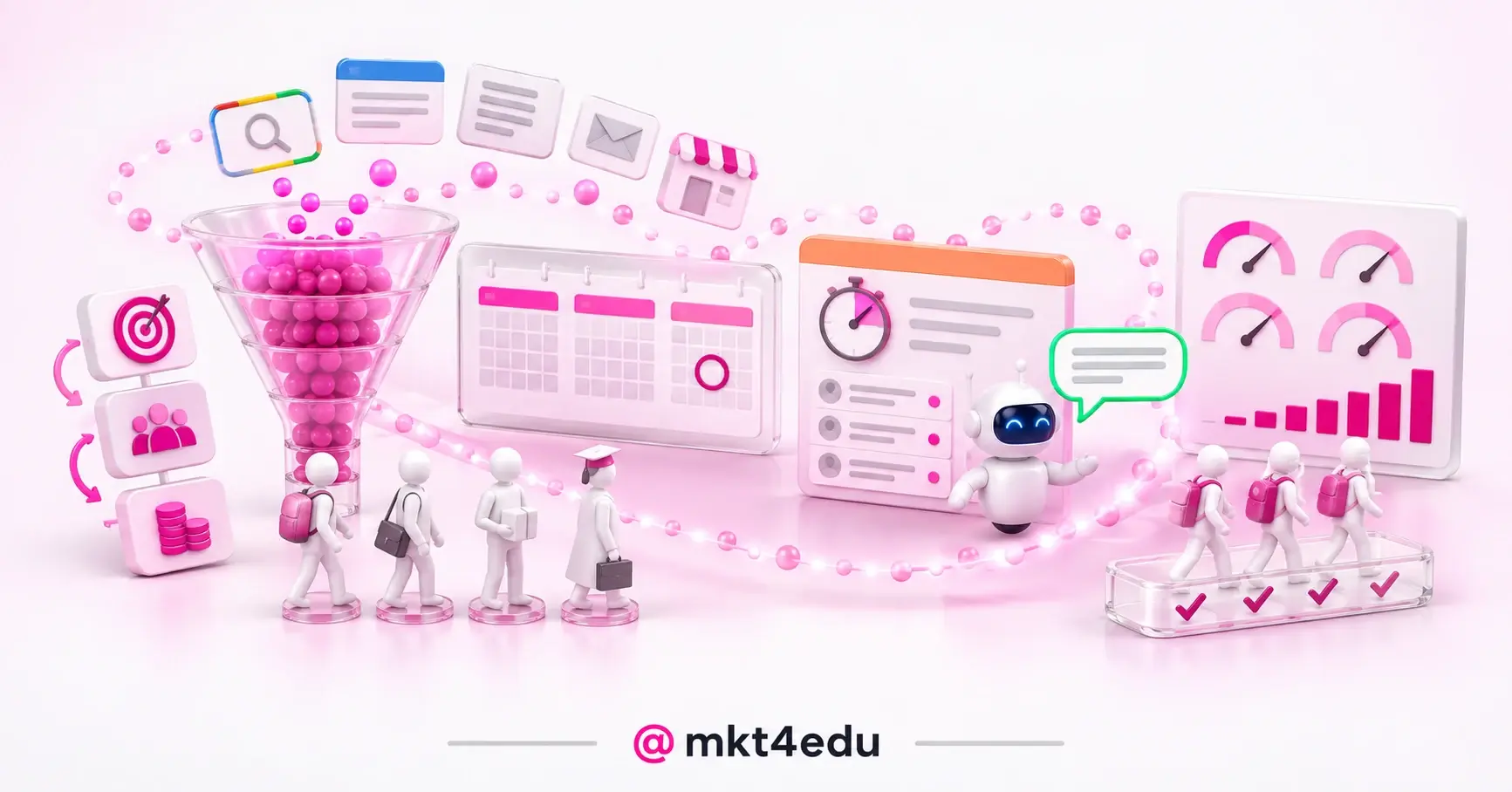
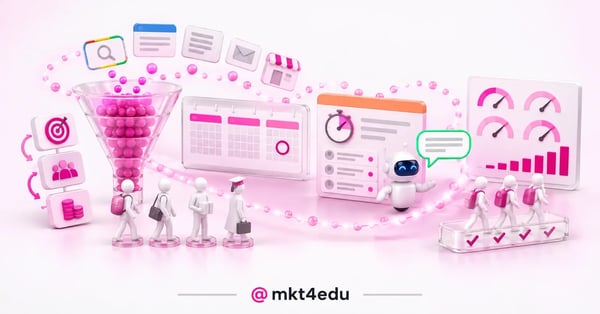 Caption: a student recruitment strategy links the enrolment funnel to the channel mix, the campaign calendar and CAC per course on the dashboard
The two get confused because the campaign is visible and the strategy is not. Without an investment criterion per course, the institution handles student recruitment by repetition rather than by decision.
The market makes that repetition more expensive. Brazil's 16th Mapa do Ensino Superior, published by Semesp and based on the 2024 higher education census, shows 10.2 million enrolments in the country, with 50.7% of students in distance-learning courses.
Distance learning has overtaken on-campus study, and competition has grown for a candidate who compares dozens of offers on a phone. The same survey shows 2024 dropout across all networks: a total rate of 41.6% in distance learning and total dropout of 24.8% on campus.
Every enrolment lost hands recruitment the cost of replacing the student, which ties recruitment and retention into the same strategy and makes the student retention strategy the other half of the method. That is why the central concept here is the enrolment funnel: visitor, lead, applicant, enrolled student and student who stays.
Looking at the whole funnel is what separates a predictable educational marketing strategy from a campaign that depends on luck.
Step 1: how do you diagnose the enrolment funnel?
Diagnosing the enrolment funnel means gathering the history of leads, applicants and enrolled students by course, by channel and by period, with the conversion rate of each stage and the current acquisition cost. It answers a single question: where does the institution lose candidates today? Without that answer, any target is a guess.
The starting point is the CRM (Customer Relationship Management). A CRM centralizes all your customer information and interactions in one place, which makes it possible to track a candidate from the first click to enrolment.
With the CRM organised, build the reading in four blocks:
- Volume per stage and per course: leads, applicants and enrolments from the last two or three terms.
- Conversion rate between stages: lead to applicant and applicant to enrolled, by course and by channel.
- Cost per stage: each channel's budget divided by that channel's leads, applicants and enrolments.
- Response time and cycle time: how long it takes to reply to a lead and the days between application and enrolment.
Applicant-to-enrolment conversion is the number that surprises most. Courses with many applicants and few enrolments signal that the problem is not attraction but service or the offer itself.
The second frequent finding is lead loss between the form and the first contact, a leak that is cheaper to fix than any new campaign.
Outside the CRM, GA4 (Google Analytics 4) shows whether traffic arrives with intent, through the engaged session, which lasts longer than 10 seconds, has a key event or reaches two or more page views. Google Search Console shows which searches lead candidates to the course pages.
By the end of the step, the institution has three numbers per course: applicant-to-enrolment conversion, current CAC (Customer Acquisition Cost) and the point of greatest lead loss.
Video: 4RevOps audioblog on the diagnostic assessment that opens a student recruitment strategy
Step 2: how do you set enrolment targets and calculate the budget backwards?
The enrolment targets of a student recruitment strategy are set backwards: the institution fixes how many enrolments it needs per course, applies the conversion rates from the diagnosis and works out how many applicants, how many leads and how much budget are required. Reverse maths turns a target number of places into a defensible budget and a target CAC.
The target comes from finance and course coordination, not from marketing, and the calculation follows the funnel in reverse. Here is how the maths looks for a hypothetical course, with illustrative numbers rather than market benchmarks:
|
Funnel stage |
Historical rate used |
Volume required |
|
Enrolments (course target) |
Set by finance |
300 |
|
Applicants |
40% applicant to enrolled |
750 |
|
Leads |
25% lead to applicant |
3,000 |
|
Media and content budget |
Average CPL (cost per lead) of BRL 25 |
BRL 75,000 |
|
Target CAC per enrolment |
BRL 75,000 ÷ 300 |
BRL 250 |
Table: illustrative example of reverse maths in a student recruitment strategy; the rates and the cost per lead should come from each institution's own diagnosis
The maths exposes the strategy's two levers: lowering the cost per lead, which depends on the channel mix, or raising conversion between stages, which depends on the operation. If applicant-to-enrolment conversion rises from 40% to 50%, the leads required fall from 3,000 to 2,400.
The target CAC also sets the ceiling for the budget. If the tuition fee and the student's average persistence do not pay BRL 250 per enrolment, the target or the conversion has to change before the campaign. That reasoning guides the moves to reduce the institution's CAC without cutting volume.
Step 3: who is the candidate and how do they decide to enrol?
The audience and journey step defines who the institution wants to enrol and at which moments that person decides. The candidate is not a single person: the 17-year-old school leaver, the working adult who wants distance learning, the student asking for a transfer and the postgraduate seeker have different motivations and deadlines, and each profile calls for its own message, channel and pace.
The tool for this is the persona, the semi-fictional representation of your ideal customer built from real CRM data and interviews. In education, age, employment situation, delivery mode, funding route and who else takes part in the decision all carry weight.
Each profile has distinct decision moments. The school leaver decides between the national exam results and the public-admissions deadline; the adult decides when money frees up or when an employer asks for the degree. Those moments calibrate the calendar.
Candidate research has also moved. HEPI's Student Generative AI Survey 2026, run by Savanta with 1,054 full-time UK undergraduates, shows that 95% of students report using AI in at least one way. The sample is British, but it indicates that part of the comparison between institutions now happens inside AI assistants.
The step ends with two or three priority profiles per course and the list of questions each one asks before applying, which is raw material for content and for service scripts.
Step 4: how do you choose the channel mix to recruit students?
The channel mix of a student recruitment strategy is the combination of organic, paid, conversational and in-person channels chosen on two criteria: the cost per enrolment each channel delivers and the funnel stage it works in. No channel solves it alone, and the right mix changes from course to course, according to the profiles mapped.
The first group is inbound marketing strategies, which attract the candidate through what they are already looking for. The inbound methodology rests on content, SEO (Search Engine Optimization) and course pages. SEO is about helping search engines understand your content, and it is the channel whose cost falls over time.
The second group is inbound sales strategies, which look after the lead once they raise a hand. In inbound selling, the rep serves each lead individually, considering their specific pains and goals, and in education that translates into an SDR (Sales Development Representative), WhatsApp and enrolment advisers.
The third group is paid traffic. Meta Ads and Google Ads bring volume fast, but they charge for it, and they are the channel that suffers most when the funnel leaks. Using paid traffic without the step 1 diagnosis is the fastest way to blow the CAC.
Social media, offline marketing (events, fairs, school visits) and student referrals complete the mix, as long as they are tracked in the CRM.
With the channels listed, the choice follows three rules:
- By funnel stage: SEO and social media attract; paid media accelerates; inbound sales and WhatsApp convert.
- By cost per enrolment: the channel with the lowest CAC gets more budget until it loses efficiency.
- By candidate profile: the school leaver is on Instagram and TikTok, the adult is on Google and WhatsApp.
The digital marketing strategies that work in education combine all three groups: inbound to build demand, paid media for the peak windows and inbound sales so that nobody who arrived is lost. Those marketing strategies are general; education only changes the calendar and the language.
For anyone asking how to increase student recruitment without raising the budget, the answer usually lies in redistributing the mix rather than adding a new channel, as the video below sums up.
Video: mkt4edu audioblog with three fronts that change the channel mix of a student recruitment strategy
Step 5: how do you build the student recruitment calendar and the campaigns?
The student recruitment calendar spreads educational marketing campaigns across the year's decision windows: summer and winter entrance exams, national exam results, public funding and scholarship applications, external transfers, postgraduate intakes and re-enrolment. Each window gets its own budget, message and channels, defined from the mix and the profiles of the earlier steps.
The logic is to separate the continuous from the seasonal. Inbound marketing strategies run all year, because they build the demand the campaigns go on to harvest; paid media, events and urgency pushes concentrate inside the windows.
A well-built student recruitment calendar has three layers per window: the application opening and closing dates, the date the campaign starts (usually four to six weeks earlier) and the internal milestones, such as the deadline for creative and the training of the service team.
The educational marketing campaigns in each window need creative in quantity. Creative fatigue, which is the drop in performance of an ad shown many times to the same audience, appears within a few weeks, and the calendar plans asset swaps before the cost per lead takes off.
Step 6: how do you run the lead from application to enrolment?
The lead operation is the set of processes that receives the candidate generated by the campaigns, replies fast, qualifies, nurtures and carries them through to enrolment. It is the step of the student recruitment strategy with the highest return per unit of budget, because it works with people who have already shown interest and reduces the spend of every earlier step.
The first component is the response SLA (Service Level Agreement). A lead who has filled in a form expects contact in minutes, not days. The institution sets a ceiling, such as one hour during business hours, and measures compliance in the CRM.
The second is the relationship cadence: the sequence of email, WhatsApp and phone contacts that accompanies the candidate from application to enrolment, with behaviour-based triggers. Marketing automation handles those routine tasks without human action, which frees the team for the conversation.
WhatsApp in student recruitment deserves its own treatment, because it is the channel on which the Brazilian candidate actually replies. Integrated with the CRM, it records every conversation in the contact's history; outside the CRM, it becomes a black box where the lead gets lost.
The third is lead scoring: the score that ranks candidates by enrolment potential, based on profile and behaviour. In HubSpot it feeds the lifecycle stages: the marketing qualified lead stays in nurturing and the sales qualified lead goes to the adviser.
All of this runs inside an education CRM, which is a CRM configured with course, campus, delivery mode, entrance exam, application and enrolment. Integration with the application form is the point that stalls most often, which is why mkt4edu usually starts with an enrolment system integrated with the education CRM.
The newest component is AI (Artificial Intelligence) in student recruitment. AI agents and AI SDRs answer the lead in seconds, qualify with questions and hand over to a human whoever is ready.
AI in recruitment does not replace the adviser, but it guarantees that no lead is left unanswered in the small hours after exam results. The limit of AI in recruitment is the same as the human limit: without an integrated CRM, nobody follows the lead afterwards.
How do you measure whether the student recruitment strategy is working?
A student recruitment strategy is working when the KPI (Key Performance Indicator) dashboard shows CAC per course inside the target, applicant-to-enrolment conversion rising and lead response time inside the SLA, cycle after cycle. Measurement is the step that makes the others worth doing.
The dashboard carries few indicators, read by course and by channel:
- CPL (cost per lead): the channel's budget divided by the leads generated.
- Lead-to-applicant rate: shows whether the lead arrives with intent.
- Applicant-to-enrolment conversion: the central indicator of the operation.
- CAC per enrolment: total budget divided by enrolments.
- Time to first response: the median, in minutes, to the first contact.
- Lead loss per stage: the share of contacts that stall at each CRM stage.
The data comes from three connected sources: the CRM, the media platforms (Meta Ads and Google Ads) and GA4 with Google Search Console. When the three do not talk to each other, the total CAC never adds up.
The review cycle is fortnightly inside campaign windows and monthly outside them. At each review, marketing and sales decide where to reallocate budget, which step to adjust and which hypothesis to test. The comparison that matters is with the institution's own previous cycle.
The mistakes that break student recruitment strategies most often are not in the channels but in the joins between steps. The four most frequent:
- Starting with the campaign: setting budget and creative before knowing where the funnel leaks.
- Treating paid traffic as the strategy: without inbound sales strategies behind it, the ad only buys leads that go cold.
- Separating recruitment and retention: with total dropout of 41.6% in distance learning in 2024, an institution that only recruits replaces students every term, and persistence is what pays for the acquisition cost.
- Ignoring whoever did not convert: applicants without an enrolment and cold leads are the cheapest audience of the next cycle.
The student recruitment strategies that last treat each cycle as the input for the next, and student recruitment planning matures with every review.
When should you hire an educational marketing agency or an education consultancy?
Hiring an educational marketing agency makes sense when the institution has its educational marketing strategy designed, or wants to design it with help, and has no team to execute the digital marketing strategies consistently: content, media, automation, CRM and dashboard. An education consultancy serves whoever needs the diagnosis and the method but intends to execute with the internal team.
The consultancy delivers the reading, the target, the reverse maths and the process design; the agency takes on execution, accountable for the dashboard indicators. Many institutions combine the two.
The criteria for choosing an educational marketing agency start with sector experience, because education's calendar and funnel have particularities a generalist agency takes a long time to learn. Then come the ability to operate the institution's CRM and cases with enrolment numbers.
mkt4edu, for instance, works across every step described in this article and organises those services in a services hub covering CRM, AI agents, SEO, paid media and the enrolment system.
Frequently asked questions about student recruitment strategy
Where should your institution start building its student recruitment strategy?
A student recruitment strategy starts with the diagnosis, and it fits into two weeks. Open the CRM, pull leads, applicants and enrolments by course and by channel for the last two terms, and calculate applicant-to-enrolment conversion and the current CAC. Those three numbers already show where the funnel leaks.
With the diagnosis in hand, the reverse maths follows naturally, and the decisions on channel mix, calendar and operation stop being opinion. The whole strategy is born of that first map.
If the institution has neither the history organised nor a team to operate the CRM, a diagnostic assessment of recruitment with the mkt4edu team gives back exactly that map: conversion rate per stage, CAC per course and the point of greatest lead loss, so the strategy starts in the right place. Talk to us and let's build your success together.












 Portugal