


An institution invests in media, a landing page and a CRM to generate an entrance-exam application, and then leaves that candidate waiting. That is what we found when the mkt4edu team applied, as a candidate, to the 504 largest private higher education institutions in Brazil outside the big education groups.
Student conversion is largely decided in the hours that follow the application. That is when the candidate is still comparing options and replies to whoever gets there first. The Response Radar data shows how long institutions take to speak to them, through which channel, and where recruitment loses the applicant before the first conversation even happens.
Is there any research on how private institutions treat their applicants?
Yes. Response Radar (Radar de Resposta) is a study of how private institutions respond to applicants, run by mkt4edu between October and November 2026. A researcher completed the entrance-exam application as a real candidate and timed each institution's first contact by email, WhatsApp and phone call, from the applicant's side.
 Caption: student conversion is decided in the hours after the application, between the stopwatch on the first contact and whoever takes that conversation
Until now, Brazilian higher education had no public measure of that interval. Anyone searching for how long a university takes to reply to a lead, or for research on how private institutions handle applicants, found sales studies rather than data on educational institutions.
Institutions track cost per lead, application volume and enrolment rate, but they rarely see what the candidate experiences between clicking "submit application" and the first conversation.
Why measure the first contact with an applicant?
Someone who completes an application is the most advanced candidate in the recruitment funnel. They have already chosen a course, a campus and a route of entry, and handed over an email and a mobile number. At the same time, they are still comparing institutions, often with applications open at more than one.
The value of that contact falls fast. An audit of online sales lead response published in Harvard Business Review concludes that most companies are not responding nearly fast enough. The study is about sales rather than education, and the full text sits behind a subscription, but the mechanism is the same: interest goes cold.
What was the point of Response Radar?
The point was to replace opinion with measurement. In a recruitment meeting it is common for the team to believe it replies quickly, because it looks at its own effort. Response Radar looks at the result that reaches the candidate's phone, with a timestamp on it.
The study also works as a benchmark for any educational marketing strategy and for the marketing strategies that hold recruitment up. Before raising the media budget, an institution needs to know whether its operation talks to the people who have already applied. Without that, every new campaign fills a funnel that leaks at the first stage.
How did the study measure student conversion in practice?
The study measured the time between submitting the application form and the first contact received on each channel. The universe was the 504 largest private institutions by enrolment in the 2024 Censo da Educação Superior, Brazil's higher education census run by INEP, with the big education groups excluded.
Cogna, Yduqs, Vitru, Ânima, Ser, Cruzeiro do Sul and Afya were left out of the universe. The picture therefore concentrates on independent institutions and mid-sized groups, which compete for the same candidate with very different recruitment structures.
What was the application protocol for the test?
The protocol was identical at every institution, so the comparison would be fair. Here is how each application was made:
|
Item |
How it was done |
|
Period |
21 October to 10 November 2026, close to the 2027.1 entrance exam |
|
Course |
On-campus Nursing; failing that, on-campus Business Administration; failing both, distance-learning Business Administration |
|
Time of day |
Weekdays, between 10am and 4pm Brasília time |
|
Contact details |
An email address and mobile number used only for the study |
|
The clock |
Starts when the form is submitted and stops at the first contact on each channel |
|
Observation |
All contacts up to 12 November, between 2 and 22 days per institution |
|
Attribution |
Email domain or phone number, checked manually; SMS (Short Message Service) counts as WhatsApp |
Table: protocol applied identically at the 504 institutions of the Radar study, the basis of this student conversion measurement
The fixed course order keeps the comparison between similar offers, and the business-hours window stops a slow reply from being blamed on the middle of the night or a weekend. Each institution received a single application.
How was the 0 to 100 score calculated?
Each channel earns points for the speed of the first contact, and the final score is the weighted average of the three. Phone and WhatsApp weigh more because they are direct conversation; email weighs less because it may be nothing more than an automatic system confirmation.
|
First contact |
Points on the channel |
|
Within 5 minutes |
100 |
|
Within 1 hour |
75 |
|
Same day |
50 |
|
Next day |
25 |
|
Later than that, or no contact |
0 |
|
Weight in the final score |
Phone 40% · WhatsApp 40% · Email 20% |
Table: points for speed on each channel and the weight of each one in the Radar student conversion score
To reach 100, an institution would have to call, send a WhatsApp message and send an email within the first five minutes. The median score across the 305 institutions measured was 19, and none went above 75.
How long does an institution take to speak to someone who has just applied?
When it does talk, an institution takes almost a day to speak to someone who has just applied: the median for direct contact was 20 hours and 38 minutes. And most never get that far. Only 35.1% of the 305 institutions spoke to the candidate on WhatsApp or by phone, and just 8.5% did so within the first hour.
Response time to a lead at a university is therefore measured in hours, not minutes. In that gap, a candidate who applied to two or three institutions has already had time to be served by another one.
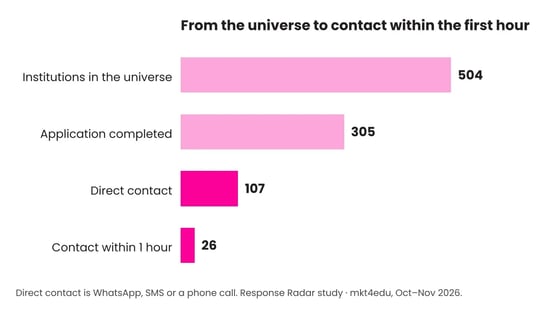 Caption: the student conversion funnel in the Response Radar study: of 504 institutions, 26 spoke to the candidate within the first hour
Of 504 institutions, 26 spoke to the candidate within the first hour. Put another way, an applicant picking one of these universities at random would have roughly a 5% chance of being approached while their interest was still warm.
What did the applicant actually receive, in the end?
Adding up the three channels, the candidate's experience splits into three groups of almost the same size. A third had a conversation with someone, a third received only an email and a quarter received nothing.
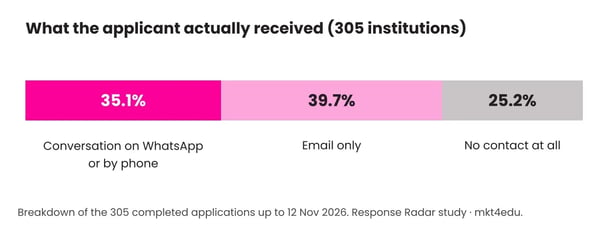 Caption: what the applicant received at each of the 305 institutions measured, the opening picture of student conversion after the application
That picture undercuts the idea that the silence is a technology failure. These institutions have an application system, email sending and, in many cases, a CRM (Customer Relationship Management). What is missing is recruitment's basic homework: talking to whoever has just applied.
How long do institutions take to reply to an entrance-exam applicant?
It depends on the channel. The automatic email arrives within minutes at most institutions, but the real reply, on WhatsApp or by phone, almost always lands after the first hour. Only 19 of the 305 institutions called, and WhatsApp appeared at a third of them, often the next day.
Which channel do institutions use to reply to an applicant?
Email dominates, WhatsApp shows up at a third of institutions and the phone barely rings. Here is how many institutions used each channel at any point during the observation:
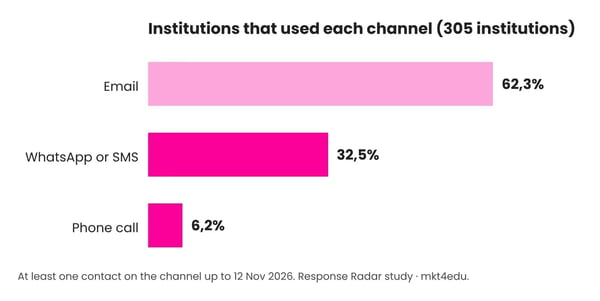 Caption: channels institutions used for the first contact and the weight of each one in student conversion after the application
WhatsApp, the channel on which the candidate actually replies, reached 32.5% of institutions, and even then a good share of those messages arrived the next day or later.
How long does each channel take to reach the candidate?
Speed varies a great deal between channels. Email arrives fast because the system fires it; WhatsApp, when it comes, tends to come late. Here is the distribution of the first contact:
|
Channel |
Within 5 min |
1 to 24 h |
After 24 h |
Channel not used |
|
|
39% |
10% |
— |
38% |
|
WhatsApp or SMS |
— |
11% |
13% |
68% |
|
Phone call |
— |
— |
— |
93.8% |
Table: time to first contact by channel, as a percentage of the 305 institutions measured for student conversion
Two readings complete the table. On email, another 7% of institutions wrote between 5 and 60 minutes. On WhatsApp and phone, the study measures speed in aggregate: 8.5% of institutions spoke to the candidate on one of those two channels within the first hour, and only 19 institutions, or 6.2%, ever called at all.
The figure that stands out most is in the email column: 35.7% of institutions sent a message within two minutes. That interval belongs to a system confirmation, not to a conversation. For 39.7% of applicants, that email was everything they got.
Does the size of the institution change the response time?
Not in favour of the biggest. Among institutions with more than 15,000 enrolments, 11 out of 32 spoke to the candidate directly, and none did so within the first hour. Among the smallest, with up to 2,000 enrolments, 44% had a conversation with the applicant and 14% did it within the first hour.
|
Enrolments (2024) |
Institutions |
Direct contact |
Direct contact within 1 h |
|
Up to 2,000 |
100 |
44.0% |
14.0% |
|
2,000 to 5,000 |
119 |
23.5% |
5.0% |
|
5,000 to 15,000 |
54 |
44.4% |
11.1% |
|
More than 15,000 |
32 |
34.4% |
0.0% |
|
Total |
305 |
35.1% |
8.5% |
Table: direct contact by institution size and the effect of scale on student conversion, measured by 2024 census enrolments
The 2,000 to 5,000 band is the weakest on direct contact, with fewer than a quarter of institutions talking to the candidate. The largest ones actually talk more than that band, but too late to compete for the applicant in the first hour.
Why do the largest institutions speak to nobody within the first hour?
The result points to a capacity problem rather than a lack of intent. Large institutions receive thousands of applications in the same week, and a human service team cannot call all of them on the same day, let alone within the first hour.
Hiring more agents solves little, because application volume concentrates in campaign peaks. That is exactly the kind of bottleneck AI (Artificial Intelligence) agents were designed to absorb.
Why did 4 in 10 institutions block the online application?
Of the 504 institutions in the universe, the application could only be completed at 305, or 60.5%. At the other 199, the researcher ran into a form demanding a scheduled exam or a fee, a closed admissions process, a page with no application link, or a site that was down. For the candidate, most of those obstacles have the same effect.
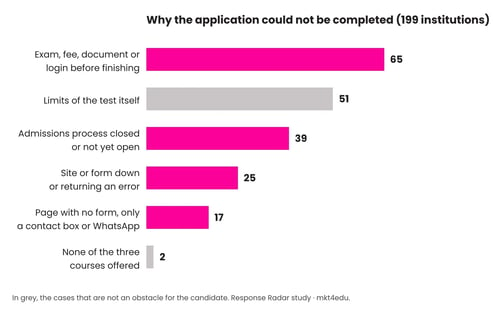 Caption: what blocked the application before student conversion could even start, at the 199 institutions where the form was not completed
The biggest blocker was the form that asks for a scheduled exam, a fee, documents or a login before it ends, at 65 institutions. Every extra step before "submit" is a drop-off point, and the candidate who gives up there never even becomes a lead for the recruitment team.
How does CRO help unblock the application form?
CRO (Conversion Rate Optimization) is the discipline that measures and reduces friction at each step of a page up to the conversion. On an application form, that means testing which fields are genuinely needed in the first step and which can wait until after approval.
One rule of thumb helps: anything that does not stop the institution from talking to the candidate can wait. Name, mobile number, email, course and route of entry are enough to open the conversation. Documents, fees and exam scheduling come later, with someone already following the applicant.
Closed admissions processes weigh too: 39 institutions were outside their application window weeks before the 2027.1 entrance exam. An enrolment system that keeps recruitment open all year, with an interest list when the process has not opened yet, stops the page from simply shutting the door.
Why do entrance-exam applicants never become enrolments?
Applicants largely fail to become enrolments because nobody talks to them in time. Applying is usually free and quick, so the candidate applies to more than one institution. The enrolment tends to go to whoever resolves the questions about price, scholarships, paperwork and timetable first.
Response Radar shows the first link in that chain. Before any objection about price, the candidate meets silence: an automatic email, sometimes nothing at all. That is why the entrance-exam conversion rate is usually read as a media or pricing problem, when the bottleneck may sit in the service.
What is the entrance-exam conversion rate?
The entrance-exam conversion rate is the share of applicants who reach a confirmed enrolment in the same admissions round. It measures the final stretch of the funnel, between application, approval and payment, and it is the indicator that suffers most from a slow first contact.
To work out how to convert applicants into enrolled students after approval, an institution needs a sequence of contacts covering the decision week. Response Radar shows that many operations never even start that sequence.
Which failures break student conversion after the application?
The failures that show up in the study repeat across recruitment operations of every size, and the applicant is lost at five points:
- Late first contact: the median of 20 hours and 38 minutes leaves the candidate free to talk to the competition.
- Wrong channel: the automatic email confirms the application but answers no questions and builds no bond.
- Forgotten phone: only 6.2% of institutions called, even with the mobile number supplied on the form.
- An operation with no scale: at the largest institutions, application volume exceeds what a human team handles in a day.
- No cadence at all: without a defined relationship cadence, each applicant depends on whichever agent happens to be free.
Each of those failures also explains why so many teams look for ways to convert applicants into enrolments without looking at day one. And they all carry a direct cost. A lost enrolment takes the media spend, the team's time and a whole course's worth of tuition with it.
Video: mkt4edu and 4RevOps audioblog on the communication cadence that holds student conversion up after the application
Which strategies raise conversion after the application?
The strategies that raise conversion after the application revolve around speed, channel and continuity. They hold for any student recruitment strategy, from the traditional entrance exam to entry by national exam score:
- Make the first contact on WhatsApp or by phone within the first minutes, including at night and at weekends.
- Build a relationship cadence with messages by day and by channel all the way to enrolment.
- Prioritise the applicants most likely to enrol through AI-assisted lead scoring.
- Record every contact in the CRM so no candidate depends on an agent's memory.
- Measure response time every week, alongside cost per applicant and enrolment rate.
These marketing strategies ask for no new media budget, and they serve any student recruitment strategy that already generates applications. They ask for operation, and that is where automation with AI agents changes the maths.
How does an AI SDR agent solve the first contact with an applicant?
An AI SDR agent solves the first contact because it speaks to the applicant seconds after the application, by voice and on WhatsApp, without depending on a shift or a queue. SDR (Sales Development Representative) is the pre-sales professional who approaches and qualifies an interested person; the AI agent does that work at scale.
In practice, the AI SDR agent takes the trigger from the application form, opens the conversation, answers opening questions about the course, scholarships and the admissions process, and hands the human team the candidates ready to move forward. Everything is recorded in the institution's CRM.
How does the AI SDR agent work by voice?
The voice agent calls the candidate right after the application and holds a natural conversation by phone. It confirms interest, answers frequent questions, identifies the moment of decision and can book a conversation with the recruitment team or with the course coordinator.
The call solves the most forgotten channel in the study. While only 6.2% of institutions called at any point, a voice agent can call 100% of applicants, including at peak times when the human team cannot keep up.
How does the SDR agent work on WhatsApp?
The SDR agent on WhatsApp opens the conversation in the app the candidate already uses and keeps the dialogue going for as long as they need. It replies at any hour, sends information on scholarships and paperwork, and transfers the conversation to a human agent when the case calls for negotiation.
Voice and WhatsApp complement each other. The call creates urgency and a bond in the first hour; WhatsApp sustains the conversation over the following days, which is when the candidate compares offers and decides.
Why does an SDR agent integrated with the CRM make a difference?
The SDR agent integrated with the CRM records every contact, reply and next step in the candidate's history. The human team then picks the conversation up where the agent left it, and management sees response time and conversion rate per stage in real time.
Without that integration the agent becomes one more loose channel. With it, the conversation feeds the relationship cadence, the lead scoring and the recruitment reports. For institutions already running on HubSpot CRM, the agent operates inside the same flow of data.
How does AI lead qualification work after the application?
AI lead qualification uses the candidate's answers and behaviour to estimate the chance of enrolment. AI-assisted lead scoring assigns a score to each applicant and orders the human team's queue by the cases most likely to close.
A candidate who replied immediately, asked about scholarships and requested the exam calendar gets priority. Whoever did not reply enters another branch of the cadence. The agent does the first triage, and the human agent spends time where a decision is at stake.
Video: mkt4edu and 4RevOps audioblog on lead scoring, the prioritisation that organises student conversion after the application
What are the benefits of AI SDR agents in recruitment?
The benefits land exactly on the points where Response Radar found failures. Here is how each measured figure changes when an agent takes the first contact:
|
Failure measured in the Radar |
Figure |
With an AI SDR agent |
|
Direct contact in the 1st hour |
8.5% |
First call or message within seconds, for every applicant |
|
Institutions that called |
6.2% |
A voice agent calls every applicant, including at campaign peak |
|
Median for direct contact |
20h38 |
Service 24 hours a day, at night and at weekends |
|
Applicants who got only email |
39.7% |
A WhatsApp conversation that answers questions, not just a confirmation |
|
Applicants with no contact |
25.2% |
No applicant is left unanswered, because the form itself is the trigger |
|
Large institutions within 1 hour |
0 of 32 |
Capacity that follows volume, with no hiring for the peak |
Table: failures measured in the Radar study and what changes in student conversion when an AI SDR agent takes the first contact
The gain does not come from replacing the team, but from moving where each side works. The agent handles speed and coverage; the human team keeps negotiation, exceptions and the conversations that call for real empathy.
AI SDR agent vs human SDR: who serves the applicant better?
In the comparison between an AI SDR agent and a human SDR, each wins part of the job. The agent wins on speed, hours and scale; the human wins on negotiation, cases outside the standard and decisions that involve money or an exception. In student recruitment, the best design uses both.
|
Criterion |
AI SDR agent |
Human SDR |
|
First contact |
Seconds after the application |
Depends on the queue and the shift |
|
Hours |
24 hours, every day |
Business hours |
|
Campaign peak |
Scales with volume |
Needs temporary hiring |
|
CRM record |
Automatic and complete |
Manual, with gaps |
|
Negotiation and exceptions |
Transfers to the team |
Resolves with autonomy |
|
Consistency of the pitch |
Same quality on every contact |
Varies with the person and the day |
Table: comparison between an AI SDR agent and a human SDR on student conversion tasks after the application
The full comparison of AI SDR vs human SDR shows that the right question is not "which replaces which" but "who does what". At the entrance exam, the answer is clear: the agent makes sure nobody waits; the human makes sure the negotiation closes.
How much does an AI SDR cost for an educational institution?
The cost of an AI SDR depends on application volume, the channels switched on and the CRM integration, so there is no single price. What gets compared is the cost of the agent against the cost of keeping a team sized for the campaign peak, plus the enrolments lost to delay.
The analysis of how much an AI SDR costs breaks down the components of the investment and how to calculate the return. In the Radar's context, the maths starts with the 25.2% of applicants who got no contact: each of them already cost media spend and never had a single conversation.
AI SDR and data protection: is it safe to talk to an applicant through AI?
Yes, as long as the data processing follows Brazil's LGPD, the General Personal Data Protection Law. The candidate hands over an email and a mobile number in order to take part in the admissions process, and the agent's contact has to respect that purpose, with records and transparency about who is speaking.
On WhatsApp there is an extra layer. The platform's policy requires opt-in permission from the recipient before a business sends messages, so the application form has to carry clear consent for contact on that channel. The data protection precautions are gathered in the guide to AI and data protection in prospecting.
How do you implement an AI SDR agent in student recruitment?
To implement an AI SDR agent in student recruitment, an institution has to connect the application form to the CRM, define the conversation script per channel, set the rules for handing over to the human team and measure response time from day one. The project starts with one course and scales with the data.
The walkthrough on how to implement an AI SDR agent is organised into five steps:
|
Step |
What to do |
Signal that it worked |
|
1. Diagnosis |
Measure current response time per channel, as the Radar did |
A baseline on record |
|
2. Integration |
Connect the application form, the CRM and the voice and WhatsApp channels |
Every applicant appears in the CRM within seconds |
|
3. Script |
Write the questions, answers and qualification criteria |
Frequent questions resolved without a transfer |
|
4. Handover |
Define when a human takes over, with the full history |
The agent picks up where the AI left off |
|
5. Measurement |
Track response time, connection rate and enrolment |
Student conversion compared with the previous cycle |
Table: steps for rolling out an AI SDR agent for student conversion and the signal that confirms each one
The diagnosis step is the one most often skipped, and it is the one that gives the others meaning. Without a baseline, an institution cannot tell whether the agent improved service or merely changed the channel. mkt4edu's AI agents for recruitment service starts with exactly that measurement.
Which AI SDR agent metrics should you track?
The AI SDR agent metrics that matter most after the application are the ones the Radar used, now seen from inside the operation. They show whether the agent is reaching the candidate and whether the conversation is turning into enrolment:
- Time to first contact, per channel, with a target in minutes rather than hours.
- Connection rate on calls, that is, how many were picked up by the candidate.
- WhatsApp reply rate in the first 24 hours.
- Transfer rate to the human team, and the reason for each one.
- Entrance-exam conversion rate, from applicant to enrolled, compared with the previous cycle.
Those metrics live in the CRM, next to the media indicators. Management then sees the whole funnel, from the click on the ad to the signed contract.
How do you fit the agent into the student recruitment calendar?
The agent has to be live before the peak, not during it. A student recruitment calendar shows when applications concentrate, and the rollout should finish at least a few weeks before the first big media push.
Enrolment campaigns also change shape once an agent is in place, and the same holds for educational marketing campaigns around the entrance exam and the national exam.
Instead of buying more applications to offset the loss, enrolment campaigns with an agent hold the same budget at a higher conversion rate. Ideas for an enrolment campaign gain a different kind of efficiency when every applicant gets a reply.
Where does the SDR agent sit in an institution's digital marketing strategies?
The SDR agent sits at the end of the digital marketing strategies, where investment in attraction turns into conversation. Paid media, SEO and content bring the candidate to the form; the agent makes sure that application does not go cold on the way to enrolment.
That is why educational marketing campaigns measured only by cost per applicant tell half the story. The more mature digital marketing strategies also follow who closes the sale, and a complete educational marketing strategy treats recruitment, service and enrolment as a single funnel.
Frequently asked questions about student conversion
Student conversion with an AI SDR agent: now or can it wait?
It is for now, because the 2027.1 entrance exam is already under way and every applicant left without a reply is an enrolment contested without your institution in the conversation. Response Radar shows that the market standard is slow: replying within the first hour already sets an institution apart among 504.
The good news is that this is an operations problem, not a budget one. An institution does not need to double its media to convert more students; it needs to make sure every candidate gets a call or a message while they are still deciding. AI agents by voice and WhatsApp, integrated with the CRM, do that from the very first applicant.
The first step is knowing where your institution starts from. In the Response Radar ranking, in Portuguese, you can see all 504 institutions anonymously and request your own position, with your name, institutional email, phone and LinkedIn, to find out how many applicants your recruitment leaves waiting. Check the ranking and talk to us so we can build your success together.










 Portugal